Citizenship – Class 11 Political Science Notes
Chapter – 16
Citizenship
1. Who Is a Citizen?
Citizenship means full and equal membership of a political community. Citizens have rights (such as voting and equal protection of law) and duties (such as obeying laws and paying taxes). Citizenship also gives an identity and a sense of belonging.
Remember: The British sociologist T.H. Marshall, in Citizenship and Social Class (1950), described three kinds of citizenship rights: civil, political and social.
2. Struggles for Citizenship
- The French Revolution (1789) spread the idea that people are citizens with rights, not subjects of a king.
- In South Africa, the struggle against apartheid was a struggle for equal citizenship for the black majority.
- Women, workers, minorities and colonised peoples have struggled for equal citizenship in many countries.
3. Equal Rights and Equality of Citizenship
Equal citizenship means every citizen has the same rights and protections. However, the poor, slum-dwellers, homeless people, tribal communities and migrants may in practice find it hard to enjoy these rights. Governments must ensure that citizenship is not just legal but real, by providing basic services and protection to all.
Example: Slum-dwellers in cities contribute to the economy but often lack water, sanitation and secure housing; ensuring these is part of equal citizenship.
4. Citizenship in India
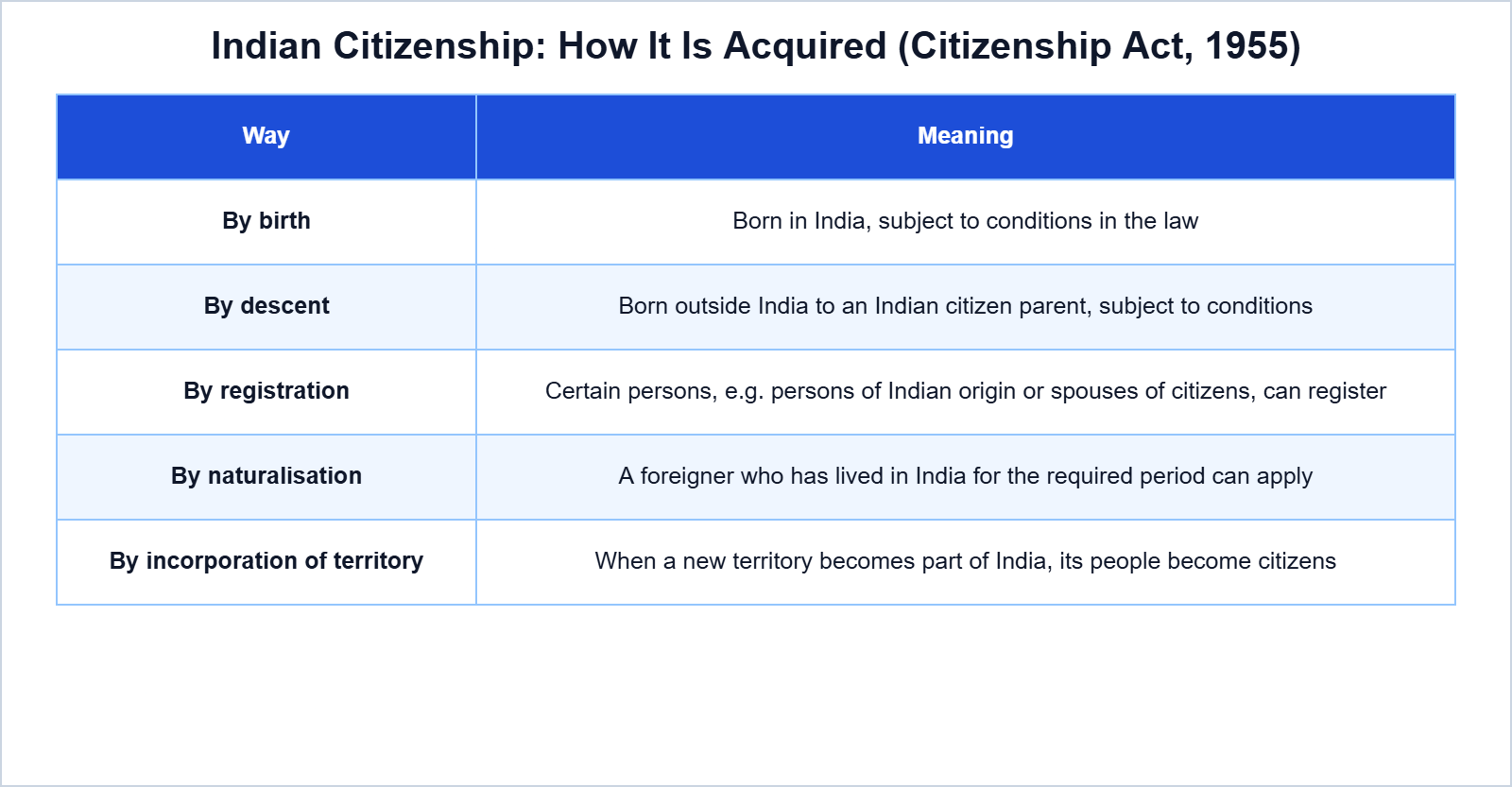
- The Constitution deals with citizenship in Part II (Articles 5 to 11) and gives Parliament the power to make laws on it.
- The Citizenship Act, 1955 lays down the ways of acquiring and losing citizenship.
- India has single citizenship: there is no separate state citizenship.
5. Grounds for Inclusion and Exclusion; New Claims
- States decide who can become a citizen through their laws. Grounds such as birth, descent, residence and marriage are generally used.
- Refugees and stateless people, who are forced to leave their homes because of war, persecution or disaster, often have no citizenship and face hardship.
- Internal migrants may face hostility in the places where they move for work, even though they are citizens of the same country.
- New claims to citizenship are negotiated through laws, courts, international agreements and democratic debate.
6. Can We Have Global Citizenship?
- Arguments for: The world is interconnected through communication, trade and travel. Problems like climate change, pandemics and refugees require global cooperation. The idea of global citizenship encourages people to care for humanity as a whole.
- Arguments against: There is no world government to guarantee rights; national citizenship still provides the main protection and identity.
- Many thinkers suggest combining national citizenship with a sense of global responsibility.
Easy Memory Trick: Marshall’s rights “C-P-S” = Civil, Political, Social.
7. Important Exam Questions
Q1. What is citizenship?
Ans. Full and equal membership of a political community, with rights and duties.
Q2. Which Articles of the Indian Constitution deal with citizenship?
Ans. Part II, Articles 5 to 11.
Q3. Name the five ways of acquiring Indian citizenship under the Citizenship Act, 1955.
Ans. By birth, descent, registration, naturalisation and incorporation of territory.
Q4. What three kinds of rights did T.H. Marshall link with citizenship?
Ans. Civil, political and social rights.
Q5. Who are stateless persons?
Ans. People who are not recognised as citizens by any country, often refugees, who lack legal protection.
Q6. Give one argument for global citizenship.
Ans. Global problems such as climate change and refugees require people to think and act as members of a global community.
Conclusion: Citizenship gives people rights, duties and a sense of belonging. Making citizenship equal and inclusive for all is a continuing democratic task, both nationally and globally.