Executive – Class 11 Political Science Notes
Chapter – 4
Executive
1. What Is the Executive?
The executive is the branch of government that implements laws and policies. It includes the political executive (President, Prime Minister, ministers, Governors, Chief Ministers), who are elected or appointed for a fixed period, and the permanent executive (civil servants), who serve for a long career.
2. Why the Parliamentary System?
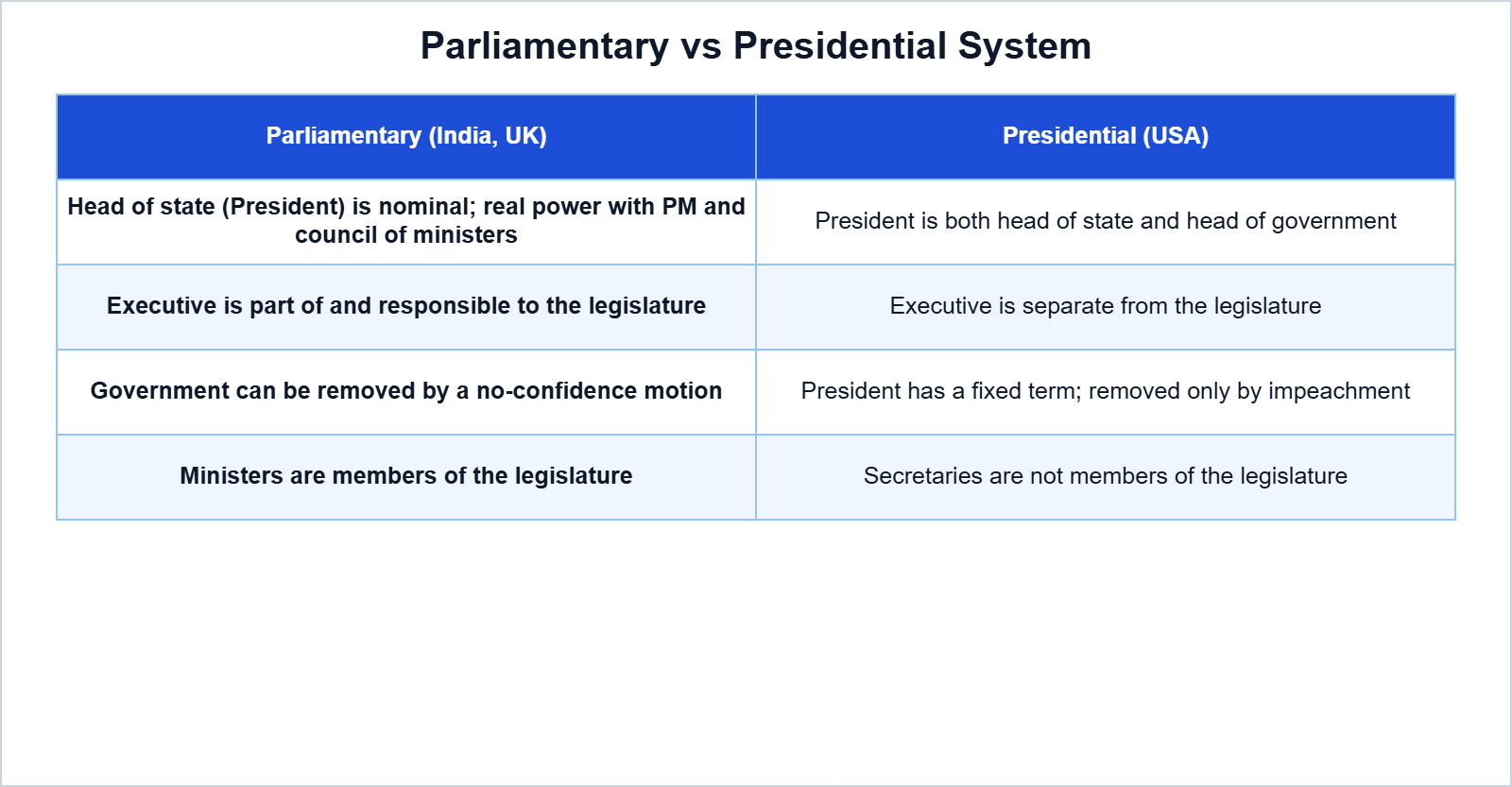
- India had some experience of a parliamentary system under British rule.
- The makers wanted an executive that is responsible to the elected legislature and through it to the people.
- They wanted to avoid concentrating too much power in one person, as can happen in a presidential system.
3. Why a Constitutional Head?
In a parliamentary system, the real power lies with the Prime Minister and the council of ministers. A constitutional (nominal) head, the President, acts as a symbol of national unity, stays above party politics and ensures continuity, especially when governments change or no party has a majority.
4. The President of India
- Election: By an electoral college of elected members of both Houses of Parliament and elected members of State Legislative Assemblies (including Delhi and Puducherry), through proportional representation by single transferable vote.
- Term: 5 years; can be removed by impeachment (Art 61) for violation of the Constitution.
- Executive powers: Appoints the Prime Minister, ministers, Governors, judges of the Supreme Court and High Courts, the Chief Election Commissioner and others. All executive action is taken in the President’s name.
- Legislative powers: Summons and prorogues Parliament, can dissolve the Lok Sabha, gives assent to bills, and can issue ordinances (Art 123) when Parliament is not in session.
- Judicial power: Can grant pardons (Art 72).
- Emergency powers: National Emergency (Art 352), President’s Rule in a state (Art 356) and Financial Emergency (Art 360).
- Discretionary powers: Can send advice of the council of ministers back once for reconsideration; can withhold or delay assent to a bill (pocket veto); can choose the Prime Minister when no party or coalition has a clear majority.
Important: Normally the President acts on the advice of the council of ministers (Art 74).
5. The Vice-President
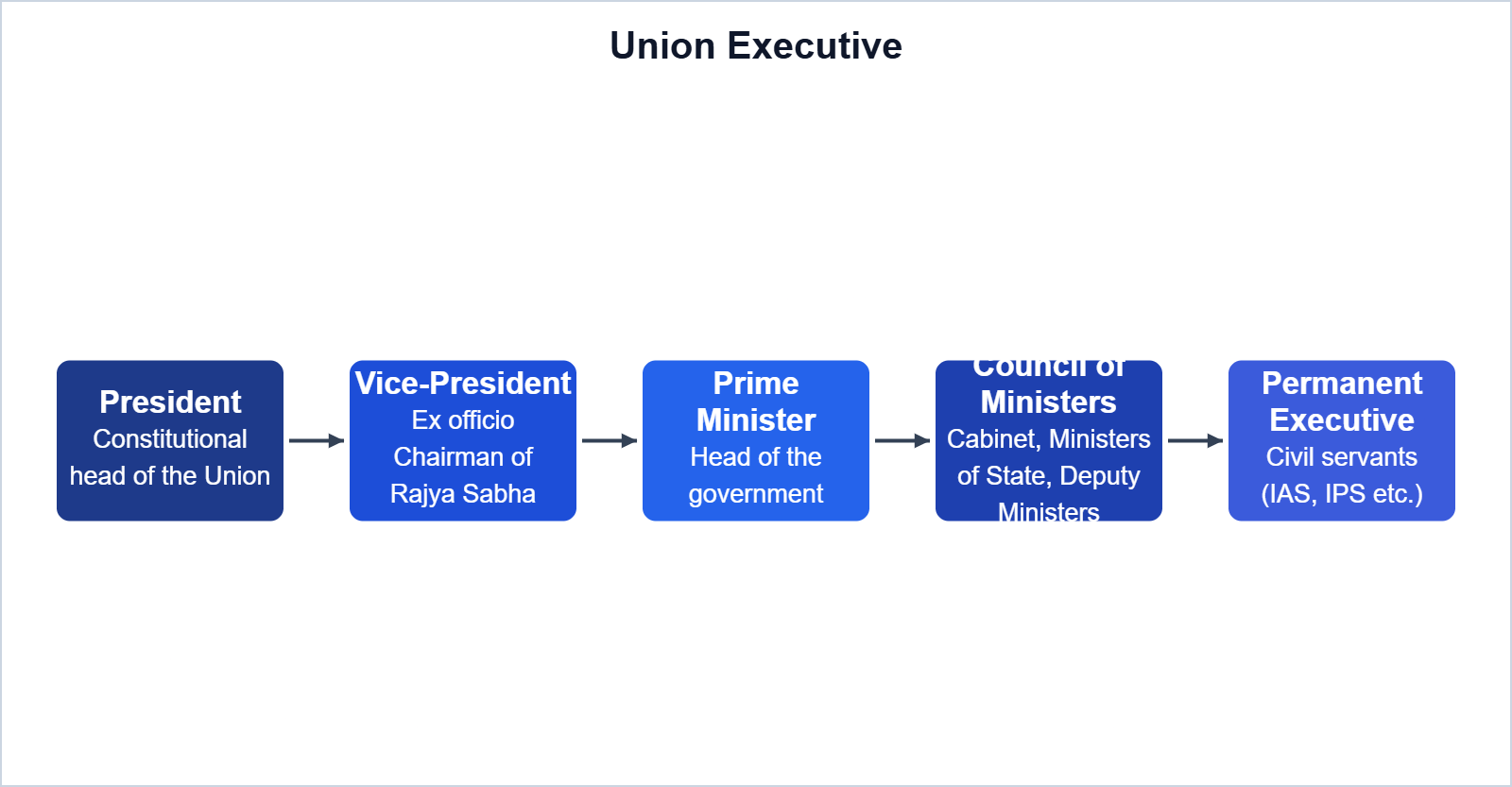
Elected by the members of both Houses of Parliament for 5 years. The Vice-President is the ex officio Chairman of the Rajya Sabha and acts as President when the office falls vacant.
6. Prime Minister, Chief Minister and Council of Ministers
- How chosen: The President appoints as Prime Minister the leader of the party or coalition that has majority support in the Lok Sabha. Similarly, the Governor appoints the Chief Minister who has majority support in the Vidhan Sabha.
- Council of ministers: Includes Cabinet ministers, Ministers of State and Deputy Ministers. Its size cannot exceed 15% of the total members of the Lok Sabha (or Vidhan Sabha for states), as fixed by the 91st Amendment (2003).
- Collective responsibility: The council of ministers is collectively responsible to the Lok Sabha (Art 75(3)). If it loses a vote of confidence, it must resign.
- Powers of the PM: Chooses ministers and allocates portfolios, chairs Cabinet meetings, coordinates policy, advises the President and leads the country in national and international matters.
7. The Governor
The Governor is the constitutional head of a state, appointed by the President (Art 155), usually for 5 years. The Governor appoints the Chief Minister, can reserve some bills for the President, and can recommend President’s Rule (Art 356). The Governor’s discretionary role has sometimes led to Centre-state tensions.
Example: Himachal Pradesh has a Governor appointed by the President and a Chief Minister who leads the majority in the 68-member Vidhan Sabha.
8. Permanent Executive: Bureaucracy
Civil servants implement government policies. All-India services such as the IAS and IPS are recruited by the Union Public Service Commission (UPSC); state services are recruited by State Public Service Commissions. Civil servants are expected to be politically neutral.
Easy Memory Trick: Emergency Articles “352-356-360” = National, State, Financial.
9. Important Exam Questions
Q1. Who elects the President of India?
Ans. An electoral college of elected members of both Houses of Parliament and the elected members of State Legislative Assemblies, including Delhi and Puducherry.
Q2. What is an ordinance?
Ans. A temporary law issued by the President (Art 123) or Governor when the legislature is not in session.
Q3. What is collective responsibility?
Ans. The council of ministers is jointly responsible to the Lok Sabha; if a no-confidence motion is passed, the whole council must resign.
Q4. What is the maximum size of the council of ministers?
Ans. 15% of the total strength of the Lok Sabha (or Vidhan Sabha), under the 91st Amendment (2003).
Q5. Name the three types of emergency with Articles.
Ans. National Emergency (Art 352), President’s Rule (Art 356) and Financial Emergency (Art 360).
Q6. Why does a parliamentary system need a constitutional head?
Ans. To provide a non-partisan symbol of the nation, ensure continuity and act as a guardian of constitutional processes, while real power remains with the elected government.
Q7. What is the difference between the political and the permanent executive?
Ans. The political executive is elected or appointed for a fixed term and makes policy; the permanent executive consists of civil servants who serve long careers and implement policy.
Conclusion: India’s parliamentary executive combines a constitutional head with a responsible government. This ensures that real power is exercised by elected leaders who remain accountable to the people’s representatives.