Constitution: Why and How? – Class 11 Political Science Notes
Chapter – 1
Constitution: Why and How?
1. Why Do We Need a Constitution?
A constitution is a body of fundamental rules and principles according to which a country is governed. It is the supreme law of the land.
- Coordination and assurance: It provides a set of basic rules that allow minimal coordination and trust among members of a society.
- Specification of decision-making powers: It decides who has the power to make decisions and how the government will be constituted.
- Limitations on the powers of government: It sets limits on what a government can impose on citizens, mainly through fundamental rights.
- Aspirations and goals of a society: It enables the government to fulfil the aspirations of society and create conditions for a just society.
- Fundamental identity of a people: It expresses the collective identity and core values of the people.
Remember: A constitution must be authoritative. It is effective when it is made in a democratic way, has balanced institutions and is respected by the people.
2. What Does a Constitution Do? (Features of an Effective Constitution)
- Mode of promulgation: How it was made and who made it; a constitution made by popular representatives has more legitimacy.
- Substantive provisions: It should give everyone a reason to follow it, by respecting freedom and equality.
- Balanced institutional design: Power should be divided among institutions so that no single group can destroy the constitution.
3. Who Made Our Constitution? (The Constituent Assembly)
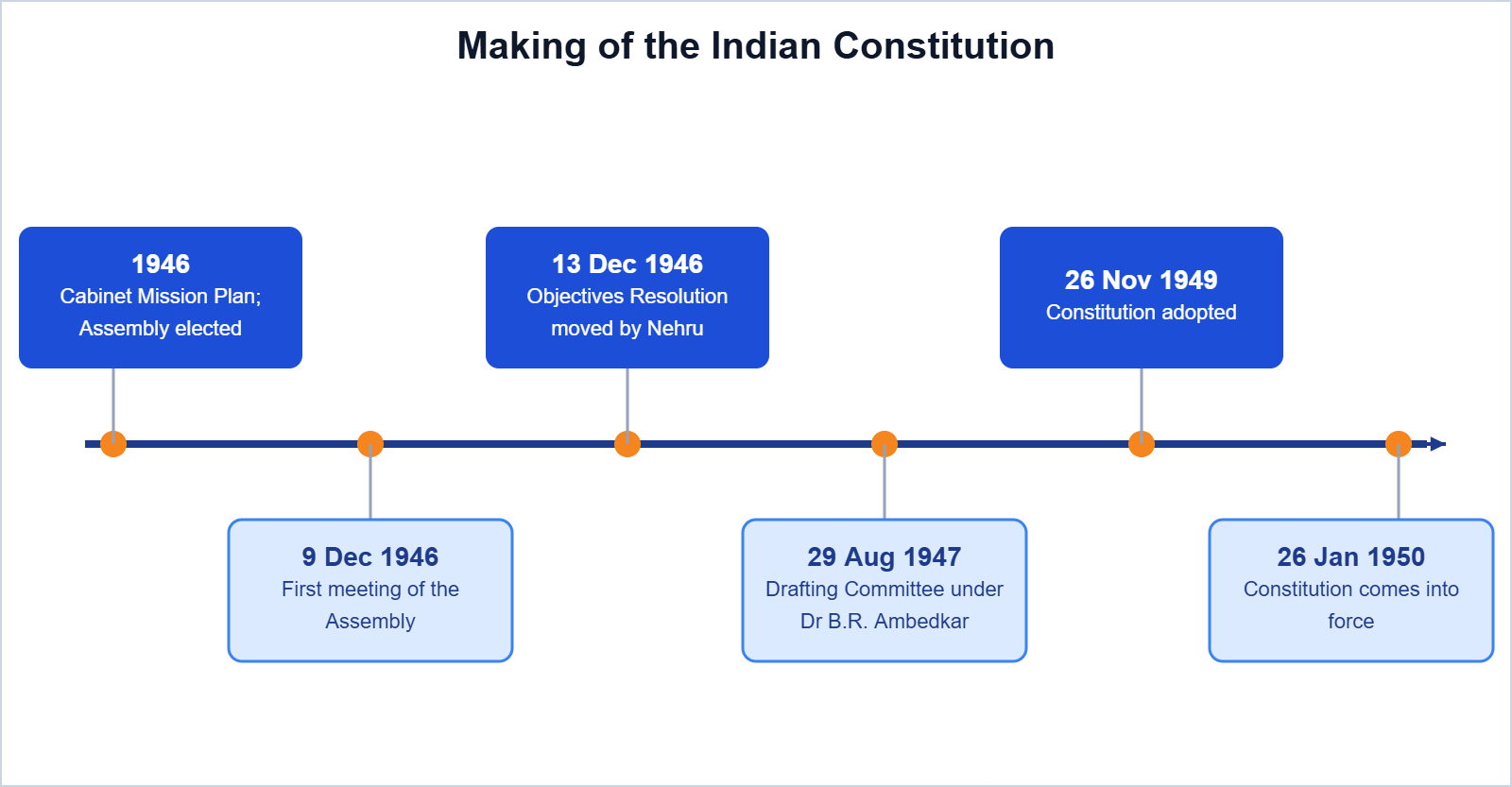
- The Constituent Assembly was formed under the Cabinet Mission Plan (1946). Its members were indirectly elected by the members of the provincial legislative assemblies; princely states sent representatives.
- Its first meeting was held on 9 December 1946. Dr Rajendra Prasad was elected its President.
- On 13 December 1946, Jawaharlal Nehru moved the Objectives Resolution, which laid down the aims and values of the Constitution.
- The Drafting Committee, chaired by Dr B.R. Ambedkar, was set up on 29 August 1947.
- The Constitution was adopted on 26 November 1949 and came into force on 26 January 1950. It took nearly three years (2 years, 11 months and 18 days).
- Members represented different regions, religions, castes and political views. Debates were open, careful and based on discussion and consensus.
Exam point: 26 November is celebrated as Constitution Day; 26 January is Republic Day.
4. How Did Partition Affect the Constituent Assembly?
- The Assembly was originally planned to have 389 members.
- After the partition of India in 1947, members from areas that went to Pakistan left, and the strength was reduced to 299.
- The violence of Partition made the members more concerned about national unity and security, which influenced the choice of a strong Centre.
5. Sources of the Constitution
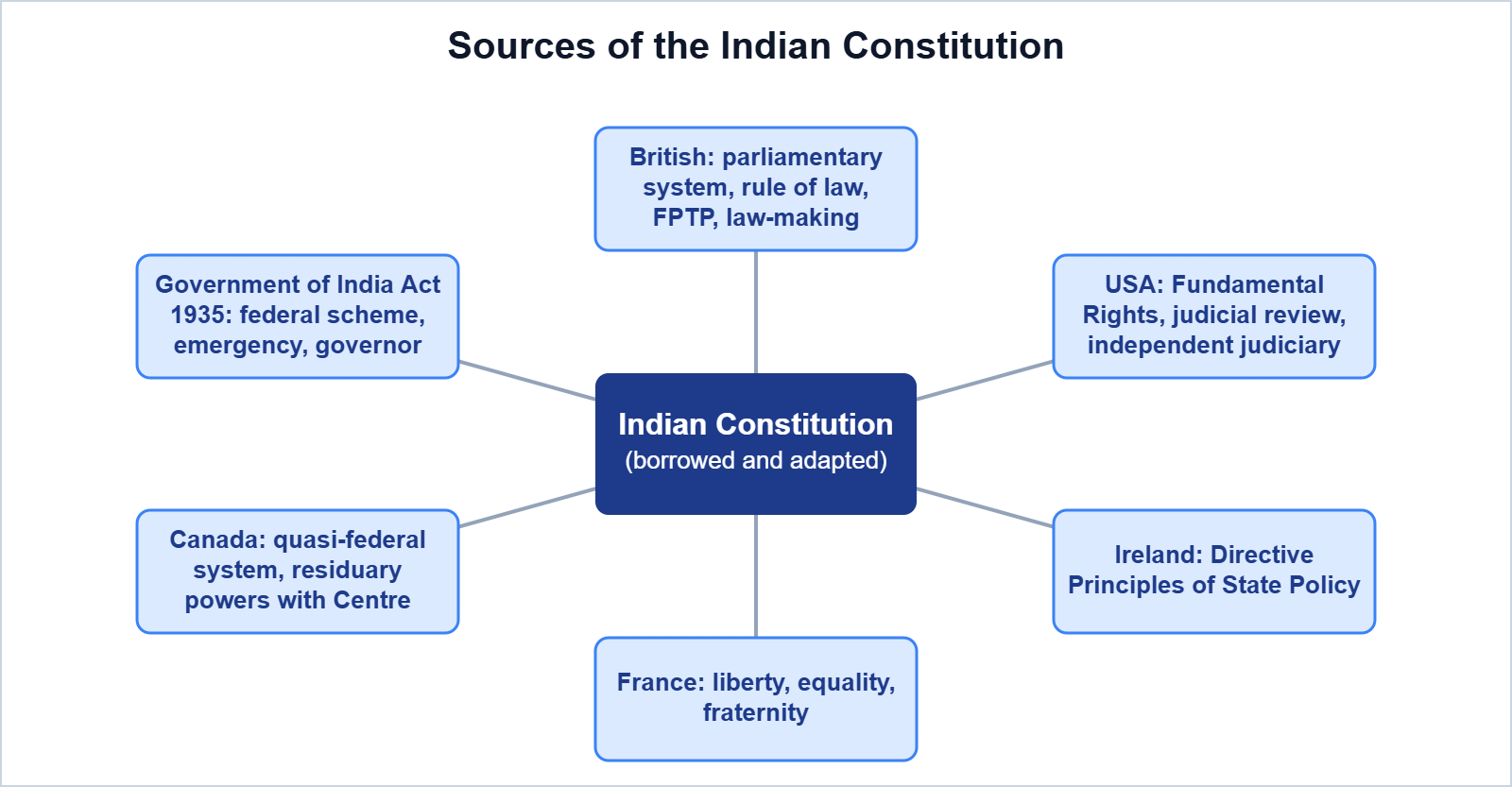
Important: The makers did not copy blindly. They adapted ideas to Indian conditions and added many original features, such as the Directive Principles adapted to Indian needs and the reservation system.
6. Institutional Design of the Constitution
The Constitution creates a balance between the legislature, executive, judiciary and independent bodies (like the Election Commission). It is neither too rigid nor too flexible: it can be amended, but core features are protected.
Easy Memory Trick: Dates of the Constitution: “9-12-46 start, 26-11-49 adopt, 26-1-50 begin”.
7. Important Exam Questions
Q1. What is a constitution?
Ans. A constitution is the supreme law of a country that lays down the basic rules for its government, the powers of institutions, the rights of citizens and the goals of the state.
Q2. When did the Constituent Assembly first meet, and who was its President?
Ans. It first met on 9 December 1946. Dr Rajendra Prasad was its President.
Q3. Who was the chairman of the Drafting Committee?
Ans. Dr B.R. Ambedkar.
Q4. What was the Objectives Resolution?
Ans. It was the resolution moved by Jawaharlal Nehru on 13 December 1946, which described the aims of the Constitution: a sovereign, democratic republic ensuring justice, liberty and equality to all.
Q5. How did Partition affect the Constituent Assembly?
Ans. The membership fell from 389 to 299, and the violence of Partition made the members give greater importance to national unity and a strong Centre.
Q6. Name any three sources of the Indian Constitution with one borrowed feature each.
Ans. Britain: parliamentary system; USA: judicial review; Ireland: Directive Principles of State Policy.
Q7. Why is the Indian Constitution called a “living document”?
Ans. Because it can be changed by amendments and interpretation according to changing needs, while keeping its basic structure.
Conclusion: The Indian Constitution was made through careful discussion by a representative assembly. It borrowed the best ideas from other countries and adapted them to Indian needs, giving the nation a strong and lasting framework.