Chapter – 13
Equality
1. Why Does Equality Matter?
Equality is a powerful moral and political ideal. It means that all human beings have equal worth and dignity and deserve equal respect and consideration. Struggles against slavery, colonialism, caste discrimination and gender inequality have all been inspired by the idea of equality.
2. Do All Differences Involve Inequality?
- No. Some differences are natural, arising from different abilities, talents and physical features (for example, some people are better at music or sports). These are not necessarily unjust.
- Social inequalities are created by society, such as unequal treatment based on caste, gender, race or class. These are unjust and should be removed.
- Many inequalities that seem “natural” are actually caused by society (for example, the belief that women cannot do certain jobs).
3. Does Equality Imply Sameness?
No. Equality does not mean that everyone must be the same or be treated in exactly the same way. It means that people should not be discriminated against because of factors like birth, caste or gender, and that everyone should have equal opportunities to develop their abilities. People may still achieve different results based on their effort and choices.
4. Major Forms of Equality and Inequality
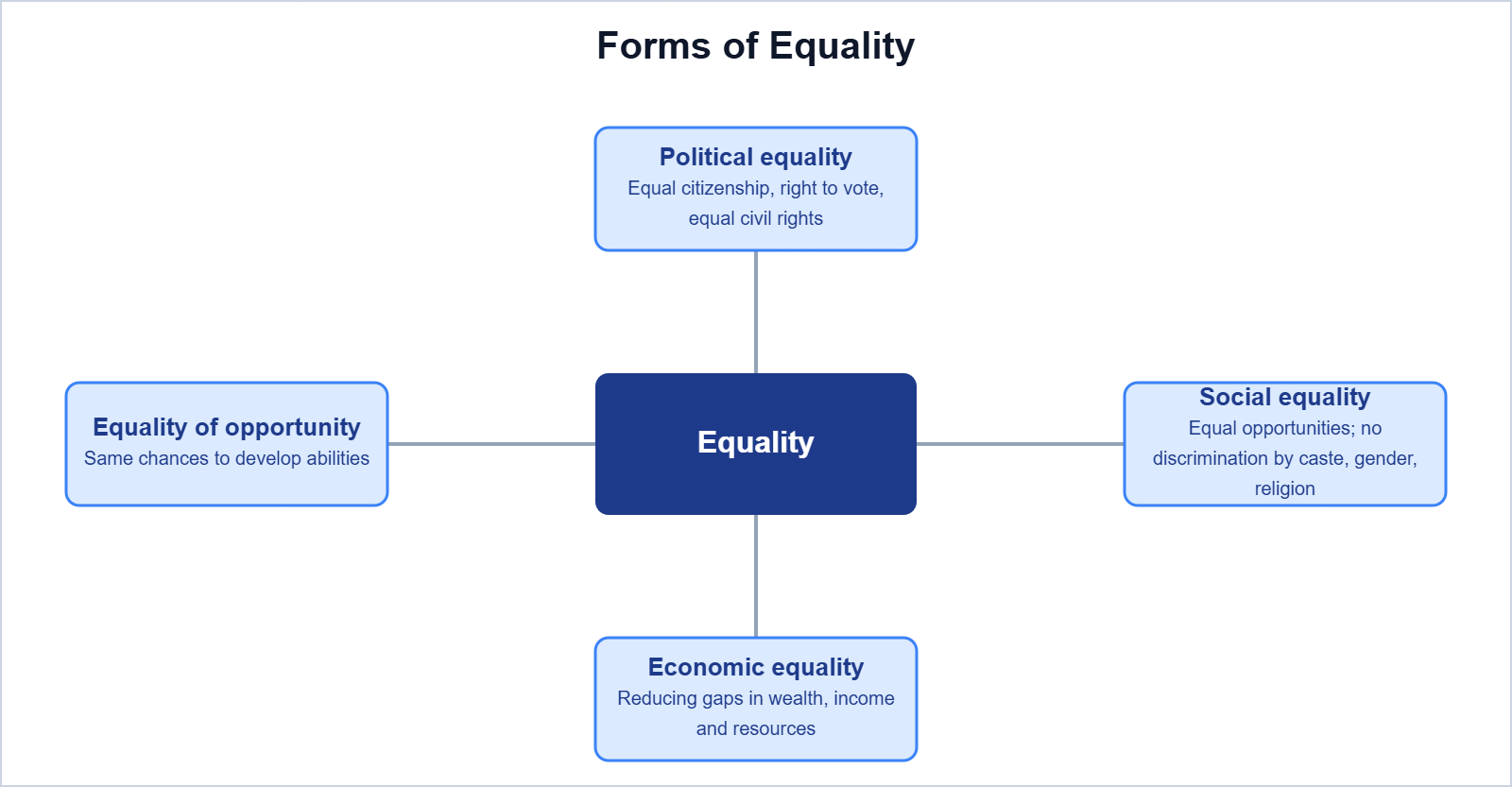
- Political equality: Equal citizenship and equal rights to vote, express opinions and form associations. Political equality alone may not remove social and economic inequalities.
- Social equality: Equal opportunities in education, health and jobs, and removal of discrimination based on caste, religion or gender.
- Economic equality: Reducing large gaps in wealth and income so that everyone can live with dignity.
Remember: The socialist leader Ram Manohar Lohia identified several kinds of inequality that must be fought together, including those between men and women, those based on caste, those based on skin colour, those between colonised and colonising nations, and economic inequality.
5. Different Views on Equality
View | Main idea |
|---|---|
Marxism | Inequality comes from private ownership of important resources; equality needs public control of these resources |
Liberalism | Competition with fair opportunities is the best way to distribute resources; state should ensure equal opportunities |
Feminism | Inequality between men and women is created by society (patriarchy) and must be removed |
Socialism | The state should reduce economic inequality through welfare and regulation |
6. How Can Equality Be Realized?
- Establishing formal equality: Laws must end discrimination and privileges based on birth, caste, race or gender. The Indian Constitution prohibits discrimination (Art 15), abolishes untouchability (Art 17) and guarantees equality before law (Art 14).
- Equality through differential treatment: Sometimes people must be treated differently to make them truly equal, such as ramps for persons with disabilities or special facilities for women.
- Affirmative action: Policies such as reservation in education and jobs for disadvantaged groups help correct historical injustice.
Exam point: Affirmative action is a temporary measure to create a level playing field; its goal is a society in which such measures are no longer needed.
Easy Memory Trick: “Equal, not same”.
7. Important Exam Questions
Q1. What is equality?
Ans. The ideal that all human beings have equal worth and should be treated with equal respect, without discrimination.
Q2. Distinguish between natural and social inequalities.
Ans. Natural inequalities arise from differences in abilities and talents; social inequalities are created by society, such as caste or gender discrimination.
Q3. Does equality mean sameness?
Ans. No. It means equal opportunities and no discrimination, not identical treatment or results.
Q4. Name the three main forms of equality.
Ans. Political, social and economic equality.
Q5. What is affirmative action?
Ans. Special measures, like reservation, to help disadvantaged groups overcome historical disadvantages.
Q6. How does the Indian Constitution promote equality?
Ans. Through equality before law (Art 14), prohibition of discrimination (Art 15), equal opportunity in public employment (Art 16) and abolition of untouchability (Art 17).
Conclusion: Equality does not mean making everyone the same; it means removing unjust differences and giving everyone a fair chance. Laws, differential treatment and affirmative action all help achieve it.