Election and Representation – Class 11 Political Science Notes
Chapter – 3
Election and Representation
1. Elections and Democracy
In a large democracy, people cannot take every decision directly. They choose representatives through elections. This is called indirect (representative) democracy. The Constitution lays down rules about how elections are held and who can vote.
2. Methods of Representation and Their Effects
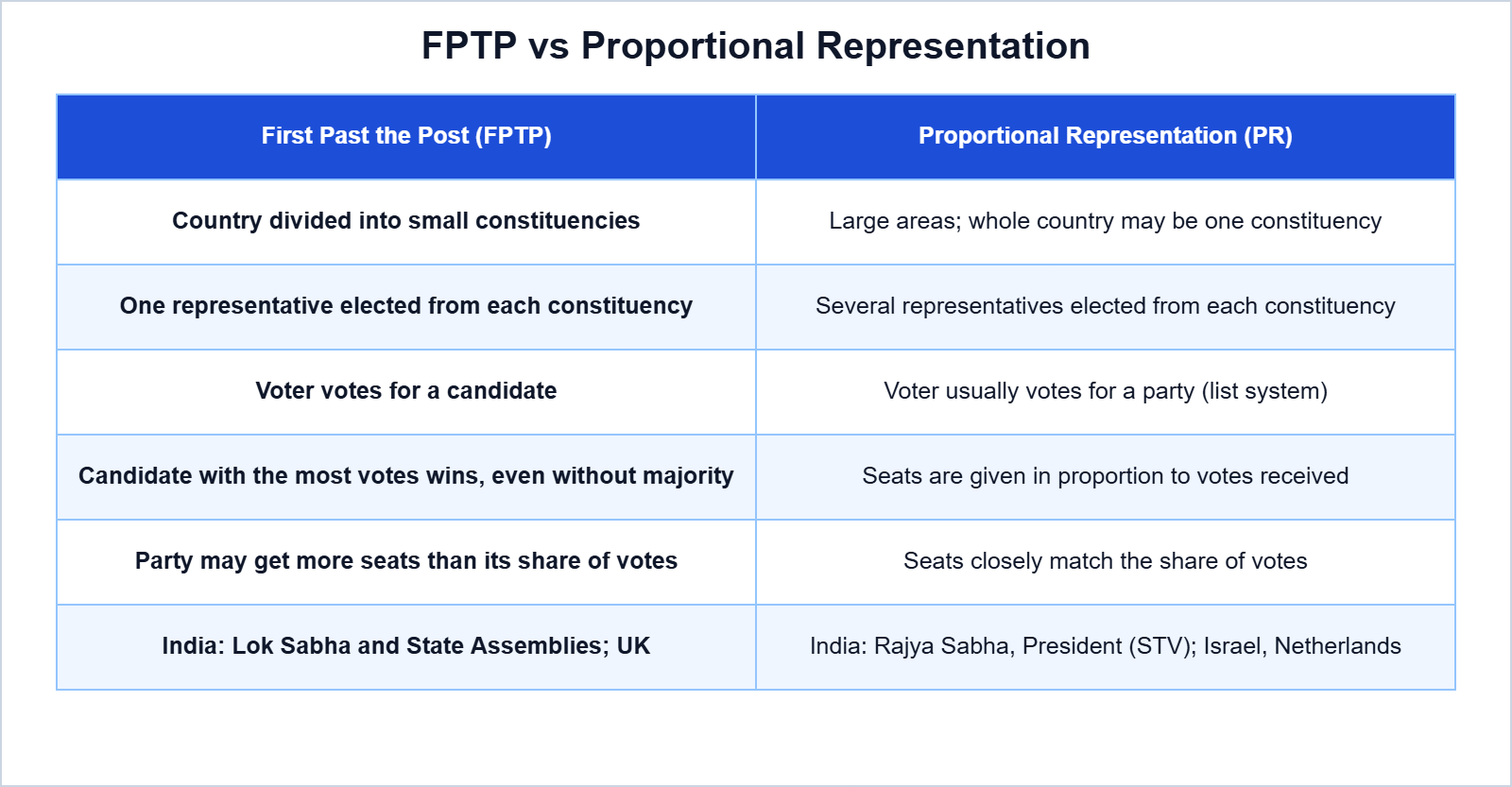
- First Past the Post (FPTP): The candidate with the highest number of votes wins, even if he or she gets less than half the votes. It is also called the plurality system.
- Proportional Representation (PR): Parties get seats in proportion to their votes. In India, a form of PR called the Single Transferable Vote (STV) is used to elect the President, Vice-President, members of the Rajya Sabha and the Legislative Councils.
- Effects on parties and politics: FPTP tends to give big parties more seats than their vote share and encourages stable governments and two-party or dominant-party competition. PR gives smaller parties fairer representation but may lead to coalition governments.
3. Why Was FPTP Chosen in India?
- It is simple to understand, even for voters who are not familiar with complex systems.
- Voters choose a specific candidate, so the representative is accountable to a particular area.
- It usually gives stable governments, which is important in a parliamentary system.
- It encourages candidates and parties to seek the support of different social groups in a constituency.
Effects in India: In the early decades, the Congress won a much larger share of seats than its share of votes. Over time, FPTP has also allowed regional parties and coalitions to grow.
4. Reserved Constituencies
To ensure fair representation of disadvantaged groups, seats are reserved for Scheduled Castes (SCs) and Scheduled Tribes (STs) in the Lok Sabha (Art 330) and State Assemblies (Art 332). In a reserved constituency, all voters can vote, but only a candidate from the reserved group can contest. The Delimitation Commission decides which constituencies are reserved.
Example: In Himachal Pradesh, the Shimla Lok Sabha seat is reserved for Scheduled Castes. HP has 4 Lok Sabha seats (Kangra, Mandi, Hamirpur and Shimla), 3 Rajya Sabha seats and 68 seats in the Vidhan Sabha.
5. Free and Fair Elections
- Universal Adult Franchise: Every citizen aged 18 years or above can vote, without discrimination. The voting age was reduced from 21 to 18 by the 61st Amendment (1988).
- Right to contest: Any citizen meeting the minimum age (25 years for Lok Sabha and State Assemblies) can contest.
- Independent Election Commission to conduct elections.
- Secret ballot, Electronic Voting Machines (EVMs), voter ID cards and the Model Code of Conduct help ensure fairness.
6. The Election Commission
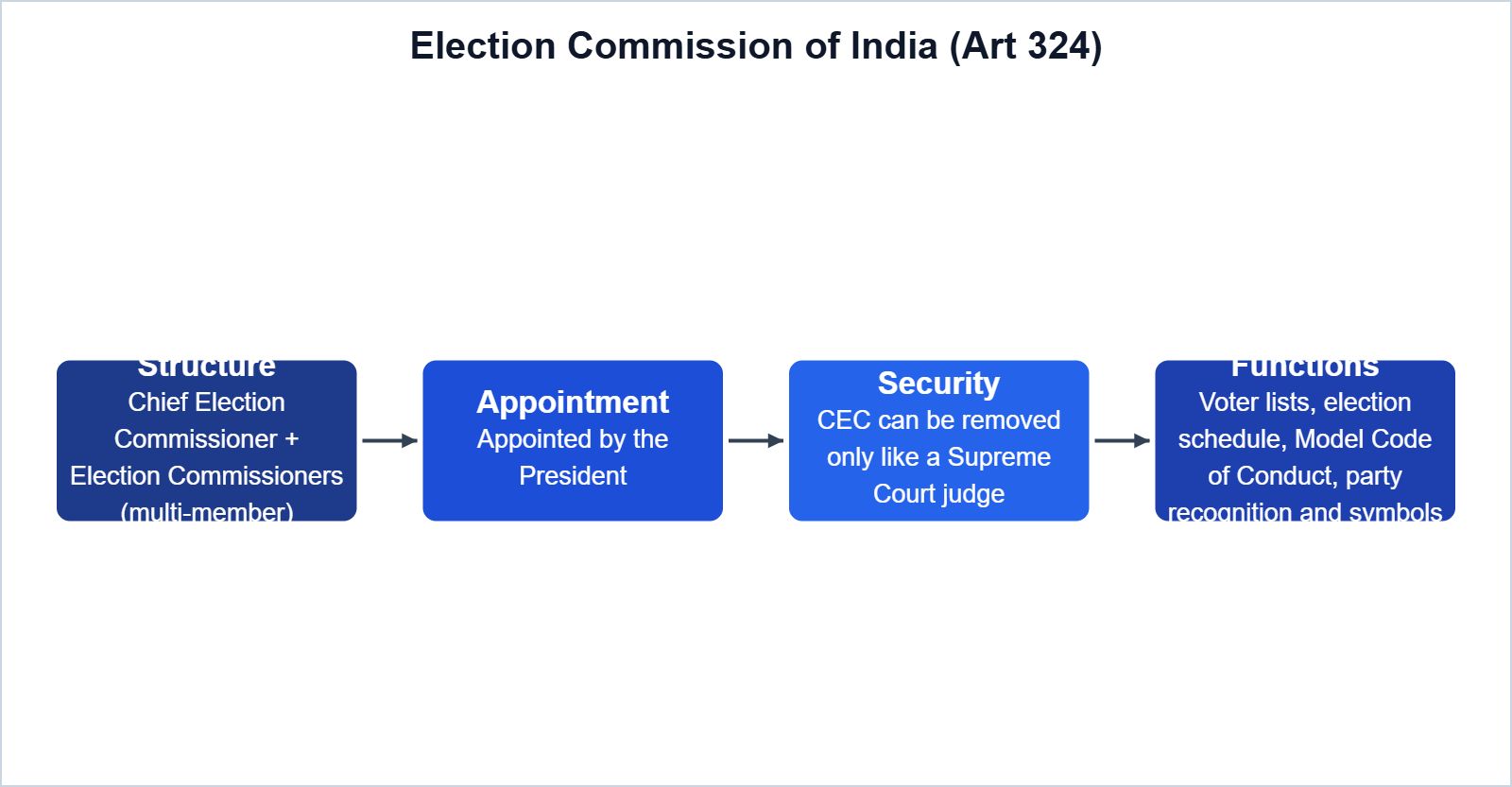
- Set up under Article 324. Since 1993 it has been a multi-member body: a Chief Election Commissioner and two Election Commissioners.
- It supervises the preparation of voter lists, decides the election schedule, enforces the Model Code of Conduct, recognises political parties and allots symbols, and can order a re-poll.
- Each state has a Chief Electoral Officer. Panchayat and municipal elections are conducted by the State Election Commission.
Remember: The Election Commission is an independent constitutional body, which makes it a key guarantor of free and fair elections.
Easy Memory Trick: “Most votes wins = FPTP; share of votes = PR”.
7. Important Exam Questions
Q1. What is the FPTP system?
Ans. It is an electoral system in which the candidate who gets the highest number of votes in a constituency is declared the winner, even without a majority.
Q2. Which elections in India use proportional representation?
Ans. Elections of the President, Vice-President, Rajya Sabha and State Legislative Councils, using the Single Transferable Vote.
Q3. Why are some constituencies reserved?
Ans. To ensure that Scheduled Castes and Scheduled Tribes get adequate representation in the Lok Sabha and State Assemblies.
Q4. Which Article provides for the Election Commission?
Ans. Article 324.
Q5. Which amendment reduced the voting age to 18?
Ans. The 61st Amendment (1988).
Q6. Give two functions of the Election Commission.
Ans. It prepares and updates voter lists and enforces the Model Code of Conduct during elections.
Q7. How many Lok Sabha, Rajya Sabha and Vidhan Sabha seats does Himachal Pradesh have?
Ans. 4 Lok Sabha seats, 3 Rajya Sabha seats and 68 Vidhan Sabha seats.
Conclusion: India’s electoral system, with universal adult franchise, FPTP, reserved seats and an independent Election Commission, has made the world’s largest democracy work through regular, free and fair elections.