Rights – Class 11 Political Science Notes
Chapter – 15
Rights
1. What Are Rights? How Is a Right Different from Any Claim?
A right is a claim that is justified by reason, accepted by society and usually protected by the state. Not every claim is a right. A claim becomes a right when it is necessary for a person to live with dignity and develop his or her abilities, and when it is beneficial to society as a whole.
Example: The claim to free speech is a right because it helps individuals express themselves and helps society discover truth. A claim to harm others or to take others’ property is not a right.
2. Where Do Rights Come From?
- Natural rights: In the 17th and 18th centuries, thinkers like John Locke argued that people have natural rights to life, liberty and property simply because they are human, and that governments exist to protect them.
- Human rights: Today the idea of human rights is based on the equal dignity of all human beings. The Universal Declaration of Human Rights was adopted by the United Nations on 10 December 1948.
- Legal rights: Rights recognised in law and in constitutions (such as Fundamental Rights in India) can be enforced through courts.
3. What Are the Major Kinds of Rights?
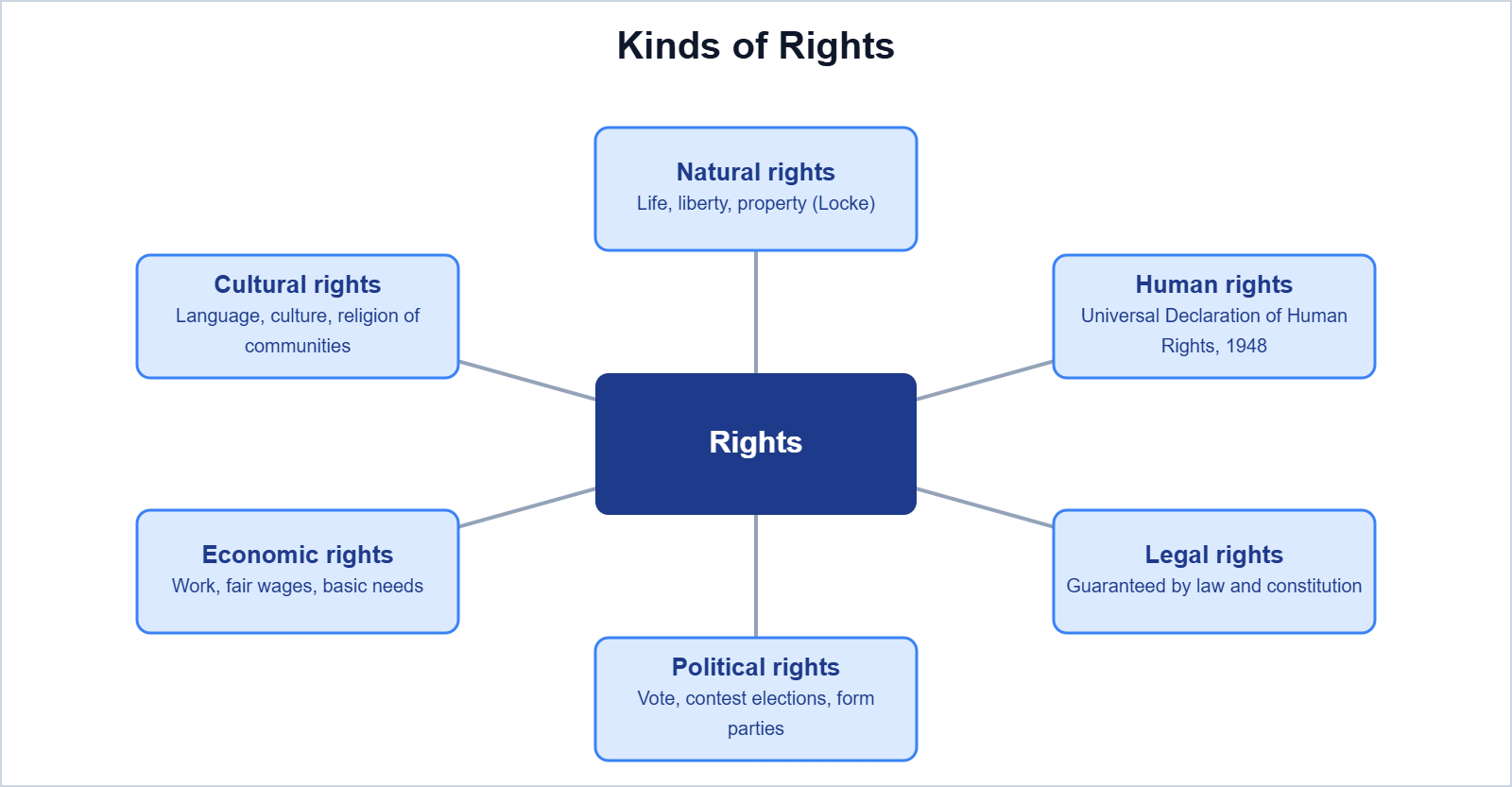
- Political rights: Right to vote, to contest elections, to form political parties and to criticise the government.
- Economic rights: Rights to work, fair wages, housing and basic needs like food and health care.
- Cultural rights: Rights of communities to preserve their language, culture and religion, and to education in their mother tongue.
4. Rights and Responsibilities
- Rights impose a duty on the state to protect and promote them.
- Rights also impose duties on citizens: to respect the rights of others, to use rights responsibly, and to balance rights when they conflict.
- We must be alert to limits placed on rights in the name of national security, and ensure that such limits are reasonable and justified.
5. How Do We Resolve Conflicts Between Individual and Community Rights?
Sometimes the rights of individuals clash with the claims of a community (for example, an individual’s right to choose a marriage partner versus community customs, or a community’s cultural practices that discriminate against some members). Such conflicts are resolved by:
- Giving priority to the basic dignity and equality of every individual.
- Respecting community culture as long as it does not violate individual rights.
- Dialogue, reform from within communities, and the guidance of the Constitution and courts.
6. How Does the State Enable and Obstruct Rights?
State enables rights by | State may obstruct rights by |
|---|---|
Recognising rights in the constitution and laws | Passing laws that restrict freedom without good reason |
Providing courts and remedies | Using security laws to detain people without trial |
Providing education, health and welfare | Censorship and surveillance that go beyond reasonable limits |
Important: Citizens, the media, courts and civil society must remain vigilant to protect rights.
Easy Memory Trick: Locke’s natural rights “L-L-P” = Life, Liberty, Property.
7. Important Exam Questions
Q1. What is a right?
Ans. A claim justified by reason, necessary for a dignified life, recognised by society and usually protected by the state.
Q2. What are natural rights according to John Locke?
Ans. The rights to life, liberty and property.
Q3. When was the Universal Declaration of Human Rights adopted?
Ans. On 10 December 1948 by the United Nations.
Q4. Give one example each of political, economic and cultural rights.
Ans. Political: the right to vote. Economic: the right to work. Cultural: the right to preserve one’s language.
Q5. Why do rights involve duties?
Ans. Because rights can be enjoyed only if others respect them; every right creates a duty on the state and citizens to protect it.
Q6. How can the state obstruct rights?
Ans. By passing unreasonable laws, detaining people without trial or imposing excessive censorship.
Conclusion: Rights protect human dignity and allow people to develop fully. They require both a responsible state and responsible citizens.