Secularism – Class 11 Political Science Notes
Chapter – 18
Secularism
1. What Is Secularism?
Secularism is a doctrine that opposes all forms of inter-religious domination (one religion dominating another) and intra-religious domination (domination within a religion, for example of men over women or of upper castes over lower castes). It promotes equality and freedom within and between religions.
Remember: Secularism is not anti-religion; it is against domination and discrimination in the name of religion.
2. Which Domains of Life Does It Relate To?
- Relations between religious communities (inter-religious).
- Relations within a religious community (intra-religious), such as caste and gender inequality.
- Relations between the state and religion.
3. What Is a Secular State?
- It is not run by religious leaders and does not have an official religion.
- It keeps religious and political institutions separate.
- It treats all citizens equally regardless of religion and is committed to peace, freedom and equality.
4. Western and Indian Models of Secularism
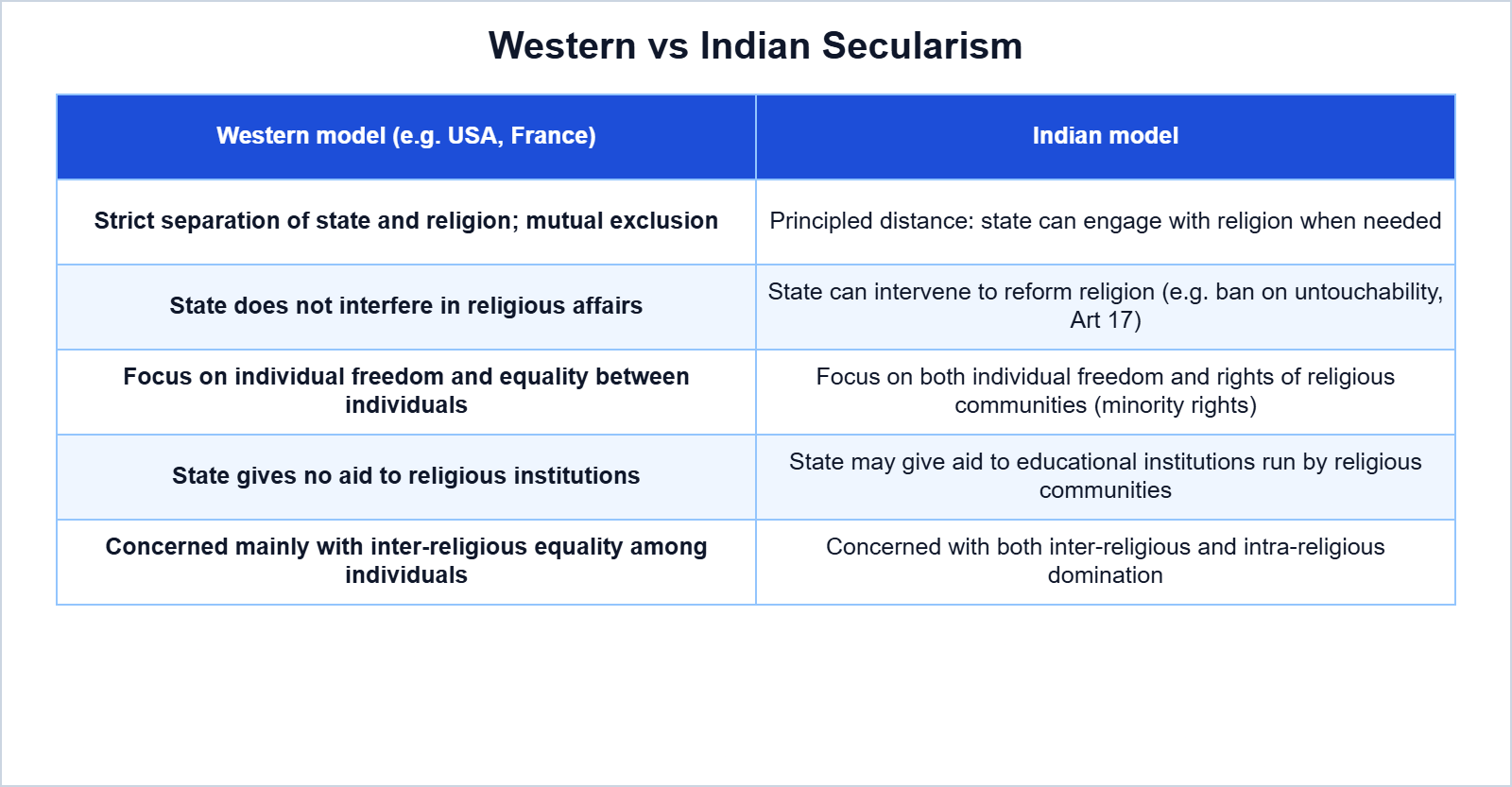
The Indian model is often described as “principled distance”: the state keeps a distance from all religions, but it may engage with or intervene in religion when needed to promote freedom, equality and peace. Articles 25 to 30 guarantee religious and minority rights, and Article 17 abolishes untouchability.
5. Why Do We Need a Secular State in Modern Times?
- Modern societies are religiously diverse; a secular state protects the freedom of all.
- It prevents the domination of one religion over others, and of powerful groups within a religion over weaker members.
- It promotes peace, equal citizenship and national unity.
- History shows that religious discrimination and violence (for example, communal riots) cause great suffering; secularism helps prevent this.
6. Criticisms of Indian Secularism
Criticism | Response |
|---|---|
Anti-religious | It opposes religious domination, not religion; it protects religious freedom |
Western import | It developed in India’s own diverse context and differs from Western models |
Minoritism (favours minorities) | Minority rights are basic protections, not special privileges |
Interventionist | State intervention is guided by constitutional values to end discrimination |
Vote-bank politics | This is a misuse of secularism by politicians, not a flaw of the idea itself |
7. Is Secularism Suitable for India?
Yes. India is home to many religions, languages and cultures. Secularism allows all communities to live together with equal rights and dignity, while the state works to end discrimination within communities. Despite challenges, it remains essential for India’s unity and democracy.
Easy Memory Trick: Indian secularism = “Principled distance, equal respect”.
8. Important Exam Questions
Q1. What is secularism?
Ans. A doctrine opposing inter-religious and intra-religious domination and promoting freedom and equality within and between religions.
Q2. What is meant by “principled distance”?
Ans. The Indian approach in which the state keeps a distance from all religions but may intervene when necessary to promote freedom, equality and peace.
Q3. Give two differences between Western and Indian secularism.
Ans. Western secularism requires strict separation of state and religion, while India allows state intervention for reform; Indian secularism protects community (minority) rights as well as individual rights.
Q4. Which Articles guarantee religious freedom in India?
Ans. Articles 25 to 28 (with minority rights in Articles 29 and 30).
Q5. Name two criticisms of Indian secularism.
Ans. It is said to be anti-religious and to encourage vote-bank politics.
Q6. Why is secularism important for India?
Ans. Because India is highly diverse; secularism ensures equal rights, freedom and peace for all religious communities.
Conclusion: Secularism protects freedom and equality in a society of many religions. India’s model of principled distance is suited to its diversity and is vital for its democracy.