Federalism – Class 11 Political Science Notes
Chapter – 7
Federalism
1. What Is Federalism?
Federalism is a system of government in which power is divided between a central (national) government and regional (state) governments, each with its own area of authority given by the constitution. The Indian Constitution calls India a “Union of States” (Art 1).
Remember: Main features of a federation – two levels of government, written constitution, division of powers, independent judiciary to settle disputes, and a rigid amendment procedure for federal features.
2. How Does Federalism Accommodate Diversity?
India has many languages, religions, cultures and regions. Federalism allows states to make policies suited to their local needs and gives regional identities a political voice, while keeping the country united. The reorganisation of states on a linguistic basis (from 1956) is an example.
Example: Himachal Pradesh became a full state on 25 January 1971, which allowed the hill region to govern itself according to its special needs.
3. Federal Features of the Indian Constitution
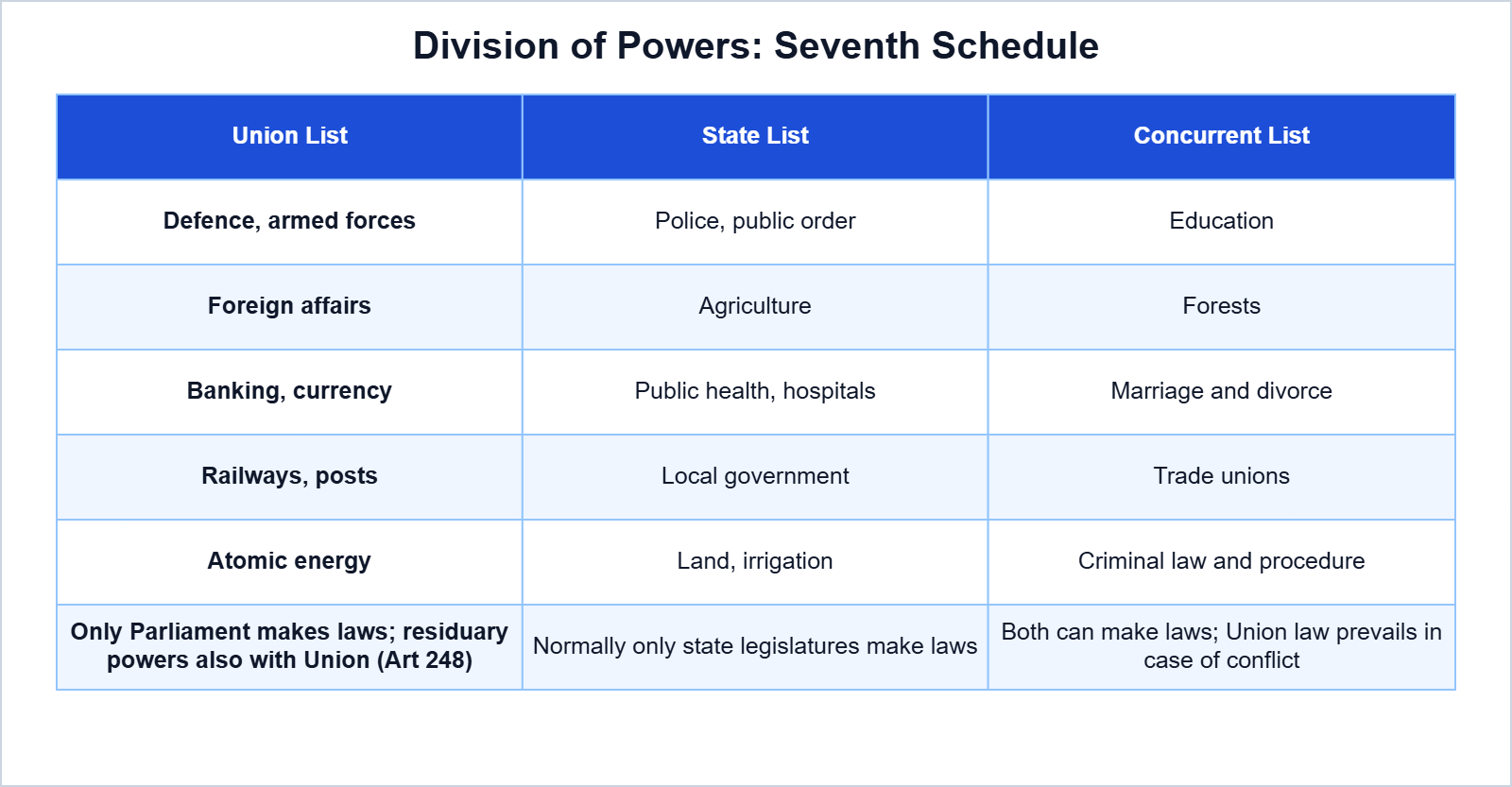
- Division of powers through three lists in the Seventh Schedule.
- Written and supreme Constitution.
- Independent judiciary to settle Centre-state disputes (Art 131).
- Bicameral Parliament with the Rajya Sabha representing states.
- Amendment of federal provisions requires ratification by half the states.
4. How the Constitution Strengthens the Centre
- Creation of new states: Parliament can change the boundaries or names of states (Art 3).
- Emergency provisions: During an emergency, the federal system becomes almost unitary.
- Residuary powers belong to the Union (Art 248).
- Governor is appointed by the President and can recommend President’s Rule (Art 356).
- Financial powers: The Union controls major sources of revenue; states depend on grants and a share of taxes decided through the Finance Commission (Art 280).
- Art 249: Parliament can legislate on State List subjects in the national interest.
- All-India services, single citizenship and an integrated judiciary.
Important: Because of these features, India is often described as a federation with a strong Centre or a “quasi-federal” system.
5. Conflicts in Indian Federalism
- Centre-state relations: Disputes over the role of the Governor and the use of Art 356. The Supreme Court in the S.R. Bommai case (1994) limited the misuse of Art 356.
- Demands for autonomy: States have demanded more financial and administrative powers.
- Inter-state disputes: Over boundaries and the sharing of river waters.
- The Sarkaria Commission (set up in 1983) examined Centre-state relations.
6. Special Provisions for Some States and Areas
- Article 371 and related Articles (371A to 371J) give special provisions to some states, such as Nagaland, Mizoram, Sikkim, Manipur, Assam and Arunachal Pradesh, to protect local customs, land rights and development needs.
- The Fifth and Sixth Schedules provide special arrangements for tribal areas.
- Article 370 gave special status to Jammu and Kashmir. It was made inoperative in August 2019, and the state was reorganised into two Union Territories: Jammu and Kashmir, and Ladakh.
Easy Memory Trick: “Union = national, State = local, Concurrent = common”.
7. Important Exam Questions
Q1. What is federalism?
Ans. A system in which power is divided between the central government and state governments by the constitution.
Q2. Who has residuary powers in India?
Ans. The Union (Parliament), under Art 248.
Q3. Give two examples each of Union and State List subjects.
Ans. Union: defence and foreign affairs. State: police and agriculture.
Q4. Why is India called a federation with a strong Centre?
Ans. Because the Centre has residuary powers, emergency powers, control over the Governor and major revenues, and can even change state boundaries.
Q5. What happened to Article 370 in 2019?
Ans. It was made inoperative, and Jammu and Kashmir was reorganised into two Union Territories.
Q6. Which Article deals with the Finance Commission?
Ans. Article 280.
Q7. When did Himachal Pradesh become a full state?
Ans. On 25 January 1971.
Conclusion: Indian federalism balances unity and diversity. It gives states their own powers while keeping a strong Centre to protect national unity.