Constitution as a Living Document – Class 11 Political Science Notes
Chapter – 9
Constitution as a Living Document
1. Why Is the Constitution a Living Document?
A living document is one that grows and changes with time, like a living being, while keeping its core identity. The Indian Constitution has adapted to new situations through amendments, judicial interpretation and political practice, without losing its basic values.
Remember: The Indian Constitution is neither too rigid nor too flexible. Some parts can be changed easily, others need a special majority and the approval of states.
2. How Has the Constitution Changed? (Amendment Procedure)
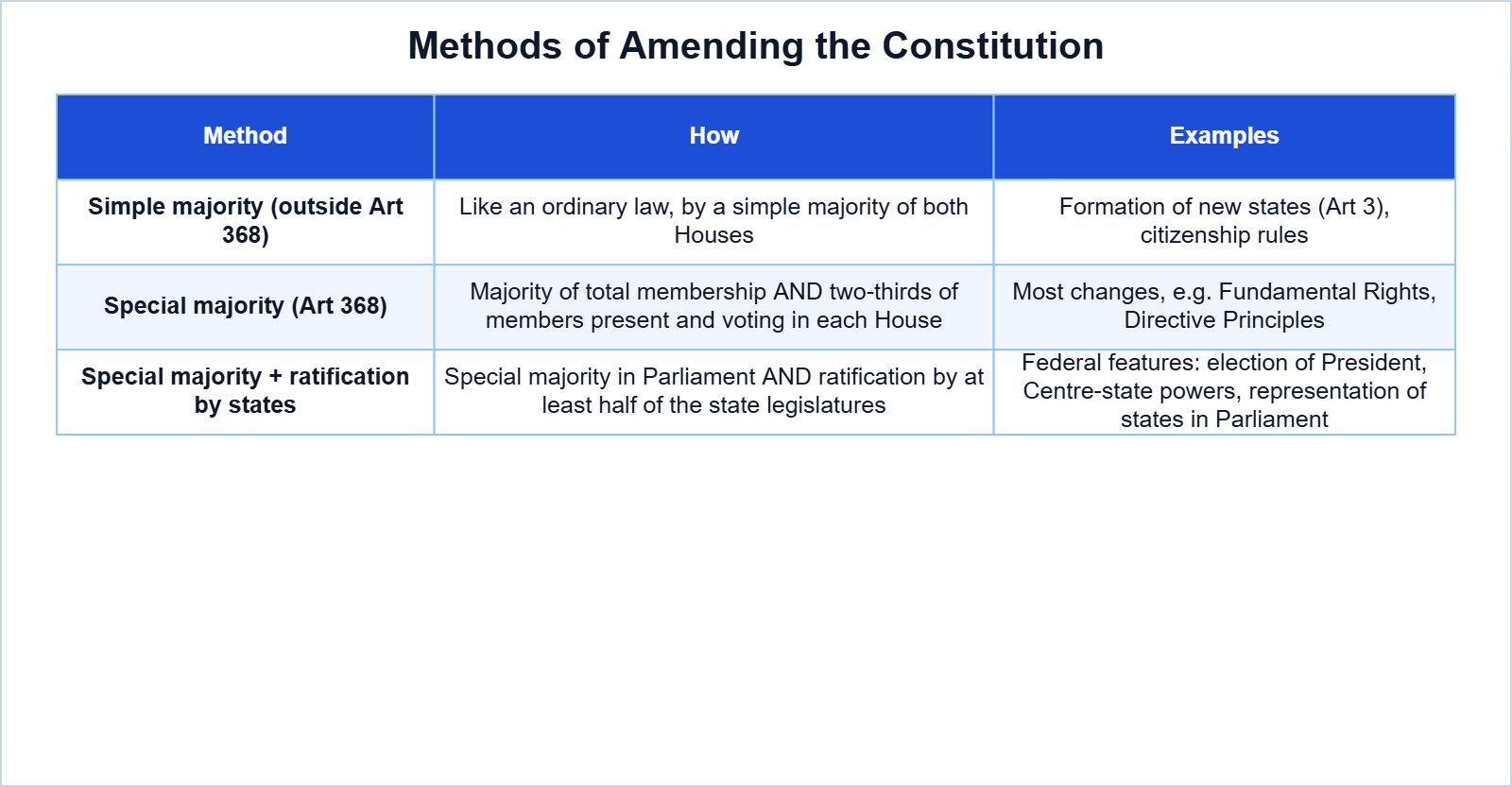
The procedure for amendment is given in Article 368. An amendment bill can be introduced only in Parliament; there is no separate body or referendum.
Important: The Constitution has been amended more than 100 times. Most amendments are technical or administrative, or reflect a broad political consensus.
3. Why Are Further Changes Being Debated?
- Society, the economy and technology keep changing, leading to new demands (for example, reservation for women, electoral reforms, Centre-state relations).
- Some amendments arose from differences between the judiciary and Parliament over the interpretation of the Constitution.
- Debates continue on how far Parliament can change the Constitution.
4. The Basic Structure Doctrine
- In the Kesavananda Bharati case (1973), the Supreme Court held that Parliament can amend any part of the Constitution, but cannot change its basic structure.
- Elements of the basic structure include: supremacy of the Constitution, the democratic and republican form of government, secularism, federalism, separation of powers, judicial review and the essence of Fundamental Rights.
- This doctrine balances flexibility (the power to amend) with stability (protection of core values).
Exam point: The basic structure doctrine was laid down in Kesavananda Bharati v. State of Kerala, 1973.
5. How Has the Working of Democracy Affected the Constitution?
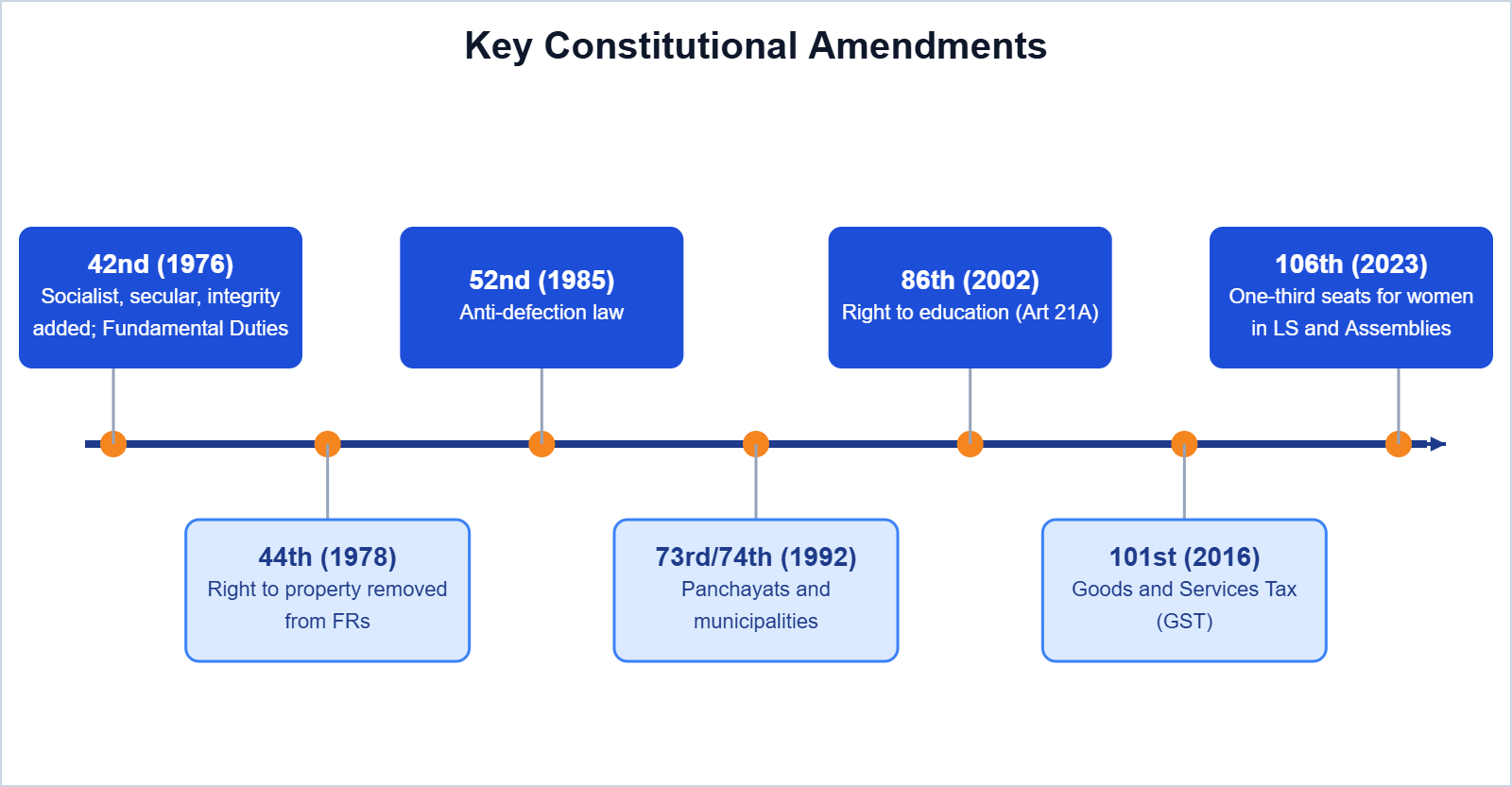
- The 42nd Amendment (1976), passed during the Emergency, made many changes that weakened the judiciary and extended the term of legislatures. After the Emergency, the 44th Amendment (1978) reversed many of these changes and added safeguards against misuse of emergency powers.
- Judicial interpretation has expanded rights (for example, Article 21) and limited the misuse of power.
- Coalition politics and the rise of regional parties have strengthened federal practices.
- The Constitution has been made more inclusive through amendments for local government, education and women’s representation.
Easy Memory Trick: “Amend, but don’t destroy” – the essence of the basic structure doctrine.
6. Important Exam Questions
Q1. Which Article deals with the amendment of the Constitution?
Ans. Article 368.
Q2. What is a special majority?
Ans. A majority of the total membership of each House and at least two-thirds of the members present and voting.
Q3. Which amendments require ratification by the states?
Ans. Amendments affecting federal features, such as the election of the President, distribution of powers and representation of states in Parliament.
Q4. What is the basic structure doctrine?
Ans. The principle that Parliament cannot amend the Constitution in a way that destroys its basic features, laid down in the Kesavananda Bharati case (1973).
Q5. Which words were added to the Preamble by the 42nd Amendment?
Ans. Socialist, secular and integrity.
Q6. Why is the Indian Constitution called a living document?
Ans. Because it has changed with time through amendments and interpretation, while keeping its core values.
Q7. Name the amendment that introduced GST.
Ans. The 101st Amendment (2016).
Conclusion: The Indian Constitution has remained relevant for over seven decades because it can change with the times, while the basic structure doctrine protects its core values.