Local Governments – Class 11 Political Science Notes
Chapter – 8
Local Governments
1. Why Do We Need Decentralisation?
Decentralisation means transferring power from the central and state governments to local bodies. Local government is the government closest to the people.
- Local problems are best understood and solved by local people.
- It increases people’s participation in democracy.
- It helps make development plans suited to local needs.
- It trains people in leadership and self-government.
2. Status of Local Government in the Constitution
- Originally, local government was a State List subject, and Art 40 (a Directive Principle) asked the state to organise village panchayats.
- The Balwantrai Mehta Committee (1957) recommended a three-tier Panchayati Raj system. Rajasthan was among the first states to adopt it in 1959.
- However, local bodies remained weak, with irregular elections and few powers.
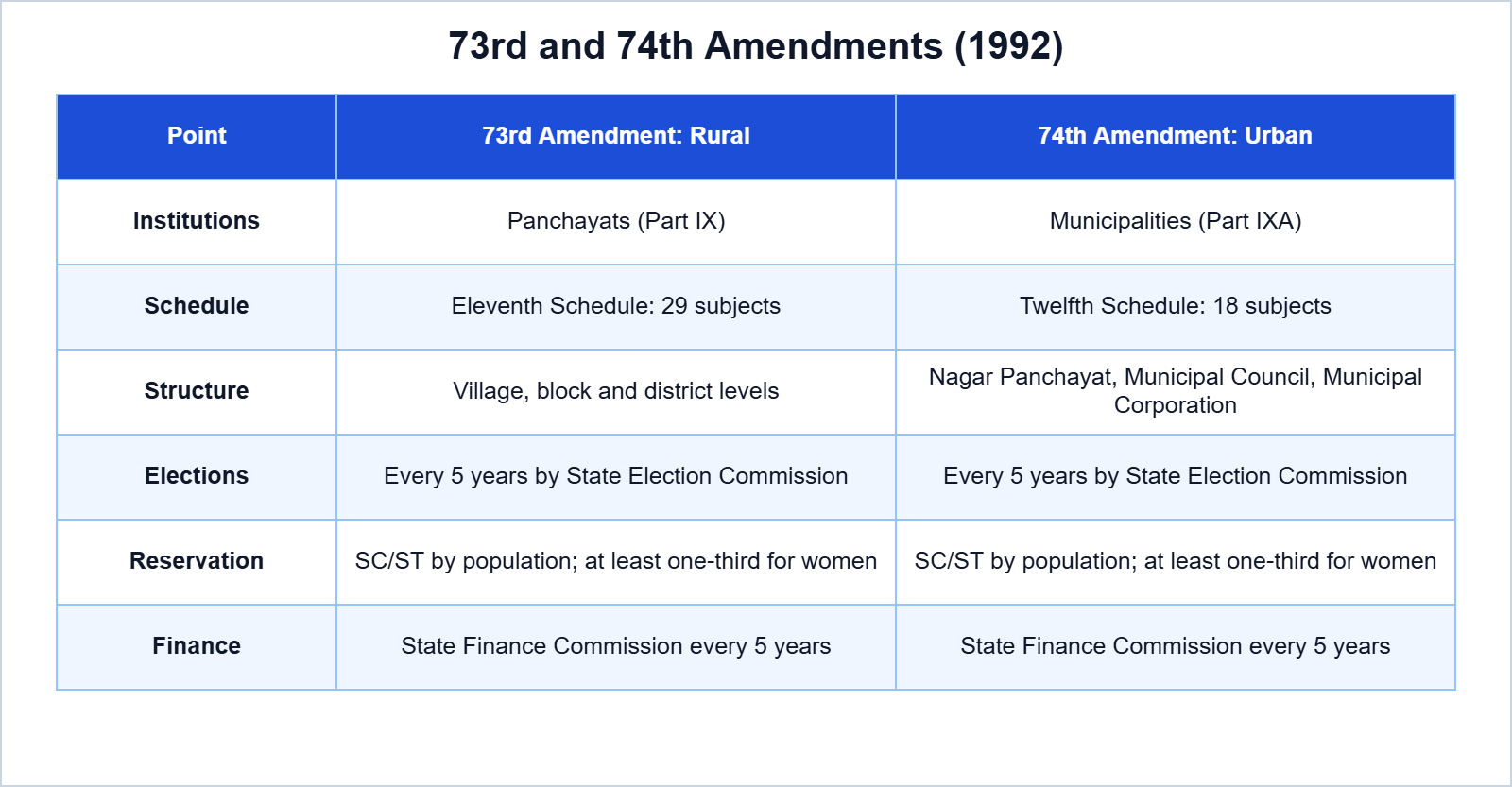
- The 73rd and 74th Amendments, passed in 1992 and in force from 1993, gave constitutional status to rural and urban local governments.
3. Rural Local Government (73rd Amendment)

- Three-tier structure: Gram Panchayat (village), Panchayat Samiti (block) and Zila Parishad (district). Small states may skip the middle tier.
- Gram Sabha: Consists of all adult voters of the village; it approves plans and reviews the panchayat’s work.
- Elections: Every 5 years, conducted by the State Election Commission.
- Reservation: Seats for SCs and STs in proportion to their population; at least one-third of seats and of chairperson posts reserved for women.
- Finance: A State Finance Commission every 5 years reviews the finances of local bodies.
- Subjects: 29 subjects in the Eleventh Schedule, such as agriculture, drinking water, roads, primary education and health.
Example: Himachal Pradesh passed the HP Panchayati Raj Act, 1994, and has a three-tier system with Gram Panchayats, Panchayat Samitis and a Zila Parishad in each district. HP has increased reservation for women in Panchayati Raj institutions to 50%.
4. Urban Local Government (74th Amendment)
- Nagar Panchayat for areas changing from rural to urban, Municipal Council for smaller urban areas, and Municipal Corporation for larger cities (for example, the Shimla Municipal Corporation).
- Same provisions for elections, reservation and State Finance Commission as in rural bodies.
- 18 subjects in the Twelfth Schedule, such as urban planning, water supply, public health and sanitation.
5. Effects of Constitutional Status
- Regular elections to local bodies across the country.
- Lakhs of women and members of SC/ST communities have entered public life as elected representatives.
- Limitations: Local bodies often lack enough funds and real powers; they depend on state governments, and in some cases relatives of women members exercise power on their behalf.
Easy Memory Trick: “73 = Village (rural), 74 = City (urban); 29 and 18 subjects”.
6. Important Exam Questions
Q1. Which amendment gave constitutional status to panchayats?
Ans. The 73rd Amendment (1992).
Q2. What is the Gram Sabha?
Ans. It is the body of all adult voters of a village, which approves plans and reviews the work of the Gram Panchayat.
Q3. How many subjects are in the Eleventh and Twelfth Schedules?
Ans. 29 subjects in the Eleventh Schedule and 18 in the Twelfth Schedule.
Q4. What is the minimum reservation for women in local bodies under the Constitution?
Ans. At least one-third of seats and chairperson posts.
Q5. Who conducts elections to local bodies?
Ans. The State Election Commission.
Q6. Which committee recommended a three-tier Panchayati Raj system?
Ans. The Balwantrai Mehta Committee (1957).
Q7. Name the three types of urban local bodies.
Ans. Nagar Panchayat, Municipal Council and Municipal Corporation.
Conclusion: The 73rd and 74th Amendments made local governments a constitutional part of Indian democracy, bringing power closer to the people, though more funds and powers are still needed.