Chapter – 14
Social Justice
1. What Is Justice?
Justice means giving each person his or her due. Different thinkers have explained it differently. In ancient Greece, Plato in The Republic discussed justice as each person doing what he or she is best fitted for. The German philosopher Immanuel Kant stressed that every human being has dignity and must be treated as an end, not merely as a means.
2. Is Justice All About Fairness? Principles of Justice
- Equal treatment for equals: People should get equal rights and should not be discriminated against on grounds of class, caste, race or gender.
- Proportionate justice: Rewards should be in proportion to effort, skill and the nature of work.
- Recognition of special needs: People with disadvantages (such as persons with disabilities or those who faced historical discrimination) may need special help.
Important: Justice requires balancing these three principles.
3. What Is the Relationship Between Justice and Equality?
Justice and equality are closely linked. Social justice means a fair distribution of goods, opportunities and resources in society, so that everyone can live with dignity. This requires reducing unjust inequalities through laws and policies such as land reforms, reservations and welfare schemes.
4. Rawls’ Theory: Justice as Fairness
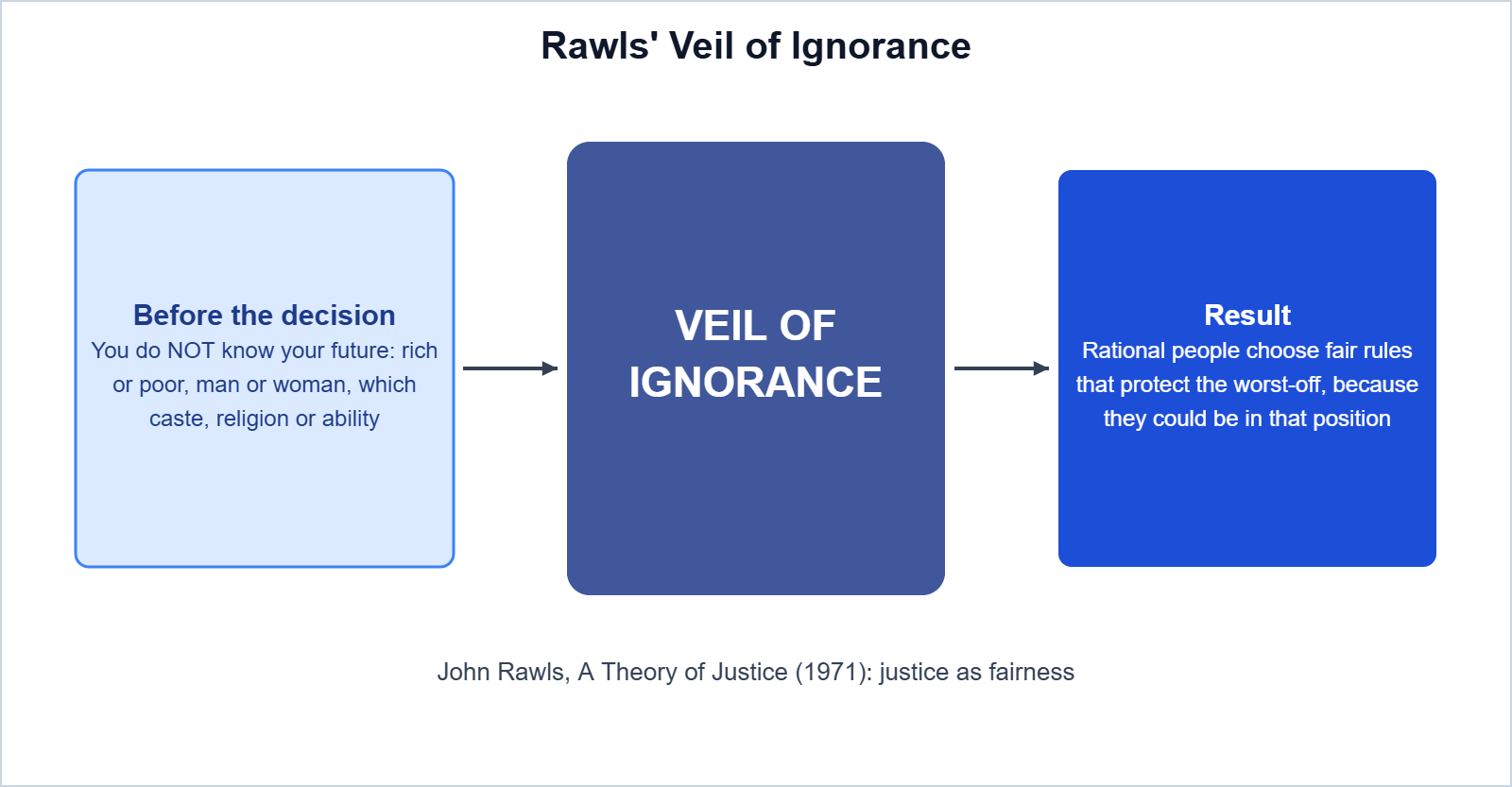
The American philosopher John Rawls, in A Theory of Justice (1971), suggested a thought experiment. Imagine people deciding the rules of society behind a “veil of ignorance”: they do not know what position they will have in society. Since anyone could end up poor or disadvantaged, rational people would choose rules that are fair to all and that benefit the least advantaged.
Remember: Rawls’ idea shows that fairness can be reached through reasoning, not just through kindness or charity.
5. What Are the Different Forms of Injustice?
- Discrimination on grounds of caste, religion, gender or race.
- Exploitation of workers, children and the poor.
- Unequal distribution of land, wealth, education and health care.
- Denial of basic needs such as food, shelter, clean water and health.
6. In Which Ways Can Justice Be Secured?
Free market view | State intervention view |
|---|---|
Markets reward talent and effort; the state should only ensure fair rules and protect property | Markets alone increase inequality; the state should provide basic needs and opportunities to the disadvantaged |
Encourages efficiency and choice | Ensures a minimum standard of living for all |
In practice, most democracies, including India, combine both: markets with state welfare measures such as free education, health care, food security and reservations.
Easy Memory Trick: Three principles of justice “Equal – Proportionate – Special”.
7. Important Exam Questions
Q1. What is social justice?
Ans. Fair distribution of goods, opportunities and resources so that every person can live with dignity.
Q2. Name the three principles of justice.
Ans. Equal treatment for equals, proportionate justice and recognition of special needs.
Q3. What is Rawls’ “veil of ignorance”?
Ans. A thought experiment in which people choose the rules of society without knowing their own future position, so they choose fair rules that help the least advantaged.
Q4. Name the book in which Rawls explained his theory.
Ans. A Theory of Justice (1971).
Q5. Give two forms of injustice.
Ans. Discrimination on the basis of caste or gender, and exploitation of workers.
Q6. How does the Indian state try to secure social justice?
Ans. Through reservations, land reforms, free education, health and food security schemes, and laws against discrimination.
Conclusion: Social justice requires fairness in the distribution of resources and opportunities. By combining equal rights, rewards for effort and support for the disadvantaged, society can become more just.