Chapter – 2
Rights in the Indian Constitution
1. Why Do We Need a Bill of Rights?
A bill of rights is a list of rights guaranteed by the constitution. It protects citizens against the misuse of power by the government and by other citizens, and ensures that the government cannot violate these rights. It also provides a remedy (a way to get justice) if rights are violated.
Remember: In India, the bill of rights is called Fundamental Rights, given in Part III (Articles 12 to 35) of the Constitution.
2. Fundamental Rights in the Indian Constitution
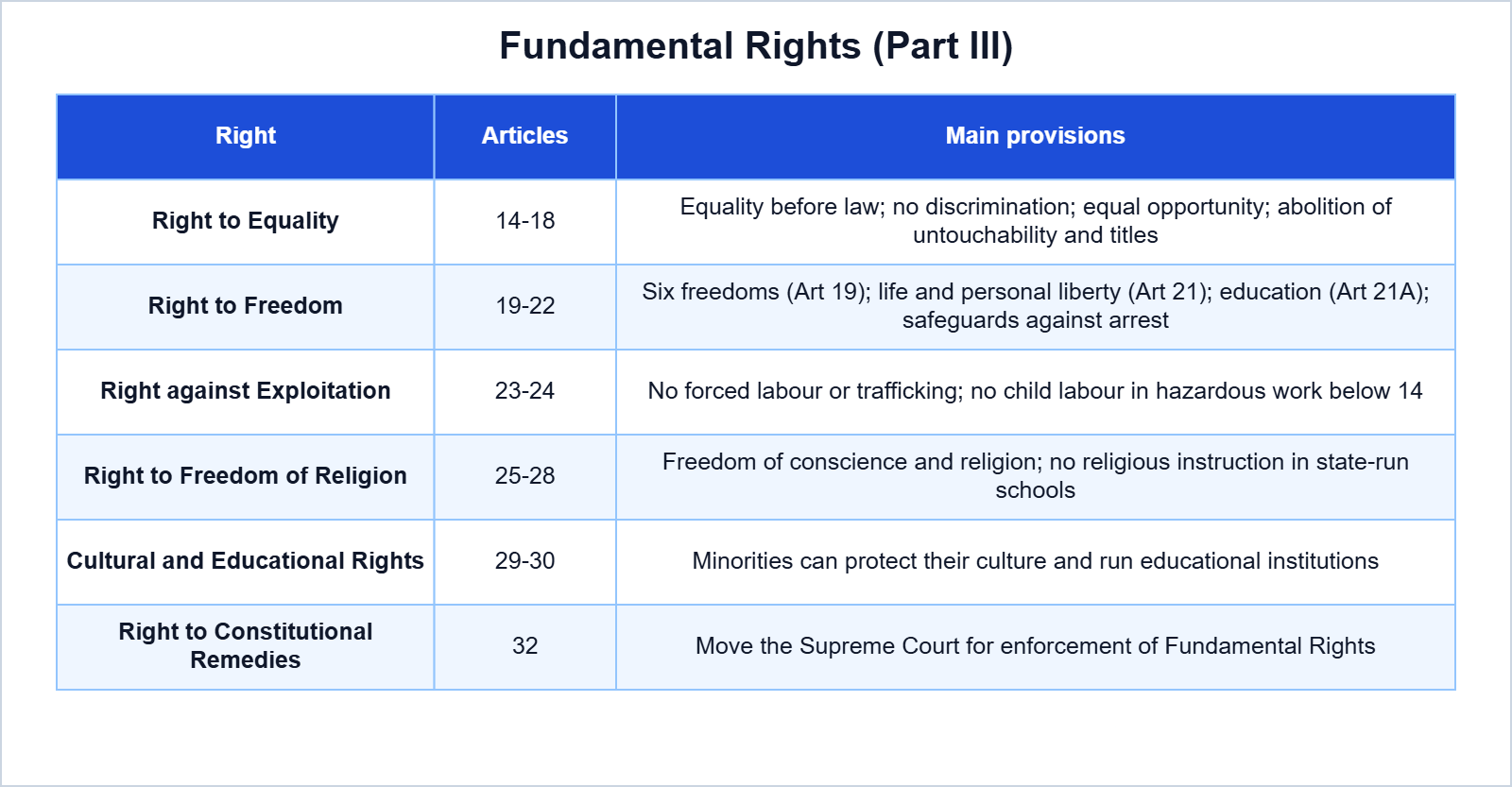
- Right to Equality (Arts 14-18): Equality before law and equal protection of laws (Art 14); no discrimination on grounds of religion, race, caste, sex or place of birth (Art 15); equality of opportunity in public employment (Art 16); abolition of untouchability (Art 17); abolition of titles (Art 18).
- Right to Freedom (Arts 19-22): Art 19 gives six freedoms: speech and expression, assembly, association, movement, residence, and profession. Art 20 protects in respect of conviction for offences, Art 21 protects life and personal liberty, Art 21A gives the right to free and compulsory education to children aged 6-14, and Art 22 gives protection against arbitrary arrest and detention.
- Right against Exploitation (Arts 23-24): Bans human trafficking, forced labour (begar) and employment of children below 14 in factories, mines or hazardous work.
- Right to Freedom of Religion (Arts 25-28): Freedom to profess, practise and propagate religion, subject to public order, morality and health.
- Cultural and Educational Rights (Arts 29-30): Minorities can conserve their language and culture and establish their own educational institutions.
- Right to Constitutional Remedies (Art 32): Citizens can go directly to the Supreme Court if their Fundamental Rights are violated. Dr Ambedkar called it the “heart and soul” of the Constitution.
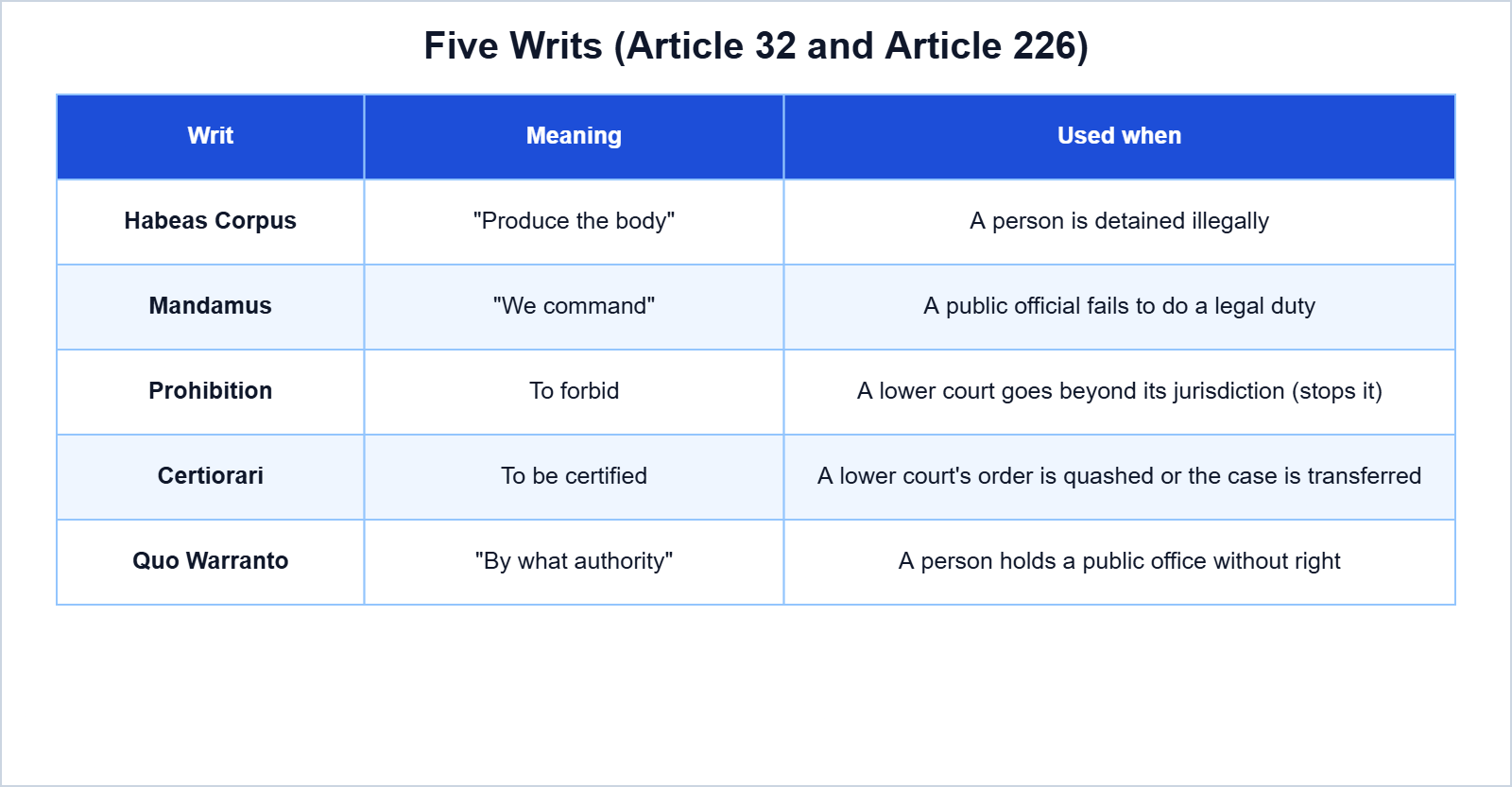
Exam point: Under Art 32 the Supreme Court issues writs; under Art 226 the High Courts can issue writs.
3. Why Was the Right to Property Removed?
The right to property was originally a Fundamental Right. It created obstacles to land reforms and the abolition of zamindari, as many laws were challenged in court. Therefore the 44th Amendment (1978) removed it from the list of Fundamental Rights and made it a legal right under Article 300A. The state can now take property for public purposes by law, with fair procedure.
4. How Have Court Interpretations Shaped Fundamental Rights?
- The courts have widened the meaning of Art 21 (right to life) to include the right to live with dignity, livelihood, shelter, a clean environment, health and privacy.
- In Kesavananda Bharati (1973), the Supreme Court held that Parliament cannot change the basic structure of the Constitution, which protects core rights.
- In Maneka Gandhi (1978), the Court held that any law restricting personal liberty must be just, fair and reasonable.
5. Fundamental Rights and Civil Liberties Movements
Fundamental Rights gave citizens a strong basis to fight for civil liberties. After the experience of the Emergency (1975-77), citizens’ groups such as the People’s Union for Civil Liberties (PUCL) worked to protect the rights of prisoners, workers, tribal people and others. The National Human Rights Commission (set up in 1993) also protects human rights.
6. Directive Principles of State Policy (Part IV)
Directive Principles (Arts 36-51), inspired by the Irish Constitution, are guidelines for the government to build a welfare state, such as adequate livelihood, equal pay for equal work, village panchayats (Art 40) and a uniform civil code (Art 44). They are not enforceable in court, but are fundamental in governance.
Fundamental Rights | Directive Principles |
|---|---|
Justiciable (enforceable by courts) | Non-justiciable |
Limit the power of the state | Guide the state to take positive action |
Protect individual rights | Aim at social and economic welfare |
7. Fundamental Duties
Fundamental Duties were added by the 42nd Amendment (1976) in Article 51A. There are now 11 duties; the 11th (duty of parents to provide opportunities for education to children aged 6-14) was added by the 86th Amendment (2002). Examples: respect the Constitution, the national flag and anthem; protect the environment; promote harmony; safeguard public property.
Easy Memory Trick: Six Fundamental Rights = “E-F-E-R-C-C”: Equality, Freedom, Exploitation (against), Religion, Cultural-Educational, Constitutional remedies.
8. Important Exam Questions
Q1. Which right did Dr Ambedkar call the heart and soul of the Constitution?
Ans. The Right to Constitutional Remedies (Art 32).
Q2. Which amendment removed the right to property from Fundamental Rights?
Ans. The 44th Amendment (1978); it is now a legal right under Art 300A.
Q3. What is the writ of habeas corpus?
Ans. It is an order of the court to produce a detained person before it, to check whether the detention is legal.
Q4. Name the six freedoms under Article 19.
Ans. Speech and expression, assembly, association, movement, residence, and profession/occupation.
Q5. When and by which amendment were Fundamental Duties added?
Ans. In 1976 by the 42nd Amendment, in Article 51A.
Q6. Give two differences between Fundamental Rights and Directive Principles.
Ans. Fundamental Rights are justiciable and limit the state; Directive Principles are non-justiciable and guide the state towards welfare.
Q7. How has Article 21 been widened by the courts?
Ans. It now includes the right to live with dignity, livelihood, shelter, health, a clean environment and privacy.
Conclusion: Fundamental Rights protect the dignity and freedom of every citizen. Together with Directive Principles and Fundamental Duties, they balance individual liberty with social welfare and responsibility.