Chapter – 5
Legislature
1. Why Do We Need a Parliament?
The legislature makes laws, controls the executive, passes the budget and represents the people. In India, the Union legislature is called Parliament. It consists of the President, the Lok Sabha and the Rajya Sabha.
2. Why Two Houses? (Bicameralism)
- India is a large and diverse country; the Rajya Sabha gives representation to the states.
- A second House allows reconsideration of every decision, preventing hasty laws.
- It provides a place for experienced people and experts (12 nominated members from literature, science, art and social service).
Important: States may have one House (unicameral) or two Houses (bicameral). Himachal Pradesh has a unicameral legislature, the Vidhan Sabha, with 68 members.
3. How Are Parliament and State Assemblies Constituted?
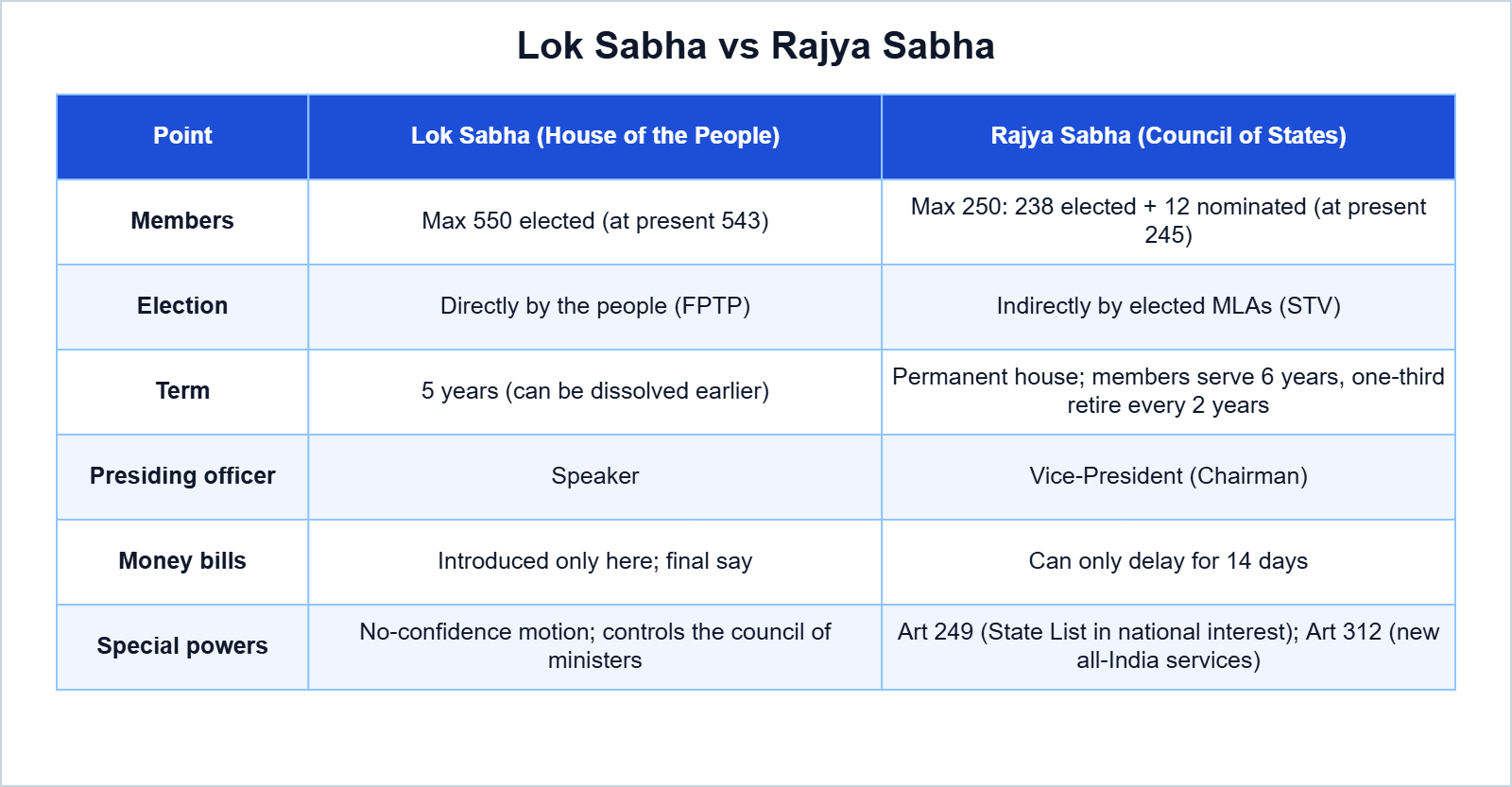
- Lok Sabha: Members are directly elected for 5 years from territorial constituencies. The Constitution allows a maximum of 550 elected members (530 from states and 20 from Union Territories); at present there are 543. The nomination of two Anglo-Indian members was ended by the 104th Amendment.
- Rajya Sabha: Members are elected by elected members of State Legislative Assemblies through the single transferable vote. Seats are allotted to states mainly on the basis of population (HP has 3). The maximum is 250 (238 elected + 12 nominated by the President).
- State Legislative Assembly (Vidhan Sabha): Directly elected for 5 years.
4. Powers of the Lok Sabha and the Rajya Sabha
- Both Houses make laws on the Union List and the Concurrent List and pass constitutional amendments.
- Lok Sabha: Money bills can be introduced only here; the Rajya Sabha can delay them for at most 14 days. Only the Lok Sabha can remove the government through a no-confidence motion.
- Rajya Sabha: Can authorise Parliament to make laws on a State List subject in the national interest (Art 249) and create new all-India services (Art 312).
5. How Is a Law Passed?
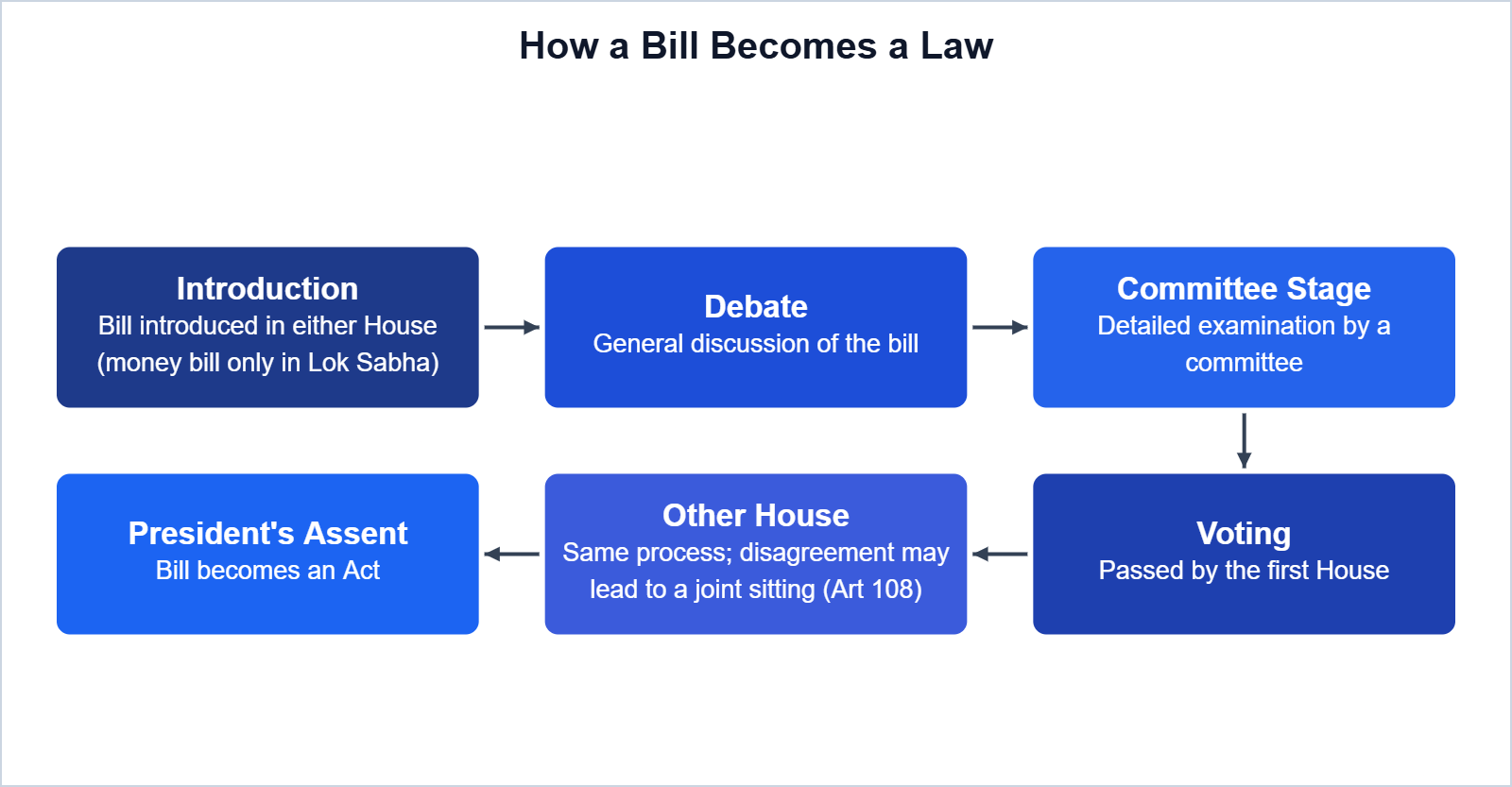
If the two Houses disagree on an ordinary bill, the President may call a joint sitting (Art 108), presided over by the Speaker. A joint sitting cannot be held for money bills or constitutional amendment bills.
6. How Is the Executive Made Accountable?
- Deliberation and discussion: Question Hour, Zero Hour, debates and adjournment motions.
- Approval and ratification of laws: No law can be passed without Parliament.
- Financial control: Parliament passes the budget; committees like the Public Accounts Committee examine spending.
- No-confidence motion: The Lok Sabha can remove the government.
- Parliamentary committees examine bills and government work in detail.
7. Preventing Defection
Defection means an elected member leaving the party on whose ticket he or she was elected, or voting against party directions. The 52nd Amendment (1985) added the Tenth Schedule (anti-defection law). The 91st Amendment (2003) removed the protection for a “split” in a party. A member who defects can be disqualified; the Speaker or Chairman decides such cases.
Easy Memory Trick: “Lok = People = Money; Rajya = States = Permanent”.
8. Important Exam Questions
Q1. Why is the Rajya Sabha called a permanent House?
Ans. It is never dissolved; one-third of its members retire every two years, and each member serves a six-year term.
Q2. How long can the Rajya Sabha delay a money bill?
Ans. 14 days.
Q3. Who presides over a joint sitting of Parliament?
Ans. The Speaker of the Lok Sabha.
Q4. What is the maximum strength of the Rajya Sabha?
Ans. 250 members: 238 elected and 12 nominated by the President.
Q5. Which amendment brought the anti-defection law?
Ans. The 52nd Amendment (1985), which added the Tenth Schedule.
Q6. Name two ways in which Parliament controls the executive.
Ans. Question Hour and the no-confidence motion.
Q7. Is the Himachal Pradesh legislature unicameral or bicameral?
Ans. Unicameral; it has only the Vidhan Sabha with 68 members.
Conclusion: Parliament is the heart of Indian democracy. Through law-making, financial control and questioning the government, it keeps the executive accountable to the people.