Judiciary – Class 11 Political Science Notes
Chapter – 6
Judiciary
1. What Is the Rule of Law?
Rule of law means that everyone, rich or poor, ruler or ruled, is equal before the law and is governed by the same laws. No one is above the law. The judiciary protects the rule of law by settling disputes, protecting rights and checking the misuse of power.
2. Why Do We Need an Independent Judiciary?
- To decide disputes fairly between citizens, between citizens and government, and between governments.
- To protect Fundamental Rights and the Constitution.
- To ensure that the legislature and executive act within their constitutional limits.
Remember: Independence does not mean the judiciary is unaccountable; it means it must be free from pressure from the executive, legislature and other interests.
3. Provisions That Ensure Judicial Independence
- Appointment: The legislature is not involved in appointing judges.
- Security of tenure: Judges hold office until retirement (65 years for Supreme Court, 62 for High Courts) and can be removed only by a difficult process.
- Removal: Only on grounds of proved misbehaviour or incapacity, by a motion passed by a special majority in both Houses of Parliament (Art 124(4)).
- Financial independence: Salaries and allowances are charged on the Consolidated Fund of India and cannot be reduced to their disadvantage.
- Protection from criticism: The conduct of judges cannot be discussed in the legislature except during removal proceedings; courts can punish for contempt.
4. How Are Judges Appointed?
Judges of the Supreme Court and High Courts are appointed by the President. Since the 1990s, appointments follow the collegium system, in which the Chief Justice of India and senior-most judges recommend names. The National Judicial Appointments Commission (NJAC), created by the 99th Amendment (2014), was struck down by the Supreme Court in 2015, so the collegium system continues.
5. Structure of the Judiciary
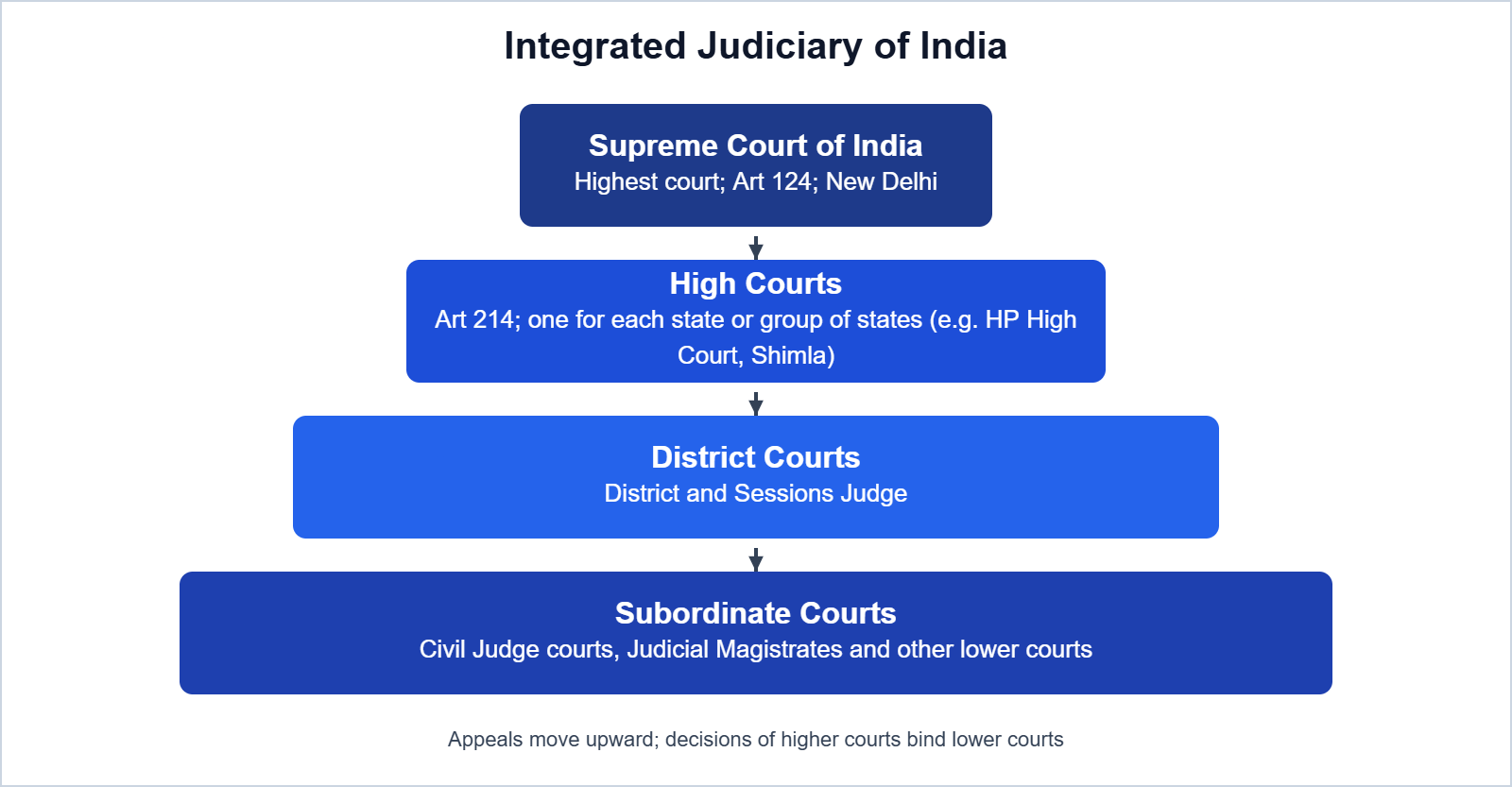
India has an integrated judiciary: a single hierarchy of courts with the Supreme Court at the top.
6. Powers (Jurisdiction) of the Supreme Court
Jurisdiction | Meaning |
|---|---|
Original (Art 131) | Disputes between the Centre and states or between states |
Writ (Art 32) | Protection of Fundamental Rights through writs |
Appellate | Hears appeals against High Court decisions in civil, criminal and constitutional cases |
Advisory (Art 143) | Gives advice to the President on questions of law or public importance |
Special leave (Art 136) | Can grant special leave to appeal against any judgment in the country |
Court of record (Art 129) | Its decisions are recorded and binding; can punish for contempt |
High Courts hear appeals from lower courts, issue writs under Art 226 (for Fundamental Rights and other legal rights) and supervise subordinate courts.
7. Judicial Review
Judicial review is the power of courts to examine whether a law or government action is consistent with the Constitution and to declare it invalid if it is not. In Kesavananda Bharati (1973), the Supreme Court held that Parliament cannot amend the basic structure of the Constitution.
8. Public Interest Litigation (PIL) and Judicial Activism
- From the late 1970s, the Supreme Court allowed any public-spirited person or group to file a case on behalf of those who cannot approach the court themselves. This is PIL.
- Early PIL cases dealt with the rights of undertrial prisoners, bonded labourers and the poor. Courts even treated letters and newspaper reports as petitions.
- PIL has helped protect the environment, improve prison conditions and secure rights of workers.
- Criticism: Too many PILs burden courts, and judicial activism may blur the separation of powers.
Easy Memory Trick: Supreme Court jurisdiction “O-W-A-A” = Original, Writ, Appellate, Advisory.
9. Important Exam Questions
Q1. What is the rule of law?
Ans. The principle that all persons are equal before the law and no one is above it.
Q2. Give two provisions that protect judicial independence.
Ans. Security of tenure with a difficult removal process, and salaries charged on the Consolidated Fund of India.
Q3. Under which Article can the President seek the Supreme Court’s advice?
Ans. Article 143.
Q4. What is PIL?
Ans. Public Interest Litigation is a case filed in court by any person or group for the protection of public interest or the rights of those who cannot approach the court themselves.
Q5. What is judicial review?
Ans. The power of the courts to declare a law or executive action unconstitutional if it violates the Constitution.
Q6. How is a Supreme Court judge removed?
Ans. By an order of the President after a motion on grounds of proved misbehaviour or incapacity is passed by a special majority in both Houses of Parliament.
Q7. Which Article gives High Courts the power to issue writs?
Ans. Article 226.
Conclusion: An independent judiciary is the guardian of the Constitution and citizens’ rights. Through judicial review and PIL, Indian courts have strengthened democracy and the rule of law.