Recent Developments in Indian Politics – Political Science Class 12 Notes
Chapter – 16
Recent Developments in Indian Politics
1. Context of the 1990s
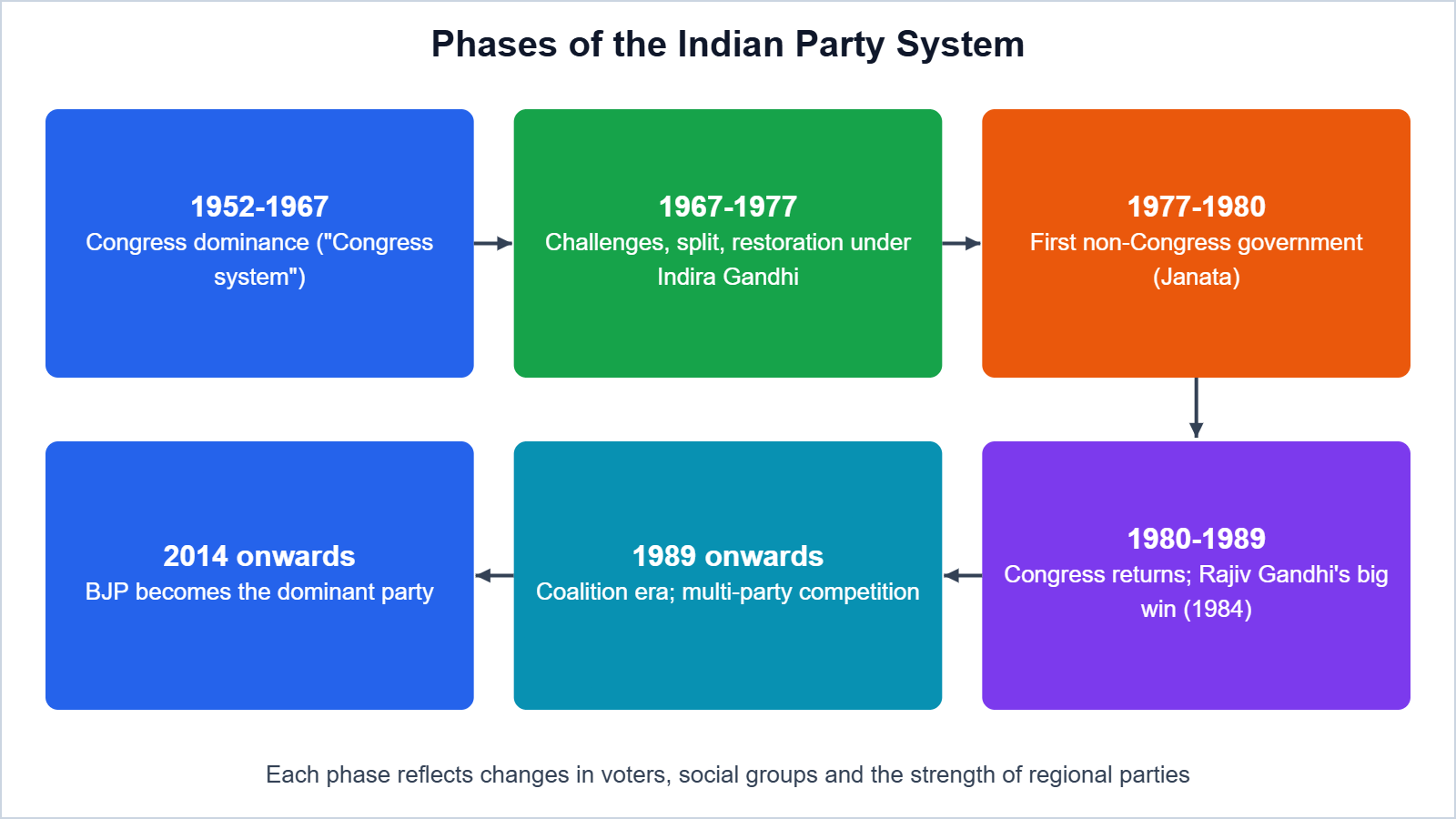
After Indira Gandhi’s assassination in October 1984, Rajiv Gandhi became Prime Minister and the Congress won a massive victory in the 1984 elections with more than 400 Lok Sabha seats. The period from the late 1980s brought five major developments: the end of the Congress system, the Mandal issue, the new economic policy of 1991, the Ayodhya dispute, and the assassination of Rajiv Gandhi in May 1991.
2. The Era of Coalitions
In the 1989 elections, the Congress was defeated, and no single party won a majority. The National Front, led by the Janata Dal and supported from outside by the BJP and the Left, formed the government under V.P. Singh. This began an era of coalition governments, in which national and regional parties shared power.
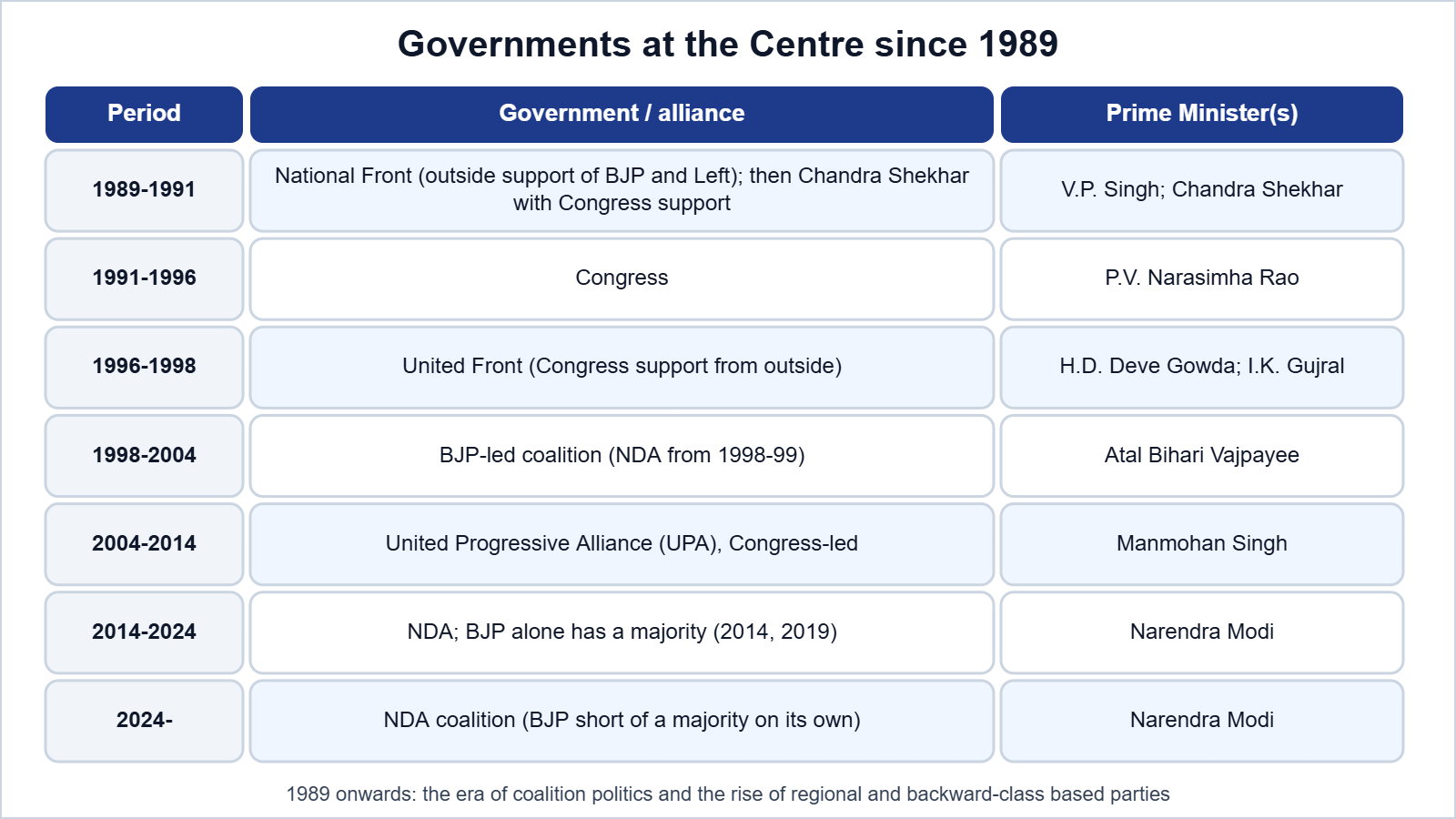
- The Congress remained important but lost its dominance; it formed a minority government under P.V. Narasimha Rao in 1991.
- The United Front governments (1996-98) depended on outside support of the Congress.
- The BJP emerged as a major party; it led a coalition under Atal Bihari Vajpayee (1998-2004), the National Democratic Alliance (NDA).
- The UPA led by the Congress governed from 2004 to 2014 under Manmohan Singh.
- In 2014 (the 16th Lok Sabha election), the BJP won a majority on its own, the first party to do so since 1984, and Narendra Modi became Prime Minister; it won again in 2019. In 2024 the NDA formed the government again as a coalition, with the BJP short of a majority on its own.
Remember: Coalition politics meant that regional parties became partners in running the central government, and pragmatism and power sharing became more important than ideology.
3. The Mandal Issue and the Rise of OBCs
The Second Backward Classes Commission, headed by B.P. Mandal, was appointed in 1979 and submitted its report in 1980. It recommended 27 per cent reservation for Other Backward Classes (OBCs) in central government jobs and educational institutions, land reform and other measures. In August 1990, the National Front government decided to implement the recommendation on jobs, leading to violent protests in many parts of north India. In the Indra Sawhney case (1992), the Supreme Court upheld the decision, excluding the well-off sections (“creamy layer”).
OBCs and Dalits became more politically active. Parties based on their support grew, such as the Janata Dal, Samajwadi Party, Rashtriya Janata Dal and the Bahujan Samaj Party (BSP), founded by Kanshi Ram in 1984.
4. Communalism, Secularism and Democracy
The Ayodhya dispute concerned the Babri Masjid built in the sixteenth century, which some Hindus believed stood at the birthplace of Lord Ram. The issue became a major political question in the late 1980s. On 6 December 1992 the mosque was demolished, followed by communal riots in many places. In 2002, after a train coach carrying karsevaks was set on fire at Godhra, large-scale violence against Muslims took place in Gujarat; the National Human Rights Commission criticised the state government for failing to control it. In 2019 the Supreme Court gave its final judgment on the Ayodhya land dispute. These events raised serious questions about communalism and the secular character of the state.
5. Defection and the Anti-defection Law
Frequent defections by legislators had made governments unstable since 1967. The 52nd Amendment (1985) added the Tenth Schedule (anti-defection law): a legislator who voluntarily gives up party membership or votes against the party’s direction can be disqualified. The 91st Amendment (2003) removed the exception for “splits” and limited the size of the Council of Ministers to 15 per cent of the strength of the House.
6. Emergence of a New Consensus
- Agreement on the new economic policies of liberalisation, though with differences on details.
- Acceptance of the political and social claims of backward castes.
- Acceptance of the role of state-level parties in governing the country.
- Emphasis on pragmatic considerations rather than ideology; coalitions formed by parties with different views.
Easy Memory Trick: “89 Coalitions, 90 Mandal, 91 Reforms, 92 Ayodhya”.
7. Timeline
Year | Event |
|---|---|
1979-80 | Mandal Commission appointed and report submitted |
1984 | Congress wins more than 400 seats; BSP founded |
1985 | 52nd Amendment (anti-defection law) |
1989 | National Front government; end of Congress dominance |
August 1990 | Mandal recommendations implemented |
May 1991 | Rajiv Gandhi assassinated |
1991 | New Economic Policy under P.V. Narasimha Rao |
1992 | Indra Sawhney judgment; Babri Masjid demolished (6 December) |
1996-98 | United Front governments |
1998-2004 | NDA government under Vajpayee |
2002 | Godhra incident and Gujarat violence |
2003 | 91st Amendment |
2004-2014 | UPA government under Manmohan Singh |
2014 | BJP wins majority; Narendra Modi PM |
2019 | BJP re-elected; Supreme Court Ayodhya verdict |
2024 | NDA coalition government formed |
8. Key Terms
Term | Meaning |
|---|---|
Coalition government | Government formed by two or more parties together |
OBC | Other Backward Classes |
Mandal Commission | Second Backward Classes Commission (1979) |
Creamy layer | Well-off section of OBCs excluded from reservation |
Defection | A legislator changing party after election |
Tenth Schedule | Anti-defection provisions added in 1985 |
NDA / UPA | BJP-led and Congress-led alliances |
9. Important Exam Questions
Q1. What is meant by coalition government? (2 marks)
Ans. A coalition government is formed when no single party wins a majority and two or more parties come together to share power. In India, the era of coalitions began in 1989, and national and regional parties have since shared power at the centre on the basis of a common programme.
Q2. What was the Mandal Commission? (2 marks)
Ans. The Mandal Commission was the Second Backward Classes Commission, appointed in 1979 under B.P. Mandal. In its 1980 report it recommended twenty-seven per cent reservation for Other Backward Classes in central government jobs and educational institutions, along with land reforms and other welfare measures.
Q3. What is the anti-defection law? (2 marks)
Ans. The anti-defection law was added to the Constitution as the Tenth Schedule by the 52nd Amendment in 1985. Under it, a legislator who voluntarily gives up the membership of his party, or votes against its direction in the House, can be disqualified from membership.
Q4. Name any two Prime Ministers of coalition governments in the 1990s. (2 marks)
Ans. V.P. Singh led the National Front government formed in 1989 with outside support from the BJP and the Left. H.D. Deve Gowda and later I.K. Gujral led the United Front governments of 1996-98, which depended on outside support from the Congress party.
Q5. Explain the main developments in Indian politics around 1989-1992. (3 marks)
Ans. First, the Congress lost the 1989 election and the era of coalition governments began with the National Front under V.P. Singh. Second, the Mandal recommendations for OBC reservation were implemented in 1990, leading to protests and a new politics of backward castes. Third, the New Economic Policy of 1991 changed the direction of the economy. Fourth, the Ayodhya dispute became central to politics, leading to the demolition of the Babri Masjid in December 1992.
Q6. What was the impact of the Mandal issue on Indian politics? (3 marks)
Ans. The decision to implement the Mandal recommendations in 1990 led to violent protests by some sections but also mobilised the Other Backward Classes politically. Parties that drew support from OBCs and Dalits, such as the Janata Dal, Samajwadi Party, Rashtriya Janata Dal and Bahujan Samaj Party, grew stronger, especially in north India. The Supreme Court upheld the reservation in 1992, and the claims of backward classes became an accepted part of national politics.
Q7. What is meant by the “new consensus” in Indian politics? (3 marks)
Ans. Despite intense competition, most parties came to agree on certain points after 1989. They accepted the new economic policies of liberalisation, even if they differed on details. They accepted the political and social claims of backward castes, including reservation. They accepted the role of state-level parties in governing the country through coalitions. Finally, they placed pragmatic considerations above ideology, forming alliances with parties holding very different views in order to gain or keep power.
Q8. Why did the 91st Amendment become necessary? (3 marks)
Ans. The anti-defection law of 1985 allowed a legislator to change party if one-third of the legislature party “split” from it. This exception was misused by groups of legislators seeking office. The 91st Amendment of 2003 removed this exception, so that only a merger with two-thirds support is protected. It also limited the size of the Council of Ministers to fifteen per cent of the House, reducing the temptation to reward defectors.
Q9. Explain the rise of coalition politics in India after 1989. (5 marks)
Ans. Coalition politics became the main feature of Indian democracy after 1989 for several reasons. First, the Congress lost its dominant position. In the 1989 elections it was defeated, and no party won a clear majority, so the National Front, led by the Janata Dal formed the government under V.P. Singh. Second, regional parties grew stronger in many states and became important partners at the centre, so national parties needed their support. Third, the politics of backward classes after the Mandal decision of 1990, and the rise of parties representing OBCs and Dalits, fragmented the vote further. Fourth, the BJP emerged as a major national force, so competition became multi-party. As a result, a series of coalitions ruled: the National Front, the United Front under H.D. Deve Gowda and I.K. Gujral, the NDA under Atal Bihari Vajpayee from 1998 to 2004, and the UPA under Manmohan Singh from 2004 to 2014. In 2014 and 2019 the BJP won majorities on its own, though it governed with allies, and in 2024 coalition government returned.
Q10. Explain the issues of communalism and secularism that arose in Indian politics after the 1980s. (5 marks)
Ans. From the late 1980s, communal issues became central to Indian politics. The most important was the Ayodhya dispute over the Babri Masjid, a sixteenth-century mosque at a site that many Hindus believed to be the birthplace of Lord Ram. In 1986 the locks on the building were opened after a court order, and the issue became a mass campaign. On 6 December 1992, the mosque was demolished by karsevaks, and communal riots followed in many parts of India, causing heavy loss of life. In February 2002, a train coach carrying karsevaks was set on fire at Godhra in Gujarat, and large-scale violence against Muslims followed in the state; the National Human Rights Commission criticised the government’s failure to control it. These events raised serious questions about the use of religion for political mobilisation and about the protection of minorities. They led to a major debate on the meaning of secularism. In 2019 the Supreme Court delivered its final judgment on the Ayodhya land dispute.
10. MCQs and Assertion-Reason
1. The era of coalition governments in India began in
(A) 1977 (B) 1984 (C) 1989 (D) 1996
Ans. (C)
2. The Mandal Commission recommended reservation of
(A) 15% (B) 22.5% (C) 27% (D) 50%
Ans. (C)
3. The Bahujan Samaj Party was founded by
(A) Mayawati (B) Kanshi Ram (C) Mulayam Singh Yadav (D) Lalu Prasad
Ans. (B)
4. The 16th Lok Sabha elections were held in
(A) 2009 (B) 2004 (C) 2014 (D) 2019
Ans. (C)
Options: (A) Both A and R are true and R is the correct explanation of A. (B) Both A and R are true but R is not the correct explanation of A. (C) A is true but R is false. (D) A is false but R is true.
Assertion (A): Regional parties became important partners in central governments after 1989.
Reason (R): No single party could win a majority, so national parties needed the support of regional parties.
Ans. (A)
11. Case Study
Read the passage and answer the questions: After an election in which no party crossed the halfway mark, a national party invited several regional parties to join a government on the basis of a common minimum programme. Each partner got some ministries, and important decisions were taken after consultation among the allies. Critics said that the government was unstable; supporters said that it gave a voice to many regions.
(i) What type of government is described?
Ans. A coalition government.
(ii) Since when has this type of government been common at the centre?
Ans. Since 1989.
(iii) Give one advantage of such a government.
Ans. It gives representation to many regions and social groups (or encourages consensus).
Conclusion: Since 1989 Indian politics has seen coalition governments, the rise of backward-class and regional parties, communal tensions and a new consensus on economic policy. Competition has deepened democracy, while the anti-defection law tries to keep governments stable.