Regional Aspirations – Political Science Class 12 Notes
Chapter – 15
Regional Aspirations
1. Region and the Nation
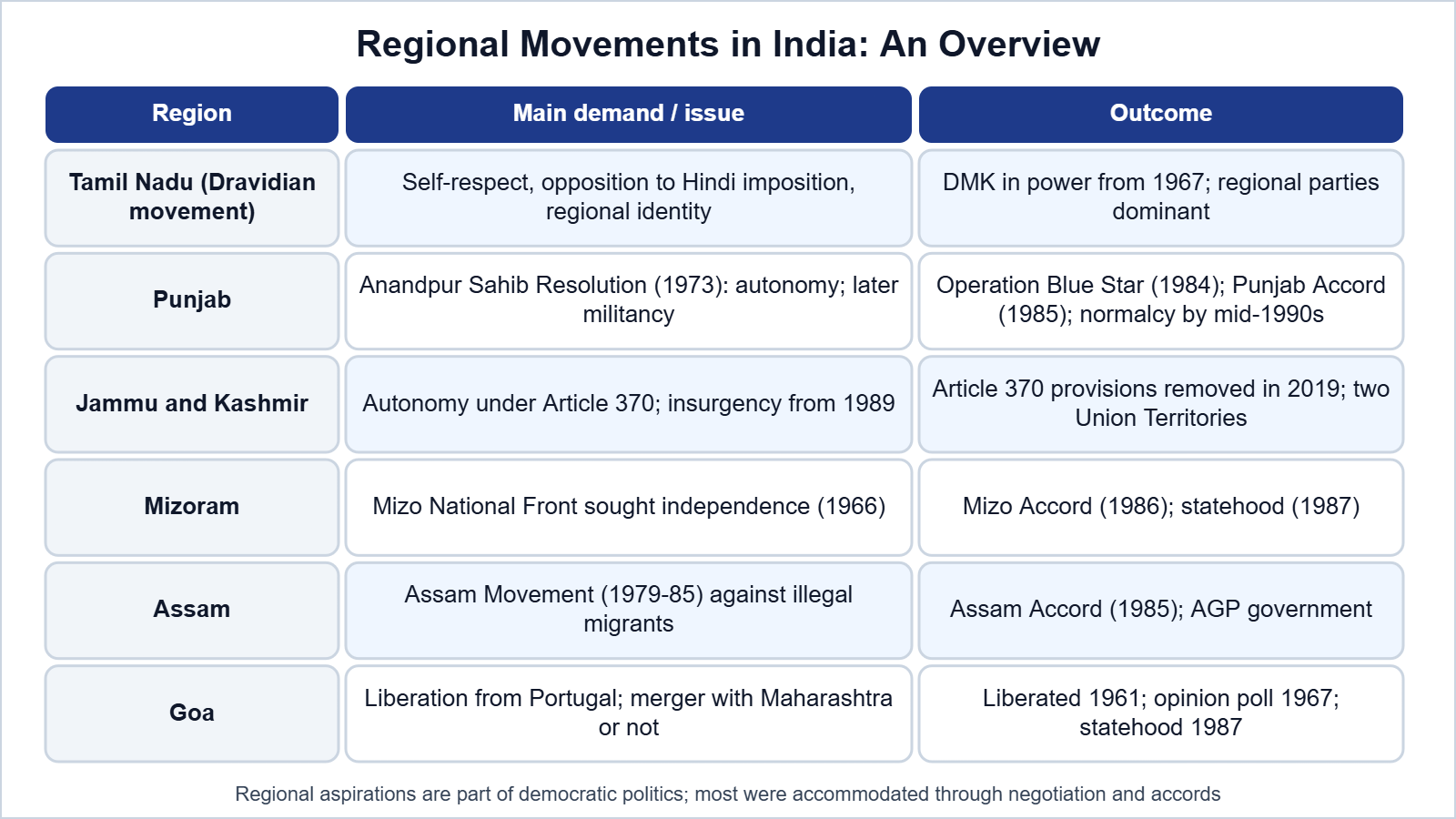
India is a land of many regions with distinct languages, cultures and histories. Regional aspirations – demands for autonomy, recognition of identity, or a fair share in development – have arisen in many parts of the country. India’s approach has been democratic: it treats regional demands as part of democratic politics, uses negotiation and accommodation, and tries to share power with regions through federalism, while refusing to accept secession.
2. Jammu and Kashmir
Jammu and Kashmir has three regions: Jammu, Kashmir and Ladakh. Maharaja Hari Singh signed the Instrument of Accession in October 1947 after an attack from Pakistan. The state was given a special status under Article 370. Sheikh Abdullah of the National Conference led the state; he was dismissed in 1953 and later returned as Chief Minister after an agreement in 1974.
The state assembly election of 1987 was widely believed to have been rigged, causing resentment. From 1989 the state saw insurgency and militancy, supported from across the border; many Kashmiri Pandits were forced to leave the valley. Political processes resumed with elections in 1996 and later. In August 2019, Parliament ended the special provisions of Article 370 and reorganised the state into two Union Territories – Jammu and Kashmir, and Ladakh.
3. Punjab
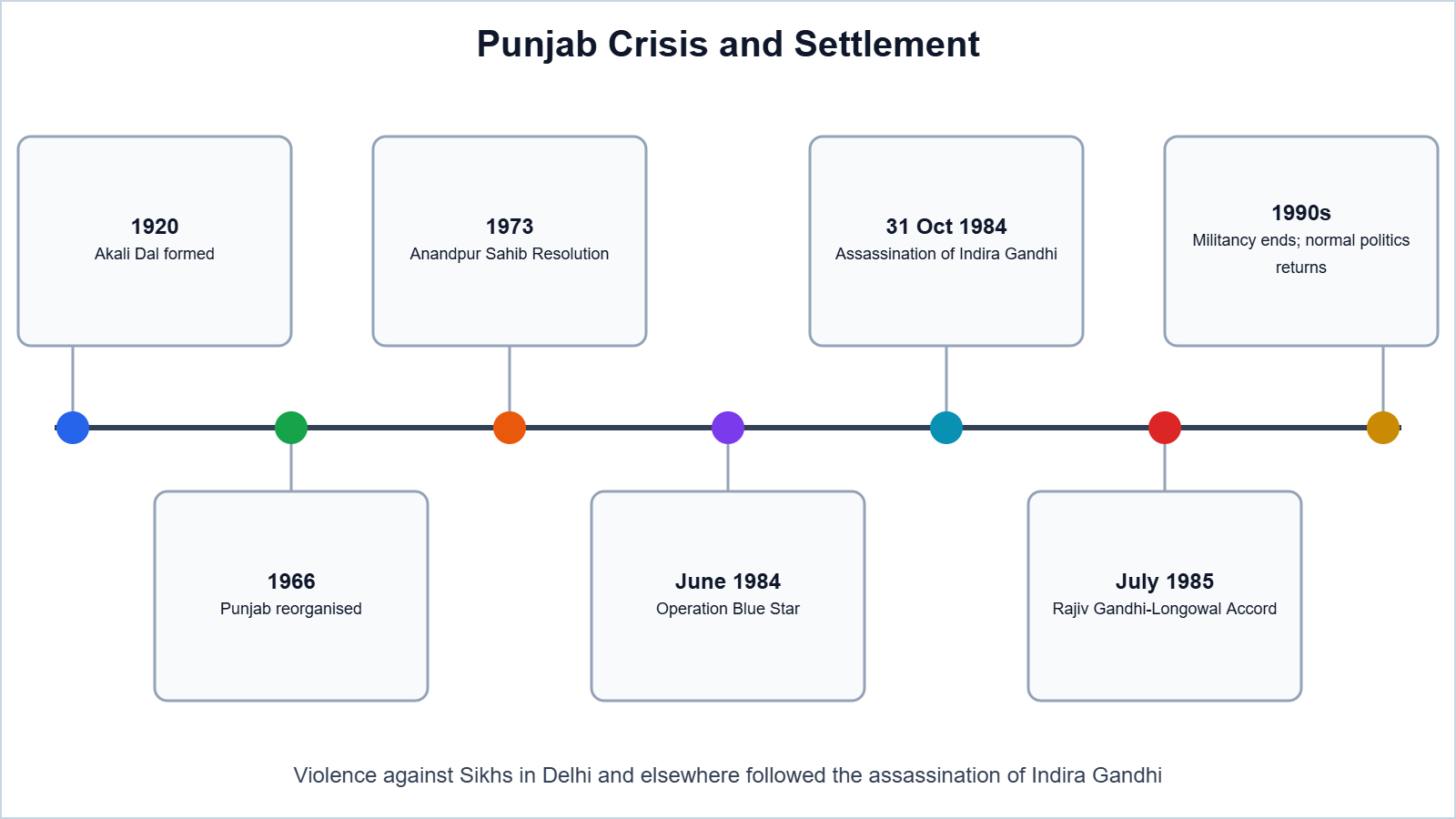
The Akali Dal, formed in 1920, led the movement for a Punjabi-speaking state (Punjabi Suba); Punjab was reorganised in 1966, when Haryana was created and some hill areas went to Himachal Pradesh. In 1973 the Akali Dal passed the Anandpur Sahib Resolution, which asked for greater autonomy for states and asserted the regional identity of the Sikhs; it also referred to the issue of river waters and Chandigarh.
In the early 1980s, a militant section led by Jarnail Singh Bhindranwale made the Golden Temple in Amritsar its headquarters. In June 1984 the army carried out Operation Blue Star to remove the militants, which also damaged the shrine and hurt Sikh sentiments. On 31 October 1984, Prime Minister Indira Gandhi was assassinated by her bodyguards; violence against Sikhs followed in Delhi and other places.
In July 1985, Prime Minister Rajiv Gandhi signed the Punjab Accord with Akali leader Harchand Singh Longowal: Chandigarh would be transferred to Punjab, a commission would settle the boundary with Haryana, a tribunal would decide the sharing of Ravi-Beas waters, and compensation would be given to victims of militancy. Longowal was assassinated in 1985 and violence continued for some years, but by the mid-1990s peace returned and normal politics resumed.
4. The North-East
The north-eastern states have distinct ethnic, cultural and linguistic identities. Three kinds of issues dominate: demands for autonomy, movements for secession and opposition to outsiders. Sikkim became part of India in 1975.
- Autonomy: several new states were carved out of Assam – Nagaland (1963), Meghalaya (1972), and later Mizoram and Arunachal Pradesh (1987). Some groups still seek autonomy under the Sixth Schedule.
- Mizoram: after resentment over the handling of a famine in 1959, the Mizo National Front under Laldenga began an armed struggle for independence in 1966. After two decades, the Mizo Accord was signed in 1986 between Rajiv Gandhi and Laldenga; Mizoram became a state in 1987 and Laldenga became Chief Minister.
- Nagaland: the Naga National Council under A.Z. Phizo demanded independence; a section of Nagas has continued talks with the government.
- Assam Movement (1979-85): led by the All Assam Students’ Union (AASU) against illegal migrants, mainly from Bangladesh. The Assam Accord (1985) provided for the detection and deportation of foreigners; the Asom Gana Parishad (AGP) won the 1985 elections.
5. The Dravidian Movement
The Dravidian movement in Tamil Nadu, led by E.V. Ramasami (Periyar), opposed Brahmin domination and asserted Dravidian identity through the Self-Respect Movement and the Dravidar Kazhagam. The DMK, founded in 1949 by C.N. Annadurai, led the anti-Hindi agitation of 1965 and came to power in 1967. Later the AIADMK was formed (1972). Since 1967, regional parties have ruled Tamil Nadu, showing how regional identity can be expressed within democratic politics.
6. Lessons from Regional Movements
- Regional aspirations are a part of democratic politics and should be addressed through dialogue rather than suppression.
- Power sharing – giving regions a real say in decisions – strengthens national unity.
- Economic imbalances between regions must be reduced.
- The flexibility of the Constitution (special provisions, the Sixth Schedule, new states) has helped accommodate diversity.
Easy Memory Trick: “73 Resolution, 84 Blue Star, 85 Accord” – the Punjab story.
7. Timeline
Year | Event |
|---|---|
1920 | Akali Dal formed |
1949 | DMK founded by C.N. Annadurai |
1961 | Goa liberated |
1963 | Nagaland becomes a state |
1965 | Anti-Hindi agitation in Tamil Nadu |
1966 | Punjab reorganised; MNF begins armed struggle |
1967 | DMK comes to power in Tamil Nadu |
1973 | Anandpur Sahib Resolution |
1975 | Sikkim becomes part of India |
1979-85 | Assam Movement |
June 1984 | Operation Blue Star |
31 Oct 1984 | Assassination of Indira Gandhi |
1985 | Punjab Accord; Assam Accord |
1986 | Mizo Accord |
1987 | Mizoram becomes a state |
1989 | Insurgency begins in Kashmir |
2019 | Article 370 provisions ended; J&K reorganised |
8. Key Terms
Term | Meaning |
|---|---|
Regional aspirations | Demands of regions for identity, autonomy or development |
Anandpur Sahib Resolution | 1973 Akali Dal resolution for state autonomy |
Operation Blue Star | 1984 army action at the Golden Temple, Amritsar |
Punjab Accord | 1985 agreement between Rajiv Gandhi and H.S. Longowal |
Mizo Accord | 1986 agreement ending insurgency in Mizoram |
Assam Accord | 1985 agreement ending the Assam Movement |
Dravidian movement | Movement for Dravidian identity and self-respect in Tamil Nadu |
9. Important Exam Questions
Q1. What was the Anandpur Sahib Resolution? (2 marks)
Ans. The Anandpur Sahib Resolution was passed by the Akali Dal in 1973. It asked for greater autonomy for the states and the strengthening of federalism, and asserted the regional identity of the Sikhs. It also raised issues such as the sharing of river waters and the status of Chandigarh.
Q2. What was Operation Blue Star? (2 marks)
Ans. Operation Blue Star was the army operation carried out in June 1984 to remove militants who had made the Golden Temple in Amritsar their headquarters. The operation succeeded, but it also damaged the holy shrine and deeply hurt the sentiments of the Sikh community.
Q3. What was the Mizo Accord? (2 marks)
Ans. The Mizo Accord was signed in 1986 between Prime Minister Rajiv Gandhi and Laldenga, leader of the Mizo National Front. It ended twenty years of armed insurgency in Mizoram. Mizoram became a full state in 1987, and Laldenga became its Chief Minister.
Q4. Who founded the DMK and when? (2 marks)
Ans. The Dravida Munnetra Kazhagam was founded in 1949 by C.N. Annadurai, a follower of Periyar. It led the anti-Hindi agitation of 1965 and came to power in Tamil Nadu in 1967. Since then Dravidian regional parties have governed the state.
Q5. What were the main provisions of the Punjab Accord of 1985? (3 marks)
Ans. The Punjab Accord was signed in July 1985 between Rajiv Gandhi and the Akali leader Harchand Singh Longowal. It agreed that Chandigarh would be transferred to Punjab and that a separate commission would resolve the boundary dispute between Punjab and Haryana. A tribunal was to decide the sharing of Ravi-Beas waters. It also promised compensation and better treatment for those affected by militancy, and the withdrawal of special powers.
Q6. Explain the main issues that dominate politics in the North-East. (3 marks)
Ans. Three issues dominate politics in the North-East. The first is the demand for autonomy, which led to the creation of new states such as Nagaland, Meghalaya, Mizoram and Arunachal Pradesh out of Assam, and to demands for autonomous councils. The second is movements for secession, as in Mizoram and Nagaland, where groups demanded independence. The third is opposition to outsiders and illegal migrants, as in the Assam Movement of 1979-85 led by students.
Q7. What was the Assam Movement? (3 marks)
Ans. The Assam Movement of 1979-85 was led by the All Assam Students’ Union against illegal migrants, mainly from Bangladesh, who were seen as a threat to the culture and economy of the Assamese people. It demanded the detection and deportation of foreigners. After six years, the Assam Accord was signed in 1985, and the Asom Gana Parishad, formed by the movement’s leaders, won the elections.
Q8. What lessons can be learnt from regional movements in India? (3 marks)
Ans. First, regional aspirations are a normal part of democratic politics, and they should be dealt with through dialogue and negotiation rather than force. Second, sharing power with regions and giving them a real voice in national decisions strengthens unity instead of weakening it. Third, economic imbalances between regions must be reduced. Finally, the flexibility of the Constitution, with special provisions and the creation of new states, has helped accommodate India’s diversity.
Q9. Explain the causes and consequences of the Punjab crisis of the 1980s. (5 marks)
Ans. The Punjab crisis had its roots in political and regional demands. The Akali Dal had led the movement for a Punjabi-speaking state, achieved in 1966, but it wanted more power for the state. In 1973 it passed the Anandpur Sahib Resolution, which asked for greater autonomy, stronger federalism and recognition of Sikh identity, and raised issues of river waters and Chandigarh. In the early 1980s, a militant section led by Bhindranwale turned to violence and made the Golden Temple its headquarters. The consequences were tragic. In June 1984 the army carried out Operation Blue Star, which removed the militants but damaged the shrine and hurt Sikh feelings. On 31 October 1984 Prime Minister Indira Gandhi was assassinated, and violence against Sikhs followed in Delhi and elsewhere. In July 1985 Rajiv Gandhi and Harchand Singh Longowal signed the Punjab Accord to restore peace, but Longowal was assassinated, and militancy and police excesses continued for several years. By the mid-1990s, peace returned, and normal democratic politics resumed in Punjab, showing the value of accommodation.
Q10. Describe the Dravidian movement and its impact on politics in Tamil Nadu. (5 marks)
Ans. The Dravidian movement was one of the earliest regional movements in India. It was led by E.V. Ramasami, popularly called Periyar, who started the Self-Respect Movement. It opposed the domination of Brahmins in social and political life, challenged caste hierarchy and asserted a distinct Dravidian identity, culture and language. Periyar founded the Dravidar Kazhagam. In 1949, his follower C.N. Annadurai founded the Dravida Munnetra Kazhagam, which decided to take part in electoral politics. The DMK took up the cause of the Tamil language and strongly opposed the imposition of Hindi; the anti-Hindi agitation of 1965 made it very popular. In the 1967 elections the DMK came to power in Madras state, which was later renamed Tamil Nadu. In 1972 a split led to the formation of the AIADMK under M.G. Ramachandran. Since 1967, the two Dravidian parties have ruled the state alternately, and national parties have had to ally with them. The movement shows how a regional identity can be expressed and accommodated within the framework of democratic politics without threatening national unity.
10. MCQs and Assertion-Reason
1. The Anandpur Sahib Resolution was passed in
(A) 1966 (B) 1973 (C) 1980 (D) 1984
Ans. (B)
2. Operation Blue Star was carried out in
(A) June 1984 (B) October 1984 (C) July 1985 (D) June 1983
Ans. (A)
3. The Mizo Accord was signed in
(A) 1966 (B) 1986 (C) 1987 (D) 1972
Ans. (B)
4. The DMK came to power in Tamil Nadu in
(A) 1949 (B) 1962 (C) 1967 (D) 1972
Ans. (C)
Options: (A) Both A and R are true and R is the correct explanation of A. (B) Both A and R are true but R is not the correct explanation of A. (C) A is true but R is false. (D) A is false but R is true.
Assertion (A): India has generally dealt with regional demands through negotiation and accommodation.
Reason (R): India’s democratic approach treats regional aspirations as part of politics, while not accepting secession.
Ans. (A)
11. Case Study
Read the passage and answer the questions: A student union in a north-eastern state launched a long agitation, claiming that large numbers of people from a neighbouring country had settled in the state illegally and were changing its population and culture. After six years, an accord was signed with the central government, and the leaders of the movement formed a new party that won the state elections.
(i) Name the movement described.
Ans. The Assam Movement (1979-85).
(ii) Which organisation led it?
Ans. The All Assam Students’ Union (AASU).
(iii) Name the party formed by its leaders.
Ans. The Asom Gana Parishad (AGP).
Conclusion: Regional aspirations in Kashmir, Punjab, the North-East and Tamil Nadu show the diversity of India. Through negotiation, accords and power sharing, Indian democracy has accommodated most of these demands while protecting national unity.