Challenges to and Restoration of the Congress System – Political Science Class 12 Notes
Chapter – 13
Challenges to and Restoration of the Congress System
1. The Challenge of Political Succession
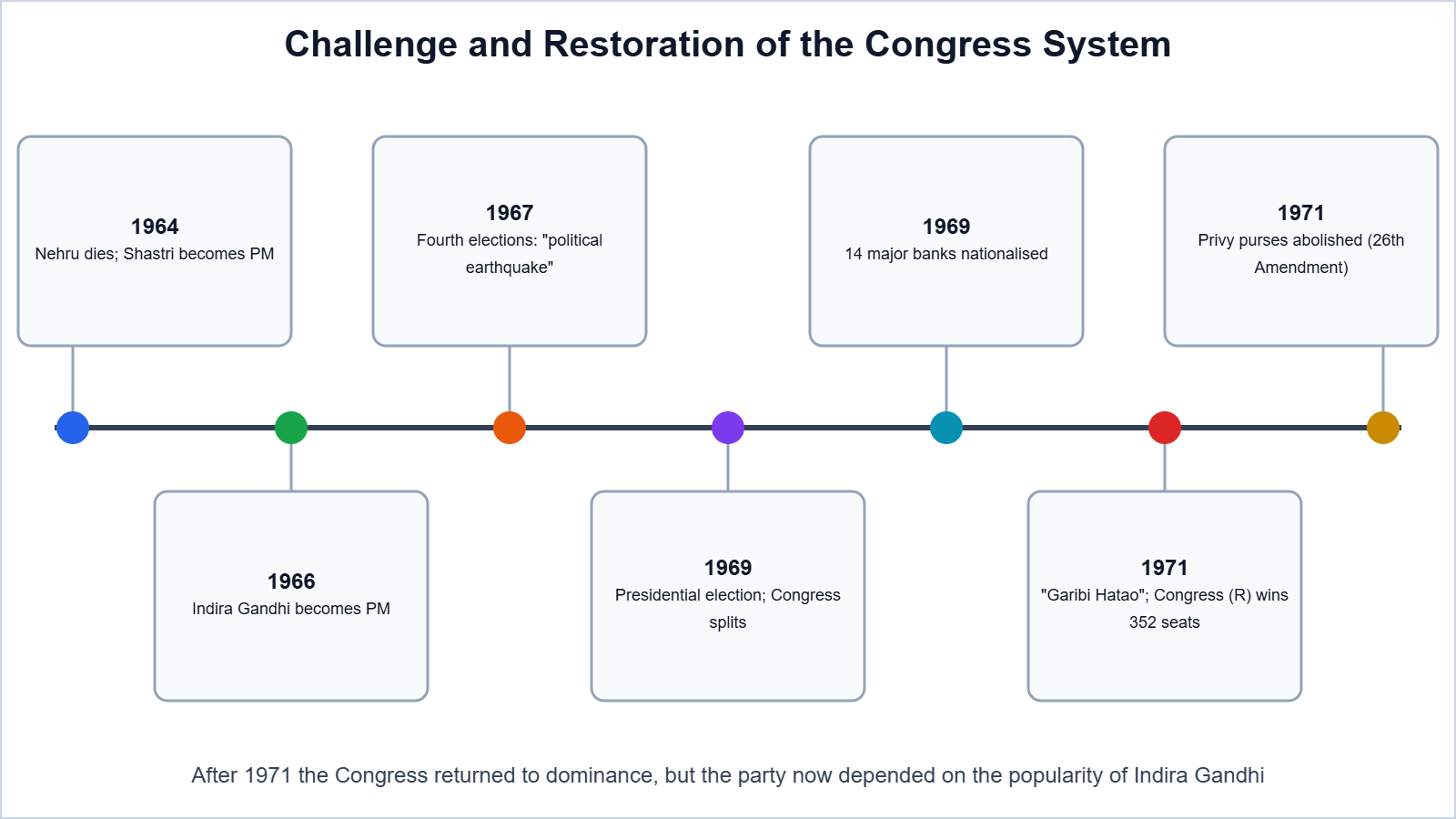
When Nehru died in May 1964, many doubted whether democracy would survive the transition. But the succession was smooth. K. Kamaraj, the Congress President, consulted party leaders, and Lal Bahadur Shastri became Prime Minister. Shastri led India during the 1965 war with Pakistan and gave the slogan “Jai Jawan Jai Kisan”. He died suddenly in Tashkent in January 1966.
After a contest within the Congress parliamentary party, Indira Gandhi defeated Morarji Desai and became Prime Minister in January 1966. Senior leaders, known as the Syndicate, expected her to depend on their advice. The country faced economic difficulties: drought, food shortage, the devaluation of the rupee (1966), price rise and unemployment.
2. The Fourth General Election of 1967
The election of 1967 is called a “political earthquake”. The Congress kept its majority in the Lok Sabha, but with its lowest tally of seats and votes since 1952. Several ministers lost, and the party lost power in many states, where non-Congress coalition governments were formed. In Madras (Tamil Nadu), the DMK came to power on its own after the anti-Hindi agitation.
- Non-Congressism: socialist leader Ram Manohar Lohia argued that Congress rule was undemocratic and against the poor, and urged opposition parties to unite against it.
- Coalitions: the non-Congress governments in states were coalitions of parties with very different ideologies, called Samyukt Vidhayak Dal (SVD).
- Defection: legislators frequently changed parties. The phrase “Aya Ram Gaya Ram” came from Gaya Lal, an MLA in Haryana who changed his party three times within a fortnight in 1967.
3. The Split in the Congress (1969)
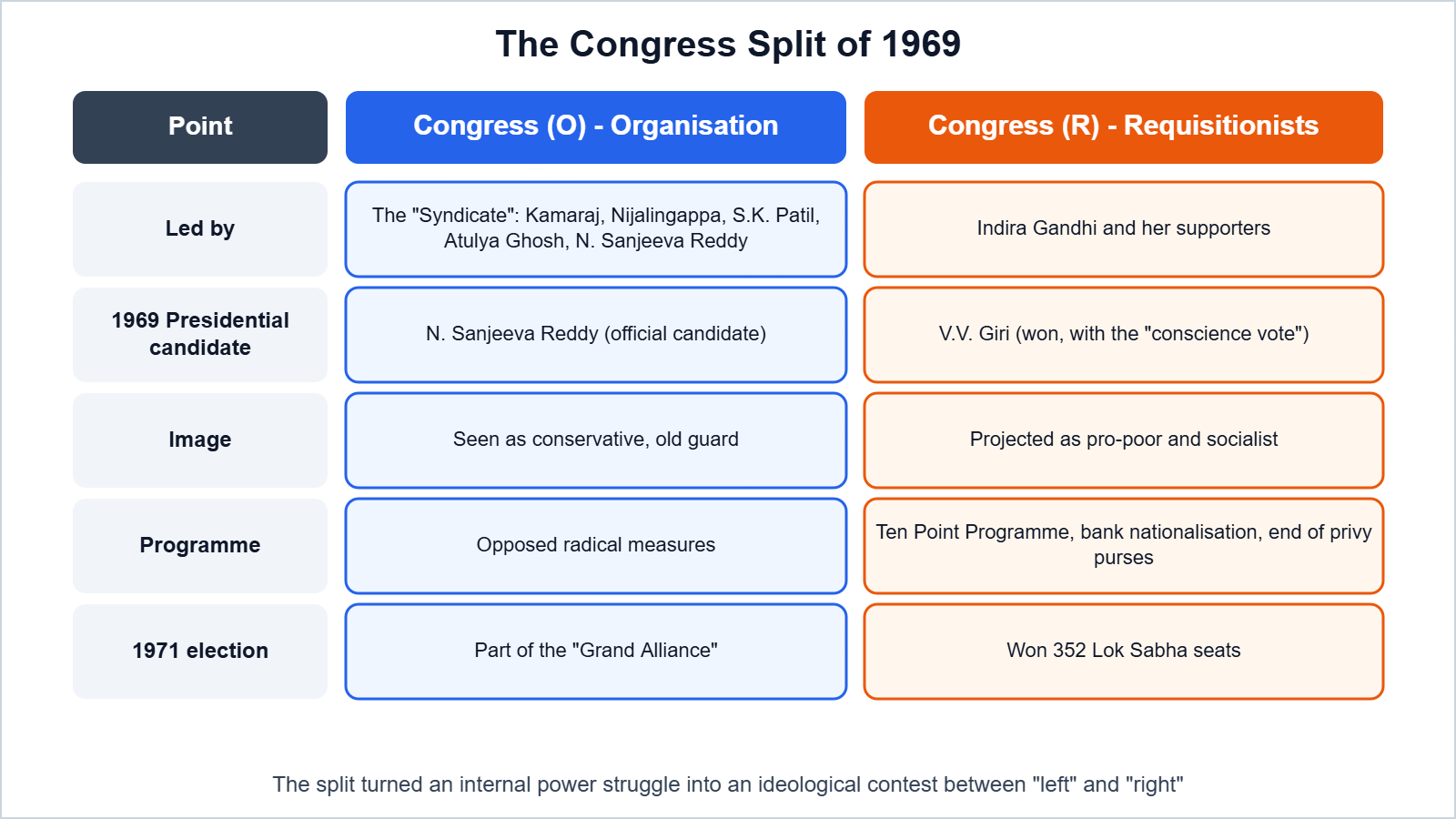
Tension between Indira Gandhi and the Syndicate came to a head in 1969. After President Zakir Hussain’s death, the Syndicate nominated N. Sanjeeva Reddy as the official Congress candidate for President. Indira Gandhi encouraged the Vice-President, V.V. Giri, to stand as an independent and called for a “conscience vote”. Giri won. The Congress split in November 1969 into Congress (O) (Organisation), led by the Syndicate, and Congress (R) (Requisitionists), led by Indira Gandhi.
Indira Gandhi presented the split as an ideological struggle between socialists and conservatives. Her government nationalised 14 major private banks in July 1969 and moved to abolish the privy purses of former rulers. When the Supreme Court struck down a presidential order derecognising the princes, the privy purses were finally abolished by the 26th Constitutional Amendment in 1971.
4. The 1971 Election and Restoration
Indira Gandhi called early Lok Sabha elections in 1971. The opposition formed a “Grand Alliance” of non-communist, non-Congress parties (Congress (O), Jana Sangh, Swatantra Party, SSP and others) with the slogan “Indira Hatao”. Indira Gandhi responded with the slogan “Garibi Hatao” (remove poverty), promising land reform, public sector growth and an end to princely privileges. Congress (R) won 352 seats – a massive victory. After the Bangladesh war of December 1971, the party also won most state assembly elections in 1972.
Restoration of the Congress system? The Congress returned to dominance, but it was a different party: it depended almost entirely on the popularity of one leader, its organisation was weaker, factions could not express themselves freely, and it drew support from the poor, women, Dalits, Adivasis and minorities. This was a new kind of populism.
Easy Memory Trick: “67 shook, 69 split, 71 won”.
5. Timeline
Year | Event |
|---|---|
27 May 1964 | Death of Jawaharlal Nehru |
June 1964 | Lal Bahadur Shastri becomes Prime Minister |
January 1966 | Death of Shastri; Indira Gandhi becomes Prime Minister |
June 1966 | Devaluation of the rupee |
1967 | Fourth general election; non-Congress governments in many states |
July 1969 | Nationalisation of 14 major banks |
August 1969 | V.V. Giri elected President |
November 1969 | Congress splits into Congress (O) and Congress (R) |
March 1971 | Fifth general election; Congress (R) wins 352 seats |
1971 | 26th Amendment abolishes privy purses |
1972 | Congress wins most state assembly elections |
6. Key Terms
Term | Meaning |
|---|---|
Syndicate | Group of powerful senior Congress leaders in the 1960s |
Political earthquake | Term for the dramatic results of the 1967 election |
Non-Congressism | Strategy of uniting opposition parties against the Congress |
SVD | Samyukt Vidhayak Dal: coalition of non-Congress parties in states |
Aya Ram Gaya Ram | Phrase for frequent defections by legislators |
Garibi Hatao | “Remove poverty”: Congress slogan in 1971 |
Grand Alliance | Opposition coalition against Congress (R) in 1971 |
7. Important Exam Questions
Q1. Who were the Syndicate? (2 marks)
Ans. The Syndicate was a group of powerful senior leaders of the Congress organisation in the 1960s, including K. Kamaraj, S. Nijalingappa, S.K. Patil, Atulya Ghosh and N. Sanjeeva Reddy. They played a key role in choosing Prime Ministers and later clashed with Indira Gandhi.
Q2. What is meant by “Aya Ram Gaya Ram”? (2 marks)
Ans. The phrase refers to the frequent changing of parties by legislators for personal gain. It came from Gaya Lal, an MLA in Haryana, who changed his party three times within a fortnight in 1967. Such defections made governments unstable in many states.
Q3. What was non-Congressism? (2 marks)
Ans. Non-Congressism was the strategy, advocated by the socialist leader Ram Manohar Lohia, of bringing together opposition parties with different ideologies against the Congress. He argued that Congress rule was undemocratic and against the interests of the poor, so its monopoly of power had to be ended.
Q4. Why is the 1967 election called a “political earthquake”? (2 marks)
Ans. In 1967 the Congress kept a narrow majority in the Lok Sabha but with its lowest seats and votes since 1952. Many senior leaders lost, and the party lost power in several states to non-Congress coalitions. This sudden decline of a dominant party shocked observers.
Q5. Explain the circumstances of the Congress split in 1969. (3 marks)
Ans. Indira Gandhi and the Syndicate differed over power and policy. In 1969, after the death of President Zakir Hussain, the Syndicate nominated N. Sanjeeva Reddy as the official Congress candidate. Indira Gandhi encouraged V.V. Giri to contest as an independent and asked for a conscience vote. Giri won, the official candidate lost, and the party was divided in November 1969 into Congress (O), led by the Syndicate, and Congress (R), led by Indira Gandhi.
Q6. What was the significance of the slogan “Garibi Hatao”? (3 marks)
Ans. In the 1971 election, the opposition Grand Alliance had a negative slogan, “Indira Hatao”. Indira Gandhi replied with the positive slogan “Garibi Hatao”, meaning remove poverty. It promised land reform, growth of the public sector, an end to privileges of the princes and help for the poor. The slogan built a new social base for the Congress among the poor, landless labourers, Dalits, Adivasis, women and minorities, and it won a huge victory.
Q7. How were the privy purses abolished? (3 marks)
Ans. The privy purse was an annual grant promised to the former rulers of princely states when they merged with India. In 1970 Indira Gandhi’s government issued a presidential order to derecognise the princes, but the Supreme Court struck it down. After the 1971 election victory, Parliament passed the 26th Constitutional Amendment, which ended the privy purses and the special privileges of the princes. This was presented as a step towards equality.
Q8. Mention three changes in Indian politics after the 1967 elections. (3 marks)
Ans. First, the dominance of the Congress was challenged, and non-Congress coalition governments came to power in several states. Second, coalition politics began in the states, as parties with very different ideas joined hands in the Samyukt Vidhayak Dal. Third, defection became common, with legislators changing parties for office, which made governments unstable. Regional parties such as the DMK in Tamil Nadu also gained importance, and politics became more competitive.
Q9. Explain the main factors that led to the victory of the Congress (R) in 1971. (5 marks)
Ans. Several factors explain the huge victory of the Congress led by Indira Gandhi in 1971. First, Indira Gandhi turned the split of 1969 into an ideological contest. She presented herself as the champion of the poor and of socialism against the conservative Syndicate. Second, her government had taken popular radical measures, such as the nationalisation of fourteen major banks in July 1969 and the move to abolish the privy purses of former princes, which gave her a progressive image. Third, she gave the positive slogan Garibi Hatao, remove poverty, while the opposition Grand Alliance had only the negative slogan Indira Hatao and no common programme. Fourth, she built a new social base among the poor, landless labourers, Dalits, Adivasis, women, minorities and the unemployed youth, who saw her as their leader. Fifth, the opposition alliance was a collection of parties with very different ideologies, which made it look opportunistic. Finally, Indira Gandhi’s personal popularity and her direct appeal to voters, bypassing party bosses, proved decisive. Congress (R) won 352 Lok Sabha seats.
Q10. Explain the challenges faced by the Congress system between 1964 and 1967. (5 marks)
Ans. Between 1964 and 1967, the Congress system faced serious challenges. The first was the challenge of succession. Nehru died in May 1964, and although Lal Bahadur Shastri took over smoothly, he died suddenly in January 1966. A contest followed in which Indira Gandhi defeated Morarji Desai, showing that the party was divided. Second, the country faced a grave economic crisis: successive droughts, food shortages, the devaluation of the rupee in 1966, rising prices and unemployment caused widespread discontent, strikes and protests. Third, the new Prime Minister had to establish her authority over the powerful Syndicate, who expected her to follow their advice. Fourth, opposition parties began to unite under the strategy of non-Congressism advocated by Ram Manohar Lohia. These pressures came together in the fourth general election of 1967, the political earthquake, in which the Congress barely kept its majority in the Lok Sabha and lost power in many states to coalition governments. Defections and unstable coalitions followed. These developments showed that the dominance of the Congress could no longer be taken for granted.
8. MCQs and Assertion-Reason
1. Who gave the slogan “Jai Jawan Jai Kisan”?
(A) Jawaharlal Nehru (B) Lal Bahadur Shastri (C) Indira Gandhi (D) Morarji Desai
Ans. (B)
2. V.V. Giri was elected President in
(A) 1967 (B) 1969 (C) 1971 (D) 1974
Ans. (B)
3. How many major banks were nationalised in 1969?
(A) 10 (B) 14 (C) 20 (D) 6
Ans. (B)
4. Privy purses were abolished by the
(A) 24th Amendment (B) 26th Amendment (C) 42nd Amendment (D) 44th Amendment
Ans. (B)
Options: (A) Both A and R are true and R is the correct explanation of A. (B) Both A and R are true but R is not the correct explanation of A. (C) A is true but R is false. (D) A is false but R is true.
Assertion (A): The 1967 election is called a political earthquake.
Reason (R): The Congress lost power in many states and won its lowest tally of seats since 1952.
Ans. (A)
9. Case Study
Read the passage and answer the questions: In a state assembly, a legislator left his party to join a rival group, then returned, and then left again, all within two weeks. Governments formed by alliances of parties with very different ideas collapsed one after another. A senior leader joked that legislators had become like people who “come and go”.
(i) Which phrase became popular to describe such behaviour?
Ans. “Aya Ram Gaya Ram”.
(ii) In which year and state did this episode occur?
Ans. 1967, in Haryana.
(iii) What were such coalition governments called?
Ans. Samyukt Vidhayak Dal (SVD) governments.
Conclusion: Between 1964 and 1971, the Congress faced succession struggles, an economic crisis, the 1967 setback and the 1969 split. Indira Gandhi restored its dominance in 1971 through radical policies and the slogan Garibi Hatao, but the restored Congress depended mainly on her personal popularity.