International Organisations – Political Science Class 12 Notes
Chapter – 5
International Organisations
1. Why Do We Need International Organisations?
International organisations help countries cooperate on issues of war and peace, development, health, environment and human rights. They provide a forum for discussion, help settle disputes peacefully, gather information and give technical help. No country, however powerful, can solve global problems alone.
2. The United Nations
The United Nations was founded on 24 October 1945, after the Second World War, as the successor to the League of Nations. The UN Charter was signed by 51 states; today the UN has 193 members. Its headquarters is in New York. Its aims are to prevent war, promote international cooperation, protect human rights and promote social and economic development.
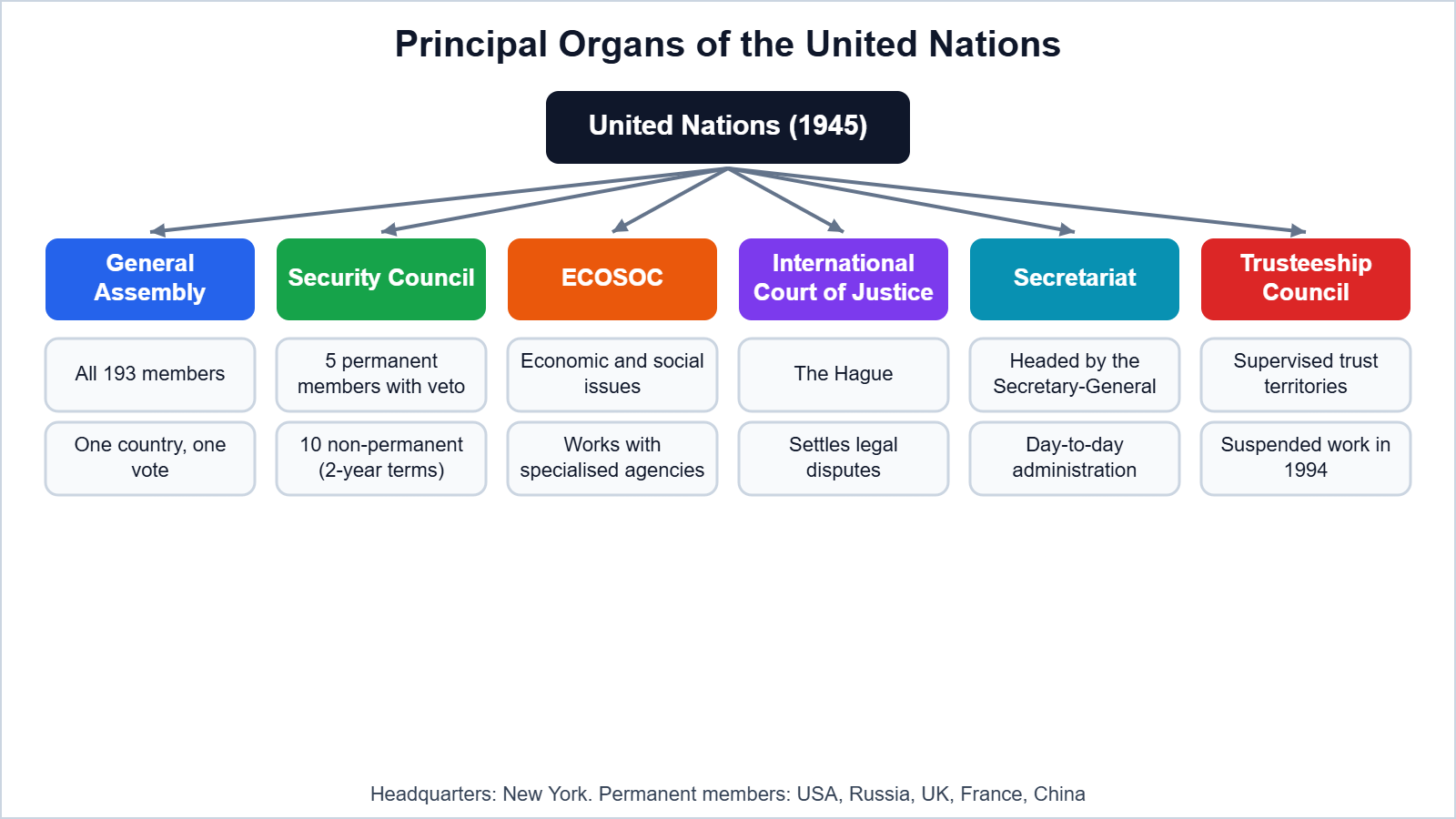
The Security Council has 15 members: 5 permanent members (USA, Russia, UK, France, China) and 10 non-permanent members elected by the General Assembly for two-year terms. Each permanent member has a veto – it can block any substantive decision. The head of the UN is the Secretary-General; António Guterres of Portugal has held the post since 2017.
Remember: 24 October is celebrated as United Nations Day. The International Court of Justice is the only principal organ not located in New York; it sits at The Hague (Netherlands).
3. Reform of the United Nations
Since 1945 the world has changed: the number of members has grown greatly, the Cold War has ended, and new powers such as India have risen, but the Security Council still reflects the power structure of 1945. Reforms are demanded in two areas: structures and processes (especially the Security Council) and issues the UN should deal with (terrorism, climate change, development, peace-building).
In 1992 the General Assembly adopted a resolution on reform. Suggested criteria for new permanent members include: a major economic and military power, a large contributor to the UN budget and peacekeeping, a big nation in terms of population, respect for democracy and human rights, and representation of geography, economic systems and cultures. The veto is criticised as undemocratic, but the permanent members are unwilling to give it up.
4. India and the UN
- India is a founding member and has been elected a non-permanent member of the Security Council several times.
- India is one of the largest contributors of troops to UN peacekeeping missions.
- India argues that the Security Council should be expanded and made more representative, and claims a permanent seat as the largest democracy, with a large population and economy, and a long record of support for the UN.
- Some countries, especially Pakistan, oppose India’s claim; others worry about adding more veto powers.
5. Other International Organisations
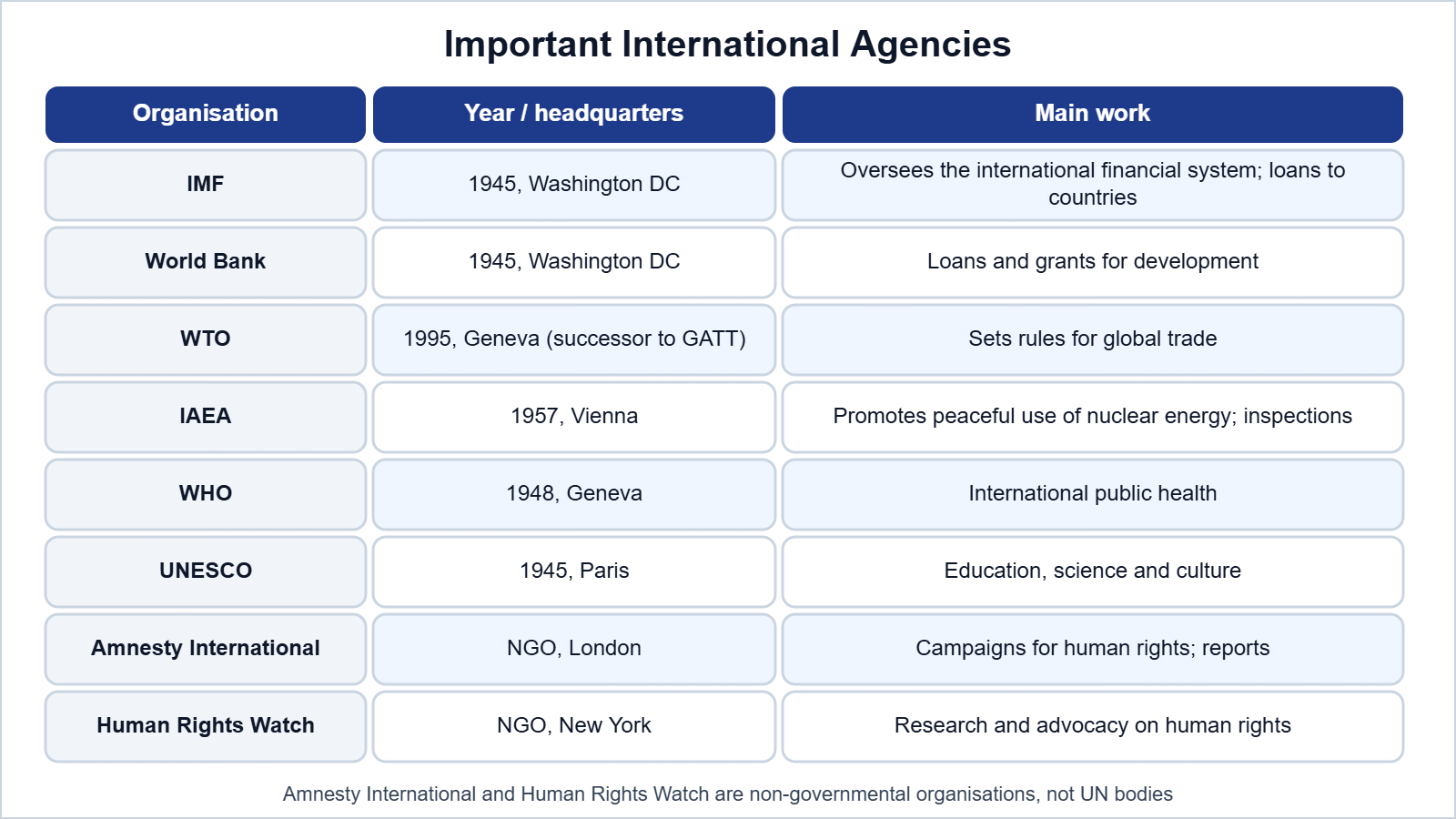
The IMF oversees the international financial system and lends to countries facing balance of payments problems; voting is weighted by contribution, so rich countries have more say. The World Bank gives loans and grants for human development, agriculture, infrastructure and the environment. The WTO (1995) sets rules for global trade and is criticised for favouring developed countries. The IAEA (1957) promotes peaceful use of nuclear energy and inspects nuclear facilities. The WHO (1948, Geneva) leads international public health work.
Non-governmental organisations such as Amnesty International and Human Rights Watch collect and publish information on human rights abuses and campaign for their protection.
6. The UN in a Unipolar World
After the Cold War, many feared that the UN would be dominated by the USA, the only superpower and the largest contributor to its budget. Yet the UN remains the only forum where all countries can discuss global issues together, and it can sometimes restrain powerful states by bringing world opinion to bear on them.
Easy Memory Trick: Permanent members “CRUFU” – China, Russia, UK, France, USA.
7. Timeline
Year | Event |
|---|---|
1919 | League of Nations formed |
1945 | UN Charter signed by 51 states; UN founded on 24 October |
1945 | IMF and World Bank established |
1948 | WHO set up; Universal Declaration of Human Rights |
1957 | IAEA established |
1992 | General Assembly resolution on UN reform |
1994 | Trusteeship Council suspends operations |
1995 | WTO replaces GATT |
2011 | South Sudan becomes the 193rd member |
2017 | António Guterres becomes Secretary-General |
8. Key Terms
Term | Meaning |
|---|---|
Veto | Power of a permanent member to block a Security Council decision |
Permanent members | USA, Russia, UK, France and China |
Secretary-General | Chief administrative officer of the UN |
IMF | International Monetary Fund |
WTO | World Trade Organisation (1995) |
IAEA | International Atomic Energy Agency (1957) |
NGO | Non-governmental organisation |
9. Important Exam Questions
Q1. When was the United Nations founded and what are its aims? (2 marks)
Ans. The United Nations was founded on 24 October 1945, after the Second World War. Its aims are to prevent war and maintain peace, to develop friendly relations among nations, to promote economic and social development, and to protect human rights through cooperation among its member countries.
Q2. What is the veto power? (2 marks)
Ans. The veto is the power of each of the five permanent members of the Security Council to block any substantive resolution, even if all other members support it. The permanent members are the USA, Russia, the UK, France and China. It is often criticised as undemocratic.
Q3. What is the role of the IAEA? (2 marks)
Ans. The International Atomic Energy Agency was set up in 1957 with its headquarters in Vienna. It promotes the peaceful use of nuclear energy and tries to prevent its use for military purposes. Its inspectors regularly visit nuclear facilities around the world to check that they are used safely.
Q4. Name the headquarters of the WHO and state its main function. (2 marks)
Ans. The World Health Organisation has its headquarters at Geneva in Switzerland. Set up in 1948, it directs and coordinates international public health work, supports countries in fighting diseases, sets health standards and guides responses to global health emergencies such as epidemics.
Q5. Describe the composition of the UN Security Council. (3 marks)
Ans. The Security Council has fifteen members. Five are permanent members: the United States, Russia, the United Kingdom, France and China, each of which has the power of veto. The other ten are non-permanent members elected by the General Assembly for terms of two years, chosen so that different regions of the world are represented. The Council has the main responsibility for maintaining international peace and security and its decisions are binding.
Q6. Why is the reform of the UN Security Council needed? (3 marks)
Ans. The Security Council reflects the power structure of 1945, when the UN had only fifty-one members. Since then membership has grown to 193, many Asian and African countries have become independent, and new powers such as India, Brazil and Germany have risen. Yet the permanent members and the veto remain unchanged. Many countries feel that the Council is unrepresentative and undemocratic, and that its legitimacy would improve if it were expanded to include developing countries.
Q7. What is the role of the World Trade Organisation? (3 marks)
Ans. The World Trade Organisation was set up in 1995 as the successor to the General Agreement on Trade and Tariffs. It sets rules for global trade and provides a forum for negotiations to reduce trade barriers among its members. It also settles trade disputes between countries. However, it is criticised because major economies such as the USA and the EU are believed to have a stronger influence over its rules than developing countries.
Q8. How do Amnesty International and Human Rights Watch work? (3 marks)
Ans. Amnesty International is a non-governmental organisation that campaigns for the protection of human rights everywhere. It prepares and publishes reports on human rights violations and uses them to put pressure on governments. Human Rights Watch, another NGO with headquarters in New York, carries out research and advocacy on human rights. Both organisations draw international attention to abuses, help victims, and influence governments and the UN through the information they collect.
Q9. Explain India’s claim to a permanent seat in the UN Security Council. (5 marks)
Ans. India has several strong grounds for its claim to permanent membership of the Security Council. First, it is the most populous country in the world and its largest democracy, so a Council without India cannot be called fully representative. Second, India is one of the fastest-growing major economies, with growing influence in world trade and finance. Third, India has made very large contributions to UN peacekeeping operations, sending troops to many missions over several decades, and it has also contributed to the UN budget. Fourth, India has been elected a non-permanent member of the Council several times and has played an active role in the UN since its founding, supporting decolonisation, disarmament and development. Fifth, India has a record of respect for democracy and human rights, and it represents the developing world. However, there are obstacles. Some countries, especially Pakistan, oppose India’s claim, and others are concerned about its nuclear weapons or about adding more veto powers. Many states also want reform to include Africa and Latin America. India continues to press its case along with other countries seeking reform.
Q10. Explain the main criteria suggested for new permanent members of the Security Council and the debate over the veto. (5 marks)
Ans. Several criteria have been proposed for choosing new permanent members of the Security Council. A new member should be a major economic power and a major military power. It should be a substantial contributor to the UN budget and to peacekeeping operations. It should be a large nation in terms of population, and it should respect democracy and human rights. The new members should also make the Council more representative of the world in terms of geography, economic systems and cultures. The veto is even more controversial. Many countries believe it is undemocratic, since a single permanent member can block a decision supported by all others, and that it allows great powers to protect themselves and their allies. Some propose abolishing or limiting it. However, the permanent members are unwilling to give it up, and some argue that without the veto they might lose interest in the UN. Any change to the veto requires amending the Charter, which the permanent members can themselves block.
10. MCQs and Assertion-Reason
1. The UN was founded on
(A) 24 October 1945 (B) 26 June 1945 (C) 10 December 1948 (D) 1 January 1942
Ans. (A)
2. Which is NOT a permanent member of the Security Council?
(A) France (B) China (C) Germany (D) Russia
Ans. (C)
3. The headquarters of the WHO is at
(A) New York (B) Geneva (C) Paris (D) Vienna
Ans. (B)
4. The WTO came into existence in
(A) 1945 (B) 1948 (C) 1995 (D) 2001
Ans. (C)
Options: (A) Both A and R are true and R is the correct explanation of A. (B) Both A and R are true but R is not the correct explanation of A. (C) A is true but R is false. (D) A is false but R is true.
Assertion (A): The Security Council is criticised as unrepresentative.
Reason (R): Its permanent membership still reflects the power structure of 1945.
Ans. (A)
11. Case Study
Read the passage and answer the questions: A powerful country wants the Security Council to approve military action against another state. Fourteen members vote in favour, but one permanent member votes against the resolution, and it is not passed. Some countries then argue that the rules of the Council should be changed.
(i) What power did the permanent member use?
Ans. The veto.
(ii) How many permanent members does the Security Council have?
Ans. Five.
(iii) Why do some countries want to change the rules?
Ans. They feel the veto is undemocratic, as one member can block the will of all others.
Conclusion: International organisations, especially the UN, help countries cooperate for peace, development, health and human rights. Their structures, especially the Security Council and the veto, need reform to reflect today’s world, and India seeks a larger role, including a permanent seat.