Politics of Planned Development – Political Science Class 12 Notes
Chapter – 11
Politics of Planned Development
1. Political Contestation over Development
After Independence, India had to decide how to develop – whether through the market or through the state, by industry or agriculture, and how fast. These choices involved political debates because different groups would gain or lose. Development also involved difficult decisions such as the use of mineral resources and forests, and the displacement of people for dams and industries.
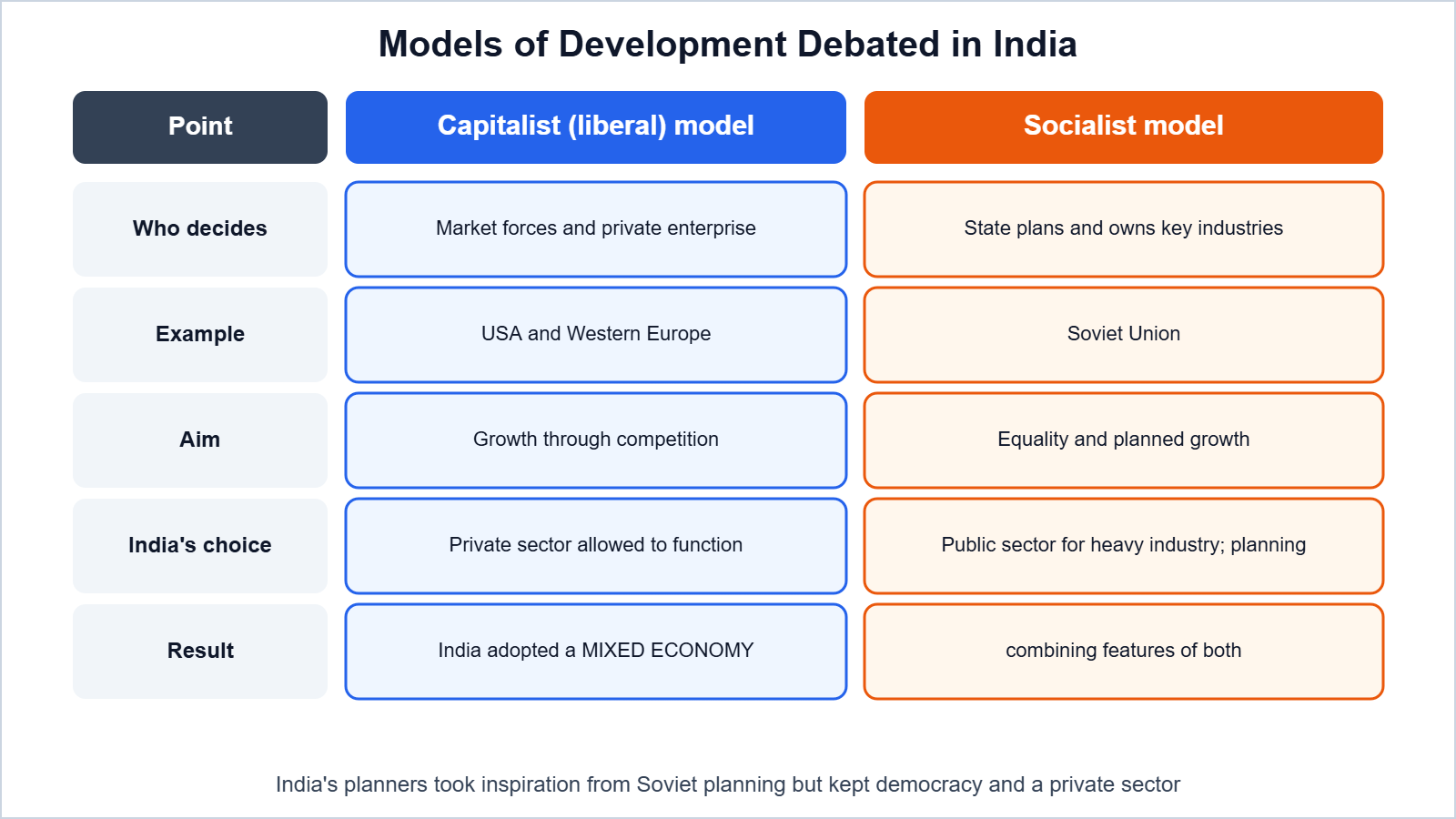
There was a consensus that development must mean economic growth with social and economic justice, and that the government must play an important role. Many leaders were inspired by the Soviet model of planning, which had achieved rapid industrialisation, but India wanted to keep democracy. India therefore chose a mixed economy, in which both the public and private sectors exist. Even industrialists had proposed planning in the Bombay Plan (1944).
2. The Planning Commission
The Planning Commission was set up in March 1950 by a simple resolution of the Government of India, with the Prime Minister as its chairperson. It prepared Five Year Plans, allocating resources for different sectors. The National Development Council (NDC), consisting of the Prime Minister and Chief Ministers, approved the plans.
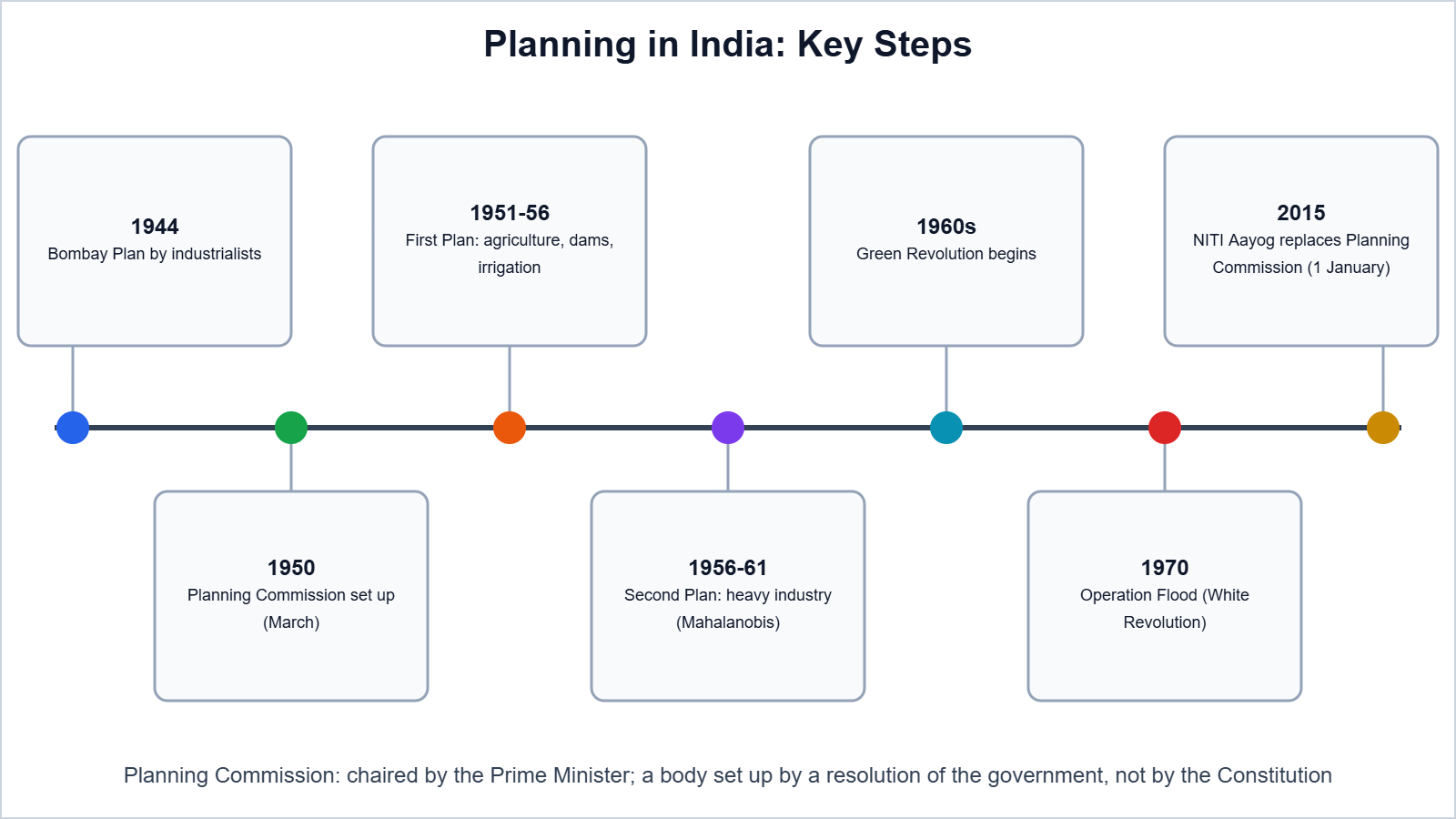
Plan | Main focus |
|---|---|
First Plan (1951-56) | Agriculture: dams and irrigation (such as Bhakra Nangal), land reform; drafted with economist K.N. Raj; aimed to get the country out of the cycle of poverty |
Second Plan (1956-61) | Rapid industrialisation and heavy industry, under the leadership of P.C. Mahalanobis; public sector expansion; protection of domestic industry |
Third Plan (1961-66) | Similar to the second; self-reliance |
Remember: In 2015 the Planning Commission was replaced by NITI Aayog (National Institution for Transforming India), set up on 1 January 2015, which acts as a think tank rather than allocating funds.
3. Key Controversies
- Agriculture versus industry: critics such as J.C. Kumarappa said the Second Plan neglected agriculture and villages; others argued that industry was needed to raise incomes and that agriculture had received attention through land reform and community development.
- Public versus private sector: some felt the private sector was not given enough freedom; others felt the public sector did not do enough for the poor and became a source of bureaucracy and corruption.
- Decentralised planning: Gandhian economists favoured village-based development and small industries.
4. Outcomes of Early Planning
- Foundations were laid for future growth: large dams, steel plants, heavy industries, transport and communication.
- Land reforms abolished the zamindari system, though land ceiling laws were not implemented well.
- The Green Revolution (from the mid-1960s) increased food production through high-yielding seeds, fertilisers and irrigation, mainly in Punjab, Haryana and western Uttar Pradesh, but increased regional and class inequality and led to the rise of a middle peasantry.
- The White Revolution: Operation Flood (1970), led by Verghese Kurien of the Amul cooperative at Anand (Gujarat), made India a leading milk producer through dairy cooperatives.
5. The Kerala Model
Kerala followed a path of development that emphasised education, health, land reform, effective food distribution and poverty alleviation, even though its per capita income was not high. It also tried decentralised planning through the People’s Plan Campaign, in which panchayats drew up local plans. The result was high literacy, long life expectancy and low infant mortality – a model admired for human development.
6. Later Shifts
From the late 1960s the state took a bigger role (bank nationalisation, 1969), but by the 1980s growth was seen as slow. In 1991 India adopted the New Economic Policy of liberalisation, reducing the role of planning and the state.
Easy Memory Trick: “First Farm, Second Steel” – the First Plan focused on agriculture, the Second on heavy industry.
7. Timeline
Year | Event |
|---|---|
1944 | Bombay Plan |
March 1950 | Planning Commission set up |
1951-56 | First Five Year Plan |
1952 | National Development Council formed |
1956-61 | Second Five Year Plan (Mahalanobis) |
Mid-1960s | Green Revolution begins |
1969 | Nationalisation of 14 major banks |
1970 | Operation Flood launched |
1991 | New Economic Policy |
1 January 2015 | NITI Aayog replaces the Planning Commission |
8. Key Terms
Term | Meaning |
|---|---|
Planning | Deliberate allocation of resources to achieve development goals |
Mixed economy | Economy with both public and private sectors |
Five Year Plan | Document setting targets and spending for five years |
Green Revolution | Rise in food output using high-yielding seeds, fertiliser and irrigation |
Operation Flood | Dairy cooperative programme that created the White Revolution |
Kerala model | Development focused on education, health and land reform |
NITI Aayog | Think tank that replaced the Planning Commission (2015) |
9. Important Exam Questions
Q1. When was the Planning Commission set up and who was its chairperson? (2 marks)
Ans. The Planning Commission was set up in March 1950 by a simple resolution of the Government of India. It was not created by the Constitution. The Prime Minister was its chairperson, and it prepared the Five Year Plans that guided India’s economic development.
Q2. What was the Bombay Plan? (2 marks)
Ans. The Bombay Plan was a proposal made in 1944 by a group of leading industrialists. It suggested that the government should take major steps in industrial and other economic investments after Independence. It showed that even the business class supported planned development.
Q3. What was the main focus of the Second Five Year Plan? (2 marks)
Ans. The Second Five Year Plan of 1956-61, prepared under the leadership of P.C. Mahalanobis, stressed rapid industrialisation, especially heavy industry, through a large public sector. Domestic industry was protected against foreign competition. Critics felt that it neglected agriculture and rural development.
Q4. What is NITI Aayog? (2 marks)
Ans. NITI Aayog, or the National Institution for Transforming India, was set up on 1 January 2015 to replace the Planning Commission. It works as a think tank of the government, providing policy advice and promoting cooperative federalism, rather than allocating funds to states.
Q5. Why did India adopt a mixed economy? (3 marks)
Ans. Indian leaders wanted rapid growth with social justice. They admired the success of Soviet planning in building heavy industry quickly, but they did not want to give up democracy and individual freedom. They also saw the strengths of private enterprise. So India chose a mixed economy, in which the state owned and planned key sectors such as heavy industry and infrastructure, while the private sector was allowed to operate in other areas under regulation.
Q6. What were the main features of the First Five Year Plan? (3 marks)
Ans. The First Five Year Plan, for 1951-56, aimed to get the country out of the cycle of poverty. It focused on agriculture, investing in dams and irrigation such as the Bhakra Nangal project, and on land reforms to distribute land more fairly. It was drafted with the help of the economist K.N. Raj, who argued that India should move slowly for the first two decades because fast growth might hurt democracy.
Q7. What is the Kerala model of development? (3 marks)
Ans. The Kerala model is the path of development followed by Kerala, which concentrated on education, health, land reform, effective food distribution and poverty alleviation rather than only on industrial growth. Although its per capita income was not high, Kerala achieved high literacy, long life expectancy and low infant mortality. It also tried decentralised planning through the People’s Plan Campaign, in which panchayats prepared local development plans.
Q8. What were the effects of the Green Revolution? (3 marks)
Ans. The Green Revolution, from the mid-1960s, used high-yielding seeds, fertilisers, pesticides and irrigation to raise food production, especially wheat and rice, so India became self-sufficient in food grains. However, its benefits were concentrated in regions such as Punjab, Haryana and western Uttar Pradesh and among richer farmers. It increased regional and class inequality, led to the rise of a politically strong middle peasantry, and later caused environmental problems.
Q9. Explain the main debates over the strategy of planned development in India. (5 marks)
Ans. India’s planned development involved several debates. The first was about agriculture versus industry. The Second Five Year Plan gave priority to heavy industry, and critics such as J.C. Kumarappa argued that it neglected agriculture and the villages, where most people lived, and favoured a Gandhian model of village-based development. Others replied that without industry, agriculture could not be modernised, and that agriculture had been supported through land reforms and community development. The second debate was about the public versus the private sector. India adopted a mixed economy, but critics on one side said that the private sector was given too little space and that the public sector was inefficient, bureaucratic and corrupt. Critics on the other side said the state did not do enough for the poor and allowed the rich to benefit from protection. A third debate concerned centralised versus decentralised planning, with some favouring planning by local bodies, as later tried in Kerala. These debates shaped the political contest over development and continued until the economic reforms of 1991.
Q10. Describe the outcomes of the early phase of planned development. (5 marks)
Ans. The early phase of planning laid the foundations of India’s future growth. Large dams, irrigation projects such as Bhakra Nangal, steel plants, heavy industries, power stations and transport networks were built, many of them in the public sector. Land reforms abolished the zamindari system, ending the power of a class of big landlords, although land ceiling laws were poorly implemented and consolidation of holdings was uneven. In the mid-1960s, the Green Revolution greatly increased the production of food grains through high-yielding seeds, fertilisers and irrigation, ending India’s dependence on food imports. However, it benefited mainly richer farmers and a few regions, increasing inequality and creating a powerful middle peasantry. The White Revolution through Operation Flood, launched in 1970 and led by Verghese Kurien, built a network of dairy cooperatives and made India a leading milk producer. On the negative side, planning created a large bureaucracy and the licence system, growth remained slow, and poverty and unemployment continued. These problems led to more state control in the late 1960s and finally to the economic reforms of 1991.
10. MCQs and Assertion-Reason
1. The Planning Commission was set up in
(A) 1947 (B) 1950 (C) 1951 (D) 1956
Ans. (B)
2. Who is associated with the Second Five Year Plan?
(A) K.N. Raj (B) P.C. Mahalanobis (C) J.C. Kumarappa (D) Verghese Kurien
Ans. (B)
3. India borrowed the idea of planning mainly from
(A) the USA (B) the Soviet Union (C) the UK (D) Japan
Ans. (B)
4. NITI Aayog was set up on
(A) 1 January 2014 (B) 1 January 2015 (C) 15 August 2015 (D) 26 January 2016
Ans. (B)
Options: (A) Both A and R are true and R is the correct explanation of A. (B) Both A and R are true but R is not the correct explanation of A. (C) A is true but R is false. (D) A is false but R is true.
Assertion (A): The Green Revolution increased regional inequalities.
Reason (R): Its benefits were concentrated in regions with irrigation and among richer farmers.
Ans. (A)
11. Case Study
Read the passage and answer the questions: A state with modest income levels decided to spend heavily on schools, health centres and a public food distribution system. It also carried out land reforms and asked village councils to prepare their own development plans. Decades later, it had one of the highest literacy rates and longest life expectancies in the country.
(i) Which model of development is described?
Ans. The Kerala model.
(ii) What was the campaign of local planning called?
Ans. The People’s Plan Campaign.
(iii) Give one achievement of this model.
Ans. High literacy (or long life expectancy, low infant mortality).
Conclusion: India chose planned development within a democracy and a mixed economy. The Five Year Plans built industry and infrastructure, while debates over agriculture, industry and the role of the state shaped politics. Planning gave way to liberalisation in 1991 and to NITI Aayog in 2015.