Contemporary Centres of Power – Political Science Class 12 Notes
Chapter – 3
Contemporary Centres of Power
1. Alternative Centres of Power
After the end of the Cold War, regional organisations and fast-growing economies emerged as alternative centres of power that could limit the dominance of the USA. The most important are the European Union, the Association of South East Asian Nations (ASEAN), and the rising economies of China, Japan and South Korea.
2. The European Union (EU)
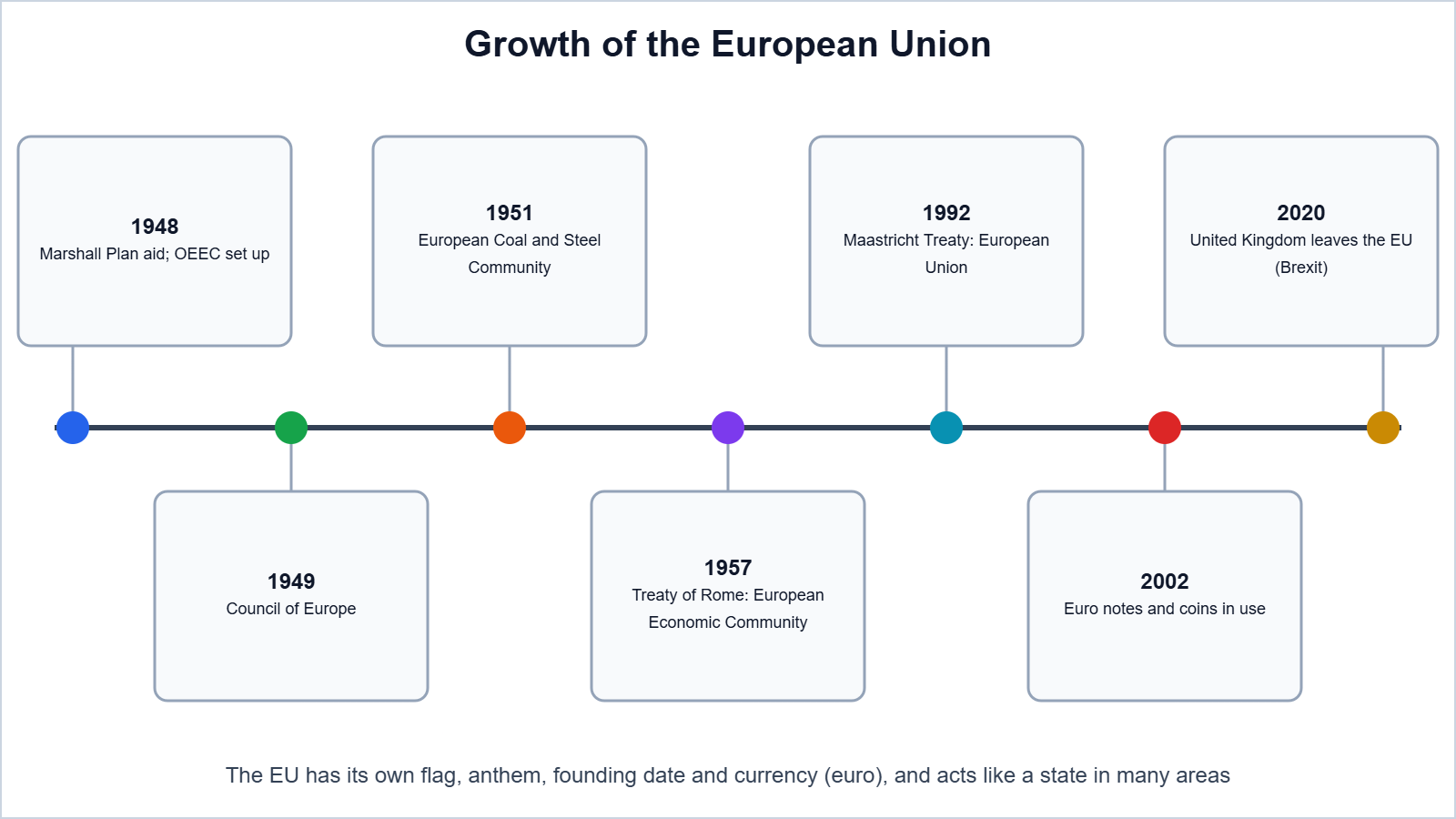
After the Second World War, European leaders wanted to rebuild their economies and avoid future wars. The USA helped through the Marshall Plan, and NATO provided collective security. Economic cooperation grew step by step: the European Coal and Steel Community (1951), the European Economic Community (1957) and finally the European Union, established by the Maastricht Treaty (1992).
- Economic influence: one of the largest economies in the world; its currency, the euro, is a strong international currency.
- Political and diplomatic influence: France is a permanent member of the UN Security Council, and several EU members are non-permanent members from time to time; the EU uses diplomacy and dialogue, as with China and Iran.
- Military influence: its members together have large armed forces; France is a nuclear power.
- Supranational features: a common flag, anthem, currency for many members, and common foreign and security policies in many areas.
Remember: The United Kingdom left the EU on 31 January 2020 (Brexit). Some members, such as Denmark and Sweden, did not adopt the euro.
3. ASEAN
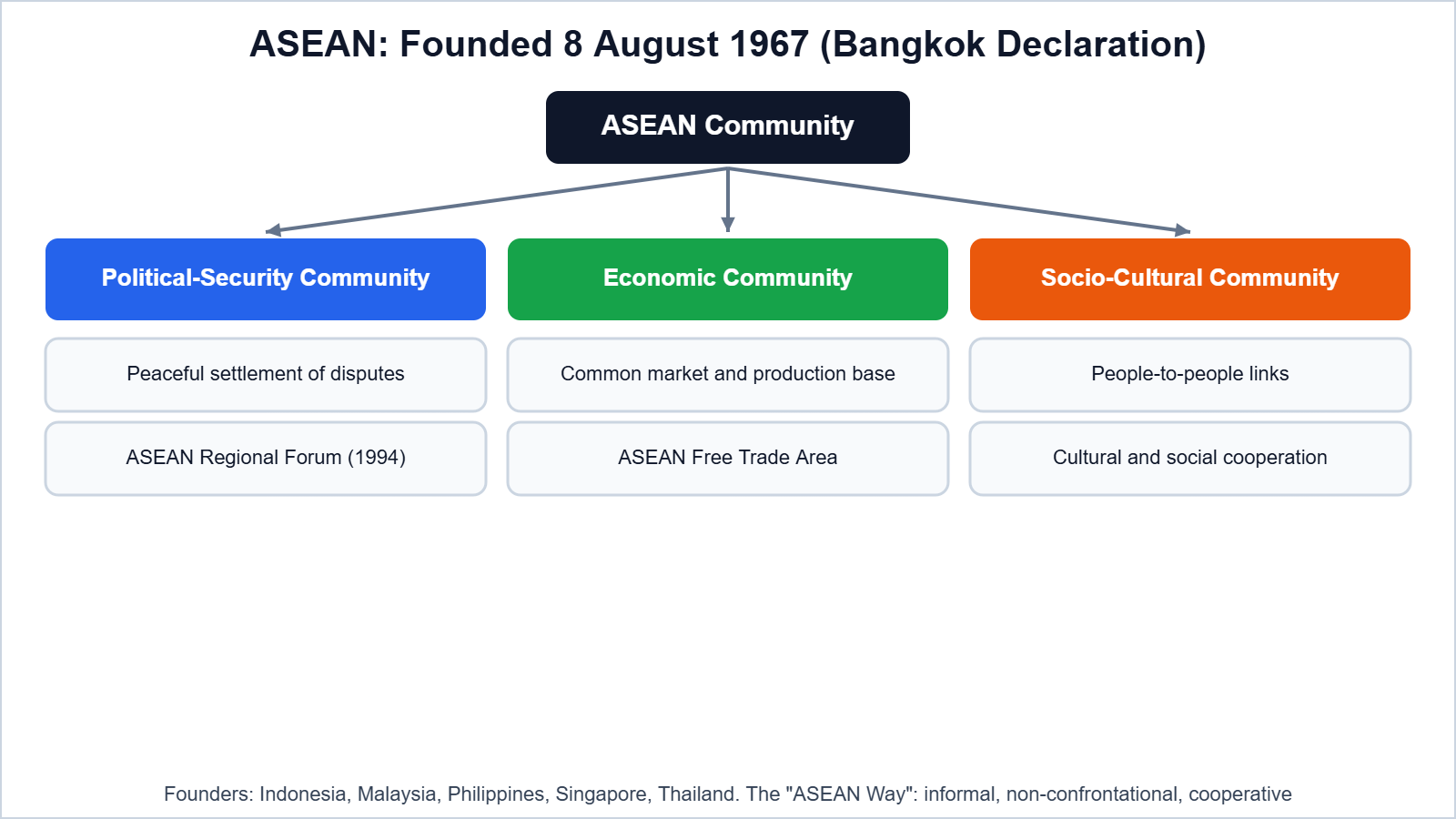
ASEAN was set up on 8 August 1967 by the Bangkok Declaration, signed by Indonesia, Malaysia, the Philippines, Singapore and Thailand. Brunei, Vietnam, Laos, Myanmar and Cambodia joined later, making ten members by 1999. Its aims were to speed up economic growth, social progress and cultural development, and to promote regional peace based on the rule of law and the UN Charter.
The “ASEAN Way” is a form of interaction that is informal, non-confrontational and cooperative, respecting national sovereignty. The ASEAN Community rests on three pillars: the ASEAN Security Community, the ASEAN Economic Community and the ASEAN Socio-Cultural Community. The ASEAN Regional Forum (1994) carries out coordination of security and foreign policy.
India and ASEAN: India adopted the Look East Policy in 1991, upgraded to the Act East Policy in 2014. India has a free trade agreement with ASEAN in goods, and growing links in trade, investment, connectivity, culture and security. ASEAN is a major trading partner of India.
4. The Rise of China
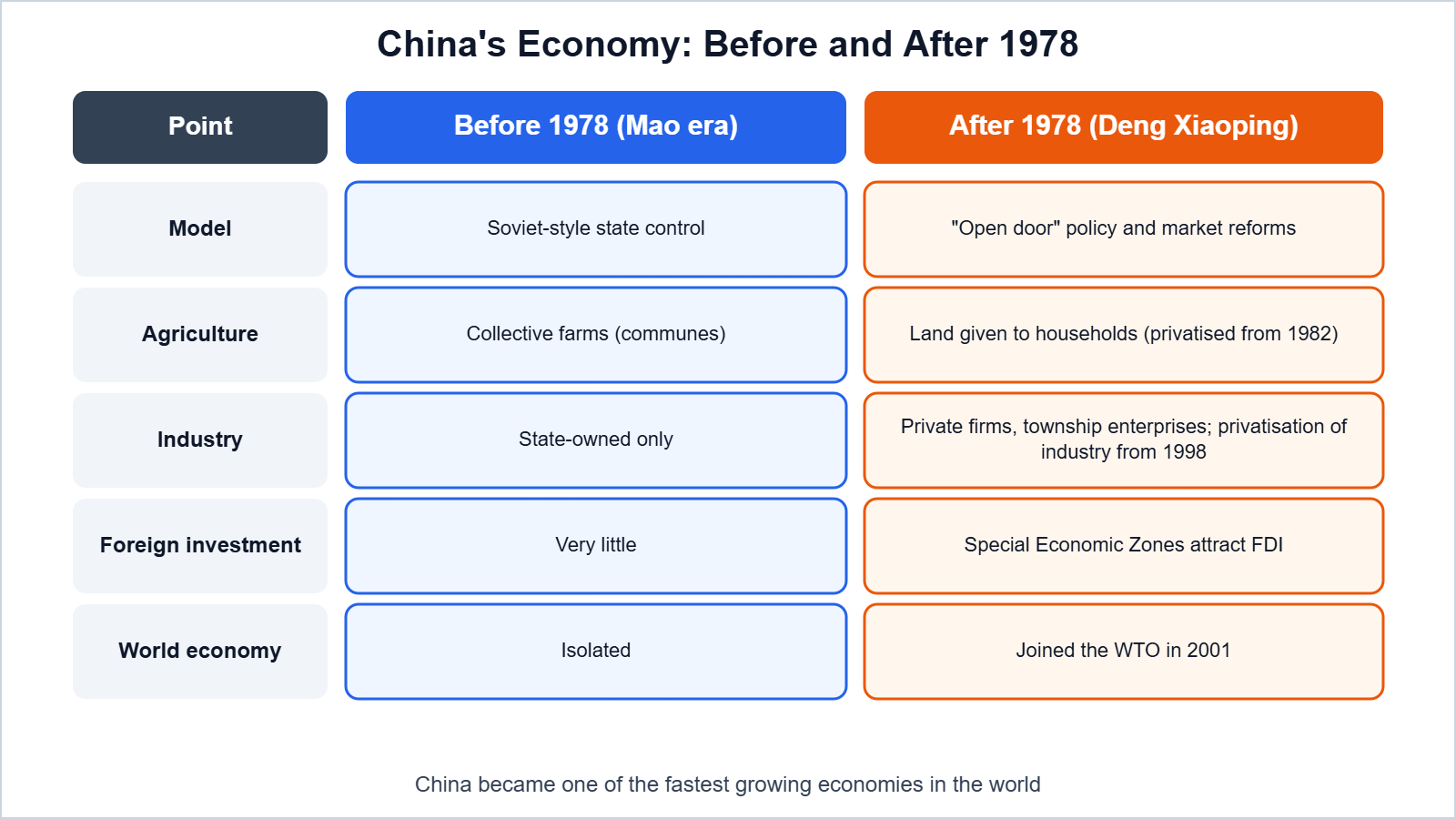
After the Communist revolution of 1949 under Mao Zedong, China followed the Soviet model of a state-controlled economy, with collective farms and heavy industry. Growth was slow and the country remained largely cut off from the world economy.
In 1978, under Deng Xiaoping, China announced the “open door” policy and economic reforms, aiming to generate higher productivity through investment of capital and technology from abroad. Agriculture was privatised from 1982 and industry from 1998; Special Economic Zones (SEZs) were set up for foreign firms; China joined the WTO in 2001. China became a major global economic power and the “factory of the world”.
Problems: not all Chinese benefited equally – unemployment, regional and rural-urban inequality, environmental damage and corruption increased.
India-China relations: after friendly ties in the 1950s (“Hindi-Chini bhai-bhai”), relations broke down with the 1962 war. Prime Minister Rajiv Gandhi’s visit to China in 1988 improved relations. Today trade between the two countries is large, but border disputes and China’s close ties with Pakistan remain areas of concern.
5. Japan and South Korea
Japan: the only country to have suffered atomic bombing (1945), Japan rebuilt itself into one of the world’s leading economies, known for technology and brands such as Sony, Panasonic, Canon, Toyota and Honda. It is a member of the G7, a large contributor to the UN budget and a major source of development aid. Its constitution (Article 9) renounces war as a means of settling disputes.
South Korea: after the Korean War (1950-53), South Korea grew rapidly from the 1960s to the 1980s, a development often called the “Miracle on the Han River”. Both Koreas became members of the UN in 1991. Its companies, such as Samsung, LG and Hyundai, are known worldwide, and it is a leading example of rapid industrial growth.
Easy Memory Trick: ASEAN founders “I M P S T” – Indonesia, Malaysia, Philippines, Singapore, Thailand.
6. Timeline
Year | Event |
|---|---|
1949 | Communist revolution in China |
1951 | European Coal and Steel Community |
1957 | European Economic Community (Treaty of Rome) |
1962 | India-China war |
1967 | ASEAN founded by the Bangkok Declaration |
1978 | China’s open door policy under Deng Xiaoping |
1988 | Rajiv Gandhi visits China |
1991 | India’s Look East Policy |
1992 | Maastricht Treaty: European Union |
1994 | ASEAN Regional Forum |
2001 | China joins the WTO |
2014 | Act East Policy |
2020 | UK leaves the EU |
7. Key Terms
Term | Meaning |
|---|---|
European Union | Union of European states with common economic, foreign and security policies |
Euro | Common currency of many EU members |
ASEAN Way | Informal, non-confrontational and cooperative style of ASEAN |
Open door policy | China’s policy of opening its economy to foreign trade and investment (1978) |
SEZ | Special Economic Zone with special rules to attract investment |
Look East / Act East | India’s policy of closer ties with South-East and East Asia |
8. Important Exam Questions
Q1. What was the Maastricht Treaty? (2 marks)
Ans. The Maastricht Treaty, signed in 1992, established the European Union. It moved European cooperation beyond the economic community towards a common foreign and security policy, cooperation on justice and home affairs, and preparation for a common currency, the euro, for member countries.
Q2. When and by whom was ASEAN established? (2 marks)
Ans. ASEAN was established on 8 August 1967 by the Bangkok Declaration. Its five founding members were Indonesia, Malaysia, the Philippines, Singapore and Thailand. It aimed to speed up economic growth, social progress and cultural development, and to promote regional peace and stability.
Q3. What is meant by the “ASEAN Way”? (2 marks)
Ans. The ASEAN Way is the style of working of ASEAN members. It is informal, non-confrontational and cooperative, and it respects the national sovereignty of each member. Decisions are usually reached through discussion and consensus rather than by force or binding rules imposed from above.
Q4. What was China’s open door policy? (2 marks)
Ans. In 1978, under Deng Xiaoping, China announced the open door policy. It opened the Chinese economy to foreign trade, capital and technology, set up Special Economic Zones, and gradually introduced market reforms in agriculture and industry, leading to very rapid economic growth over the following decades.
Q5. Mention any three factors that make the EU an influential organisation. (3 marks)
Ans. First, the EU is one of the largest economies in the world, and its currency, the euro, is strong in international markets. Second, it has political and diplomatic influence: France is a permanent member of the UN Security Council and the EU uses dialogue and diplomacy effectively. Third, its members together have large armed forces and France has nuclear weapons, giving the EU military weight in addition to its economic strength.
Q6. What are the three pillars of the ASEAN Community? (3 marks)
Ans. The ASEAN Community rests on three pillars. The ASEAN Security Community aims at peaceful settlement of disputes so that conflicts do not turn into armed confrontation. The ASEAN Economic Community aims to create a common market and production base and to help social and economic development. The ASEAN Socio-Cultural Community aims at closer people-to-people links and cooperation in culture, education and social welfare among the member countries of the region.
Q7. Why does India give importance to its relations with ASEAN? (3 marks)
Ans. ASEAN is one of India’s largest trading partners and an important source of investment. Through the Look East Policy of 1991 and the Act East Policy of 2014, India has built links in trade, connectivity, culture and security with South-East Asia. A free trade agreement in goods has increased commerce. Close ties with ASEAN also help India to play a larger role in the Asia-Pacific region and to balance other powers.
Q8. Describe any three economic reforms introduced in China after 1978. (3 marks)
Ans. After 1978 China privatised agriculture, giving land to households instead of collective farms, which raised production and rural incomes. It allowed private enterprise in industry, and later privatised state industries, so that competition increased efficiency. It also set up Special Economic Zones where foreign companies could invest with special incentives, bringing capital and technology. Joining the World Trade Organisation in 2001 further opened China to world markets and investment.
Q9. Explain the rise of the Chinese economy after 1978. What problems has this growth created? (5 marks)
Ans. After the Communist revolution of 1949, China followed the Soviet model, with state ownership of industry, collective farms and very little contact with the world economy. Growth was slow. In 1978 Deng Xiaoping announced the open door policy and economic reforms. China decided to generate higher productivity by inviting foreign capital and technology. Agriculture was privatised from 1982, which raised farm output and rural incomes. Private enterprise was encouraged in industry and state enterprises were exposed to competition; privatisation of industry followed from 1998. Special Economic Zones were created to attract foreign direct investment, and trade expanded rapidly. China joined the World Trade Organisation in 2001 and became the factory of the world, with huge foreign exchange reserves. However, the benefits did not reach everyone equally. Unemployment grew in some sectors, and inequality increased between regions, between coastal and inland areas, and between cities and villages. Rapid industrialisation also caused severe environmental damage and pollution, and corruption became a serious problem. Thus growth was spectacular but uneven.
Q10. Describe the main features of India-China relations since 1947. (5 marks)
Ans. India and China, two ancient civilisations, began their modern relationship on friendly terms. In the early 1950s the slogan “Hindi-Chini bhai-bhai” reflected this, and the two countries agreed on the principles of Panchsheel in 1954. However, differences arose over the border and over China’s action in Tibet, and the two countries fought a war in 1962, in which India suffered a military setback. Relations remained cold for many years, though ambassadors were exchanged again in 1976. A turning point came with Prime Minister Rajiv Gandhi’s visit to China in 1988, after which both sides agreed to maintain peace on the border while negotiating the boundary question, and to expand cooperation. Since then, trade has grown enormously and the two countries cooperate in forums such as BRICS and on issues like climate change. At the same time, there are continuing concerns: the unresolved border dispute and incidents along the Line of Actual Control, China’s close relationship with Pakistan, and competition for influence in the region. The relationship therefore combines cooperation with rivalry.
9. MCQs and Assertion-Reason
1. The European Union was established by the
(A) Treaty of Rome (B) Maastricht Treaty (C) Bangkok Declaration (D) Marshall Plan
Ans. (B)
2. Which was NOT a founding member of ASEAN?
(A) Indonesia (B) Thailand (C) Vietnam (D) Singapore
Ans. (C)
3. China joined the WTO in
(A) 1995 (B) 2001 (C) 2008 (D) 1978
Ans. (B)
4. India’s Look East Policy began in
(A) 1985 (B) 1991 (C) 2004 (D) 2014
Ans. (B)
Options: (A) Both A and R are true and R is the correct explanation of A. (B) Both A and R are true but R is not the correct explanation of A. (C) A is true but R is false. (D) A is false but R is true.
Assertion (A): China’s economy grew rapidly after 1978.
Reason (R): China opened its economy to foreign investment and introduced market reforms under Deng Xiaoping.
Ans. (A)
10. Case Study
Read the passage and answer the questions: A group of countries in South-East Asia came together to reduce mistrust among themselves. Instead of strict rules, they preferred informal discussions and consensus, and they agreed not to interfere in one another’s internal affairs. Over time their cooperation grew from economic matters to security and culture.
(i) Name the organisation described.
Ans. ASEAN.
(ii) What is its style of working called?
Ans. The ASEAN Way.
(iii) Name the three pillars of its community.
Ans. Security Community, Economic Community and Socio-Cultural Community.
Conclusion: The EU, ASEAN, China, Japan and South Korea have become important centres of power. Their economic strength and cooperation limit the dominance of any one power, and India has built close ties with them, especially through its Act East policy.