Challenges of Nation Building – Political Science Class 12 Notes
Chapter – 9
Challenges of Nation Building
1. Challenges for the New Nation
India became independent at midnight on 14-15 August 1947. Jawaharlal Nehru, the first Prime Minister, addressed the Constituent Assembly in his famous “tryst with destiny” speech. The new nation faced three kinds of challenges:
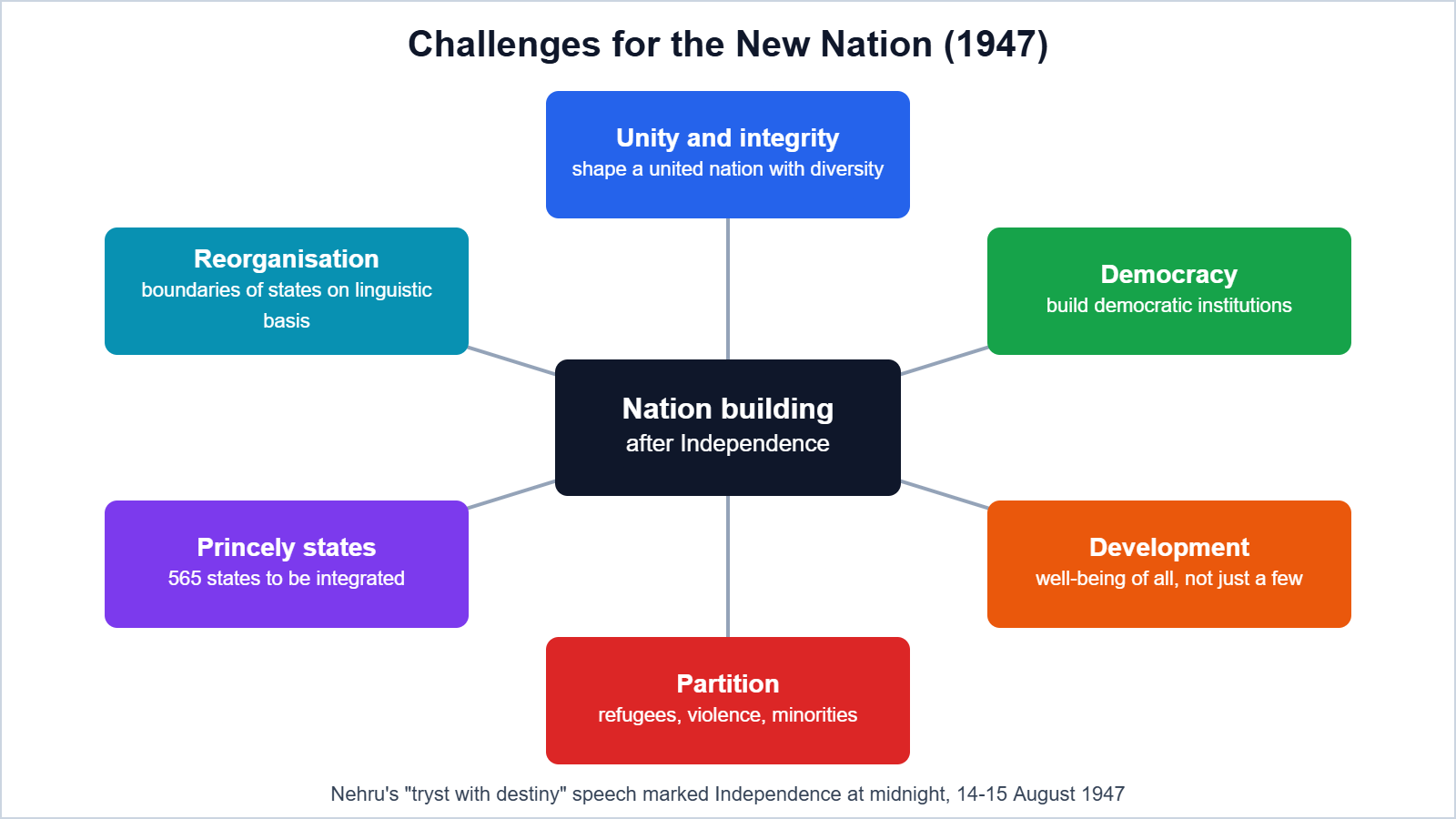
- To shape a nation that was united while accommodating the diversity of society (languages, cultures, religions).
- To establish democracy – a constitution with fundamental rights, universal adult franchise and a parliamentary system.
- To ensure development and well-being of the whole society, especially the poor and the socially disadvantaged.
2. Partition: Displacement and Rehabilitation
India was partitioned on the basis of the “two-nation theory” advanced by the Muslim League, which claimed that Hindus and Muslims were two separate nations; Pakistan was created for the Muslims. The Congress opposed this theory but finally accepted Partition.
- There was no single Muslim-majority belt: two areas of concentration, in the west and in the east, became West and East Pakistan.
- Not all Muslim-majority areas wanted Pakistan; for example Khan Abdul Ghaffar Khan, the leader of the North-Western Frontier Province, opposed the two-nation theory.
- Punjab and Bengal had large non-Muslim populations, so these provinces were divided.
- Minorities on both sides faced great insecurity.
Consequences: Partition caused one of the largest and most violent movements of people in history. Lakhs of people were killed, women were abducted and abused, and about eight million people migrated across the new border. Property, government assets and even employees had to be divided. Mahatma Gandhi worked tirelessly for communal peace; he was assassinated by Nathuram Godse on 30 January 1948.
Remember: The leaders of India rejected the idea of a religious state; they chose a secular state in which all citizens have equal rights irrespective of religion.
3. Integration of Princely States
At Independence there were about 565 princely states. Under the British plan, they were free to join India or Pakistan, or remain independent. This threatened the unity of India. Sardar Vallabhbhai Patel, the Deputy Prime Minister and Home Minister, with V.P. Menon, persuaded almost all rulers to sign the Instrument of Accession, by which they accepted that their state would become part of India.
- Junagadh: the Nawab wanted to join Pakistan; after popular protest and a plebiscite, it joined India.
- Hyderabad: the Nizam wanted independence; after the Razakars’ violence, the Indian army moved in in September 1948 and the state joined India.
- Manipur: the Maharaja Bodhachandra Singh signed the Instrument of Accession; Manipur held elections under universal adult franchise in June 1948; in September 1949 the Maharaja signed a Merger Agreement without consulting the elected Assembly, which caused resentment.
- Kashmir: Maharaja Hari Singh signed the Instrument of Accession in October 1947 after an attack by tribesmen from Pakistan.
Privy purse: in return for merger, the rulers were promised a privy purse (an annual payment) and certain privileges. These were abolished in 1971.
4. Reorganisation of States
The national movement had promised linguistic provinces, but after Partition the leaders feared that division on the basis of language might weaken national unity. Movements for linguistic states grew. Potti Sriramulu died in December 1952 after an indefinite fast for a separate Telugu state; Andhra State was created in October 1953.
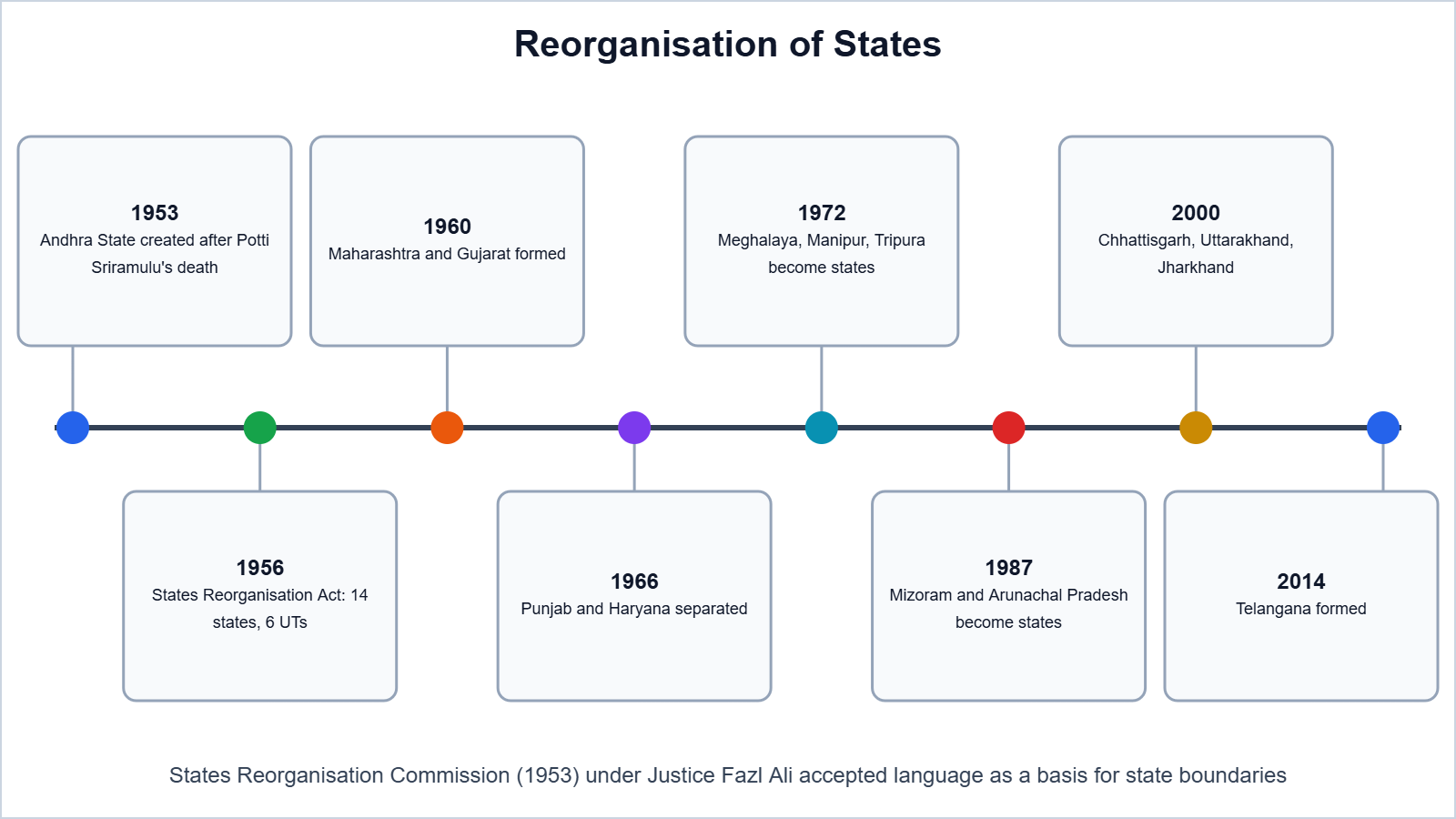
The States Reorganisation Commission (1953), headed by Justice Fazl Ali, recommended that state boundaries should reflect the boundaries of languages. The States Reorganisation Act (1956) created 14 states and 6 union territories. Linguistic states strengthened democracy, made administration easier in people’s own languages, and did not lead to the break-up of the country, as some had feared.
Easy Memory Trick: Three challenges of nation building “U-D-D” – Unity, Democracy, Development.
5. Timeline
Year | Event |
|---|---|
14-15 Aug 1947 | Independence; Partition; “tryst with destiny” speech |
Oct 1947 | Kashmir signs the Instrument of Accession |
30 Jan 1948 | Assassination of Mahatma Gandhi |
June 1948 | Elections in Manipur |
Sept 1948 | Hyderabad joins India |
Sept 1949 | Manipur Merger Agreement |
Oct 1953 | Andhra State formed |
1953 | States Reorganisation Commission appointed |
1956 | States Reorganisation Act |
1960 | Maharashtra and Gujarat formed |
1966 | Punjab and Haryana separated |
1971 | Privy purses abolished |
6. Key Terms
Term | Meaning |
|---|---|
Two-nation theory | The idea that Hindus and Muslims were two separate nations |
Princely states | States ruled by princes under British paramountcy |
Instrument of Accession | Document by which a ruler agreed to join India |
Privy purse | Annual payment given to former rulers; abolished in 1971 |
Linguistic states | States formed on the basis of language |
SRC | States Reorganisation Commission (1953) |
7. Important Exam Questions
Q1. What was the two-nation theory? (2 marks)
Ans. The two-nation theory, advanced by the Muslim League, claimed that India consisted of two separate nations, Hindus and Muslims. On this basis the League demanded a separate country, Pakistan, for Muslims. The Congress opposed the theory, but Partition finally took place in 1947.
Q2. What was the Instrument of Accession? (2 marks)
Ans. The Instrument of Accession was the legal document signed by the rulers of princely states to join the Indian Union. By signing it, a ruler accepted that his state would become a part of India. Almost all princely states signed it soon after Independence.
Q3. What was the privy purse? (2 marks)
Ans. The privy purse was an annual grant of money and certain privileges promised to the rulers of the former princely states when they merged their states with India. It was criticised as inconsistent with equality and democracy, and it was finally abolished in 1971.
Q4. Why was Andhra State created in 1953? (2 marks)
Ans. There was a strong movement among Telugu-speaking people for a separate state. Potti Sriramulu, a Congress leader and Gandhian, went on an indefinite fast for this demand and died in December 1952. The resulting protests forced the government to create Andhra State in October 1953.
Q5. Mention the three challenges faced by India after Independence. (3 marks)
Ans. The first challenge was to shape a nation that was united and yet accommodated the great diversity of languages, cultures and religions. The second was to establish democracy, with a constitution guaranteeing rights, universal adult franchise and a parliamentary form of government. The third was to ensure development and the well-being of the whole society, so that the poor and disadvantaged sections also benefited from independence and were not left out.
Q6. Explain any three difficulties in implementing the two-nation theory. (3 marks)
Ans. First, there was no single region of Muslim majority; Muslims were concentrated in two areas, one in the west and one in the east, which became West and East Pakistan, far apart. Second, not all Muslim-majority areas wanted Pakistan; Khan Abdul Ghaffar Khan of the North-Western Frontier Province opposed it. Third, Punjab and Bengal had large non-Muslim populations, so these provinces had to be divided district by district, causing great suffering.
Q7. How was Hyderabad integrated into India? (3 marks)
Ans. Hyderabad was the largest princely state, ruled by the Nizam, who wanted it to remain independent. He signed a standstill agreement with India in 1947 while negotiations went on. Meanwhile, a people’s movement grew against his rule, and the Razakars, a paramilitary force loyal to the Nizam, attacked people. In September 1948, the Indian army moved in to control the situation. The Nizam surrendered, and Hyderabad became part of India.
Q8. What were the recommendations of the States Reorganisation Commission? (3 marks)
Ans. The States Reorganisation Commission was appointed in 1953 under Justice Fazl Ali. It accepted that the boundaries of states should reflect the boundaries of different languages, while keeping national unity in view. On the basis of its report, the States Reorganisation Act was passed in 1956, creating fourteen states and six union territories. This reorganisation changed the political map of India and was later extended to other regions.
Q9. Explain the consequences of the Partition of India in 1947. (5 marks)
Ans. The Partition of India in 1947 was one of the most tragic events in modern history. First, it caused the largest and most abrupt migration of people in history. Around eight million people crossed the new border, Hindus and Sikhs moving to India and Muslims to Pakistan. Second, it was accompanied by terrible communal violence. Lakhs of people were killed on both sides. Third, women suffered greatly; many were abducted, raped, forcibly converted or killed, and families were broken. Fourth, refugees lost their homes, land and property and had to start life again in camps and new towns; their rehabilitation became a huge task for the new government. Fifth, the division of assets, including government property, the army, railway equipment and even furniture and staff, created disputes. Sixth, minorities on both sides faced insecurity, and Mahatma Gandhi, who worked for communal harmony, was assassinated in January 1948. Finally, Partition left behind lasting mistrust between India and Pakistan, especially over Kashmir. Yet India chose to remain a secular state with equal rights for all citizens.
Q10. Describe the integration of the princely states into the Indian Union. (5 marks)
Ans. At the time of Independence, about 565 princely states existed, and under the British plan they were free to join India or Pakistan or remain independent. This posed a serious threat to the unity of the country. The task of integration was handled by Sardar Vallabhbhai Patel, the Deputy Prime Minister and Home Minister, assisted by V.P. Menon. Patel used a mix of persuasion and firmness. Most rulers were persuaded to sign the Instrument of Accession, giving control over defence, external affairs and communications to the Union, and later they merged their states fully with India in return for privy purses. A few states posed problems. The Nawab of Junagadh wanted to join Pakistan, but after protests and a plebiscite the state joined India. The Nizam of Hyderabad wanted independence; after violence by the Razakars, the Indian army moved in in September 1948, and Hyderabad joined India. In Kashmir, Maharaja Hari Singh signed the Instrument of Accession in October 1947 after an attack from Pakistan. In Manipur, the Maharaja signed a Merger Agreement in 1949 without consulting the elected assembly.
8. MCQs and Assertion-Reason
1. Who was mainly responsible for the integration of princely states?
(A) Jawaharlal Nehru (B) Sardar Vallabhbhai Patel (C) B.R. Ambedkar (D) Rajendra Prasad
Ans. (B)
2. The States Reorganisation Act was passed in
(A) 1950 (B) 1953 (C) 1956 (D) 1960
Ans. (C)
3. Mahatma Gandhi was assassinated on
(A) 15 August 1947 (B) 30 January 1948 (C) 26 January 1950 (D) 2 October 1948
Ans. (B)
4. Privy purses were abolished in
(A) 1956 (B) 1967 (C) 1969 (D) 1971
Ans. (D)
Options: (A) Both A and R are true and R is the correct explanation of A. (B) Both A and R are true but R is not the correct explanation of A. (C) A is true but R is false. (D) A is false but R is true.
Assertion (A): Linguistic reorganisation of states strengthened Indian democracy.
Reason (R): It allowed people to be governed and to take part in politics in their own languages.
Ans. (A)
9. Case Study
Read the passage and answer the questions: After a leader died following a long fast for a separate state for the speakers of his language, there were violent protests across the region. The government, which had earlier been reluctant, announced the formation of the new state within a few days. Soon after, a commission was appointed to examine the question of state boundaries for the whole country.
(i) Name the leader referred to.
Ans. Potti Sriramulu.
(ii) Which state was formed as a result?
Ans. Andhra State (1953).
(iii) Name the commission that was appointed later.
Ans. The States Reorganisation Commission (1953), headed by Justice Fazl Ali.
Conclusion: India met the challenges of Partition, the integration of princely states and the reorganisation of states while keeping its unity and democracy. Accommodation of diversity, especially through linguistic states, proved to be a source of strength rather than division.