Environment and Natural Resources – Political Science Class 12 Notes
Chapter – 7
Environment and Natural Resources
1. Environmental Concerns in Global Politics
Environmental problems such as the loss of cultivable land, shortage of clean water, deforestation, loss of biodiversity, depletion of the ozone layer, pollution of coastal waters and global warming affect the whole world. Since no country can solve them alone, they have become part of world politics.
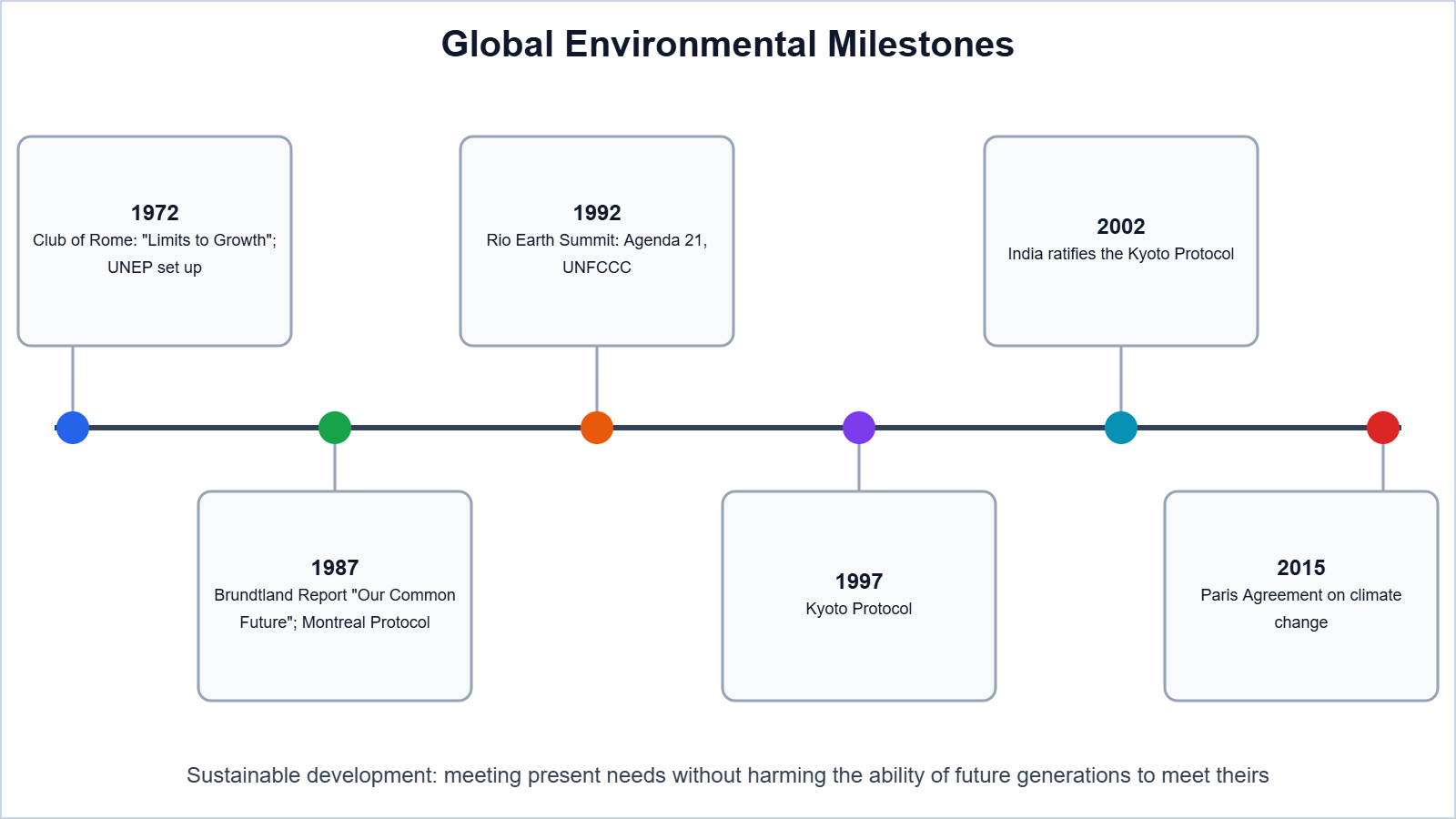
In 1972 the Club of Rome published “Limits to Growth”, warning that resources would run out as population grew. The UN Environment Programme (UNEP) was set up the same year. The Brundtland Report “Our Common Future” (1987) emphasised sustainable development.
2. The Rio Earth Summit (1992)
The UN Conference on Environment and Development held in Rio de Janeiro, Brazil, in June 1992 is known as the Earth Summit. It produced conventions on climate change (UNFCCC), biodiversity and forestry, and a list of development practices called Agenda 21.
- It showed a difference between the global North (rich countries), concerned mainly with ozone depletion and global warming, and the global South (developing countries), concerned with the link between economic development and environmental protection.
- It recommended that development should go hand in hand with environmental protection – sustainable development.
- Critics said Agenda 21 favoured economic growth over ecological concerns.
3. Global Commons
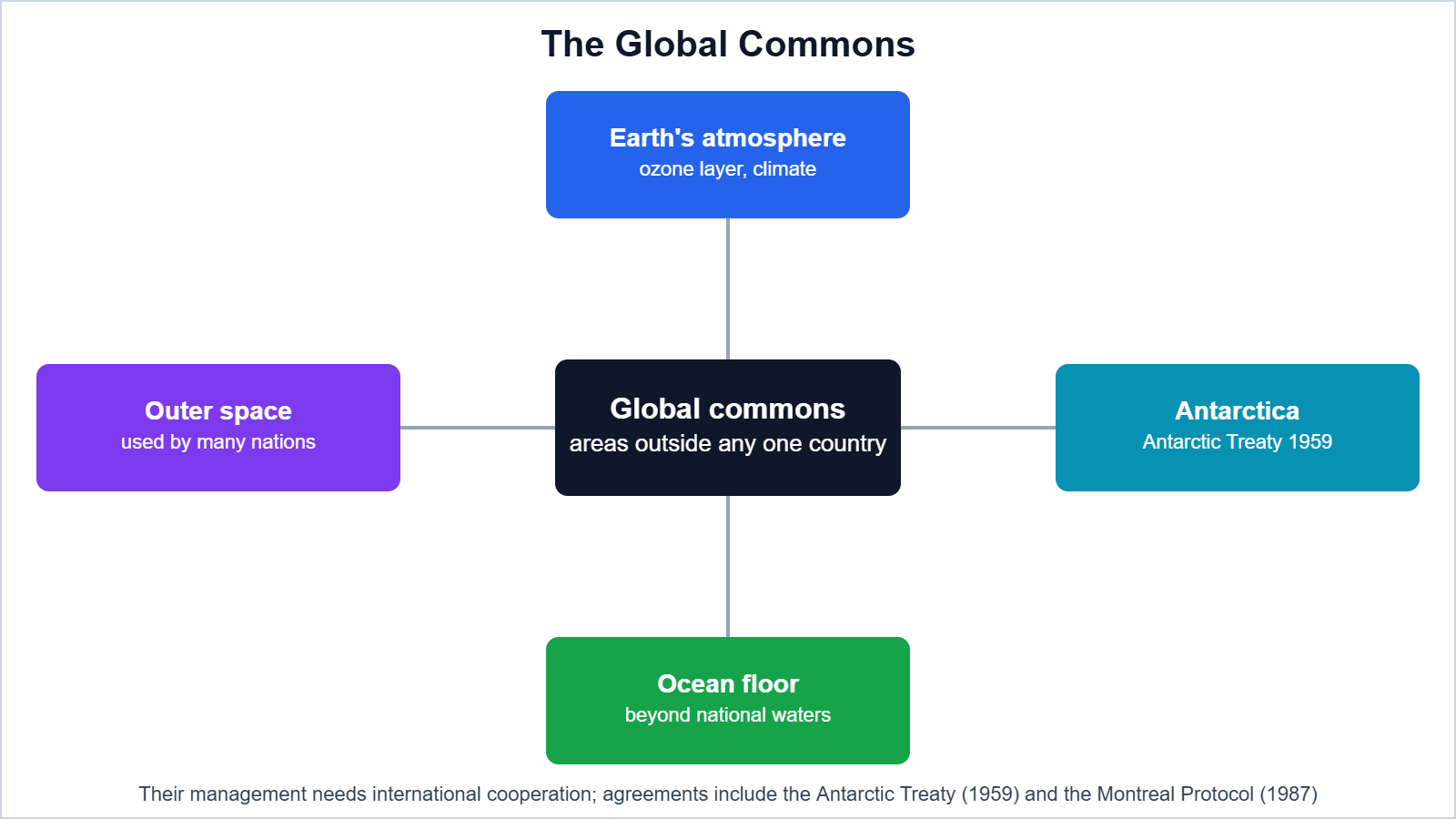
Commons are resources owned by a community rather than by individuals, such as village common lands and sacred groves. Global commons are areas outside the jurisdiction of any one state: the atmosphere, Antarctica, the ocean floor and outer space. Agreements to manage them include the Antarctic Treaty (1959), the Montreal Protocol (1987) on ozone-depleting substances, and the Antarctic Environmental Protocol (1991).
4. Common but Differentiated Responsibilities
Developing countries argue that the developed countries caused most of the environmental damage during their industrialisation, so they should take more responsibility now. This principle, accepted at Rio, is called “common but differentiated responsibilities”. The UNFCCC (1992) recognised that the largest share of historical emissions came from developed countries and that per capita emissions in developing countries are still low.
The Kyoto Protocol (1997) set targets for industrialised countries to cut greenhouse gas emissions; India and China were exempted from binding targets. India ratified it in 2002. The Paris Agreement (2015) later asked all countries to set their own climate targets.
5. India’s Stand on Environmental Issues
- India agrees that all countries have a common responsibility, but argues that the main burden of cutting emissions should fall on developed countries, given their historical responsibility.
- India’s per capita emissions are far below the world average.
- India has taken its own steps: the National Auto-fuel Policy (cleaner fuels), the Energy Conservation Act (2001), the Electricity Act (2003), promotion of natural gas and renewable energy, and the National Action Plan on Climate Change (2008).
- India reviewed the implementation of Agenda 21 and believes developed countries should provide finance and technology to developing countries.
6. Environmental Movements and Resource Geopolitics
People around the world have formed movements to protect the environment: forest movements in the South (for example in Mexico, Chile, Brazil, Malaysia, Indonesia, Africa and India), movements against mining and large dams. In India, the Chipko movement in the Himalayas (1970s) and the Narmada Bachao Andolan against large dams on the Narmada are well known.
Resource geopolitics is about who gets what resources, when, where and how. Control over oil has shaped wars and foreign policies, especially in West Asia; water is another source of conflict between countries sharing rivers. The rights of indigenous peoples, who depend on forests and land, are also part of environmental politics.
Easy Memory Trick: “Rio 92 gave A-21” – the Rio Earth Summit of 1992 adopted Agenda 21.
7. Timeline
Year | Event |
|---|---|
1959 | Antarctic Treaty |
1972 | “Limits to Growth”; UNEP established |
1973 | Chipko movement begins |
1987 | Brundtland Report; Montreal Protocol |
1992 | Earth Summit at Rio; Agenda 21; UNFCCC |
1997 | Kyoto Protocol |
2001 | Energy Conservation Act in India |
2002 | India ratifies the Kyoto Protocol |
2008 | National Action Plan on Climate Change |
2015 | Paris Agreement |
8. Key Terms
Term | Meaning |
|---|---|
Global commons | Areas outside national jurisdiction: atmosphere, Antarctica, ocean floor, outer space |
Agenda 21 | List of sustainable development practices adopted at Rio (1992) |
Sustainable development | Development that does not harm future generations |
Common but differentiated responsibilities | All countries share responsibility, but developed countries must do more |
Kyoto Protocol | 1997 agreement setting emission targets for industrialised countries |
Sacred groves | Patches of forest protected by communities for religious reasons |
Resource geopolitics | Politics of who controls natural resources |
9. Important Exam Questions
Q1. What is meant by global commons? (2 marks)
Ans. Global commons are areas or resources that lie outside the political jurisdiction of any one country and are shared by the international community. Examples are the earth’s atmosphere, Antarctica, the ocean floor and outer space. Their management requires cooperation among countries through international agreements.
Q2. What is Agenda 21? (2 marks)
Ans. Agenda 21 is a list of development practices adopted at the Rio Earth Summit in 1992. It recommends ways of combining economic growth with environmental protection, so that development becomes sustainable. Critics felt that it gave more importance to economic growth than to ecological concerns.
Q3. What was the Kyoto Protocol? (2 marks)
Ans. The Kyoto Protocol, agreed in 1997 in Japan, set targets for industrialised countries to cut their emissions of greenhouse gases that cause global warming. Developing countries such as India and China were exempted from binding targets. India ratified the protocol in August 2002.
Q4. What are sacred groves? (2 marks)
Ans. Sacred groves are patches of forest that local communities protect because of their religious beliefs. Cutting trees or hunting in them is usually forbidden. They are found in many parts of India and are a traditional example of community management of common resources and biodiversity.
Q5. What were the main outcomes of the Rio Earth Summit? (3 marks)
Ans. The Rio Earth Summit, held in June 1992, produced conventions on climate change, biodiversity and forestry, and adopted Agenda 21, a list of sustainable development practices. It accepted the idea that economic growth must be combined with environmental protection. It also recognised the principle of common but differentiated responsibilities. The summit revealed differences between the global North, concerned mainly with ozone and global warming, and the global South, concerned with development.
Q6. Explain the principle of “common but differentiated responsibilities”. (3 marks)
Ans. This principle means that protecting the environment is the shared responsibility of all countries, but their responsibilities are not equal. Developed countries caused most of the pollution during their long period of industrialisation and have more money and technology, so they should take the lead in reducing emissions and help developing countries. Developing countries, whose per capita emissions are still low, should not be forced to slow down their development to the same extent.
Q7. Describe India’s stand on climate change. (3 marks)
Ans. India accepts that climate change is a serious global problem, but argues that the historical responsibility for greenhouse gas emissions lies mainly with developed countries. Its own per capita emissions are far below the world average. India therefore supports common but differentiated responsibilities and was exempted from binding targets under Kyoto. It has also taken national steps such as the Energy Conservation Act, renewable energy and a climate action plan.
Q8. What is the Chipko movement? (3 marks)
Ans. The Chipko movement began in the early 1970s in the hills of Uttarakhand, then part of Uttar Pradesh. Villagers, especially women, hugged trees to prevent them from being cut by contractors. They demanded that local communities should have control over forest resources. The movement drew national attention to deforestation and to the rights of people who depend on forests, and it inspired other environmental movements in India and elsewhere.
Q9. Why have environmental issues become a part of global politics? Explain with examples. (5 marks)
Ans. Environmental issues have become a major part of global politics for several reasons. First, many environmental problems cross national borders and cannot be solved by any single country. Global warming caused by greenhouse gases, the depletion of the ozone layer and pollution of the oceans affect all countries, whatever their own contribution. Second, the world faces serious shortages: cultivable land is being lost, fresh water is becoming scarce, forests are being cut and biodiversity is declining, which affects food security and livelihoods. Third, there is the question of who is responsible and who should pay. Developing countries argue that rich countries caused most of the damage during industrialisation, while rich countries want all major emitters to act. This led to the principle of common but differentiated responsibilities at the Rio Earth Summit in 1992. Fourth, control over natural resources such as oil and water has caused conflicts and wars, especially in West Asia. Finally, global commons need agreements like the Antarctic Treaty, the Montreal Protocol, the Kyoto Protocol and the Paris Agreement.
Q10. Explain the role of environmental movements in protecting the environment. (5 marks)
Ans. Environmental movements are among the most lively and diverse social movements in the world. They have been organised by local communities, NGOs and activists, often outside formal politics. In the developing world, forest movements in countries such as Mexico, Chile, Brazil, Malaysia, Indonesia and India have opposed the large-scale cutting of forests and defended the rights of forest communities. In India, the Chipko movement of the 1970s in the Himalayas saw villagers hugging trees to stop felling, and it drew national attention to deforestation. Movements against mining have opposed the damage caused to land, water and local people by mining companies. Movements against large dams, such as the Narmada Bachao Andolan in India, have questioned the displacement of people and the environmental costs of big projects, and they have called for smaller, sustainable alternatives. These movements have raised awareness, influenced government policies and court decisions, and stressed the rights of indigenous and local people over their resources. Thus environmental movements have made protecting nature a matter of democracy and justice as well as science.
10. MCQs and Assertion-Reason
1. Agenda 21 was adopted at the
(A) Kyoto Conference 1997 (B) Rio Earth Summit 1992 (C) Stockholm Conference 1972 (D) Paris Conference 2015
Ans. (B)
2. Which of these is a global common?
(A) Indian Ocean coast of India (B) Antarctica (C) Himalayas (D) Sundarbans
Ans. (B)
3. “Limits to Growth” was published by
(A) UNEP (B) Club of Rome (C) WHO (D) World Bank
Ans. (B)
4. India ratified the Kyoto Protocol in
(A) 1997 (B) 2002 (C) 2008 (D) 2015
Ans. (B)
Options: (A) Both A and R are true and R is the correct explanation of A. (B) Both A and R are true but R is not the correct explanation of A. (C) A is true but R is false. (D) A is false but R is true.
Assertion (A): Developing countries argue that developed countries should bear the main burden of cutting emissions.
Reason (R): Developed countries are responsible for most historical greenhouse gas emissions.
Ans. (A)
11. Case Study
Read the passage and answer the questions: In a hill village, women learnt that contractors had been given permission to cut a large number of trees in the forest near their homes. They feared that their sources of fuel, fodder and water would disappear. They went into the forest and hugged the trees, refusing to move until the felling was stopped.
(i) Name the movement described.
Ans. The Chipko movement.
(ii) In which decade did it begin?
Ans. The 1970s.
(iii) What was the main demand of such movements?
Ans. Local control over forest resources and an end to large-scale felling.
Conclusion: Environmental problems are global and need cooperation. Agreements from the Rio Earth Summit to the Paris Agreement reflect the idea of sustainable development and common but differentiated responsibilities, which India strongly supports, while movements at the grassroots keep environmental concerns alive.