The Cold War Era and Non-Alignment – Political Science Class 12 Notes
Chapter – 1
The Cold War Era and Non-Alignment
1. What Was the Cold War?
After the Second World War (1939-45), the USA and the USSR emerged as the two superpowers. The rivalry between them, along with their allies, from about 1945 to 1991 is called the Cold War. It was “cold” because the two never fought a direct war against each other; instead they competed through ideology, alliances, an arms race and wars fought by their allies (proxy wars).
- Ideological conflict: liberal democracy and capitalism (USA) against socialism and communism (USSR).
- Nuclear deterrence: both sides had nuclear weapons capable of destroying each other, so a direct war would have been suicidal. This “balance of terror” kept the rivalry cold.
- Rational restraint: both superpowers behaved cautiously during crises.
Cuban Missile Crisis (1962): the USSR, under Nikita Khrushchev, placed nuclear missiles in Cuba, close to the US coast. President John F. Kennedy ordered a naval blockade of Cuba. The world came very close to nuclear war, but the Soviet Union withdrew the missiles. The crisis is the high point of the Cold War.
Remember: The Cold War began with the end of the Second World War in 1945, when the USA dropped atomic bombs on Hiroshima and Nagasaki (August 1945), and ended with the disintegration of the USSR in December 1991.
2. The Emergence of Two Power Blocs
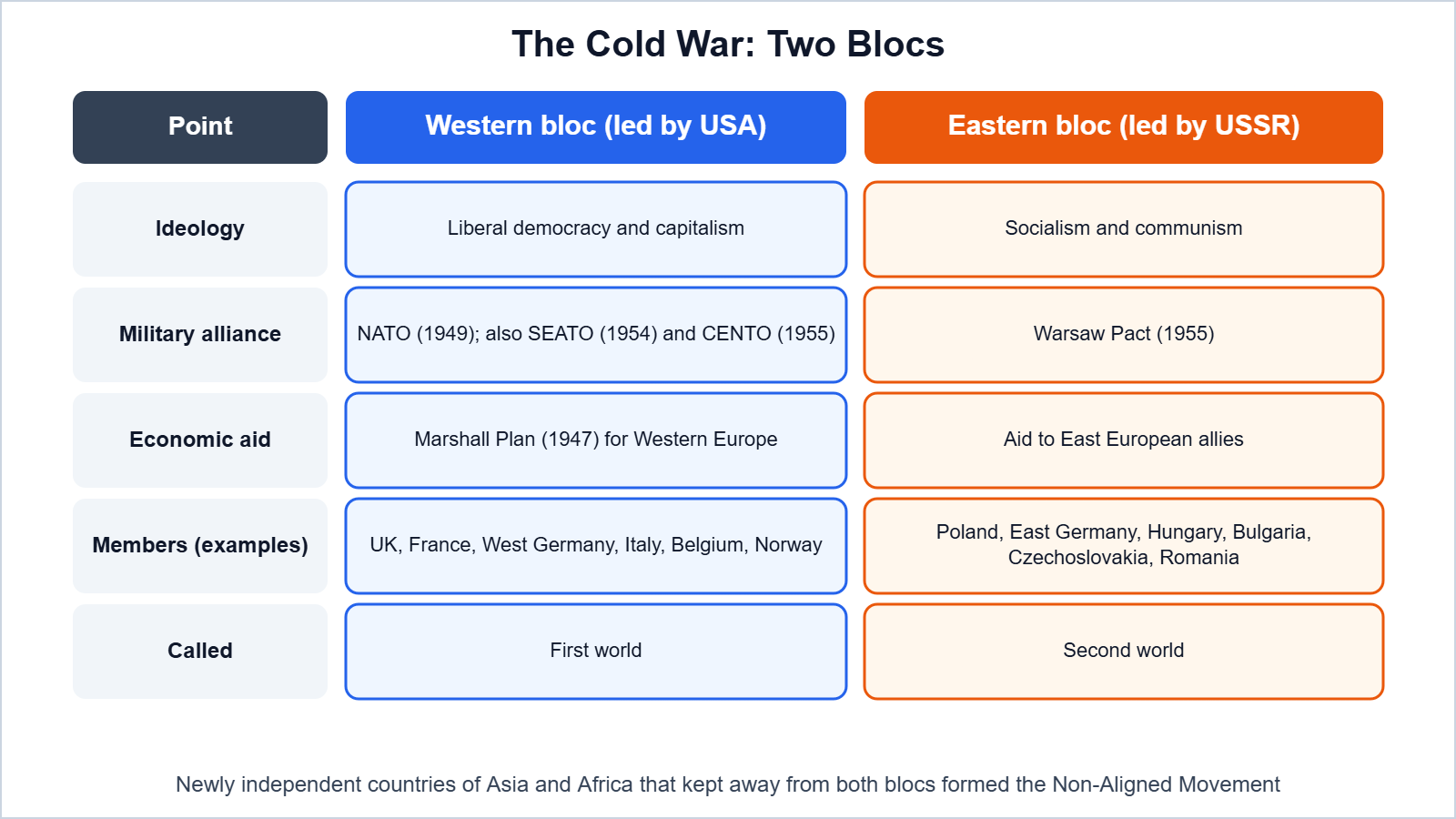
Smaller states joined the alliances to get protection, weapons and economic aid. The superpowers wanted allies for vital resources (oil and minerals), territory for military bases, locations to spy on each other, and economic support. Western Europe largely joined the USA; Eastern Europe, where the Soviet army had driven out the Nazis, came under Soviet control.
Alliance | Year | Members / purpose |
|---|---|---|
NATO (North Atlantic Treaty Organisation) | April 1949 | 12 founding members led by the USA; an attack on one would be treated as an attack on all |
SEATO (South East Asian Treaty Organisation) | 1954 | US-led alliance in South-East Asia |
CENTO (Central Treaty Organisation) | 1955 | US-led alliance including Pakistan (earlier called the Baghdad Pact) |
Warsaw Pact | 1955 | Led by the USSR with East European countries, to counter NATO |
The second world: the USSR and its East European socialist allies formed the “second world” (the capitalist West was the “first world”, and the developing countries the “third world”). Their economies were state-controlled and their political systems were dominated by communist parties.
3. Arenas of the Cold War and the Arms Race
Crises and conflicts took place in areas where the blocs met: the Korean War (1950-53), the division of Berlin (the Berlin Wall was built in 1961), the Vietnam War, the Cuban crisis and the Soviet intervention in Afghanistan (1979). Leaders of the Non-Aligned Movement, including Nehru, also played a mediating role, for example in the Korean War.
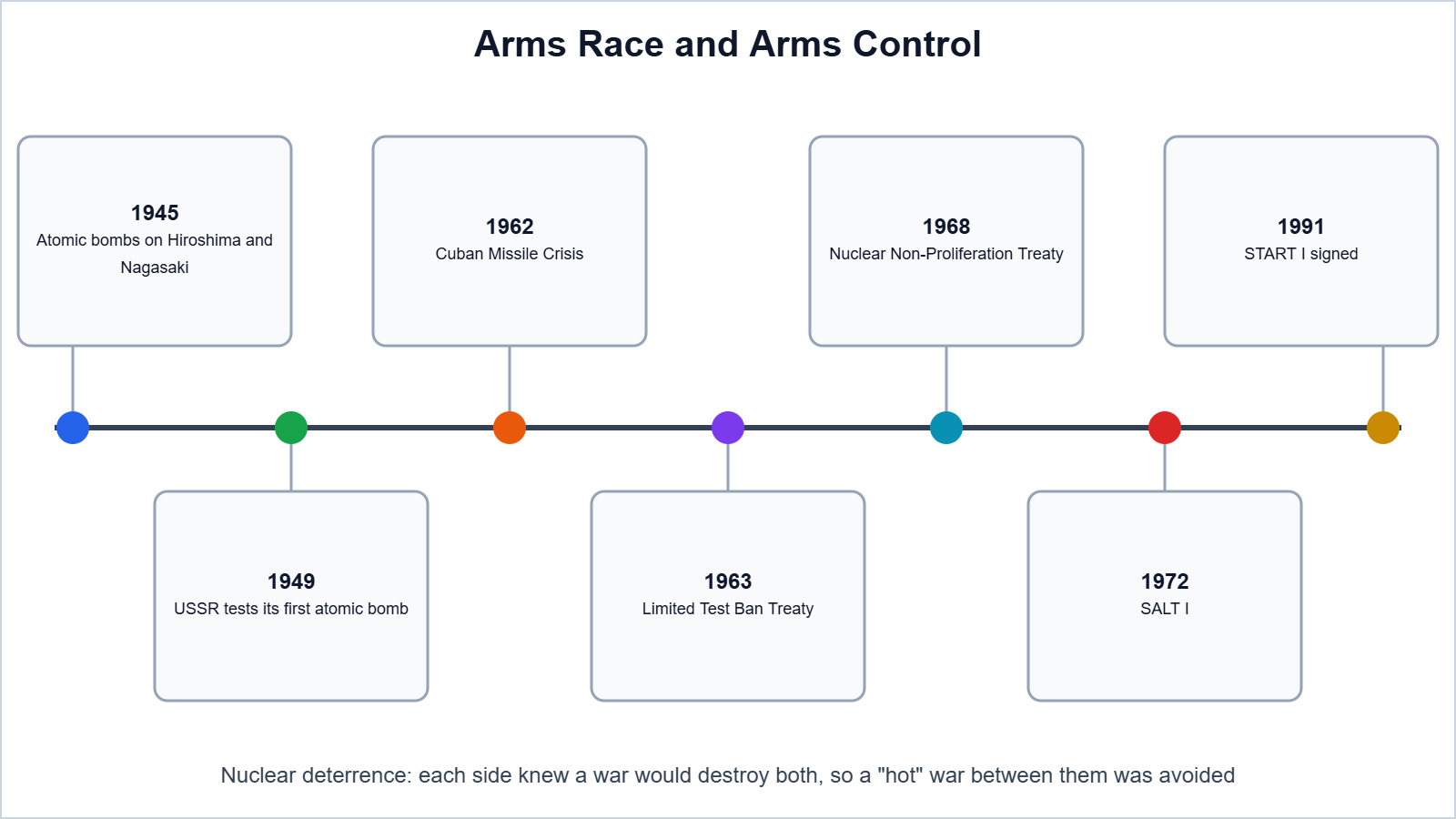
Arms control: because of the danger of nuclear war, the superpowers signed agreements to limit weapons: the Limited Test Ban Treaty (1963), the Nuclear Non-Proliferation Treaty (1968), the Strategic Arms Limitation Talks – SALT I (1972) and SALT II (1979), and the Strategic Arms Reduction Treaty – START I (1991).
4. The Non-Aligned Movement (NAM)
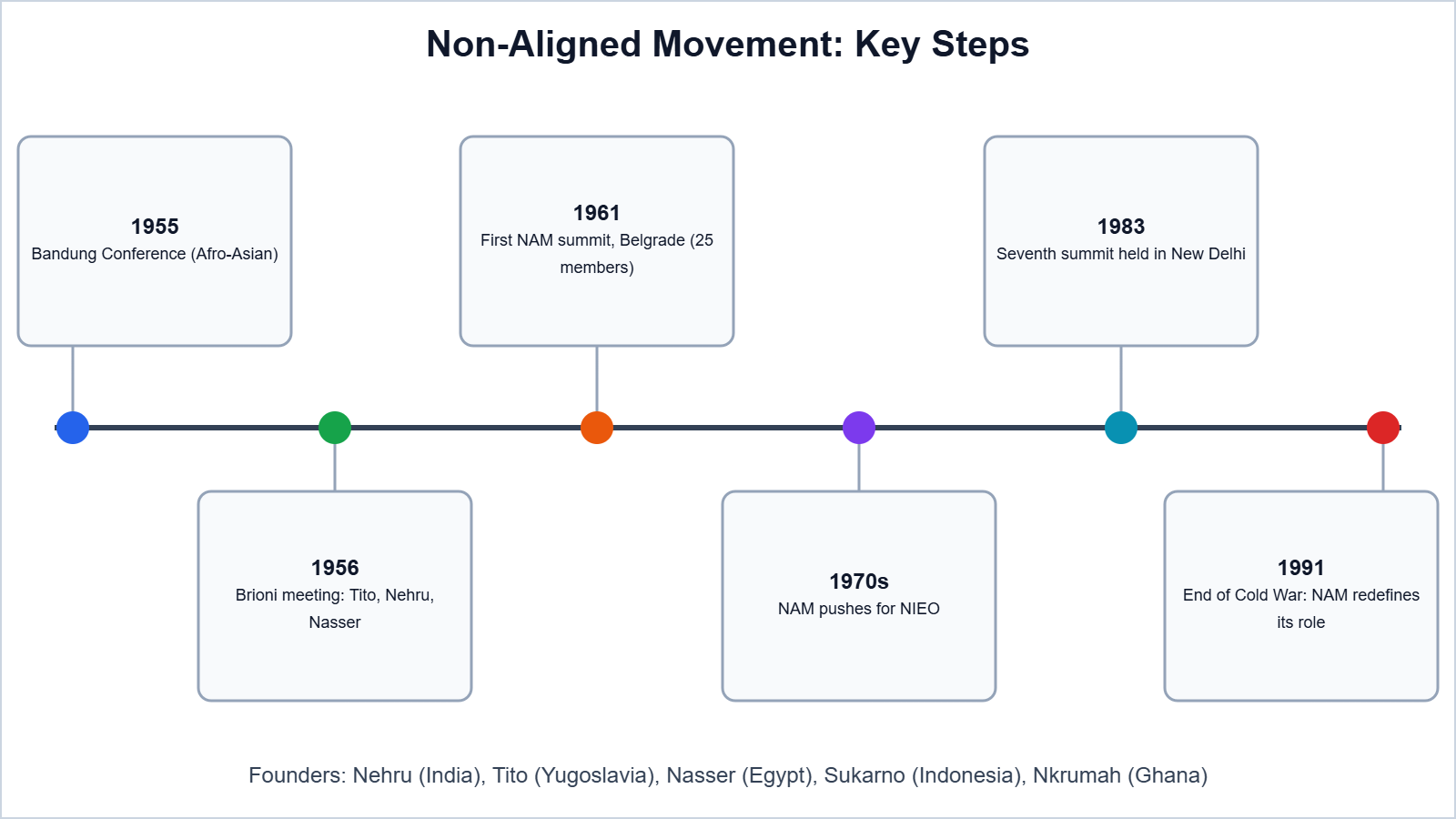
Newly independent countries did not want to join either bloc. Non-alignment means keeping away from military alliances while taking an independent stand on world issues according to one’s own national interest. It is not isolationism (staying away from world affairs) and not neutrality (keeping out of war); non-aligned countries were active in world affairs and some even fought wars.
The Afro-Asian Bandung Conference (1955) prepared the ground. The first NAM summit was held at Belgrade in 1961, with 25 member states. The founders were Jawaharlal Nehru (India), Josip Broz Tito (Yugoslavia), Gamal Abdel Nasser (Egypt), Sukarno (Indonesia) and Kwame Nkrumah (Ghana).
New International Economic Order (NIEO): most non-aligned countries were poor (“least developed countries”). In 1972 the UN Conference on Trade and Development (UNCTAD) report “Towards a New Trade Policy for Development” proposed reforms such as control of their own natural resources, access to Western markets, lower cost of technology and a greater role in international economic institutions. Gradually NAM became an economic as well as a political movement.
5. India and the Cold War
- India stayed away from both alliances so that it could take independent decisions in its national interest.
- It raised its voice against Cold War rivalries and tried to reduce tensions, for example by mediating in the Korean War.
- It could balance one superpower against the other: if one ignored India, it could turn to the other.
Criticism of India’s policy: some said non-alignment was “unprincipled”, as India avoided firm stands on some issues. In 1971 India signed the Treaty of Friendship with the USSR for 20 years, which critics said made it practically part of the Soviet camp. India explained that it needed support during the Bangladesh crisis.
Exam point: Non-alignment was India’s way of protecting its independence of action. It allowed India to receive aid and support from both blocs.
Easy Memory Trick: NAM founders “N-T-N-S-N” – Nehru, Tito, Nasser, Sukarno, Nkrumah.
6. Timeline
Year | Event |
|---|---|
1945 | End of Second World War; atomic bombs on Hiroshima and Nagasaki |
1947 | Marshall Plan announced |
1949 | NATO formed; USSR tests an atomic bomb |
1950-53 | Korean War |
1955 | Bandung Conference; Warsaw Pact formed |
1961 | First NAM summit at Belgrade; Berlin Wall built |
1962 | Cuban Missile Crisis |
1968 | Nuclear Non-Proliferation Treaty |
1971 | Indo-Soviet Treaty of Friendship |
1972 | SALT I; UNCTAD report on NIEO |
1979 | Soviet intervention in Afghanistan |
1989 | Fall of the Berlin Wall |
1991 | Disintegration of the USSR; end of the Cold War |
7. Key Terms
Term | Meaning |
|---|---|
Cold War | Rivalry between the USA and USSR without direct war (1945-91) |
Bipolarity | A world order dominated by two power centres |
Deterrence | Prevention of attack by the fear of unacceptable retaliation |
Proxy war | A war fought by allies on behalf of the superpowers |
Second world | The USSR and its East European socialist allies |
Non-alignment | Keeping away from military blocs while taking an independent stand |
NIEO | New International Economic Order demanded by developing countries |
8. Important Exam Questions
Q1. Why was the Cold War called “cold”? (2 marks)
Ans. It was called “cold” because the two superpowers never fought a direct war against each other. Both had nuclear weapons, so a war would have destroyed both. Their rivalry was carried out through ideology, alliances, the arms race and proxy wars fought by their allies.
Q2. What was the Cuban Missile Crisis? (2 marks)
Ans. In 1962 the Soviet Union placed nuclear missiles in Cuba, very close to the USA. President Kennedy ordered a naval blockade of Cuba. The world came close to nuclear war, but Khrushchev withdrew the missiles, so a direct clash was avoided at the last moment.
Q3. What is meant by the “second world”? (2 marks)
Ans. The second world was the group of socialist countries led by the Soviet Union, mainly the East European states such as Poland, East Germany, Hungary, Bulgaria, Czechoslovakia and Romania. Their economies were state-controlled and their political systems were dominated by communist parties.
Q4. Name the five founders of the Non-Aligned Movement. (2 marks)
Ans. The founders of NAM were Jawaharlal Nehru of India, Josip Broz Tito of Yugoslavia, Gamal Abdel Nasser of Egypt, Sukarno of Indonesia and Kwame Nkrumah of Ghana. The first summit of the movement was held at Belgrade in 1961 with twenty-five member states.
Q5. Why did smaller states join the superpower alliances? (3 marks)
Ans. Smaller states joined the alliances because they needed protection against their neighbours, weapons and economic aid from the superpowers. In return, the superpowers gained access to vital resources such as oil and minerals, territory for military bases, locations for spying on the rival bloc, and economic support. Ideological loyalty also mattered, as many allies shared the beliefs of their superpower. These mutual needs kept the blocs together throughout the Cold War years.
Q6. How is non-alignment different from neutrality and isolationism? (3 marks)
Ans. Isolationism means keeping away from world affairs altogether, while neutrality means staying out of war. Non-alignment is different from both. Non-aligned countries were very active in world affairs, took independent stands on issues, and tried to reduce tension between the blocs. Some of them, including India, even fought wars when their security was threatened. Non-alignment only meant not joining military alliances and judging each issue on its own merits.
Q7. What was the New International Economic Order? (3 marks)
Ans. The NIEO was a set of reforms demanded by developing countries to make the world economy fairer. The 1972 UNCTAD report proposed that poor countries should control their own natural resources, get access to Western markets, obtain technology at lower cost and have a greater say in international economic institutions. Through this demand the Non-Aligned Movement became an economic as well as a political movement, speaking for the poorer nations.
Q8. Give any three arms control treaties signed during the Cold War. (3 marks)
Ans. To reduce the danger of nuclear war, the superpowers signed several agreements. The Limited Test Ban Treaty of 1963 banned nuclear tests in the atmosphere, outer space and under water. The Nuclear Non-Proliferation Treaty of 1968 allowed only existing nuclear states to keep weapons. The Strategic Arms Limitation Talks led to SALT I in 1972 and SALT II in 1979, which limited strategic weapons.
Q9. Explain the benefits of non-alignment for India. (5 marks)
Ans. Non-alignment served India’s interests in several ways. First, it allowed India to take international decisions independently, according to its own national interest, rather than following the line of a superpower. Second, India could balance one superpower against the other: if it felt ignored or pressured by one, it could turn to the other for support. Third, staying out of military blocs meant that India could concentrate its limited resources on economic development instead of an expensive arms race. Fourth, India received economic and technical assistance from both blocs, for example help for steel plants and heavy industry. Fifth, non-alignment gave India a respected voice in world affairs. Together with other newly independent countries, it raised its voice against colonialism, racial discrimination and the arms race, and worked to reduce Cold War tensions, for instance by mediating in the Korean War. In this way non-alignment protected the hard-won independence of India and of other developing nations while allowing them to remain active in world affairs.
Q10. Explain the criticism of India’s policy of non-alignment. (5 marks)
Ans. India’s non-alignment was criticised on two main grounds. First, critics described it as unprincipled. They argued that in the name of national interest India often avoided taking a firm stand on important international issues and seemed to change its position according to convenience, which made its policy appear inconsistent. Second, it was said that India was not truly non-aligned. In 1971, during the Bangladesh crisis, India signed the Treaty of Friendship with the Soviet Union for twenty years. Critics in other countries saw this as joining the Soviet camp, because the treaty provided for consultation and support if either country faced a threat. India replied that the treaty was a response to a real danger, since the USA and China were supporting Pakistan at that time, and that it did not prevent India from having good relations with other countries. Supporters also pointed out that non-alignment had always meant the freedom to act in the national interest. The debate shows the difficulty of following an independent foreign policy in a world divided into two powerful blocs.
9. MCQs and Assertion-Reason
1. Which alliance was formed by the USSR to counter NATO?
(A) SEATO (B) CENTO (C) Warsaw Pact (D) ASEAN
Ans. (C)
2. The first NAM summit was held in
(A) Bandung (B) Belgrade (C) New Delhi (D) Cairo
Ans. (B)
3. The Cuban Missile Crisis took place in
(A) 1959 (B) 1962 (C) 1965 (D) 1968
Ans. (B)
4. Who was the leader of Yugoslavia among the founders of NAM?
(A) Nasser (B) Sukarno (C) Tito (D) Nkrumah
Ans. (C)
Options: (A) Both A and R are true and R is the correct explanation of A. (B) Both A and R are true but R is not the correct explanation of A. (C) A is true but R is false. (D) A is false but R is true.
Assertion (A): The superpowers avoided a direct war during the Cold War.
Reason (R): Both sides had nuclear weapons, and a war would have caused unacceptable destruction to both.
Ans. (A)
10. Case Study
Read the passage and answer the questions: Many newly independent countries of Asia and Africa felt that joining either superpower bloc would reduce them to the status of followers. They wanted the freedom to decide their own policies, to develop their economies, and to speak against colonialism and racism. Their leaders met in different conferences and gradually formed a movement that refused to join military alliances but remained active in world affairs.
(i) Which movement is described here?
Ans. The Non-Aligned Movement.
(ii) Why did these countries not want to join a bloc?
Ans. To keep their freedom of action and avoid becoming followers of a superpower.
(iii) Is this the same as neutrality? Give a reason.
Ans. No; they were active in world affairs and took stands on issues, while neutrality means staying out of war.
Conclusion: The Cold War divided the world into two blocs, created an arms race and many regional conflicts, but deterrence prevented a direct war. Non-alignment gave India and other new nations a way to protect their independence and to work for peace and a fairer world economy.