The Crisis of the Democratic Order – Political Science Class 12 Notes
Chapter – 14
The Crisis of the Democratic Order
1. Background to the Emergency
- Economic context: after 1971, the slogan Garibi Hatao did not bring much relief. The Bangladesh war, the stopping of US aid, the 1973 increase in world oil prices, drought and food shortage led to high inflation and unemployment.
- Gujarat and Bihar movements (1974): students in Gujarat protested in January 1974 against rising prices and corruption, and President’s rule was imposed. In Bihar, students invited Jayaprakash Narayan (JP) to lead their movement; he called for “Total Revolution” to establish true democracy.
- Railway strike (1974): the National Coordination Committee for Railwaymen’s Struggle, led by George Fernandes, organised a nationwide strike in May 1974, which the government declared illegal.
- Conflict with the judiciary: after the Kesavananda Bharati case (1973), which said Parliament could not amend the basic structure of the Constitution, the government appointed A.N. Ray as Chief Justice in 1973, superseding three senior judges. This was seen as an attempt to have a “committed judiciary”.
2. Declaration of Emergency
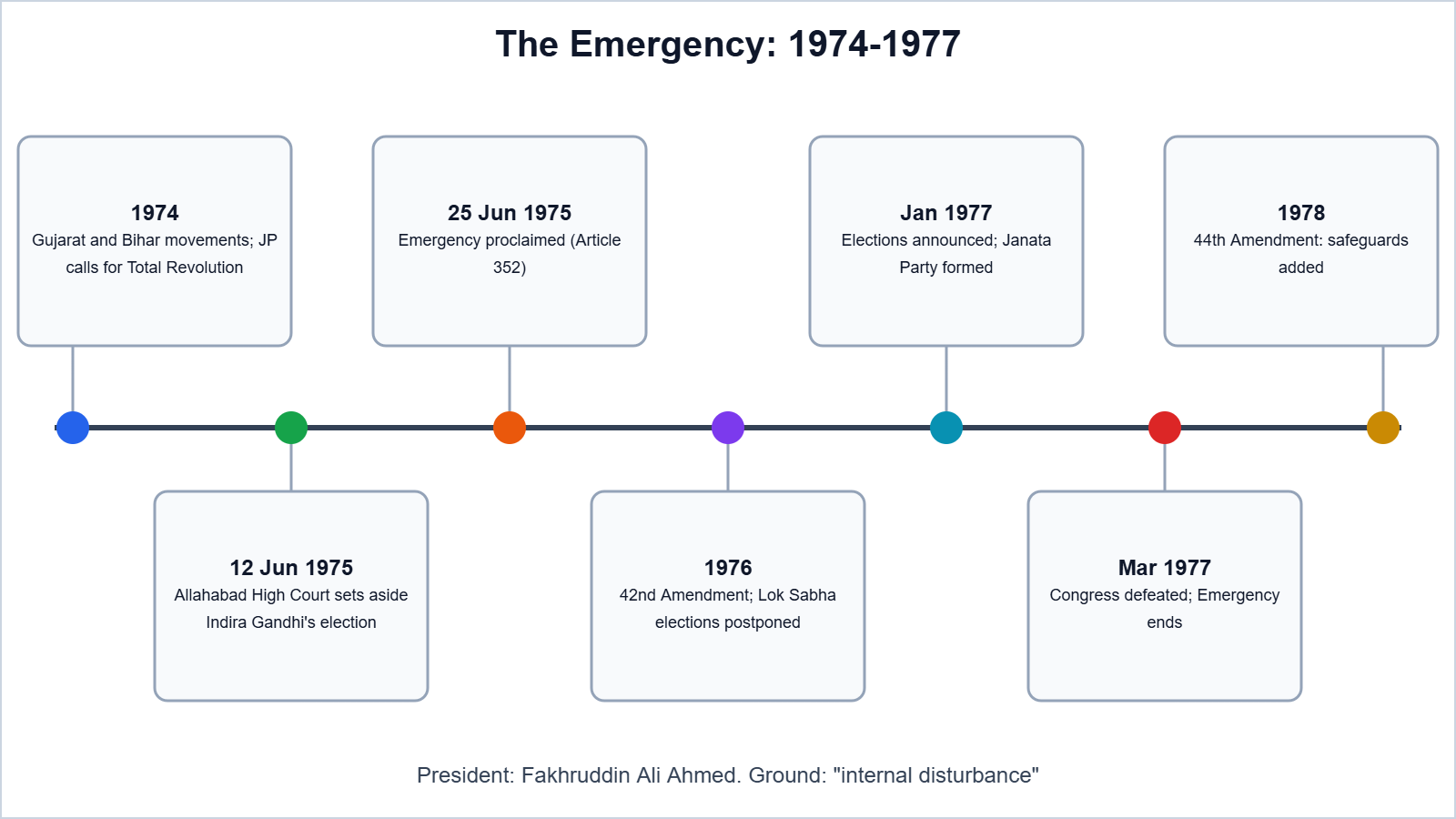
On 12 June 1975, Justice Jagmohan Lal Sinha of the Allahabad High Court, on an election petition filed by Raj Narain, declared Indira Gandhi’s election to the Lok Sabha invalid. The Supreme Court gave a partial stay: she could remain an MP but could not vote until the appeal was decided. On 25 June 1975, the opposition led by JP held a huge rally in Delhi demanding her resignation; JP appealed to the army, police and government employees not to obey “illegal and immoral orders”.
On the night of 25 June 1975, the government advised President Fakhruddin Ali Ahmed to proclaim an Emergency under Article 352 on the ground of “internal disturbance”. The cabinet was informed only the next morning.
3. Consequences of the Emergency
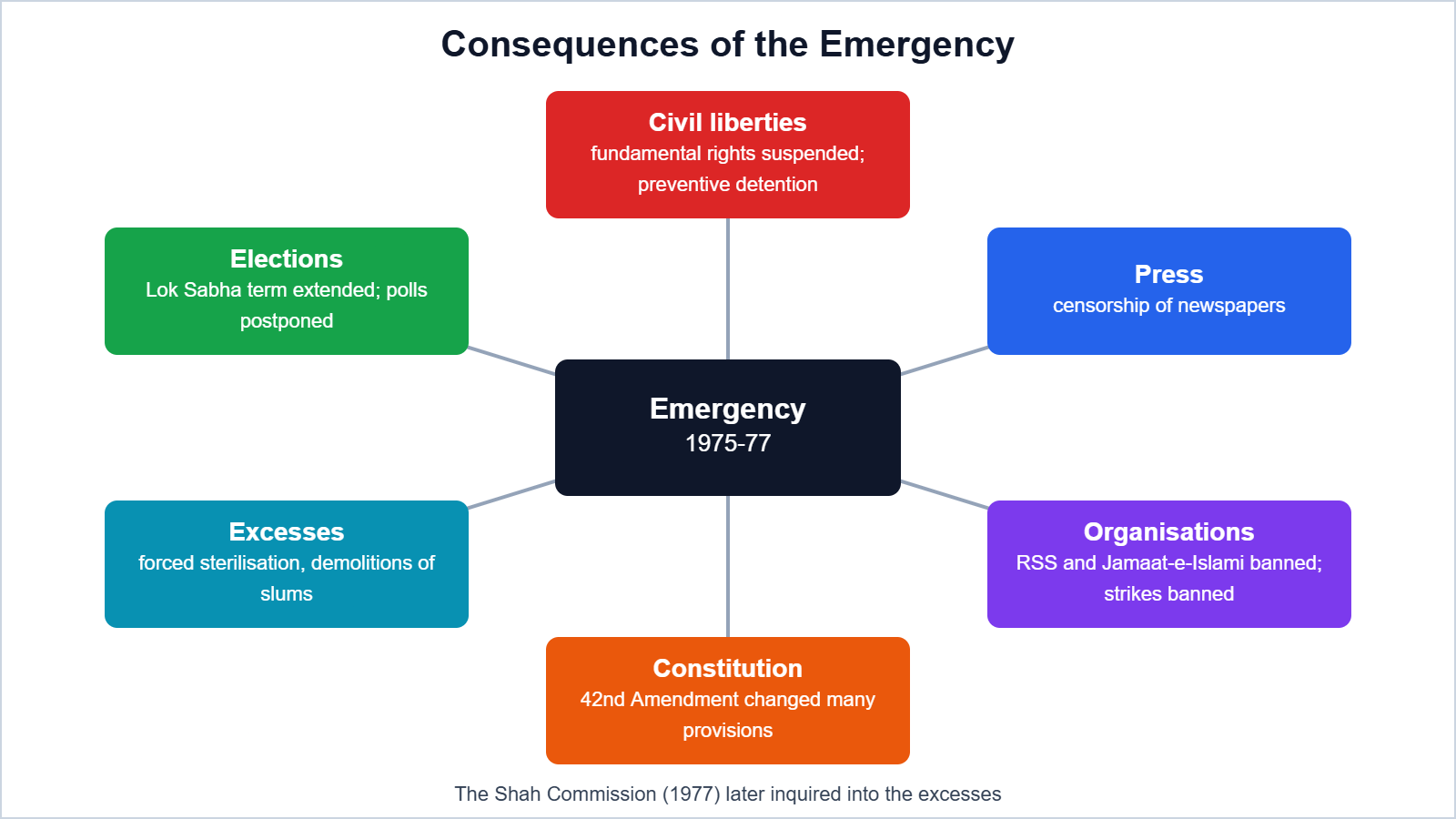
- Opposition leaders and activists were arrested under preventive detention; the right to move court for fundamental rights was suspended. In the ADM Jabalpur case (1976), the Supreme Court accepted the suspension of the right to seek habeas corpus – a decision later regarded as one of its worst.
- Press censorship: newspapers had to get prior approval; some protested by leaving blank editorials.
- The RSS and Jamaat-e-Islami were banned; protests and strikes were forbidden.
- The 42nd Amendment (1976) made many changes, including extending the term of legislatures from five to six years.
- Excesses included forced sterilisation and slum demolitions, especially in Delhi (Turkman Gate); Sanjay Gandhi, though holding no official post, wielded great power.
Committed bureaucracy: the idea that civil servants should be committed to the policies and programmes of the ruling party, rather than being politically neutral. During the Emergency, this idea weakened the independence of the administration and judiciary.
4. The 1977 Elections and the Janata Government
In January 1977, Indira Gandhi announced fresh elections. Opposition parties – Congress (O), Jana Sangh, Bharatiya Lok Dal and the Socialists – merged to form the Janata Party; Jagjivan Ram left the Congress and formed the Congress for Democracy. The elections in March 1977 became a referendum on the Emergency. The Janata Party and its allies won 330 of 542 seats, while the Congress got only 154. Indira Gandhi and Sanjay Gandhi lost their own seats. Morarji Desai became the first non-Congress Prime Minister.
The Janata government lacked unity and direction; rivalry among Morarji Desai, Charan Singh and Jagjivan Ram led to its fall in 1979. In the January 1980 elections, the Congress returned to power under Indira Gandhi.
Shah Commission: in May 1977 the Janata government appointed a commission headed by retired Supreme Court judge J.C. Shah to inquire into the excesses of the Emergency. It found that many decisions were taken without proper procedure and that there had been widespread abuse of power.
5. Lessons of the Emergency
- It is very difficult to do away with democracy in India; people voted out the government responsible.
- The 44th Amendment (1978) replaced “internal disturbance” with “armed rebellion” as a ground for a national emergency and required the written advice of the cabinet.
- It made citizens and courts more aware of civil liberties, and many civil liberties organisations emerged.
- It showed the need to keep the administration and police free from political pressure.
Easy Memory Trick: “25-6-75 to 21-3-77” – the Emergency lasted from 25 June 1975 to 21 March 1977.
6. Timeline
Year | Event |
|---|---|
1973 | Kesavananda Bharati case; supersession of judges |
1973 | Rise in world oil prices |
Jan 1974 | Gujarat movement |
Mar 1974 | Bihar movement under JP |
May 1974 | Nationwide railway strike |
12 June 1975 | Allahabad High Court verdict |
25 June 1975 | Emergency proclaimed |
1976 | 42nd Amendment; ADM Jabalpur case |
January 1977 | Elections announced; Janata Party formed |
March 1977 | Congress defeated; Emergency lifted (21 March); Morarji Desai PM |
May 1977 | Shah Commission appointed |
1978 | 44th Amendment |
1979 | Fall of the Janata government |
January 1980 | Congress returns to power |
7. Key Terms
Term | Meaning |
|---|---|
Emergency | Period from 1975 to 1977 when normal democratic rights were suspended |
Article 352 | Constitutional provision for a national emergency |
Total Revolution | JP’s call for a complete change in politics and society |
Committed bureaucracy | Civil servants committed to the ruling party’s policies |
Preventive detention | Arrest of a person to prevent a possible offence |
Shah Commission | 1977 inquiry into the excesses of the Emergency |
Censorship | Control of the press by the government |
8. Important Exam Questions
Q1. Who was the President of India when the Emergency was declared? (2 marks)
Ans. Fakhruddin Ali Ahmed was the President of India when the Emergency was proclaimed on the night of 25 June 1975. He issued the proclamation under Article 352 on the advice of Prime Minister Indira Gandhi, on the ground of internal disturbance.
Q2. What was the Allahabad High Court verdict of 12 June 1975? (2 marks)
Ans. On 12 June 1975, Justice Jagmohan Lal Sinha of the Allahabad High Court, deciding an election petition filed by Raj Narain, declared the election of Indira Gandhi to the Lok Sabha invalid. This verdict became an immediate cause of the political crisis leading to the Emergency.
Q3. What is meant by committed bureaucracy? (2 marks)
Ans. Committed bureaucracy means that civil servants should be committed to the policies and programmes of the ruling party, instead of being politically neutral. Critics argued that this idea, promoted in the early 1970s and during the Emergency, weakened the independence of the administration.
Q4. What was the Shah Commission? (2 marks)
Ans. The Shah Commission was appointed by the Janata government in May 1977, under retired Supreme Court judge J.C. Shah, to inquire into the excesses committed during the Emergency. It examined how decisions were taken and found many cases of abuse of power and arbitrary action.
Q5. Describe the economic context of the Emergency. (3 marks)
Ans. After the 1971 election, the promise of Garibi Hatao was not fulfilled. The Bangladesh war and the flow of refugees strained the economy, and the USA stopped aid to India. In 1973 world oil prices rose sharply, causing a general price rise. Industrial growth was low, unemployment was high, and droughts led to a fall in food production. Inflation rose steeply, causing great hardship to ordinary people and creating widespread discontent and protests.
Q6. What were the main features of the Bihar movement? (3 marks)
Ans. In March 1974, students in Bihar launched a movement against rising prices, food scarcity, unemployment and corruption. They invited Jayaprakash Narayan, a respected leader who had left active politics, to lead it. JP accepted on the condition that the movement would remain non-violent and not be limited to Bihar. He called for Total Revolution to establish true democracy and demanded the dismissal of the state government. The movement soon spread nationally.
Q7. Mention any three consequences of the Emergency on civil liberties. (3 marks)
Ans. First, the fundamental rights of citizens were suspended, and people lost the right to move the courts for their protection. Second, thousands of opposition leaders and workers were arrested under preventive detention laws without trial. Third, the press was censored, and newspapers needed government approval before publishing news. Organisations such as the RSS and Jamaat-e-Islami were banned, and protests and strikes were not allowed. Many excesses also took place.
Q8. Why were the 1977 elections called a referendum on the Emergency? (3 marks)
Ans. In the 1977 elections, the main issue before the voters was the experience of the Emergency. Opposition parties united as the Janata Party and campaigned against the excesses, the loss of liberty, forced sterilisation and censorship. People used their vote to give their judgement on the Emergency. The Congress was badly defeated, winning only 154 seats, and even Indira Gandhi lost her own seat. Thus the election was effectively a popular verdict on the Emergency.
Q9. Explain the main lessons learnt from the Emergency. (5 marks)
Ans. The Emergency of 1975-77 taught several important lessons to Indian democracy. First, it showed that it is extremely difficult to do away with democracy in India. Although the government suspended rights and arrested opponents, the people voted it out decisively in the 1977 elections, and democratic rule was restored. Second, it brought out the ambiguities in the emergency provisions of the Constitution. These were corrected by the 44th Amendment of 1978: the ground of internal disturbance was replaced by armed rebellion, and a national emergency can now be declared only on the written advice of the cabinet. Third, it made citizens and the courts far more aware of civil liberties. The courts became more active in protecting individual rights after the Emergency, and many civil liberties organisations came into being. Fourth, it showed the danger of using the police and administration for political ends, and the importance of an independent judiciary, a free press and a neutral bureaucracy. Finally, it raised the question of how to balance order with liberty.
Q10. Describe the circumstances that led to the declaration of Emergency in 1975. (5 marks)
Ans. Several developments created the crisis that led to the Emergency. First, the economic situation worsened after 1971: the Bangladesh war, the stopping of US aid, the rise in world oil prices in 1973 and droughts caused high inflation, food shortages and unemployment. Second, popular movements grew. In January 1974 students in Gujarat protested against prices and corruption, and in March 1974 students in Bihar invited Jayaprakash Narayan to lead their movement; he called for Total Revolution and challenged the government. A nationwide railway strike led by George Fernandes in May 1974 added to the unrest. Third, the government came into conflict with the judiciary, especially after the Kesavananda Bharati judgment of 1973 and the supersession of three senior judges in appointing A.N. Ray as Chief Justice. Fourth, on 12 June 1975, the Allahabad High Court declared Indira Gandhi’s election invalid, and the Supreme Court granted only a partial stay. The opposition demanded her resignation and planned nationwide protests. On the night of 25 June 1975, the President proclaimed an Emergency under Article 352 on the ground of internal disturbance.
9. MCQs and Assertion-Reason
1. The Emergency was declared under Article
(A) 356 (B) 352 (C) 360 (D) 370
Ans. (B)
2. Who led the Bihar movement in 1974?
(A) George Fernandes (B) Jayaprakash Narayan (C) Morarji Desai (D) Charan Singh
Ans. (B)
3. Who headed the commission that inquired into the excesses of the Emergency?
(A) Justice A.N. Ray (B) Justice J.C. Shah (C) Justice Fazl Ali (D) Justice Jagmohan Lal Sinha
Ans. (B)
4. The first non-Congress Prime Minister of India was
(A) Charan Singh (B) Morarji Desai (C) V.P. Singh (D) Chandra Shekhar
Ans. (B)
Options: (A) Both A and R are true and R is the correct explanation of A. (B) Both A and R are true but R is not the correct explanation of A. (C) A is true but R is false. (D) A is false but R is true.
Assertion (A): The 44th Amendment replaced “internal disturbance” with “armed rebellion” as a ground for national emergency.
Reason (R): The experience of 1975-77 showed that the earlier provision could be misused.
Ans. (A)
10. Case Study
Read the passage and answer the questions: A national newspaper published a blank space instead of its editorial one morning. Its editors explained privately that every news item now needed approval from a government officer before printing. Several journalists had been arrested, and public meetings were banned in the capital.
(i) To which period does this situation belong?
Ans. The Emergency of 1975-77.
(ii) What restriction is shown by the need for approval before printing?
Ans. Press censorship.
(iii) Why did the newspaper leave its editorial blank?
Ans. As a silent protest against censorship.
Conclusion: The Emergency of 1975-77 was the greatest crisis of Indian democracy. Rights were suspended and the press censored, but the 1977 elections restored democracy, and constitutional safeguards and greater public awareness have made such a crisis harder to repeat.