Contemporary South Asia – Political Science Class 12 Notes
Chapter – 4
Contemporary South Asia
1. What is South Asia?
South Asia usually includes India, Pakistan, Bangladesh, Nepal, Bhutan, Sri Lanka and the Maldives; Afghanistan and Myanmar are sometimes included. The region is bounded by the Himalayas in the north and the Indian Ocean, the Bay of Bengal and the Arabian Sea in the south, which gives it a distinct identity. It is a region of great diversity, and it has seen both cooperation and conflict.
2. Democracy in South Asia
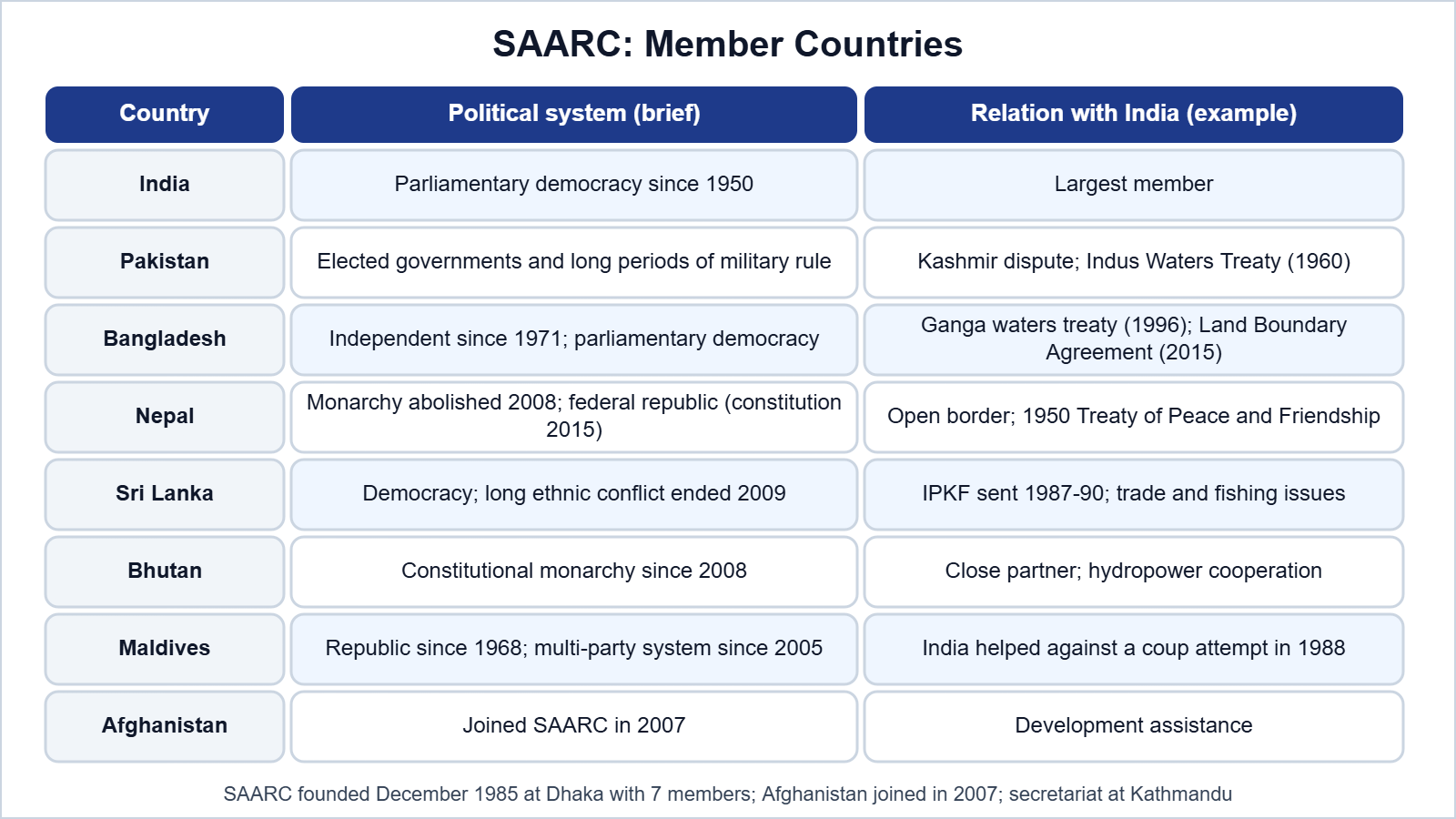
- India and Sri Lanka have been democracies since independence (Sri Lanka from 1948).
- Pakistan has alternated between elected governments and military rule – General Ayub Khan (1958), General Yahya Khan, General Zia-ul-Haq (1977) and General Pervez Musharraf (1999).
- Bangladesh became independent in 1971 after East Pakistan separated with India’s help; it has also seen military rule, but now has a parliamentary system.
- Nepal was a monarchy; after a long movement and the Maoist insurgency, the monarchy was abolished in 2008, and a new constitution was adopted in 2015.
- Bhutan became a constitutional monarchy in 2008; the Maldives became a republic in 1968 and adopted a multi-party system in 2005.
Remember: Despite military rule, coups and conflict, the people of South Asia have shown strong support for democracy in surveys and movements.
3. India-Pakistan Relations
- Kashmir: the main cause of conflict; wars in 1947-48 and 1965 and the Kargil conflict of 1999.
- 1971 war: led to the creation of Bangladesh; followed by the Shimla Agreement (1972) to settle disputes bilaterally.
- Rivers: the Indus Waters Treaty (1960), brokered by the World Bank, shared the Indus river system.
- Other issues: Siachen glacier, Sir Creek, terrorism across the border, and nuclear weapons on both sides (both tested in 1998).
- Confidence-building: bus links, trade, cultural exchanges and talks have been tried from time to time.
4. India and Its Other Neighbours
Country | Issues of cooperation and conflict |
|---|---|
Bangladesh | Sharing of Ganga and Brahmaputra waters (Ganga water treaty 1996), illegal migration, border management; the 2015 Land Boundary Agreement resolved enclave issues; trade and connectivity have grown. |
Nepal | Open border and the 1950 Treaty of Peace and Friendship allow free movement; differences have arisen over trade, the Maoist movement, and the 2015 border blockade; cooperation in hydropower and trade continues. |
Sri Lanka | Ethnic conflict between Sinhalese and Tamils; India sent the Indian Peace Keeping Force (IPKF) in 1987, withdrawn in 1990; the LTTE was defeated in 2009; trade, tourism and fishing issues. |
Bhutan | Very close relations; India supports hydropower projects and development; Bhutan helped remove insurgents from its territory. |
Maldives | Friendly relations; in 1988 India helped the Maldives government defeat a coup attempt by mercenaries. |
5. SAARC and SAFTA
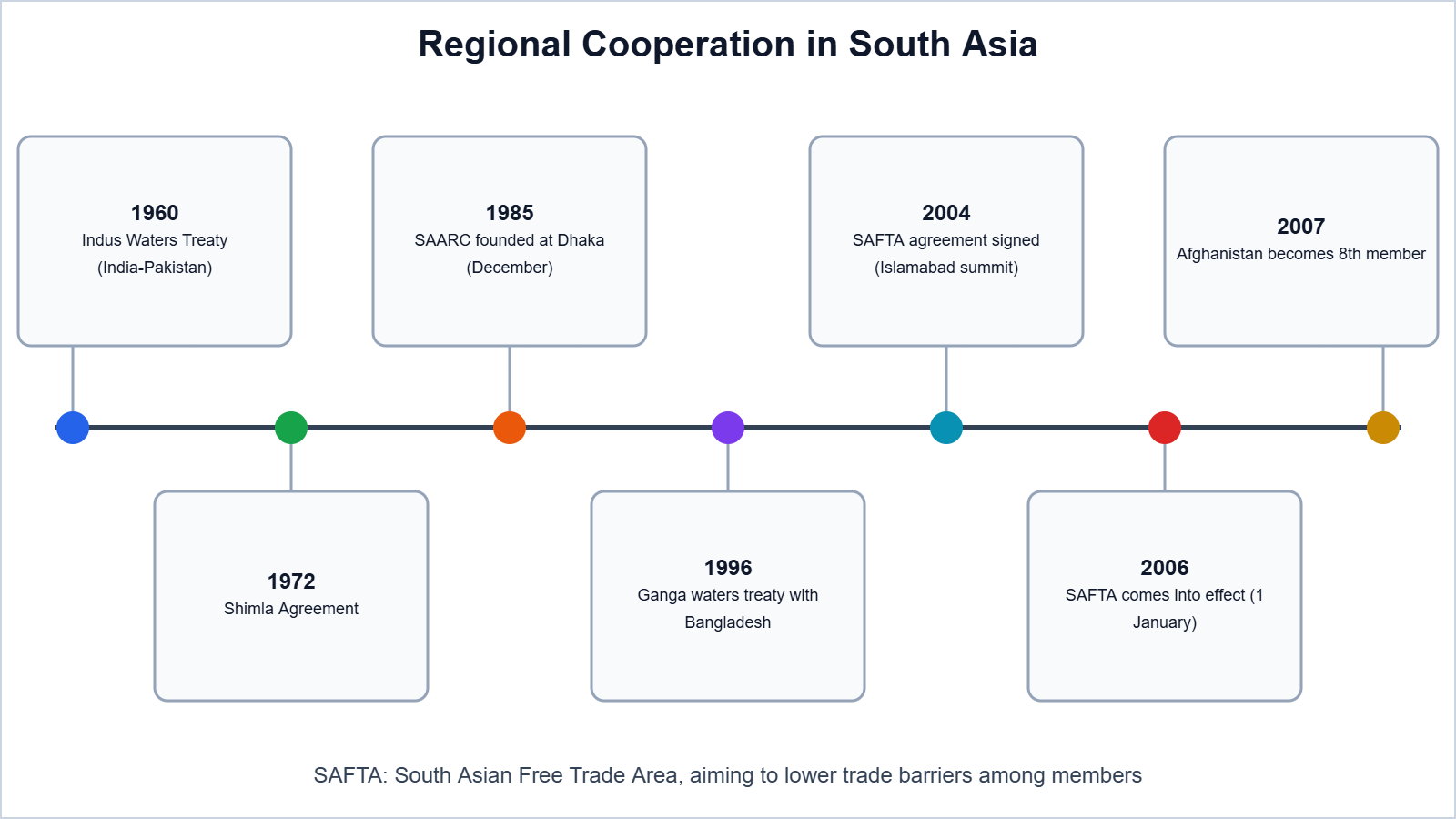
The South Asian Association for Regional Cooperation (SAARC) was founded at Dhaka in December 1985 by seven countries; Afghanistan joined in 2007. Its secretariat is at Kathmandu. It works for cooperation in agriculture, health, trade, culture and people-to-people contact.
The South Asian Free Trade Agreement (SAFTA) was signed in 2004 and came into effect on 1 January 2006. It aims to lower tariffs on trade among the members. Some smaller neighbours fear that India will dominate their markets, while India thinks SAFTA benefits all members.
Limitations: SAARC’s progress has been slow because of India-Pakistan tensions, mutual mistrust and fear among smaller countries of Indian dominance. Summits have often been postponed.
6. Challenges and Outside Powers
Major challenges in South Asia include poverty, terrorism, ethnic conflicts, water disputes, migration, climate change and natural disasters. Outside powers such as the USA and China have strong interests in the region; China’s ties with Pakistan and its investments in neighbouring countries are concerns for India.
Easy Memory Trick: SAARC founding members “BBIMNPS” – Bangladesh, Bhutan, India, Maldives, Nepal, Pakistan, Sri Lanka.
7. Timeline
Year | Event |
|---|---|
1947 | Independence of India and Pakistan; first Kashmir war (1947-48) |
1948 | Sri Lanka becomes independent |
1958 | Military rule in Pakistan (Ayub Khan) |
1960 | Indus Waters Treaty |
1965 | India-Pakistan war |
1971 | Liberation of Bangladesh |
1972 | Shimla Agreement |
1985 | SAARC founded at Dhaka |
1987-90 | IPKF in Sri Lanka |
1996 | Ganga water treaty with Bangladesh |
1999 | Kargil conflict |
2006 | SAFTA comes into effect (1 January) |
2008 | Nepal becomes a republic; Bhutan a constitutional monarchy |
2009 | End of the LTTE conflict in Sri Lanka |
8. Key Terms
Term | Meaning |
|---|---|
South Asia | Region of India, Pakistan, Bangladesh, Nepal, Bhutan, Sri Lanka and Maldives |
SAARC | South Asian Association for Regional Cooperation (1985) |
SAFTA | South Asian Free Trade Area, in effect from 1 January 2006 |
LTTE | Liberation Tigers of Tamil Eelam, a militant group in Sri Lanka |
IPKF | Indian Peace Keeping Force sent to Sri Lanka (1987) |
Shimla Agreement | 1972 India-Pakistan agreement to settle disputes bilaterally |
9. Important Exam Questions
Q1. When and where was SAARC set up? (2 marks)
Ans. SAARC was set up at Dhaka in December 1985 by seven South Asian countries: Bangladesh, Bhutan, India, the Maldives, Nepal, Pakistan and Sri Lanka. Afghanistan joined in 2007. Its secretariat is at Kathmandu, and it promotes regional cooperation in many fields.
Q2. What is SAFTA? (2 marks)
Ans. SAFTA, the South Asian Free Trade Area, was agreed upon at the Islamabad summit of SAARC in 2004 and came into effect on 1 January 2006. It aims to reduce customs duties and other trade barriers among member countries so that trade within South Asia grows.
Q3. What was the Indus Waters Treaty? (2 marks)
Ans. The Indus Waters Treaty was signed between India and Pakistan in 1960 with the help of the World Bank. It divided the use of the rivers of the Indus system between the two countries. It lasted through several wars, though it has come under strain in recent years.
Q4. Why was the IPKF sent to Sri Lanka? (2 marks)
Ans. The Indian Peace Keeping Force was sent to Sri Lanka in 1987 under an agreement between the two governments, to help bring peace during the ethnic conflict between the Sinhalese and the Tamils. It became involved in fighting with the LTTE and was withdrawn in 1990.
Q5. Mention any three issues of conflict between India and Pakistan. (3 marks)
Ans. The most important issue is Kashmir, over which the two countries fought in 1947-48 and 1965 and in Kargil in 1999. A second issue is cross-border terrorism, which India says is supported from Pakistani territory. A third issue concerns territory and resources, such as the Siachen glacier, Sir Creek and the sharing of river waters. Both countries also possess nuclear weapons, which adds to tension and makes any conflict far more dangerous.
Q6. Describe India’s relations with Bangladesh. (3 marks)
Ans. India helped Bangladesh win independence in 1971, and the two countries share a long border, culture and rivers. They signed a treaty on sharing Ganga waters in 1996 and a Land Boundary Agreement in 2015 that settled the enclave problem. Differences have arisen over illegal migration, border management and water sharing of other rivers. Trade, energy and transport connectivity have grown, and Bangladesh is an important partner in India’s Act East policy.
Q7. Why has SAARC not been very successful? (3 marks)
Ans. SAARC’s progress has been slow mainly because of political tensions between India and Pakistan, which have often led to postponed summits. Smaller countries fear that India, being much larger, will dominate the region economically and politically. Mutual mistrust, border disputes and the involvement of outside powers have also reduced cooperation. As a result, trade within South Asia remains low compared with other regions, and many agreements are only partly implemented.
Q8. How has democracy developed in Nepal? (3 marks)
Ans. Nepal was for a long time a Hindu kingdom with an absolute monarchy. A popular movement in 1990 brought a constitutional monarchy and multi-party democracy, but politics remained unstable. A Maoist insurgency demanded an end to the monarchy. After another mass movement in 2006, the king gave up power, and the monarchy was abolished in 2008, making Nepal a republic. A new constitution establishing a federal democratic republic was adopted in 2015.
Q9. Explain the main areas of cooperation and conflict between India and its neighbours other than Pakistan. (5 marks)
Ans. India has close but sometimes complicated relations with its smaller neighbours. With Bangladesh, India shares a long border and important rivers. The two signed the Ganga water treaty in 1996 and the Land Boundary Agreement in 2015, and trade and connectivity have grown, though illegal migration and the sharing of other rivers remain issues. With Nepal, India has an open border and the 1950 Treaty of Peace and Friendship, which allows people to live and work in each other’s country; differences have arisen over trade, transit and the 2015 border blockade, but cooperation in hydropower and development continues. With Sri Lanka, India was involved in the ethnic conflict, sending the IPKF in 1987 and withdrawing it in 1990; since the end of the conflict in 2009, trade and tourism have grown, though the issue of fishermen continues. With Bhutan, relations are very close, with Indian support for hydropower projects, and Bhutan helped India by removing insurgents from its territory. With the Maldives, India has friendly ties and helped defeat a coup attempt in 1988. On the whole, cooperation outweighs conflict.
Q10. Explain the role and limitations of SAARC in promoting regional cooperation. (5 marks)
Ans. SAARC was founded in 1985 at Dhaka to promote cooperation among the countries of South Asia. It has provided a forum where leaders meet regularly and discuss common problems such as poverty, health, agriculture, terrorism and natural disasters. Its most important economic step was the South Asian Free Trade Area agreement of 2004, which came into effect on 1 January 2006 and aimed to reduce tariffs and increase trade within the region. SAARC has also encouraged people-to-people contacts through cultural, educational and sports exchanges. However, its achievements have been limited. Political tensions between India and Pakistan have repeatedly affected its functioning, and several summits have been postponed. Smaller countries fear the economic and political dominance of India, while India sometimes feels that its neighbours do not respond to its concerns. Disputes over borders, water and terrorism create mistrust. Trade among SAARC countries remains a small share of their total trade, partly because of non-tariff barriers. Many members have also preferred bilateral agreements. Thus SAARC is a useful framework, but it needs greater political will to succeed.
10. MCQs and Assertion-Reason
1. SAARC was founded in
(A) 1980 (B) 1985 (C) 1991 (D) 2004
Ans. (B)
2. SAFTA came into effect on
(A) 1 January 2004 (B) 1 January 2006 (C) 1 July 2006 (D) 1 January 2010
Ans. (B)
3. The Indus Waters Treaty was brokered by
(A) the UN (B) the World Bank (C) the IMF (D) SAARC
Ans. (B)
4. Nepal became a republic in
(A) 1990 (B) 2006 (C) 2008 (D) 2015
Ans. (C)
Options: (A) Both A and R are true and R is the correct explanation of A. (B) Both A and R are true but R is not the correct explanation of A. (C) A is true but R is false. (D) A is false but R is true.
Assertion (A): SAARC has not achieved full success in promoting regional cooperation.
Reason (R): Political tensions between India and Pakistan have often affected its functioning.
Ans. (A)
11. Case Study
Read the passage and answer the questions: A small country in South Asia depends on its large neighbour for transit trade, fuel and many essential goods. Its people can cross the border freely and work in the neighbouring country. In recent years, disagreements over trade routes and a temporary blockade have created tension, but both countries continue to cooperate on hydropower and development projects.
(i) Which country is most likely being described?
Ans. Nepal.
(ii) Which treaty allows free movement of people between the two countries?
Ans. The 1950 Treaty of Peace and Friendship.
(iii) Name one area of cooperation mentioned.
Ans. Hydropower (or development projects).
Conclusion: South Asia is a region of diversity, with mixed experiences of democracy and frequent conflicts, especially between India and Pakistan. SAARC and SAFTA are steps towards cooperation, but their success depends on trust and political will among the members.