India’s External Relations – Political Science Class 12 Notes
Chapter – 12
India’s External Relations
1. International Context and Nehru’s Role
India became independent during the Cold War, when the world was divided into two blocs. India’s foreign policy was shaped by the national movement, the need for development and the desire to protect its sovereignty. The Constitution, in Article 51 (Directive Principles), asks the state to promote international peace and security, maintain just and honourable relations between nations, respect international law and settle disputes by arbitration.
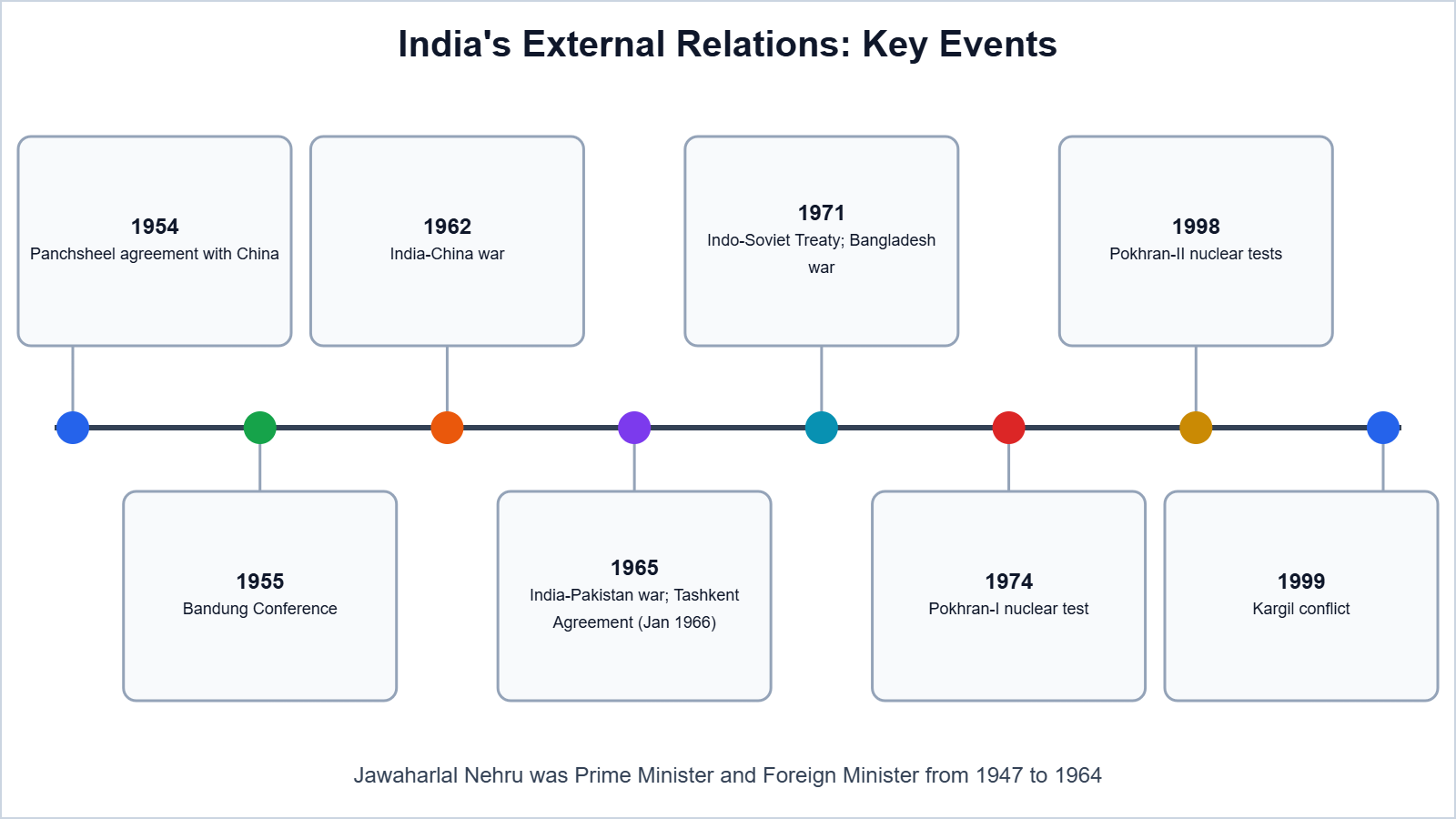
Jawaharlal Nehru was both Prime Minister and Foreign Minister from 1947 to 1964 and shaped India’s foreign policy. Its three main objectives were: to preserve hard-earned sovereignty, protect territorial integrity, and promote rapid economic development. He pursued these through non-alignment.
- India supported the decolonisation of Asia and Africa and opposed racism, for example apartheid in South Africa.
- It hosted the Asian Relations Conference (1947), supported Indonesia’s freedom struggle, and played a leading role at the Bandung Conference (1955), which led to NAM.
- It mediated in the Korean War and worked for disarmament.
2. Peace and Conflict with China
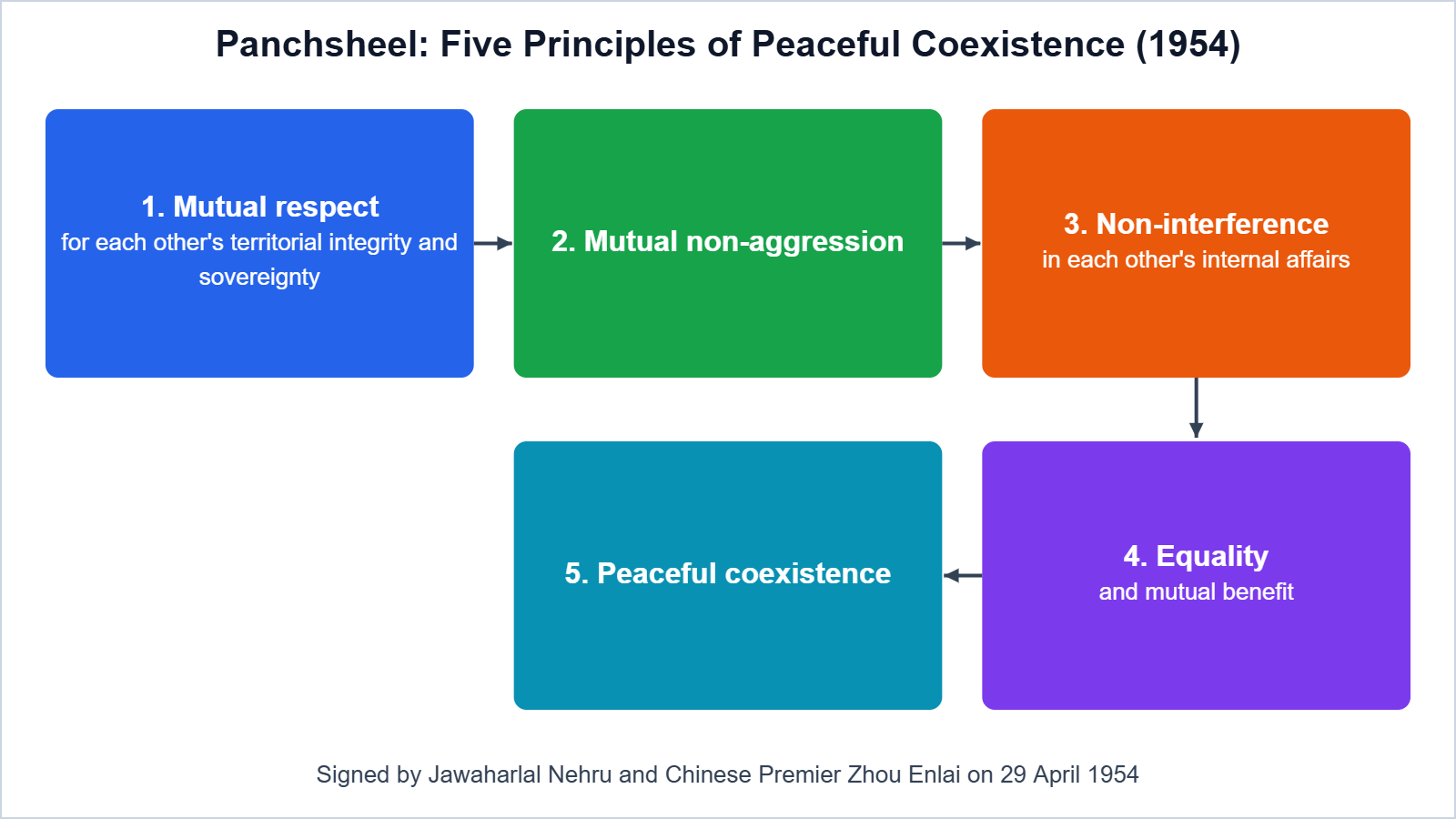
India was one of the first countries to recognise the communist government in China (1949). The Panchsheel agreement, the five principles of peaceful coexistence, was signed by Nehru and Chinese Premier Zhou Enlai on 29 April 1954. But relations soured over Tibet: China took control of Tibet in 1950, and when a revolt failed in 1959, the Dalai Lama crossed into India and was given asylum.
There were also boundary disputes over Aksai Chin in the western sector and the NEFA region (now Arunachal Pradesh) in the eastern sector. In October-November 1962 China attacked on both fronts. Indian forces suffered a setback, and China declared a unilateral ceasefire. The defeat damaged Nehru’s image; Defence Minister V.K. Krishna Menon resigned, and the government’s defence and foreign policies were criticised. It also led to a split in the Communist Party (1964). Relations improved slowly after the 1976 restoration of ambassadors and Rajiv Gandhi’s 1988 visit.
3. Wars and Peace with Pakistan
- Kashmir (1947-48): a proxy war led to the division of Kashmir along the Line of Control; the Indus Waters Treaty (1960) was signed with World Bank help.
- 1965 war: after clashes in the Rann of Kutch, Pakistan launched an attack in Jammu and Kashmir. Under Prime Minister Lal Bahadur Shastri, India pushed back. The Tashkent Agreement was signed in January 1966 between Shastri and General Ayub Khan with Soviet mediation; Shastri died in Tashkent the next day.
- 1971 war (Bangladesh): after the Pakistani army’s repression in East Pakistan, about 80 lakh refugees came to India. India signed the Treaty of Peace and Friendship with the USSR (August 1971). War broke out in December 1971; Pakistani forces in the east surrendered on 16 December, and Bangladesh became independent. The Shimla Agreement was signed by Indira Gandhi and Zulfikar Ali Bhutto in July 1972.
- Kargil (1999): India drove out intruders from the heights of Kargil.
4. India’s Nuclear Policy
India’s nuclear programme began under Homi J. Bhabha in the late 1940s. Nehru supported nuclear energy for peaceful purposes and opposed nuclear weapons. India conducted its first nuclear explosion at Pokhran in May 1974, calling it a peaceful nuclear explosion. It refused to sign the NPT (1968) and the CTBT (1996), which it considered discriminatory. In May 1998 India carried out further nuclear tests (Pokhran-II), and Pakistan followed. India’s nuclear doctrine is based on credible minimum deterrence and no first use, with a commitment to global, verifiable and non-discriminatory disarmament.
5. Shifting Alliances
Over time, India’s foreign policy has adapted to changing circumstances: closer ties with the USSR in the 1970s, improved relations with the USA, China and the West after the Cold War, the Look East (later Act East) policy, and growing economic diplomacy.
Easy Memory Trick: Panchsheel “R-N-N-E-P” – Respect, Non-aggression, Non-interference, Equality, Peaceful coexistence.
6. Timeline
Year | Event |
|---|---|
1947 | Asian Relations Conference; first Kashmir war (1947-48) |
1950 | China takes control of Tibet |
29 April 1954 | Panchsheel agreement |
1955 | Bandung Conference |
1959 | Dalai Lama gets asylum in India |
Oct-Nov 1962 | India-China war |
1965 | India-Pakistan war |
January 1966 | Tashkent Agreement |
August 1971 | Indo-Soviet Treaty of Peace and Friendship |
16 Dec 1971 | Pakistani surrender; birth of Bangladesh |
July 1972 | Shimla Agreement |
May 1974 | Pokhran-I |
May 1998 | Pokhran-II |
1999 | Kargil conflict |
7. Key Terms
Term | Meaning |
|---|---|
Panchsheel | Five principles of peaceful coexistence (1954) |
Non-alignment | Not joining military blocs; independent foreign policy |
Tashkent Agreement | 1966 India-Pakistan agreement after the 1965 war |
Shimla Agreement | 1972 India-Pakistan agreement to settle disputes bilaterally |
NEFA | North-East Frontier Agency, now Arunachal Pradesh |
No first use | Nuclear weapons only in retaliation |
CTBT | Comprehensive Test Ban Treaty (1996) |
8. Important Exam Questions
Q1. What is Panchsheel? (2 marks)
Ans. Panchsheel refers to the five principles of peaceful coexistence agreed between India and China on 29 April 1954 by Nehru and Zhou Enlai: mutual respect for territorial integrity and sovereignty, non-aggression, non-interference, equality and mutual benefit, and peaceful coexistence. These principles guided Indian foreign policy.
Q2. What were the main objectives of Nehru’s foreign policy? (2 marks)
Ans. Nehru’s foreign policy had three main objectives: to preserve the hard-earned sovereignty of India, to protect its territorial integrity, and to promote rapid economic development. He tried to achieve these goals by following non-alignment and by building friendly relations with other countries.
Q3. What was the Tashkent Agreement? (2 marks)
Ans. The Tashkent Agreement was signed in January 1966 between Prime Minister Lal Bahadur Shastri of India and General Ayub Khan of Pakistan, with the mediation of the Soviet Union. It ended the 1965 war, and both sides agreed to withdraw their forces to pre-war positions.
Q4. What is India’s nuclear doctrine? (2 marks)
Ans. India’s nuclear doctrine is based on credible minimum deterrence and no first use. This means India will keep only enough nuclear weapons to deter an attack and will use them only in retaliation. India also supports universal, verifiable and non-discriminatory nuclear disarmament.
Q5. What were the causes of the India-China war of 1962? (3 marks)
Ans. Relations between India and China worsened over Tibet, which China took over in 1950; when the Dalai Lama fled to India in 1959 and was given asylum, China accused India of interference. There were also boundary disputes over Aksai Chin in the west and the NEFA region in the east. China did not accept the boundary claimed by India. Failed talks and military build-up finally led to the Chinese attack in October 1962.
Q6. Explain the consequences of the 1962 war for India. (3 marks)
Ans. The 1962 war was a military setback that damaged India’s image at home and abroad. Nehru’s reputation suffered, and Defence Minister V.K. Krishna Menon had to resign. India realised the need to strengthen its defences, and defence spending was increased. The war also affected domestic politics: the Congress lost some by-elections, Nehru faced a no-confidence motion, and differences over China contributed to the split of the Communist Party of India in 1964.
Q7. Why did India go to war with Pakistan in 1971? (3 marks)
Ans. In 1970-71, the Pakistani army cracked down brutally on the people of East Pakistan, who supported the Awami League led by Sheikh Mujibur Rahman. About eighty lakh refugees fled to India, creating a huge economic and humanitarian burden. India supported the freedom struggle of the people of Bangladesh. After signing a treaty with the USSR in August 1971, India fought a war in December 1971 that ended with Bangladesh becoming independent.
Q8. Why did India refuse to sign the NPT? (3 marks)
Ans. India considered the Nuclear Non-Proliferation Treaty of 1968 discriminatory. It allowed the five countries that had tested nuclear weapons before 1967 to keep them, while forbidding all others from acquiring them. India argued that real security required the elimination of all nuclear weapons, not a monopoly for a few. It also wanted to keep its nuclear option open in view of threats from neighbouring countries.
Q9. Explain the main features of India’s foreign policy under Nehru. (5 marks)
Ans. Under Jawaharlal Nehru, who was both Prime Minister and Foreign Minister from 1947 to 1964, India developed a distinctive foreign policy. Its first feature was non-alignment: India refused to join either the American or Soviet bloc, so that it could take independent decisions in its national interest and receive help from both sides. Second, India supported decolonisation and opposed racism. It backed freedom struggles in Asia and Africa, supported Indonesia, and opposed apartheid in South Africa. Third, India worked for Afro-Asian unity. It hosted the Asian Relations Conference in 1947 and played an important role at the Bandung Conference in 1955, which led to the Non-Aligned Movement. Fourth, India pursued peace and peaceful coexistence. It signed the Panchsheel agreement with China in 1954 and mediated in conflicts such as the Korean War. Fifth, India supported disarmament and the United Nations. Finally, foreign policy was linked to development: India sought aid and technology from both blocs for its industries. The 1962 war with China showed the limits of this approach, but its main principles continued to guide India.
Q10. Describe the wars between India and Pakistan and their outcomes. (5 marks)
Ans. India and Pakistan have fought several wars since 1947. The first conflict, in 1947-48 over Kashmir, began when tribesmen and soldiers from Pakistan entered the state; it ended with a ceasefire and the division of Kashmir along a line of control. In 1965, after clashes in the Rann of Kutch, Pakistan launched an attack in Jammu and Kashmir. Under Lal Bahadur Shastri, Indian forces pushed back and advanced towards Lahore. The war ended with the Tashkent Agreement of January 1966, mediated by the Soviet Union, and both sides withdrew to pre-war positions. The 1971 war arose from the crisis in East Pakistan, where the Pakistani army’s repression drove about eighty lakh refugees into India. India supported the liberation struggle, and in December 1971 war broke out; within about two weeks Pakistani forces in the east surrendered, and Bangladesh became independent. The Shimla Agreement of 1972 committed both countries to settle disputes bilaterally. In 1999, Pakistani intruders occupied heights in Kargil, and India drove them out. These wars have left lasting mistrust between the two countries.
9. MCQs and Assertion-Reason
1. The Panchsheel agreement was signed in
(A) 1950 (B) 1954 (C) 1955 (D) 1962
Ans. (B)
2. The Tashkent Agreement was signed after the war of
(A) 1962 (B) 1965 (C) 1971 (D) 1999
Ans. (B)
3. India conducted its first nuclear test in
(A) 1964 (B) 1974 (C) 1988 (D) 1998
Ans. (B)
4. Who was India’s Defence Minister during the 1962 war?
(A) Y.B. Chavan (B) V.K. Krishna Menon (C) Sardar Swaran Singh (D) Morarji Desai
Ans. (B)
Options: (A) Both A and R are true and R is the correct explanation of A. (B) Both A and R are true but R is not the correct explanation of A. (C) A is true but R is false. (D) A is false but R is true.
Assertion (A): India signed a treaty of friendship with the Soviet Union in August 1971.
Reason (R): India needed support because the USA and China were backing Pakistan during the Bangladesh crisis.
Ans. (A)
10. Case Study
Read the passage and answer the questions: In 1954 two neighbouring Asian countries agreed on five principles to guide their relations, including respect for each other’s territory and non-interference in internal affairs. Within a few years, however, disputes over the boundary and the asylum given to a spiritual leader led to tension, and in 1962 the two countries fought a war.
(i) Name the agreement of 1954.
Ans. Panchsheel.
(ii) Who was the spiritual leader given asylum?
Ans. The Dalai Lama (1959).
(iii) Name the two disputed areas of the boundary.
Ans. Aksai Chin and the NEFA region (Arunachal Pradesh).
Conclusion: India’s foreign policy, shaped by Nehru, combined non-alignment, support for decolonisation and peaceful coexistence. Wars with China and Pakistan tested this policy, and India developed a nuclear capability based on no first use while continuing to adapt to a changing world.