Globalisation – Political Science Class 12 Notes
Chapter – 8
Globalisation
1. Meaning of Globalisation
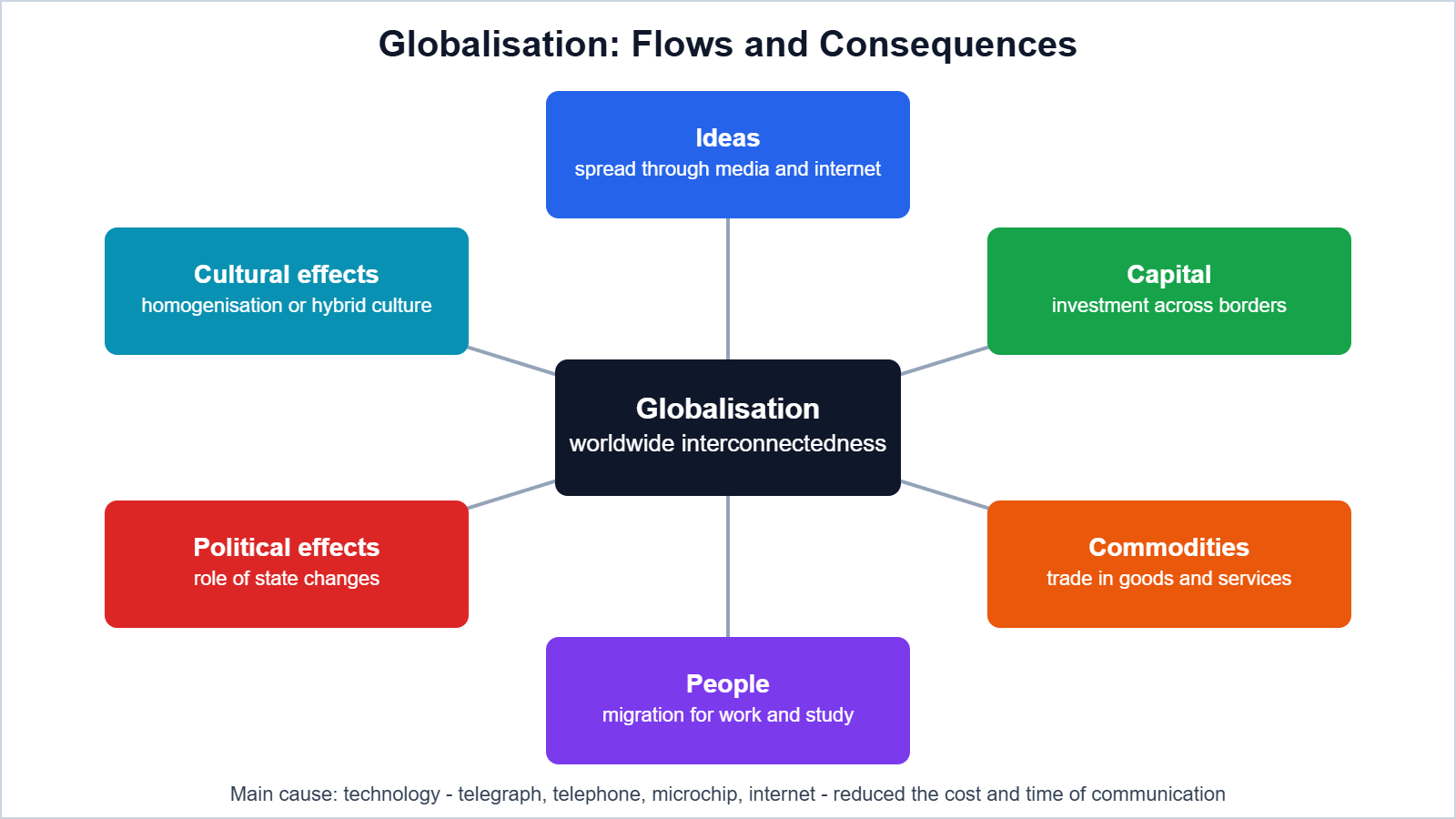
Globalisation means the growing interconnectedness of the world through flows of ideas, capital, commodities and people across national boundaries. It is a multi-dimensional process with political, economic and cultural aspects, and its effects are not the same for all societies or all groups within a society.
2. Causes of Globalisation
- Technology is the most important cause: inventions such as the telegraph, telephone, microchip and internet have revolutionised communication, making it fast and cheap.
- The ability to move ideas, capital, goods and people easily has been made possible by technology, while the awareness that events in one place affect others (for example, bird flu or a financial crisis) has encouraged closer links.
- Policies of governments and international institutions such as the IMF and WTO have also promoted free trade and investment.
3. Political Consequences
- Globalisation may reduce the capacity of the state: the welfare state gives way to a minimalist state focused on law and order and security, and market forces decide economic priorities.
- Multinational corporations gain influence over government decisions.
- At the same time, the state remains powerful in its core functions, and technology gives it better tools to gather information and govern.
4. Economic Consequences
- Greater trade in goods and services, and freer movement of capital; however, the movement of people is still restricted by visa rules of developed countries.
- Supporters argue it brings more growth, jobs and wider choices for consumers.
- Critics argue it benefits a small section, increases inequality between and within countries, causes job insecurity, and weakens social safety nets – “economic re-colonisation”.
- Developing countries were often asked by the IMF and World Bank to reduce state spending on welfare.
5. Cultural Consequences
Critics fear cultural homogenisation – the spread of a Western, especially American, culture that threatens local traditions (sometimes called “McDonaldisation”). Others point out that cultures are not static: outside influences can enrich local culture and create hybrid cultures, as when jeans are worn with a kurta. Globalisation can also spread Indian culture abroad, through films, food, yoga and music.
6. India and Globalisation
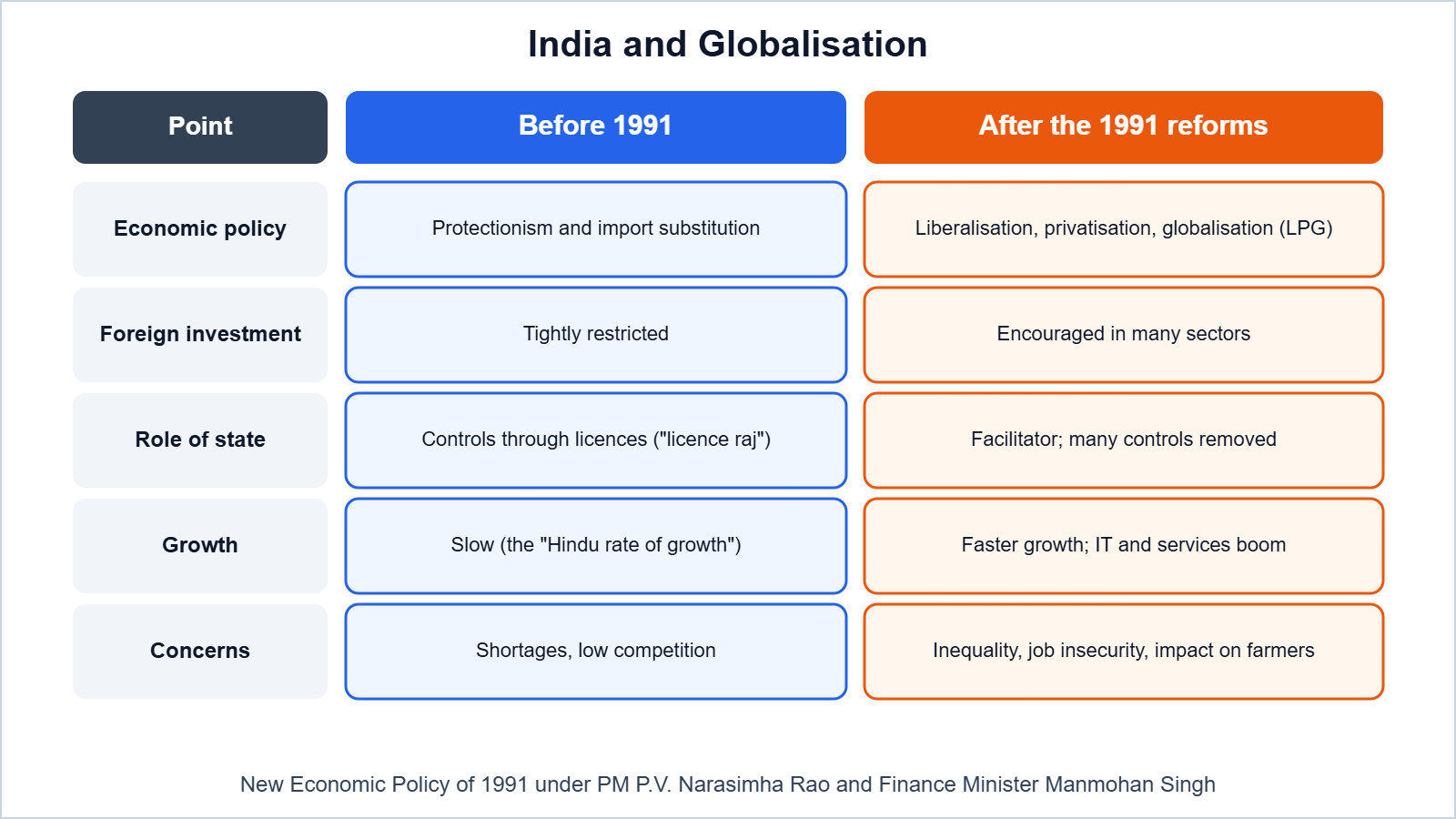
After independence, India followed protectionism, producing goods at home and restricting imports and foreign investment. This led to slow growth. Facing a financial crisis, India introduced the New Economic Policy in 1991 under Prime Minister P.V. Narasimha Rao and Finance Minister Manmohan Singh: liberalisation, privatisation and globalisation. Controls were removed, foreign investment was welcomed, and sectors such as trade, telecommunications and services grew fast.
7. Resistance to Globalisation
Globalisation has faced criticism from the left (who see it as a form of global capitalism that makes the rich richer), from the right (who fear the loss of national culture and economic sovereignty) and from many social movements. The World Social Forum, an open meeting of human rights activists, environmentalists, labour, youth and women activists opposed to neo-liberal globalisation, first met at Porto Alegre, Brazil, in 2001; its fourth meeting was held in Mumbai in 2004. Protests at the WTO meeting in Seattle (1999) drew world attention.
In India: left parties, trade unions, farmers’ groups and movements such as the Indian Social Forum have opposed parts of globalisation; there have been protests against foreign seeds and patents, and against some multinational companies. Some groups have opposed foreign cultural influences, such as foreign television channels and celebrations of Valentine’s Day.
Easy Memory Trick: Four flows of globalisation “I-C-C-P” – Ideas, Capital, Commodities, People.
8. Timeline
Year | Event |
|---|---|
1947-1990 | Protectionism and planned economy in India |
1991 | Financial crisis; New Economic Policy (LPG reforms) |
1995 | WTO established; India a founding member |
1999 | Protests at the WTO meeting in Seattle |
2001 | First World Social Forum at Porto Alegre, Brazil |
2004 | Fourth World Social Forum held in Mumbai |
2008 | Global financial crisis shows interdependence |
9. Key Terms
Term | Meaning |
|---|---|
Globalisation | Worldwide interconnectedness through flows of ideas, capital, goods and people |
Liberalisation | Removal of government controls on the economy |
Privatisation | Transfer of state enterprises to private ownership |
MNC | Multinational corporation operating in many countries |
Cultural homogenisation | Spread of one dominant culture, reducing diversity |
Hybrid culture | Mixing of local and outside cultural elements |
World Social Forum | Global meeting of groups opposed to neo-liberal globalisation |
10. Important Exam Questions
Q1. What is meant by globalisation? (2 marks)
Ans. Globalisation means the growing interconnectedness of different parts of the world through flows of ideas, capital, commodities and people across national boundaries. It is a multi-dimensional process with political, economic and cultural effects, and it affects different societies and groups in different ways.
Q2. What is the main cause of globalisation? (2 marks)
Ans. The main cause of globalisation is technology. Inventions such as the telegraph, telephone, microchip and internet have greatly reduced the cost and time of communication. This has made it possible for ideas, capital, goods and people to move across the world much faster than before.
Q3. What is the World Social Forum? (2 marks)
Ans. The World Social Forum is an open meeting of activists, including human rights workers, environmentalists, labour unions, youth and women’s groups, who oppose neo-liberal globalisation. It first met at Porto Alegre in Brazil in 2001, and its fourth meeting was held in Mumbai in 2004.
Q4. What is a hybrid culture? Give an example. (2 marks)
Ans. A hybrid culture is formed when elements of a local culture mix with elements of an outside culture, creating something new. For example, Indian youth often wear blue jeans with a khadi kurta, or Indian music combines traditional instruments with Western styles. Globalisation encourages such mixing.
Q5. Explain any three political consequences of globalisation. (3 marks)
Ans. First, globalisation may reduce the capacity of the state to act on its own, as the welfare state gives way to a minimalist state that concentrates on law and order and security. Second, multinational companies gain greater influence over government decisions, as governments compete for investment. Third, in some respects the state becomes stronger, because new technology helps it collect information about citizens and govern more efficiently, and it remains the main political authority.
Q6. Describe any three economic consequences of globalisation. (3 marks)
Ans. Globalisation has increased trade in goods and services and allowed capital to move freely across borders, giving many countries access to foreign investment and markets. Supporters say this brings growth and jobs. However, critics point out that the benefits have been uneven: inequality has grown within and between countries, many workers face job insecurity, and governments have reduced spending on welfare. Moreover, the movement of people remains restricted by strict visa rules.
Q7. Why did India adopt the New Economic Policy in 1991? (3 marks)
Ans. By 1991 India faced a severe financial crisis, with very low foreign exchange reserves and a high fiscal deficit. Years of protectionism and the licence system had produced slow growth and inefficiency. To overcome the crisis and speed up growth, the government of P.V. Narasimha Rao, with Manmohan Singh as finance minister, introduced liberalisation, privatisation and globalisation. Controls were removed, foreign investment was welcomed and trade barriers were reduced.
Q8. Explain the fear of cultural homogenisation. (3 marks)
Ans. Cultural homogenisation means the spread of one dominant culture throughout the world, reducing cultural diversity. Critics fear that globalisation spreads Western, especially American, culture through fast food, films, clothing and media, so that local traditions, languages and lifestyles may be lost. This process is sometimes called McDonaldisation. Others reply that cultures can absorb outside influences and become richer, producing hybrid cultures, and that Indian culture is also spreading abroad.
Q9. Explain the cultural consequences of globalisation. (5 marks)
Ans. Globalisation affects culture in both negative and positive ways. The main fear is cultural homogenisation, the spread of a single dominant culture, usually Western and especially American, across the world. Through television, films, the internet, advertising and global brands, young people everywhere begin to eat the same fast food, wear similar clothes and watch the same programmes. Critics call this McDonaldisation and argue that it threatens local languages, traditions, crafts and lifestyles, making the world culturally poorer. However, there are also positive effects. Cultures are not fixed; they have always changed by absorbing outside influences. Globalisation widens people’s choices and can enrich local culture without destroying it. A good example is the blue jeans that many young Indians wear with a khadi kurta, a hybrid combination that did not exist before. Similarly, Indian music and food have absorbed new elements. Globalisation also works the other way: Indian films, yoga, cuisine and music have become popular abroad. Thus globalisation produces both the danger of uniformity and the possibility of cultural heterogenisation, depending on how societies respond.
Q10. Explain the resistance to globalisation in the world and in India. (5 marks)
Ans. Globalisation has been criticised and resisted by many groups. Left-wing critics argue that it is a phase of global capitalism that makes the rich richer and the poor poorer, and that it weakens the state’s ability to protect the poor through welfare. Right-wing critics fear the loss of national culture, traditions and economic sovereignty. Worldwide, opposition has taken the form of social movements and protests. In 1999, large protests took place at the meeting of the WTO in Seattle against unfair trade practices. The World Social Forum, an open meeting of human rights activists, environmentalists, labour, youth and women’s groups, first met at Porto Alegre in Brazil in 2001 to oppose neo-liberal globalisation, and its fourth meeting was held in Mumbai in 2004. In India, resistance has come from left parties, trade unions, farmers’ groups and the Indian Social Forum. Farmers have protested against the entry of some multinational companies and against patents on seeds. Some groups have opposed foreign cultural influences, such as foreign television channels and celebrations like Valentine’s Day. Globalisation thus remains contested.
11. MCQs and Assertion-Reason
1. India adopted the New Economic Policy in
(A) 1985 (B) 1991 (C) 1995 (D) 2001
Ans. (B)
2. The first meeting of the World Social Forum was held at
(A) Mumbai (B) Seattle (C) Porto Alegre (D) Geneva
Ans. (C)
3. The main cause of globalisation is
(A) war (B) technology (C) colonialism (D) religion
Ans. (B)
4. Which of the following is NOT one of the four flows of globalisation?
(A) Ideas (B) Capital (C) Commodities (D) Weapons
Ans. (D)
Options: (A) Both A and R are true and R is the correct explanation of A. (B) Both A and R are true but R is not the correct explanation of A. (C) A is true but R is false. (D) A is false but R is true.
Assertion (A): Globalisation has not led to free movement of people as much as of goods and capital.
Reason (R): Developed countries maintain strict visa rules to protect jobs for their own citizens.
Ans. (A)
12. Case Study
Read the passage and answer the questions: A young woman in a small Indian town orders pizza through a mobile app, wears jeans with a handloom kurta, and works from home for a company based in another country. Her grandfather, a small farmer, worries that imported goods and new seed patents may harm his income.
(i) Which process is reflected in her lifestyle?
Ans. Globalisation.
(ii) What does “jeans with a handloom kurta” show?
Ans. A hybrid culture.
(iii) Why is the grandfather worried?
Ans. He fears that competition and patents introduced by globalisation may hurt small farmers.
Conclusion: Globalisation connects the world through flows of ideas, capital, goods and people. It has political, economic and cultural effects, both positive and negative. India joined it through the 1991 reforms, and the debate over its benefits and costs continues.