Security in the Contemporary World – Political Science Class 12 Notes
Chapter – 6
Security in the Contemporary World
1. What is Security?
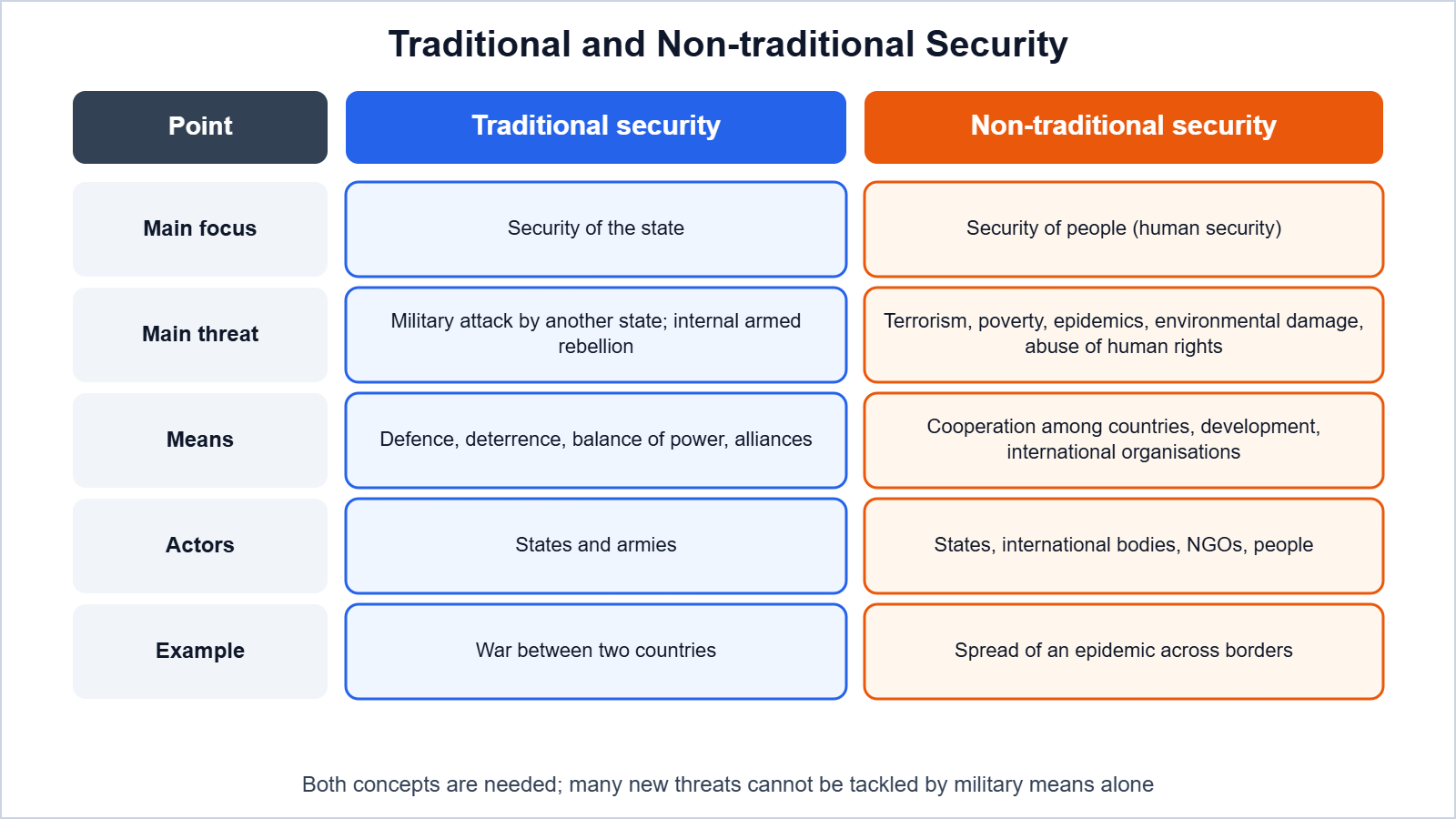
Security means freedom from threats. In politics, it refers to freedom from threats to core values so dangerous that, if nothing is done, they could cause irreparable damage. There are two broad ways of looking at security: traditional and non-traditional.
2. Traditional Notions: External Security
In the traditional view, the greatest danger to a country is military attack by another state. A government has three basic choices: to surrender, to prevent attack by making war costly (deterrence), or to defend itself to limit the damage (defence). Other means include:
- Balance of power: building up one’s own power or joining others so that no single country becomes dominant.
- Alliance building: coalitions of states that combine their military strength, usually through formal treaties (for example NATO).
- Disarmament: giving up certain kinds of weapons – for example, the Biological Weapons Convention (1972) and the Chemical Weapons Convention (1992) ban these weapons.
- Arms control: regulating the acquisition or development of weapons – for example, the Anti-Ballistic Missile Treaty (1972), SALT and START.
- Confidence building: exchanging information about military plans and intentions to avoid misunderstanding.
Important: Traditional security also includes internal security – threats from armed rebellion or separatist movements. After 1945, many new states in Asia and Africa faced both external and internal threats.
3. Non-traditional Notions of Security
Non-traditional security looks beyond military threats and focuses on human security – the protection of people rather than only states – and on global security against threats such as climate change, epidemics and terrorism that affect the whole world.
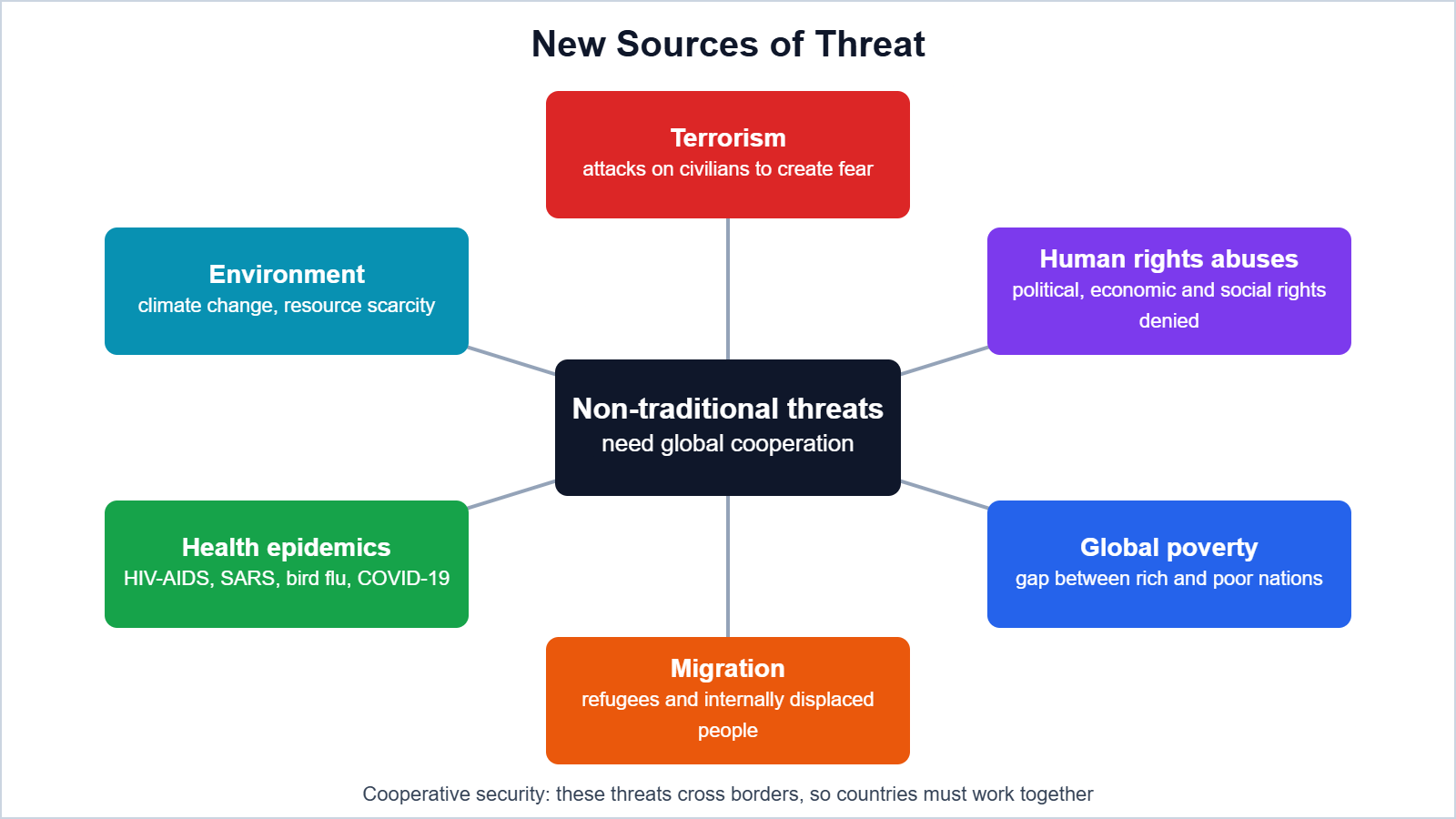
- Terrorism: political violence that deliberately targets civilians to create fear, for example the attacks on the USA on 11 September 2001.
- Human rights: political, economic, social and cultural rights, and the rights of indigenous people and minorities.
- Global poverty: the gap between rich and poor countries, and within countries, leads to conflict and migration.
- Migration: refugees who cross borders to escape war or persecution, and internally displaced persons.
- Health epidemics: diseases such as HIV-AIDS, SARS, bird flu and COVID-19 spread across borders.
4. Cooperative Security
Since these threats cross borders, they can be tackled only through cooperation among countries, international organisations (UN, WHO, World Bank, IMF), NGOs and civil society. Force may still be needed in some cases, for example against terrorists, but it should be used collectively and legitimately.
5. India’s Security Strategy
- Strengthening military capabilities: India has faced conflicts with Pakistan (1947-48, 1965, 1971, 1999) and China (1962). It conducted nuclear tests in 1974 (Pokhran-I) and 1998 (Pokhran-II) to safeguard its security.
- Strengthening international norms and institutions: India has supported decolonisation, disarmament, non-alignment and the UN; it supports universal and non-discriminatory nuclear disarmament.
- Meeting internal security challenges: dealing with militant groups in some regions while keeping democracy and accommodating different communities.
- Developing the economy: reducing poverty and inequality, since security also depends on people’s well-being.
India’s nuclear policy: India follows a policy of “no first use” and credible minimum deterrence. It has refused to sign the Nuclear Non-Proliferation Treaty (1968) and the Comprehensive Test Ban Treaty (1996), regarding them as discriminatory because they allow existing nuclear powers to keep their weapons.
Easy Memory Trick: Traditional security choices “S-D-D” – Surrender, Deterrence, Defence.
6. Timeline
Year | Event |
|---|---|
1962 | India-China war |
1968 | Nuclear Non-Proliferation Treaty |
1972 | Biological Weapons Convention; ABM Treaty; SALT I |
1974 | Pokhran-I nuclear test by India |
1992 | Chemical Weapons Convention agreed |
1996 | Comprehensive Test Ban Treaty opened for signature |
1998 | Pokhran-II tests; Pakistan also tests |
1999 | Kargil conflict |
2001 | Terrorist attacks on the USA (11 September) |
2020 | COVID-19 pandemic |
7. Key Terms
Term | Meaning |
|---|---|
Security | Freedom from threats to core values |
Deterrence | Preventing war by threatening unacceptable damage |
Balance of power | Distribution of power so no state becomes dominant |
Disarmament | Giving up certain kinds of weapons |
Arms control | Regulating the development and acquisition of weapons |
Human security | Protection of people rather than only the state |
No first use | Policy of using nuclear weapons only in retaliation |
8. Important Exam Questions
Q1. What is meant by security? (2 marks)
Ans. Security means freedom from threats. In politics it refers to freedom from extremely dangerous threats to the core values of a country or its people, threats that could cause irreparable damage if nothing is done. It includes both military and non-military dangers.
Q2. Differentiate between disarmament and arms control. (2 marks)
Ans. Disarmament means giving up certain kinds of weapons altogether, as in the conventions banning biological and chemical weapons. Arms control means regulating the development or acquisition of weapons, so that their numbers and types are limited, as in the SALT and START agreements.
Q3. What is human security? (2 marks)
Ans. Human security means protecting people rather than only protecting the state. It covers freedom from violence and also freedom from want, such as hunger, disease and poverty. Supporters argue that the primary goal of all security policy should be the safety and well-being of individuals.
Q4. What is India’s policy of “no first use”? (2 marks)
Ans. Under its policy of no first use, India has declared that it will not be the first to use nuclear weapons in a conflict. It will use them only in retaliation against a nuclear attack, while maintaining a credible minimum deterrent to discourage any such attack.
Q5. What are the components of the traditional notion of security? (3 marks)
Ans. In the traditional notion, the main threat is military attack by another country. A state can prevent attack by deterrence, making war too costly, or limit damage by defence. It can also maintain a balance of power so that no rival becomes dominant, and build alliances with other states to combine military strength. Disarmament, arms control and confidence-building measures are also part of traditional security, since they reduce the danger of war.
Q6. Name any three new sources of threats to security. (3 marks)
Ans. One new threat is terrorism, in which groups deliberately target civilians to create fear and force governments to change policy. A second is the spread of health epidemics such as HIV-AIDS, bird flu and COVID-19, which move across borders very quickly. A third is global poverty and inequality, which can lead to conflict and large-scale migration. Climate change and abuses of human rights are also considered serious non-traditional threats.
Q7. Why is cooperative security needed to deal with non-traditional threats? (3 marks)
Ans. Non-traditional threats such as terrorism, epidemics, climate change and poverty do not respect national borders. No single country, however powerful, can control them on its own. Countries must therefore share information, coordinate policies and pool resources. International organisations such as the UN, WHO, World Bank and IMF, as well as NGOs and civil society, play important roles. Military force may be needed sometimes, for example against terrorists, but it should be used collectively.
Q8. Why has India refused to sign the NPT and the CTBT? (3 marks)
Ans. India believes that both treaties are discriminatory. The NPT allows the countries that had tested nuclear weapons before 1967 to keep them, while preventing others from acquiring them. The CTBT similarly freezes the existing inequality. India supports complete, universal and non-discriminatory nuclear disarmament instead. It also argues that its nuclear capability is necessary for its security in a region where it faces nuclear-armed neighbours, and it follows no first use.
Q9. Explain the components of India’s security strategy. (5 marks)
Ans. India’s security strategy has four broad components. The first is strengthening its military capabilities. India has fought wars with Pakistan in 1947-48, 1965, 1971 and 1999, and with China in 1962, and it is surrounded by nuclear-armed neighbours. It therefore maintains strong armed forces and conducted nuclear tests in 1974 and 1998, while following a policy of no first use. The second component is strengthening international norms and institutions. India has supported Asian solidarity, decolonisation, disarmament and the United Nations as a forum for settling disputes. It has called for universal, non-discriminatory nuclear disarmament and has contributed many troops to UN peacekeeping. The third component is meeting internal security challenges. Several regions have experienced militancy and separatist movements, and India has tried to deal with them through a combination of security measures and democratic accommodation, keeping national unity while respecting diversity. The fourth component is economic development. India recognises that poverty, inequality and unemployment are threats to security, so it seeks to lift people out of poverty and reduce inequalities through economic growth and democratic welfare policies.
Q10. Distinguish between traditional and non-traditional notions of security. (5 marks)
Ans. Traditional and non-traditional notions of security differ in their focus, threats and methods. The traditional notion is concerned mainly with the security of the state. Its chief threat is military attack by another country, or armed rebellion within the country, which endangers sovereignty, territory and the lives of citizens. It relies on means such as deterrence, defence, the balance of power and military alliances, along with disarmament, arms control and confidence-building between states. The non-traditional notion goes beyond military threats and beyond the state. It focuses on human security, the protection of individuals and communities, and on global security against dangers that affect the whole world. Its threats include terrorism, abuses of human rights, global poverty, large-scale migration, health epidemics such as HIV-AIDS and COVID-19, and environmental problems such as climate change. These threats cross borders, so they require cooperation among states, international organisations, NGOs and civil society rather than military force alone. In practice both views are important, because states still face military dangers while people face many non-military threats to their well-being.
9. MCQs and Assertion-Reason
1. India conducted its first nuclear test (Pokhran-I) in
(A) 1964 (B) 1974 (C) 1988 (D) 1998
Ans. (B)
2. Which treaty bans chemical weapons?
(A) BWC 1972 (B) CWC 1992 (C) NPT 1968 (D) CTBT 1996
Ans. (B)
3. Which of the following is a non-traditional threat?
(A) Military invasion (B) Arms race (C) Health epidemic (D) Border war
Ans. (C)
4. India’s nuclear doctrine is based on
(A) first strike (B) no first use (C) preventive war (D) pre-emption
Ans. (B)
Options: (A) Both A and R are true and R is the correct explanation of A. (B) Both A and R are true but R is not the correct explanation of A. (C) A is true but R is false. (D) A is false but R is true.
Assertion (A): Global poverty is a source of insecurity.
Reason (R): Poverty and inequality can lead to conflict and large-scale migration.
Ans. (A)
10. Case Study
Read the passage and answer the questions: A new virus spreads from one country to many others within a few weeks through international travel. Hospitals are overwhelmed, economies slow down, and governments impose restrictions. Scientists from different countries share data to develop vaccines, and an international health organisation coordinates the response.
(i) Is this a traditional or non-traditional threat?
Ans. Non-traditional.
(ii) Which international organisation is likely to coordinate the response?
Ans. The World Health Organisation (WHO).
(iii) Why is cooperation necessary here?
Ans. The virus crosses borders, so no country can control it alone.
Conclusion: Security today includes both protection of the state from military attack and protection of people from threats such as terrorism, poverty, disease and environmental damage. India’s strategy combines military strength, support for international norms, internal stability and economic development.