The End of Bipolarity – Political Science Class 12 Notes
Chapter – 2
The End of Bipolarity
1. The Soviet System
The Union of Soviet Socialist Republics (USSR) was formed after the socialist revolution in Russia in 1917. It was a federation of 15 republics. After the Second World War, the East European countries liberated by the Soviet army also came under its control and formed the second world.
- Features: state ownership of all property and industry, a planned economy, one-party rule by the Communist Party, a minimum standard of living for all, free education and health care, and no unemployment.
- Achievements: a powerful economy after the USA, a strong military, large industries, nuclear and space programmes (first satellite and first man in space).
- Weaknesses: heavy bureaucracy, lack of political freedom, shortage of consumer goods, poor technology in many fields, and Russian dominance over other republics.
2. Gorbachev and the Disintegration
Mikhail Gorbachev became General Secretary of the Communist Party in 1985. He introduced perestroika (economic restructuring) and glasnost (openness), and normalised relations with the West. People in Eastern Europe began to overthrow their communist governments; the Berlin Wall fell in November 1989 and Germany was unified in 1990.
Reforms raised expectations but were opposed by hardliners. In August 1991 a coup by communist hardliners failed after Boris Yeltsin led popular resistance. In December 1991, Russia, Ukraine and Belarus declared that the USSR had been dissolved and formed the Commonwealth of Independent States (CIS). Russia became the successor state and took the Soviet seat in the UN Security Council.
Remember: The three Baltic republics – Estonia, Latvia and Lithuania – were the first to declare independence and did not join the CIS.
3. Consequences of the Disintegration
- End of the Cold War and of the arms race and ideological conflict.
- The world became unipolar, with the USA as the only superpower; capitalism became the dominant economic system and the IMF and World Bank grew in influence.
- Emergence of 15 new countries, many of which joined the European Union or NATO.
- The Baltic and East European states became more independent of Russia.
4. Shock Therapy
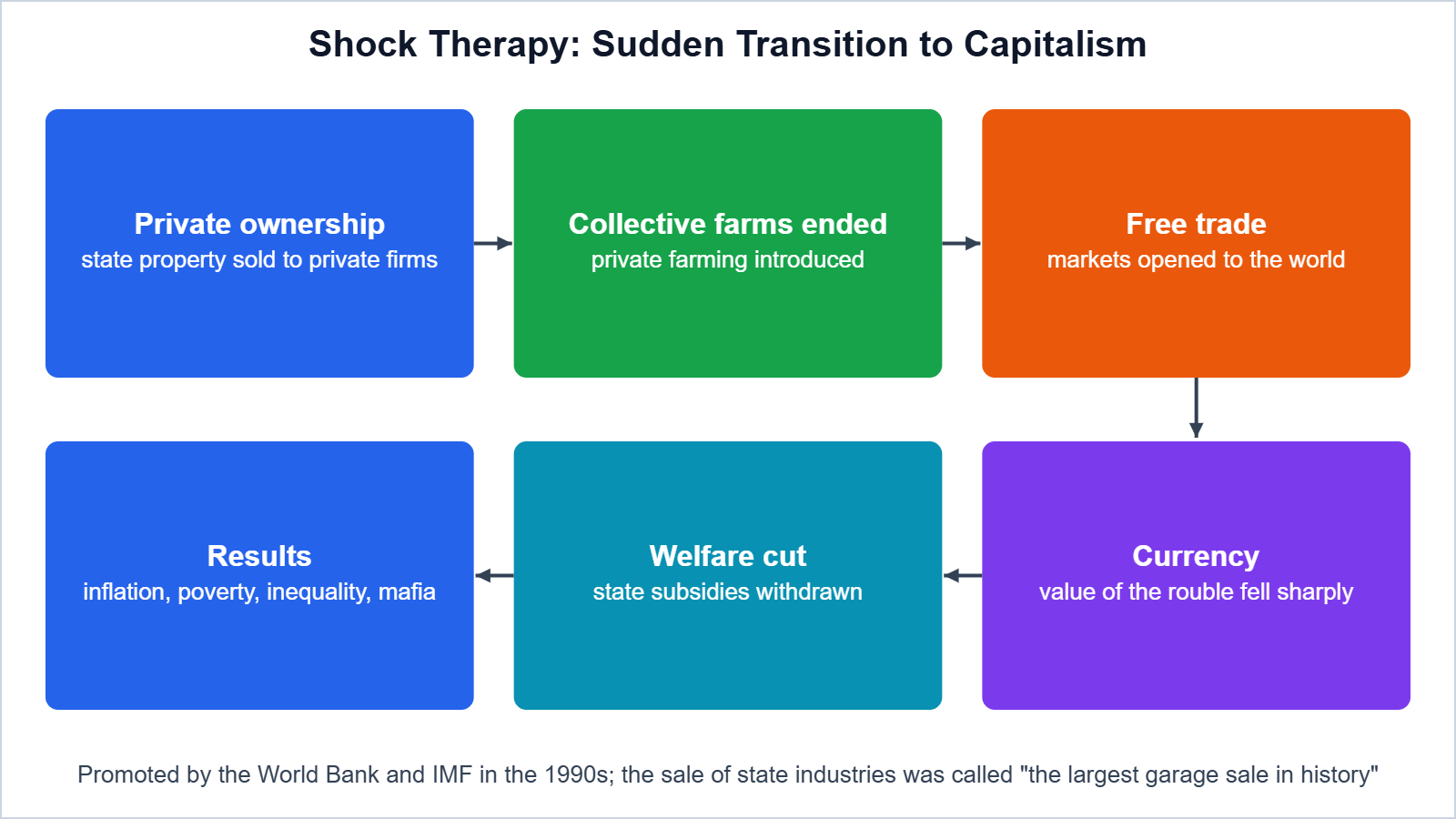
The transition from an authoritarian socialist system to a democratic capitalist system in Russia, Central Asia and Eastern Europe in the 1990s, influenced by the World Bank and the IMF, was called shock therapy. Private property replaced state ownership, collective farms gave way to private farming, the economy was opened to foreign trade and investment, and a free market decided prices.
Consequences: around 90 per cent of industries were sold to private companies at very low prices; the rouble lost value; inflation wiped out savings; the old social welfare system was dismantled; a new rich class and a mafia emerged; inequality and poverty grew. Constitutions were drafted in a hurry, and many new states had strong presidents and weak parliaments.
5. Tensions and Conflicts
Several former Soviet republics faced conflicts: secessionist movements in Chechnya and Dagestan in Russia, a long civil war in Tajikistan, and the conflict between Armenia and Azerbaijan over Nagorno-Karabakh. In Central Asia, the region’s oil and gas resources attracted the interest of outside powers.
6. India and the Post-Communist Countries
India maintains good relations with all the post-communist countries, but its strongest relationship is with Russia. Both share a vision of a multipolar world, with several centres of power and collective security. India and Russia signed a Declaration on Strategic Partnership in 2000.
- Russia has supported India on Kashmir and on terrorism, and supports India’s claim to a permanent seat in the UN Security Council.
- Russia is a major supplier of defence equipment to India; many Indian military systems are Russian in origin.
- Cooperation in energy (oil and gas), nuclear energy (for example the Kudankulam plant in Tamil Nadu) and space technology.
- Russia gains from India as a large market for its arms and as a partner in a multipolar world.
Easy Memory Trick: Gorbachev’s reforms “G and P” – Glasnost (openness) and Perestroika (restructuring).
7. Timeline
Year | Event |
|---|---|
1917 | Socialist revolution in Russia |
1922 | USSR formed |
1979 | Soviet intervention in Afghanistan |
1985 | Gorbachev becomes General Secretary |
1989 | Fall of the Berlin Wall (November) |
1990 | Germany unified; Baltic states move towards independence |
August 1991 | Failed coup against Gorbachev; Yeltsin leads resistance |
December 1991 | USSR dissolved; CIS formed; Gorbachev resigns |
2000 | India-Russia Declaration on Strategic Partnership |
8. Key Terms
Term | Meaning |
|---|---|
Perestroika | Restructuring of the Soviet economy |
Glasnost | Openness and freedom of expression |
CIS | Commonwealth of Independent States formed in December 1991 |
Shock therapy | Sudden move to a capitalist market economy in the 1990s |
Unipolarity | A world order dominated by one superpower |
Multipolarity | A world with several centres of power |
Successor state | Russia, which took over the Soviet seat in the UN |
9. Important Exam Questions
Q1. What were perestroika and glasnost? (2 marks)
Ans. These were the reform policies of Mikhail Gorbachev after 1985. Perestroika meant restructuring of the Soviet economy to make it more efficient, while glasnost meant openness, allowing people greater freedom of speech and information. Together they aimed to reform the system but ended up weakening it.
Q2. What was the Commonwealth of Independent States? (2 marks)
Ans. The CIS was the association formed in December 1991 when Russia, Ukraine and Belarus declared that the Soviet Union had ended. Most former Soviet republics, except the three Baltic states, joined it. It replaced the USSR as a loose association of independent countries led by Russia.
Q3. What is meant by shock therapy? (2 marks)
Ans. Shock therapy was the sudden change from a state-controlled socialist economy to a free-market capitalist economy in Russia, Central Asia and Eastern Europe in the 1990s. It involved privatisation, free trade and the end of collective farms, and was supported by the World Bank and IMF.
Q4. Name any four features of the Soviet system. (2 marks)
Ans. The Soviet system had state ownership of property and industry, a centrally planned economy, and one-party rule by the Communist Party. It guaranteed a minimum standard of living, with free education and health care and no unemployment, but political freedom was limited and bureaucracy was heavy.
Q5. Mention any three consequences of the disintegration of the USSR. (3 marks)
Ans. First, it ended the Cold War, the arms race and the ideological confrontation between capitalism and socialism. Second, the world became unipolar, with the United States as the only superpower, and capitalism became the dominant economic system, increasing the influence of the IMF and World Bank. Third, fifteen independent countries emerged, many of which later joined the European Union or NATO and developed their own foreign policies.
Q6. Why is the sale of Soviet state industries called “the largest garage sale in history”? (3 marks)
Ans. Under shock therapy, the valuable industries of the former Soviet Union were sold quickly to private individuals and companies. Since the sale was hurried and the assets were undervalued, they went at throwaway prices, much as goods are sold cheaply at a garage sale. About ninety per cent of industries were sold in this way. Ordinary citizens lost the wealth built up over decades, while a few people became very rich.
Q7. Why are India-Russia relations important for India? (3 marks)
Ans. Russia has been a reliable friend of India on key issues such as Kashmir and terrorism, and it supports India’s claim to a permanent seat in the UN Security Council. It is a major source of defence equipment for India and a partner in energy, nuclear power and space technology. Both countries also share the vision of a multipolar world in which several centres of power cooperate, so the relationship strengthens India’s position.
Q8. Name any three conflicts that arose in former Soviet republics. (3 marks)
Ans. Several conflicts broke out after the disintegration. In Russia, Chechnya and Dagestan saw violent secessionist movements against the central government. Tajikistan suffered a long and bloody civil war between rival groups. Armenia and Azerbaijan fought over the region of Nagorno-Karabakh, which caused heavy loss of life and displacement. These conflicts showed that the break-up of a large multinational state can leave behind serious ethnic and territorial disputes.
Q9. Explain the main causes of the disintegration of the Soviet Union. (5 marks)
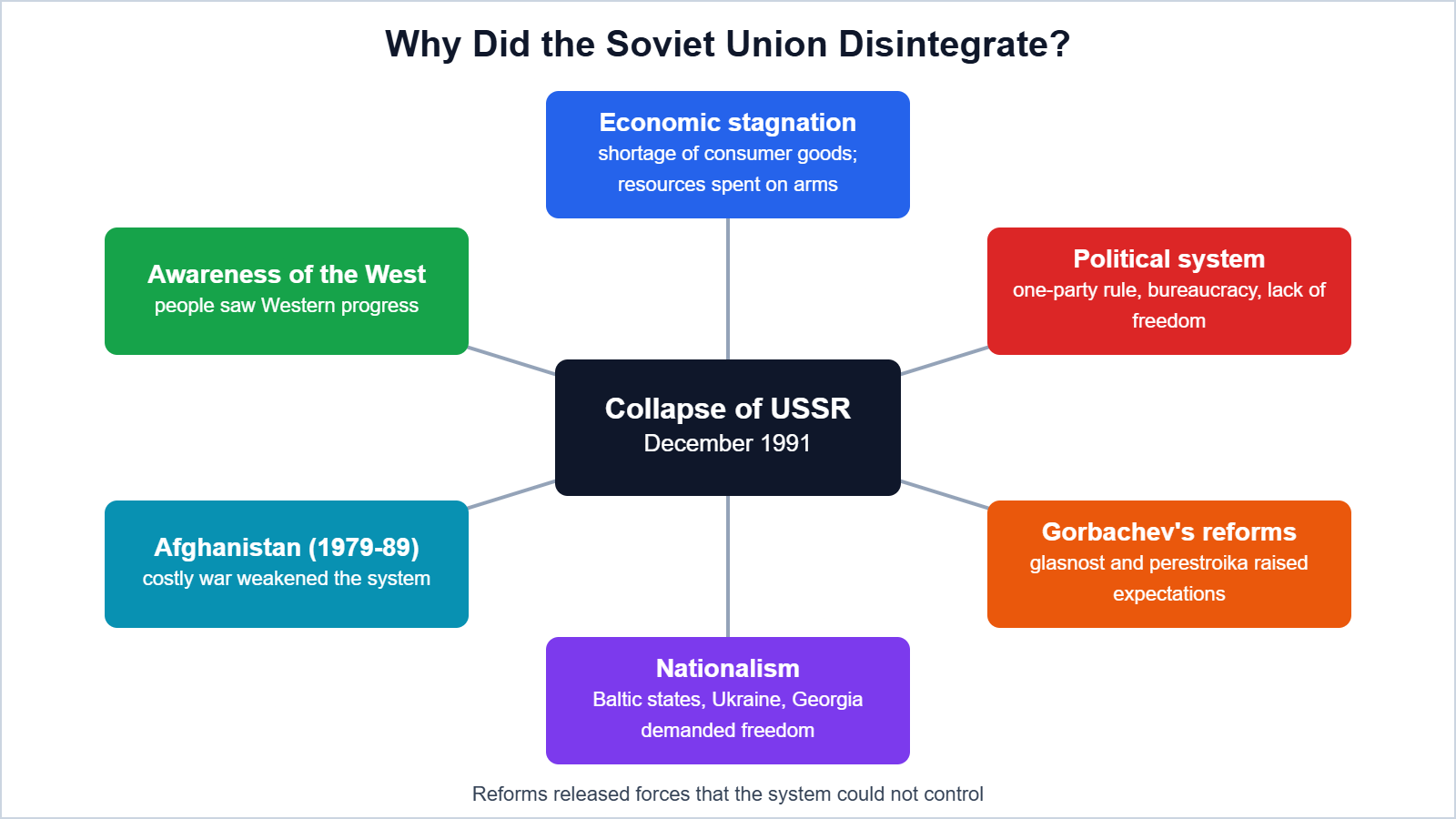
Ans. Several causes together led to the end of the USSR in December 1991. First, the Soviet economy had stagnated. It produced weapons and heavy machinery, but there were severe shortages of consumer goods and food, and technology lagged behind the West. Second, the Soviet Union spent a huge share of its resources on maintaining a nuclear arsenal, its military and its satellite states in Eastern Europe, and the long war in Afghanistan from 1979 drained it further. Third, the political system was rigid: the Communist Party ruled without opposition, bureaucracy was heavy, and people had little freedom, so the system lost popular support. Fourth, as people learned more about the progress of Western countries, they became aware of how far behind they were. Fifth, Gorbachev’s reforms of perestroika and glasnost raised expectations that could not be met quickly; hardliners opposed him, while others felt he was moving too slowly. Finally, nationalism grew in republics such as the Baltic states, Ukraine and Georgia, which demanded independence. When the August 1991 coup failed, the central authority collapsed.
Q10. Explain the consequences of shock therapy in the former Soviet countries. (5 marks)
Ans. Shock therapy brought the former Soviet countries into the capitalist world economy, but its immediate effects were largely harmful. First, the economy was ruined: state industries, built up over decades, were sold to private owners at very low prices, and around ninety per cent of industries were privatised in this way. Second, the value of the Russian rouble fell sharply, and high inflation destroyed the savings of ordinary people. Third, the collective farm system was dismantled before a new system was in place, so food security suffered and Russia began to import food. Fourth, the old system of social welfare, including subsidies and guaranteed jobs, was withdrawn, pushing many people into poverty, while a small class of very rich people appeared. Fifth, economic inequality grew sharply and a mafia emerged that controlled many economic activities. Finally, democratic institutions were not built carefully: constitutions were drafted in a hurry, and many countries ended up with very powerful presidents and weak parliaments. Thus shock therapy brought great hardship and showed the dangers of a sudden transition.
10. MCQs and Assertion-Reason
1. Gorbachev became the General Secretary of the Communist Party in
(A) 1979 (B) 1985 (C) 1989 (D) 1991
Ans. (B)
2. Which of the following did NOT join the CIS?
(A) Ukraine (B) Belarus (C) Lithuania (D) Kazakhstan
Ans. (C)
3. The USSR was dissolved in
(A) August 1991 (B) December 1991 (C) November 1989 (D) October 1990
Ans. (B)
4. India and Russia signed a Declaration on Strategic Partnership in
(A) 1971 (B) 1991 (C) 2000 (D) 2010
Ans. (C)
Options: (A) Both A and R are true and R is the correct explanation of A. (B) Both A and R are true but R is not the correct explanation of A. (C) A is true but R is false. (D) A is false but R is true.
Assertion (A): The world became unipolar after 1991.
Reason (R): The disintegration of the USSR left the USA as the only superpower.
Ans. (A)
11. Case Study
Read the passage and answer the questions: In the early 1990s, a large country with a state-controlled economy suddenly opened its markets, sold its factories to private buyers and ended guaranteed jobs and subsidies. Prices rose rapidly and people’s savings lost their value. A few individuals became extremely rich, while many families fell into poverty.
(i) What name is given to this process?
Ans. Shock therapy.
(ii) Which international institutions supported this model?
Ans. The World Bank and the IMF.
(iii) Give one harmful result described in the passage.
Ans. High inflation that destroyed savings (or growing inequality and poverty).
Conclusion: The Soviet Union collapsed because of economic stagnation, a rigid political system, costly commitments and rising nationalism. Its end created a unipolar world and new states, while shock therapy caused great hardship. India has kept a close strategic partnership with Russia.