Era of One-Party Dominance – Political Science Class 12 Notes
Chapter – 10
Era of One-Party Dominance
1. The First General Elections
The Election Commission of India was set up in January 1950, with Sukumar Sen as the first Chief Election Commissioner. India had about 17 crore voters, most of them poor and unable to read. Voter lists were prepared, polling booths set up and election officials trained; party symbols and separate ballot boxes for each candidate helped illiterate voters.
The first general election was held between October 1951 and February 1952. It was a huge success: turnout was more than half of the eligible voters, results were accepted by the losers, and the experiment proved the critics wrong who had said democracy could not succeed in a poor and illiterate country.
Remember: Later, ballot papers with the names and symbols of all candidates were used; since the 2004 Lok Sabha election, electronic voting machines (EVMs) have been used across the country.
2. Congress Dominance in the First Three Elections
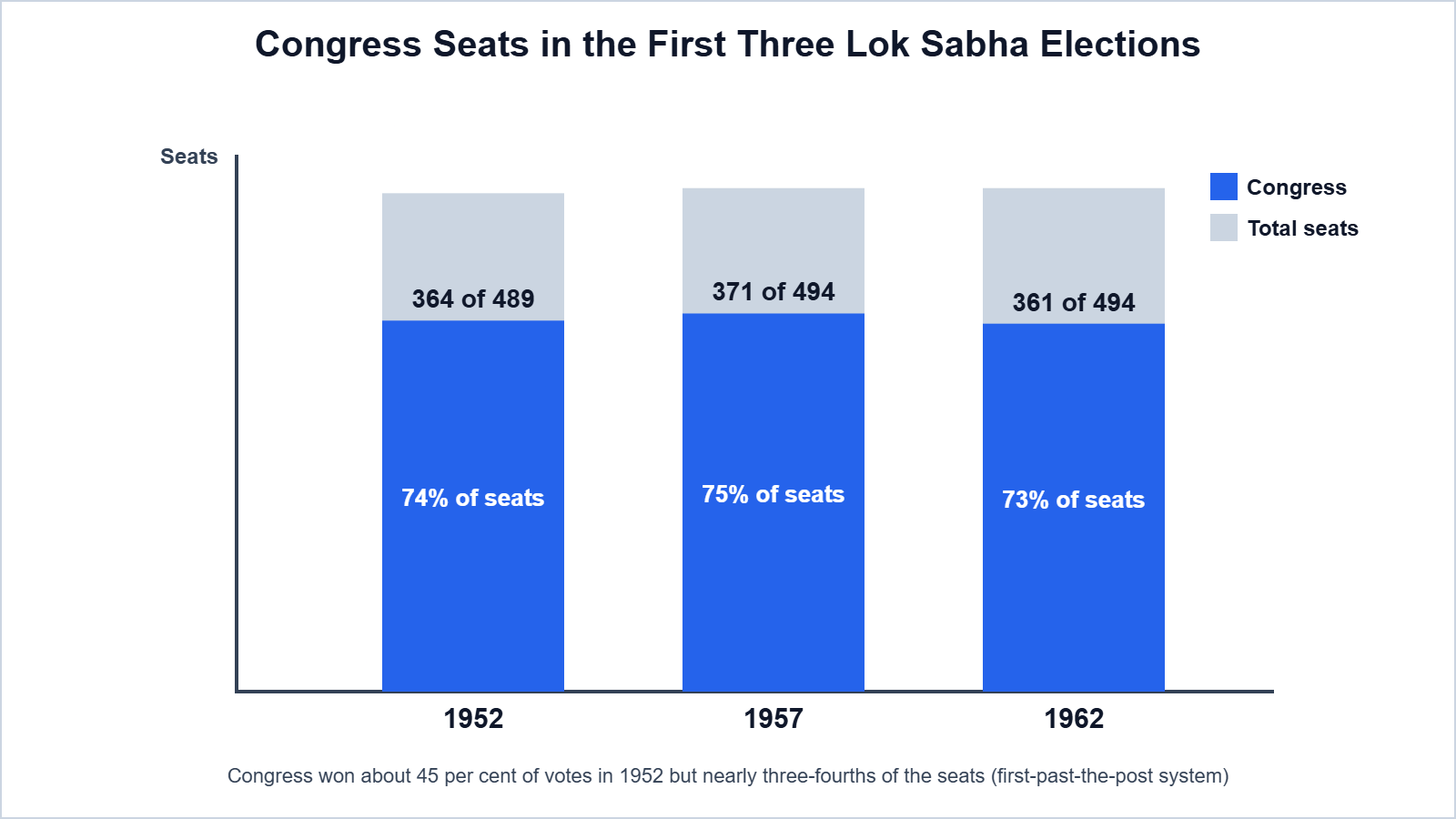
The Indian National Congress won the first three general elections (1952, 1957, 1962) with huge majorities and formed governments in almost all states. The Communist Party of India came second in 1952. In 1957 the CPI won the Kerala assembly election, and E.M.S. Namboodiripad became Chief Minister – the first time a communist party had come to power through elections. His government was dismissed in 1959 under Article 356, a decision that was much criticised.
Why did Congress dominate?
- It inherited the legacy of the national movement and had leaders such as Nehru who were known across the country.
- It was the only party with an organisation in every part of India.
- The first-past-the-post system gave it a larger share of seats than its share of votes.
- It was a social and ideological coalition: it included peasants and industrialists, urban and rural people, workers and owners, and leftists, rightists and centrists.
- It tolerated and encouraged factions within itself, so dissatisfied groups did not need to leave the party.
This pattern, in which one party dominated but democracy continued and opposition parties competed freely, is called the “Congress system”. It was different from one-party rule in countries like China, Cuba or Syria, where other parties were not allowed, or in Mexico, where one party ruled for decades with doubtful elections.
3. Emergence of Opposition Parties
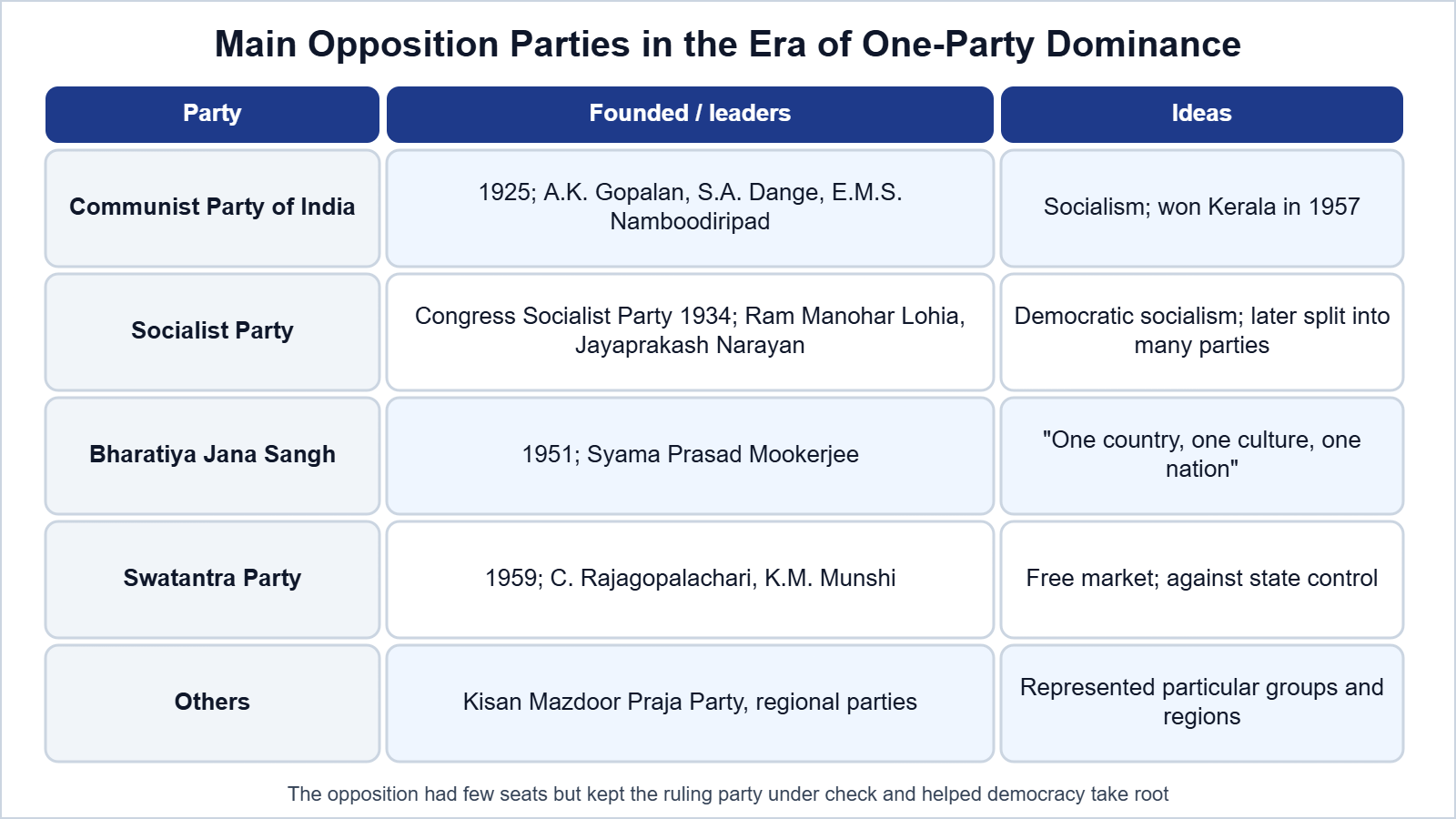
Although they won few seats, opposition parties played an important role: they criticised government policies, offered alternative ideas and kept the ruling party in check. There was mutual respect between the government and opposition leaders; Nehru even included some opposition leaders, such as Dr B.R. Ambedkar and Syama Prasad Mookerjee, in his first cabinet.
Easy Memory Trick: Congress seats “364 – 371 – 361” in 1952, 1957 and 1962.
4. Timeline
Year | Event |
|---|---|
1925 | Communist Party of India founded |
1934 | Congress Socialist Party formed |
January 1950 | Election Commission of India set up |
1951 | Bharatiya Jana Sangh founded |
1951-52 | First general election (October 1951 to February 1952) |
1957 | Second general election; CPI government in Kerala |
1959 | Kerala government dismissed; Swatantra Party founded |
1962 | Third general election |
1964 | Death of Jawaharlal Nehru |
5. Key Terms
Term | Meaning |
|---|---|
One-party dominance | One party winning repeatedly while competitive elections continue |
Congress system | Dominance of Congress as a broad coalition with internal factions |
Faction | A group within a party |
First-past-the-post | Candidate with the most votes wins the seat |
Coalition | Alliance of groups or parties |
Article 356 | Constitutional provision for President’s rule in a state |
6. Important Exam Questions
Q1. Who was the first Chief Election Commissioner of India? (2 marks)
Ans. Sukumar Sen was the first Chief Election Commissioner of India. He organised the first general election of 1951-52, a huge task involving about seventeen crore voters, most of whom could not read, with the help of party symbols, voter lists and trained polling staff.
Q2. Why is the first general election of India considered a landmark? (2 marks)
Ans. The first general election of 1951-52 was held on a vast scale among a mostly poor and illiterate population, yet it was free and fair, turnout was good and the losers accepted the results. It proved that democracy could work in a large developing country like India.
Q3. What was significant about the 1957 election in Kerala? (2 marks)
Ans. In 1957 the Communist Party of India won the assembly election in Kerala, and E.M.S. Namboodiripad became Chief Minister. It was one of the first times in the world that a communist party had come to power through democratic elections. The government was dismissed in 1959.
Q4. What is meant by the “Congress system”? (2 marks)
Ans. The Congress system refers to the period of Congress dominance in the first three general elections. The party was a broad coalition of different social groups and ideologies, tolerated factions within itself, and won repeatedly, while elections remained free and other parties competed openly.
Q5. Why did the Congress dominate the first three general elections? (3 marks)
Ans. The Congress inherited the legacy of the freedom struggle and had popular leaders like Jawaharlal Nehru. It was the only party with an organisation spread across the whole country. It was a social and ideological coalition that included many classes, castes and viewpoints, and it tolerated factions, so dissenters did not leave. Moreover, the first-past-the-post system gave it a much larger share of seats than its share of votes.
Q6. How was the Congress a social and ideological coalition? (3 marks)
Ans. The Congress brought together diverse social groups: peasants and industrialists, urban dwellers and villagers, workers and owners, the middle class and the poor, and people of many castes, religions and languages. It also accommodated different ideologies, including revolutionaries and pacifists, conservatives and radicals, and leftists, rightists and centrists. Because it included such variety, it could represent almost every section of society and remain the dominant party for many years.
Q7. What role did the opposition parties play during the era of Congress dominance? (3 marks)
Ans. Although they had few seats, opposition parties offered sustained and principled criticism of the policies of the Congress government. They kept the ruling party in check and often forced it to change its approach. They also prepared the ground for alternatives, so that democracy did not become one-party rule. There was mutual respect between opposition and government, and some opposition leaders were even included in Nehru’s first cabinet.
Q8. How was one-party dominance in India different from that in other countries? (3 marks)
Ans. In countries such as China, Cuba and Syria, only one party was allowed by the constitution, and in some others like Mexico one party ruled for decades through doubtful elections. In India, however, Congress dominance came about through free and fair elections in which many parties competed. Opposition parties had full freedom to organise and criticise, and the Congress itself contained different views. Thus Indian democracy remained competitive despite one party winning repeatedly.
Q9. Explain the factors responsible for the dominance of the Congress during the first three general elections. (5 marks)
Ans. Several factors explain the dominance of the Congress in the elections of 1952, 1957 and 1962. First, it inherited the legacy of the national movement. As the party that had led the freedom struggle, it enjoyed great prestige, and its leaders, especially Jawaharlal Nehru, were popular throughout the country. Second, it had a strong organisation that reached every part of India, down to the village level, while most other parties were small or regional. Third, the Congress was a social and ideological coalition. It included peasants and industrialists, urban and rural people, workers and owners, and people of many castes, religions and languages, and it accommodated leftists, rightists and centrists. Fourth, it tolerated factions; groups with different views could stay inside the party and compete, so disagreements did not lead to splits. Fifth, the first-past-the-post electoral system worked in its favour: in 1952 it won about forty-five per cent of the votes but nearly three-fourths of the seats, because the opposition was divided. Finally, the opposition parties were small and lacked national leaders. Together these factors produced the Congress system.
Q10. Describe the main opposition parties during the era of one-party dominance. (5 marks)
Ans. During the era of Congress dominance, several opposition parties were active. The Communist Party of India, founded in 1925, believed in socialism; it came second in the 1952 election and won Kerala in 1957, where E.M.S. Namboodiripad became Chief Minister. Its leaders included A.K. Gopalan and S.A. Dange. The Socialist Party grew out of the Congress Socialist Party formed in 1934; leaders such as Ram Manohar Lohia and Jayaprakash Narayan wanted a more radical and egalitarian programme, but the party split into several groups. The Bharatiya Jana Sangh was founded in 1951 by Syama Prasad Mookerjee; it emphasised the idea of one country, one culture and one nation and supported a strong, united India. The Swatantra Party, formed in 1959 by C. Rajagopalachari and others, opposed state control of the economy and favoured free enterprise. In addition, there were regional and smaller parties. Though they won few seats, these parties offered principled criticism, kept the government accountable and prepared the ground for future alternatives. Their existence made the Congress system democratic rather than a one-party state.
7. MCQs and Assertion-Reason
1. The Communist Party of India was founded in
(A) 1920 (B) 1925 (C) 1934 (D) 1951
Ans. (B)
2. The first Chief Election Commissioner of India was
(A) T.N. Seshan (B) Sukumar Sen (C) K.M. Munshi (D) G.V. Mavalankar
Ans. (B)
3. The first non-Congress government formed through elections in a state (1957) was in
(A) West Bengal (B) Kerala (C) Tamil Nadu (D) Punjab
Ans. (B)
4. Who founded the Swatantra Party?
(A) Ram Manohar Lohia (B) C. Rajagopalachari (C) Syama Prasad Mookerjee (D) A.K. Gopalan
Ans. (B)
Options: (A) Both A and R are true and R is the correct explanation of A. (B) Both A and R are true but R is not the correct explanation of A. (C) A is true but R is false. (D) A is false but R is true.
Assertion (A): The Congress won a much larger share of seats than votes in 1952.
Reason (R): The first-past-the-post system rewards the party with the most votes in each constituency, and the opposition was divided.
Ans. (A)
8. Case Study
Read the passage and answer the questions: In a newly independent country, nearly seventeen crore people were to vote for the first time, most of them poor and unable to read. Many observers abroad predicted that the experiment would fail. Election officials used party symbols and separate ballot boxes for each candidate. The elections were spread over several months, and the results were accepted by all parties.
(i) Which election is described?
Ans. The first general election of India (1951-52).
(ii) Who was in charge of conducting it?
Ans. Sukumar Sen, the first Chief Election Commissioner.
(iii) How did officials help voters who could not read?
Ans. By using party symbols and separate ballot boxes.
Conclusion: The first three elections established democracy in India. The Congress dominated as a broad coalition of groups and ideas, but competitive elections and a principled opposition ensured that dominance did not turn into one-party rule.