Three level architecture of DBMS
The Three-Level Architecture (also known as the ANSI-SPARC Architecture) is a framework used to separate the physical database from the user’s view. Its main goal is to achieve Data Independence.
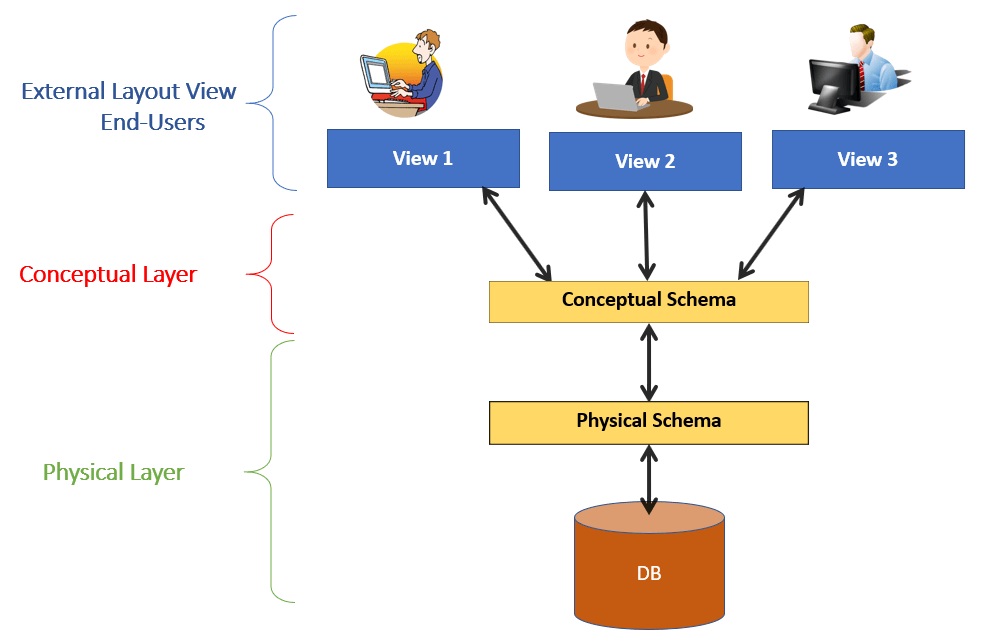
The Three Levels
1. External Level (View Level)
This is the highest level and the one closest to the users.It describes how individual users or applications see the data.
- Key Feature: Different users can have different “views” of the same data. For example, a student sees their grades, while a registrar sees grades plus financial records.
2. Conceptual Level (Logical Level)
This is the middle layer that describes what data is stored and the relationships between them.It defines the entire structure (schema) of the database, including tables, data types, and constraints (like “Age must be over 18”).
- Key Feature: It is a global view of the database that is shared by all users.
3. Internal Level (Physical Level)
This is the lowest level, closest to the physical storage. It describes how the data is actually stored on the hardware (hard drives, SSDs).
- Key Feature: It deals with complex technical details like file organization, indexing, data compression, and encryption.