Concept of Cyber Crimes and Cyber law
Cybercrime refers to any illegal activity where a computer, network, or electronic device is used as either a tool to commit the crime or as the primary target. Cyber law is the legal framework that regulates the digital space, providing rules for internet usage and establishing penalties to protect individuals and organizations from these crimes.
Cybercrime and Cyber Law Framework
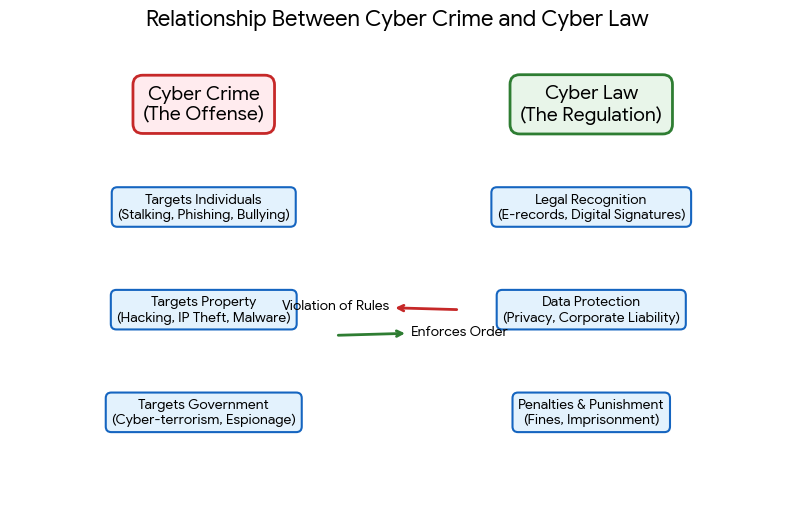
The diagram below illustrates how cybercrimes are categorized by their targets and how cyber law acts as a shield to regulate and penalize these actions.
Categories of Cybercrime
Cybercrimes are typically classified based on the target of the malicious act:
- Against Individuals: Includes activities like cyberstalking, phishing to steal personal data, identity theft, and online harassment.
- Against Property: Focuses on digital assets. Common examples are unauthorized hacking, spreading ransomware to lock files for money, and intellectual property theft (e.g., software piracy).
- Against Organizations/Government: The most severe form, involving cyber-terrorism, hacking military secrets, or distributed denial-of-service (DDoS) attacks meant to crash critical infrastructure
The Role of Cyber Law
Cyber law (such as India’s Information Technology Act, 2000) serves several vital purposes:
- Legal Validation: It gives legal recognition to electronic records and digital signatures, making online contracts as valid as paper ones.
- Security Framework: It mandates that companies use “reasonable security practices” to protect user data, with penalties for negligence.
- Prosecution: It defines specific offenses and sets punishments, ranging from heavy fines for data breaches to life imprisonment for acts of cyber-terrorism.