← Back to Computer Science-Full Course (Plus-2)
Basic of database system
Database System
At its core, a Database Management System (DBMS) acts as an intermediary between the user and the raw data stored on a computer. It is software that handles the creation, retrieval, and management of data.
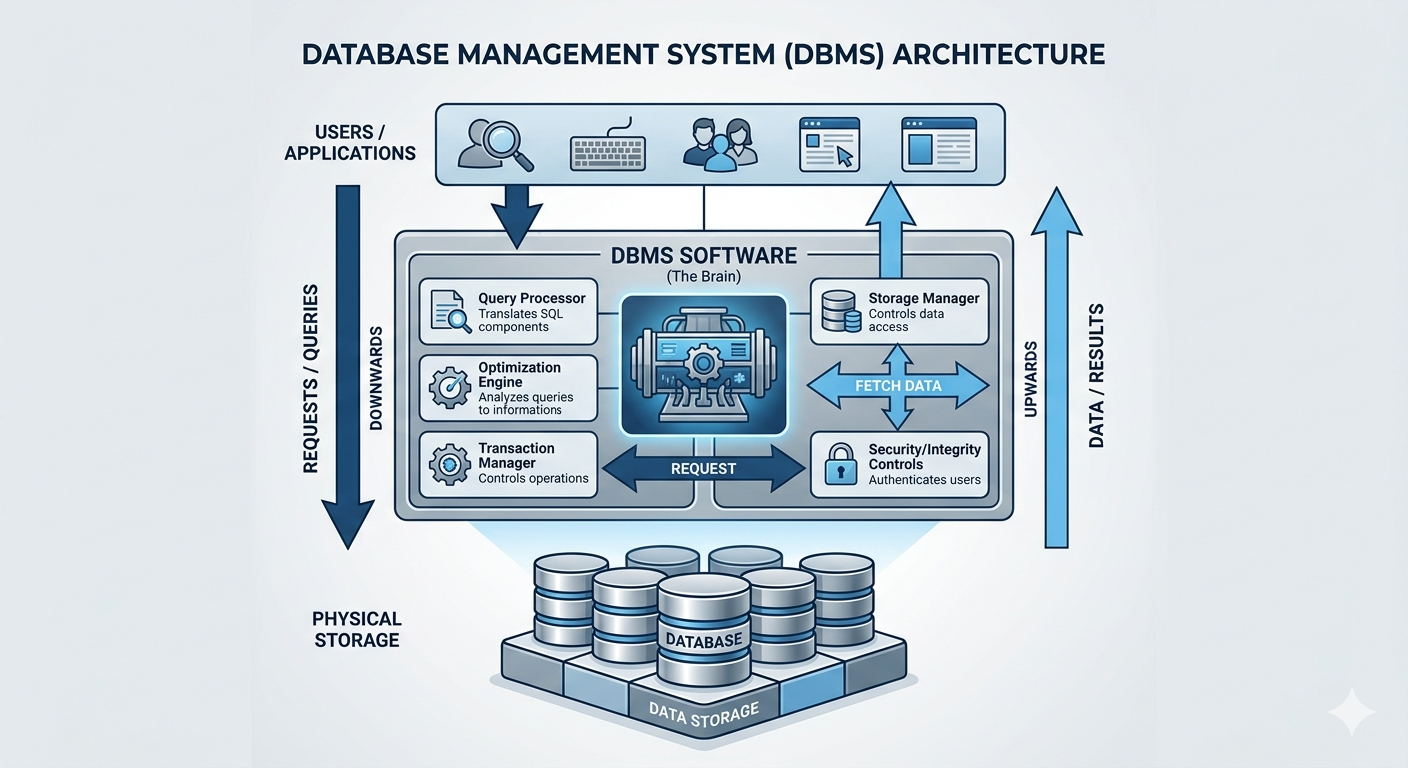
The Database vs. The DBMS
- Database: The actual collection of data (like a digital filing cabinet).
- DBMS: The software that manages that data (like the librarian who organizes and finds the files for you). Examples: MySQL, PostgreSQL, Oracle, MongoDB.
Basic Terms
- Data: raw facts and figures, e.g. 85, Riya.
- Information: processed, meaningful data, e.g. “Riya scored 85 marks”.
- Database: an organised collection of related data stored so it can be easily accessed and managed.
- DBMS: software used to create, store, update and retrieve data from a database.
Terms in a Relational Database
- Table (relation): data arranged in rows and columns.
- Field (attribute): a column, e.g. Name, RollNo.
- Record (tuple): a row containing data about one item.
- Primary key: a field that uniquely identifies each record, e.g. RollNo.
- Foreign key: a field in one table that refers to the primary key of another table.
Components of a Database System
Hardware, software (DBMS), data, users (database administrator, programmers, end users) and procedures.
Applications
Banking, railway and airline reservation, school records, hospitals, libraries and online shopping all use databases.
Important Questions
Q. Differentiate between data and information.
Ans. Data is raw facts, while information is processed data that has meaning.
Q. What is a primary key?
Ans. A primary key is a field (or set of fields) that uniquely identifies each record in a table.
Q. What is a tuple?
Ans. A tuple is a row (record) of a table.