Writing Skills | Chapter – 2
Summarising
1. What is a Summary?
A summary is a short version of a passage that keeps only its main ideas, written in your own words in full sentences. It is usually about one-third of the original length.
Remember: Notes use phrases and abbreviations. A summary uses complete sentences in a paragraph, with no abbreviations.
2. Features of a Good Summary
- Brief: Only essential ideas; no examples, quotations or repetitions.
- Accurate: It must give the same meaning as the original. Do not add your own opinions.
- In your own words: Do not copy sentences from the passage.
- Connected: Ideas should flow logically, using linking words such as however, therefore and also.
- Has a title: When asked, give a suitable title.
3. Steps in Summarising
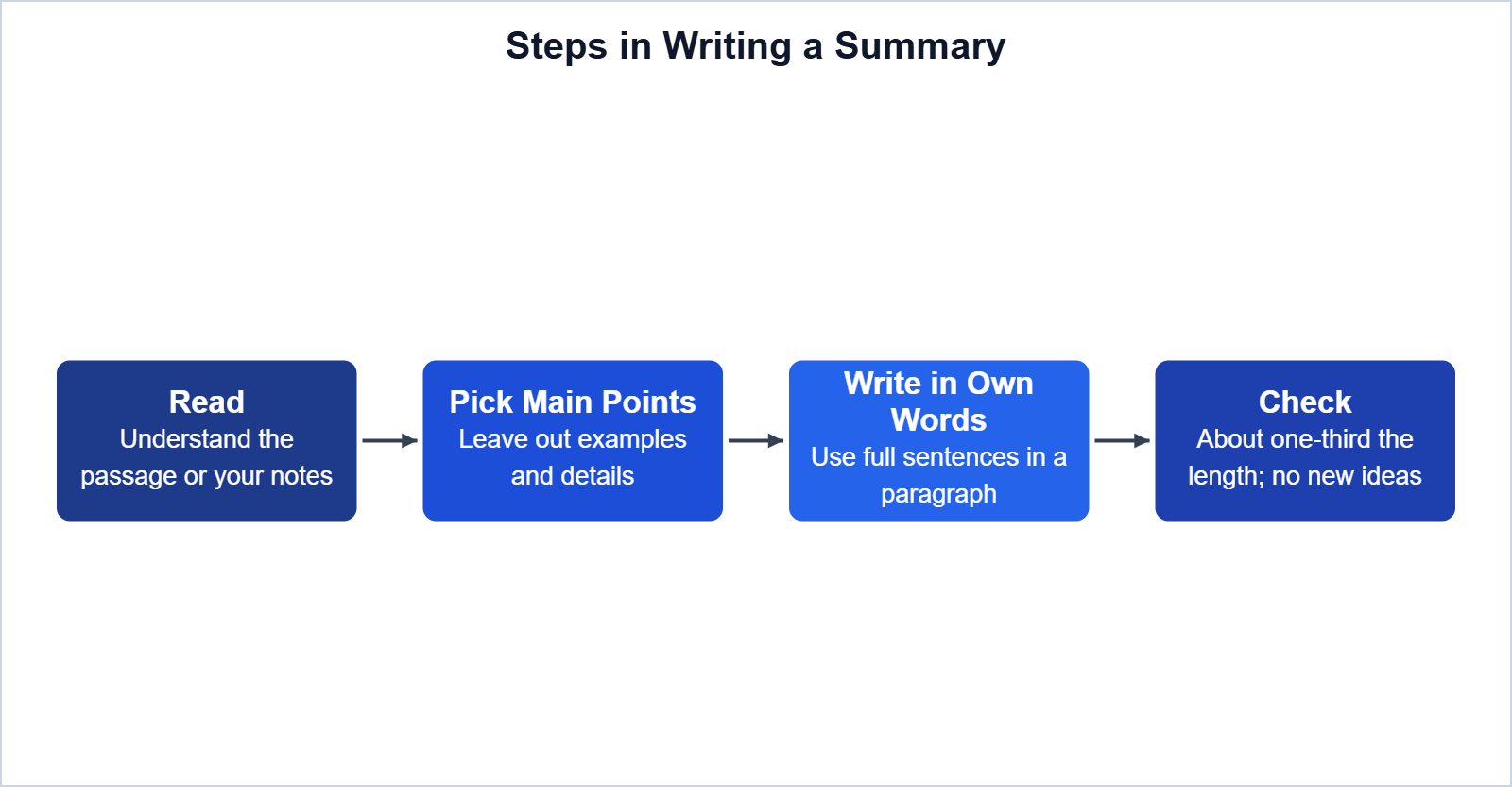
Exam point: In the exam you are often asked to write a summary of a passage using the notes you have made. Use the notes as your guide, and write about 80 words.
4. Solved Example
(Based on the notes on “Benefits of Regular Exercise” in the Note Making lesson.)
Summary: Regular exercise is good for both the body and the mind. Physically, it keeps the heart healthy, improves blood circulation and controls weight. Mentally, it reduces stress, lifts the mood, improves sleep and helps students concentrate. To get the most from exercise, beginners should start slowly, warm up and drink enough water. Choosing an activity one enjoys, such as walking or cycling, helps the habit last.
5. Do’s and Don’ts
Do | Don’t |
|---|---|
Use your own words | Copy whole sentences |
Keep only main ideas | Include examples and details |
Write in full sentences | Use abbreviations |
Stay close to the word limit | Add your own opinions |
Easy Memory Trick: “Short, Same, Own”: a summary is short, gives the same meaning, and is in your own words.
Conclusion: Summarizing is the skill of presenting the main ideas of a passage briefly and clearly in your own words. It is useful in studies, exams and at work.