Modal Auxiliaries – Class 11 English Notes
Grammar | Chapter – 4
Modal Auxiliaries
1. What are Modals?
Modal auxiliaries (modals) are helping verbs that express the mood or attitude of the speaker, such as ability, permission, possibility, necessity, advice or obligation. The syllabus asks us to use them based on their meaning (semantic considerations).
Main modals: can, could, may, might, shall, should, will, would, must, ought to, need, dare, used to.
2. Rules for Using Modals
- A modal is always followed by the base form of the verb. Example: She can sing. (not: She can sings)
- Modals do not change with the subject. Example: He must go. They must go.
- Negatives are made by adding not: cannot, should not, must not.
- Questions are made by putting the modal first: Can you help me?
- “Ought” is followed by to: You ought to obey the rules.
3. Modals and Their Uses
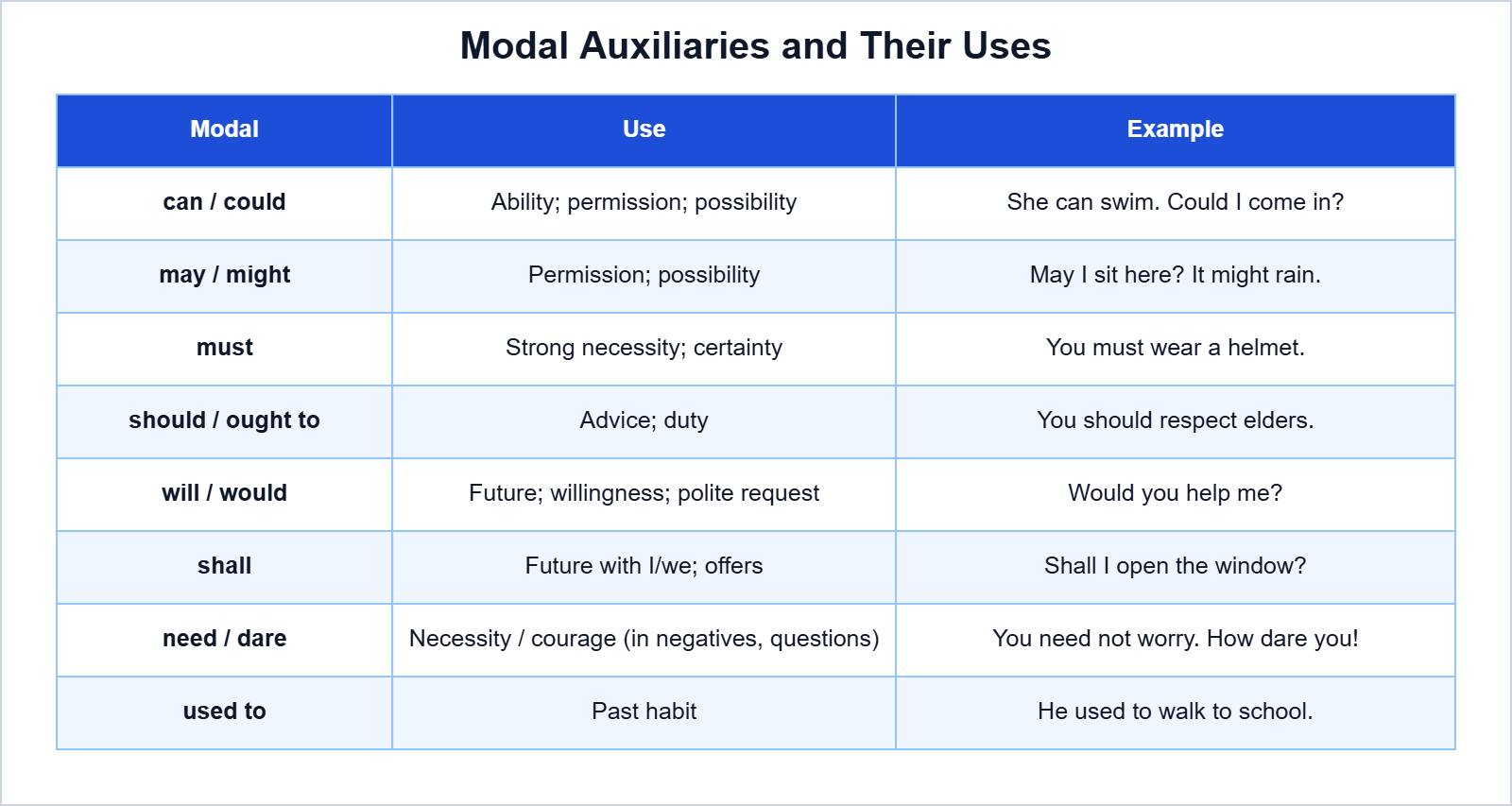
Exam point: Must not means something is forbidden (You must not smoke here). Need not means it is not necessary (You need not come tomorrow).
4. Degrees of Possibility and Obligation
Meaning | Modals (from strong to weak) |
|---|---|
Possibility | must (almost certain), may, might, could (less certain) |
Obligation / advice | must (strong), ought to, should (advice) |
Politeness in requests | could, would (more polite) than can, will |
Remember: “Could” and “would” are often used to make requests more polite. Example: Could you please pass the salt?
5. Practice Questions (with Answers)
Fill in the blanks with suitable modals:
- ______ I borrow your pen? Ans. May / Can / Could
- You ______ obey your parents. Ans. should / ought to
- He ______ run fast when he was young. Ans. could
- The sky is cloudy; it ______ rain. Ans. may / might
- You ______ not shout in the library. Ans. must
- When I was a child, I ______ play in the park every evening. Ans. used to
Easy Memory Trick: “Can = able, May = allowed, Must = a must, Should = suggested”.
Conclusion: Modals add meaning and mood to verbs. Choosing the right modal helps us express ability, permission, possibility, duty and politeness correctly.