Essay Writing – Class 11 English Notes
Writing Skills | Chapter – 4
Essay Writing
1. What is an Essay?
An essay is a piece of writing on a particular topic that presents information, ideas or arguments in an organized way. In Class 11, students are expected to write expository and argumentative essays of about 250-500 words.
2. Types of Essays
Type | Purpose | Example topic |
|---|---|---|
Descriptive | Describes a person, place or event | A Visit to a Hill Station |
Narrative | Tells a story or experience | The Day I Will Never Forget |
Expository | Explains a topic with facts | Causes of Air Pollution |
Argumentative | Gives arguments for or against a view | Should Mobile Phones Be Allowed in Schools? |
3. Structure of an Essay
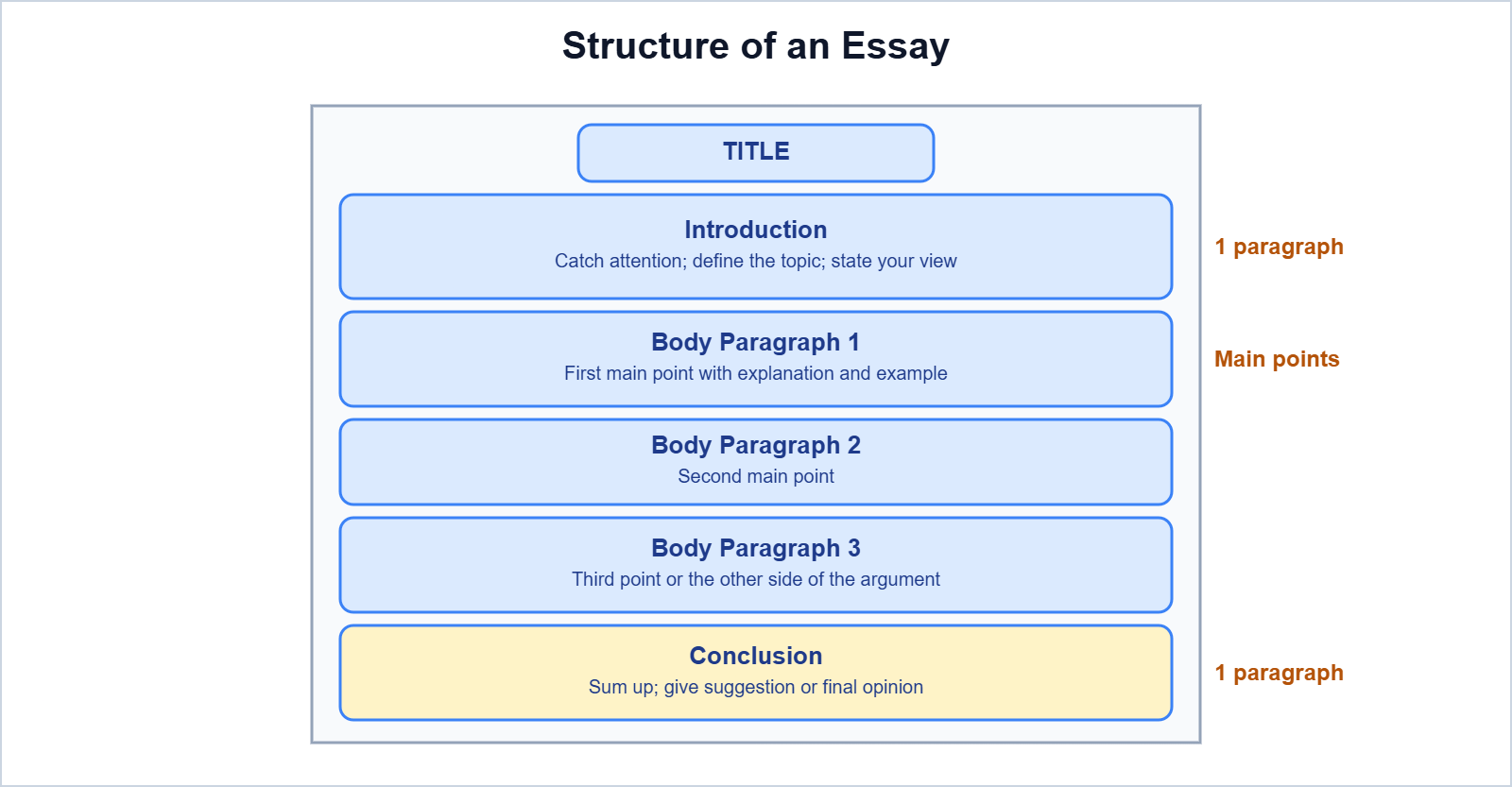
- Introduction: Begin with an interesting opening (a question, a fact or a short statement). Introduce the topic.
- Body: Two to four paragraphs, each with one main idea, supported by explanation and examples.
- Conclusion: Sum up the main points and end with a suggestion, hope or firm opinion.
Exam point: Marks are usually given for content, organization, and language (grammar, vocabulary and spelling). Plan before you write.
4. Tips for a Good Essay
- Make a short outline of points before writing.
- Use simple, correct language and avoid repetition.
- Use linking words: firstly, moreover, however, on the other hand, therefore, in conclusion.
- Keep paragraphs balanced in length.
- Stay within the word limit.
5. Sample Essay
Should Mobile Phones Be Allowed in Schools?
Mobile phones have become a part of everyday life. Almost every student today has access to one. This raises an important question: should students be allowed to carry mobile phones to school?
Those who support the idea say that phones help in emergencies. Parents can contact their children at any time, and students can call for help if they are in trouble. Phones also give quick access to information. A student can look up a word, check a fact or use an educational app during a lesson.
On the other hand, phones can be a serious distraction. Students may play games, chat or use social media in class instead of listening to the teacher. Phones can also be used to cheat in tests. Moreover, students who own expensive phones may make others feel left out, and there is always a risk of theft or loss.
A balanced solution is possible. Schools may allow students to carry phones but require them to be switched off and kept in a safe place during school hours. Teachers can allow their use for specific learning activities under supervision.
In conclusion, mobile phones are useful tools, but they must be used responsibly. With clear rules, schools can enjoy their benefits while avoiding their harmful effects.
Easy Memory Trick: “I-B-C”: Introduction, Body, Conclusion, the backbone of every essay.
Conclusion: A good essay has a clear structure, relevant ideas and correct language. Planning, linking ideas and a strong conclusion make an essay effective.