The Adventure – Class 11 English Notes
Hornbill | Chapter – 5
The Adventure
(Jayant Narlikar)
1. About the Author
Jayant Vishnu Narlikar (1938-2025) was a famous Indian astrophysicist and science-fiction writer. He wrote many stories in Marathi and English that mix science with imagination. The Adventure is a science-fiction story that mixes history, science and fantasy.
2. Main Characters
- Professor Gangadharpant Gaitonde: A historian who experiences another version of history.
- Rajendra Deshpande: A scientist (physicist) who explains the experience scientifically.
3. Summary
- A strange world: Professor Gaitonde finds himself in a Bombay that is different from the one he knows. The city is modern, but the British are only traders here. India is ruled by Indians, and the East India Company has only a small presence.
- Reading history: Puzzled, he goes to a library and reads history books. He learns that in this world the Marathas won the Third Battle of Panipat in 1761. Vishwasrao had survived because a bullet just missed him, and Maratha power had grown strong. Because of this, the British never became rulers of India.
- At the meeting: Gaitonde goes to a public meeting at Azad Maidan. He sees that the chair of the president is empty, sits on it and starts to give a speech, saying that a meeting must have a president. The angry crowd drives him away. Soon after this, he finds himself back in his own world.
- The explanation: He tells Rajendra Deshpande about his experience. Rajendra explains it with the help of two theories: catastrophe theory and quantum theory. He says that Gaitonde’s mind was full of thoughts about the battle of Panipat at the moment of an accident (a collision with a truck), and he probably moved for a while into another possible world.
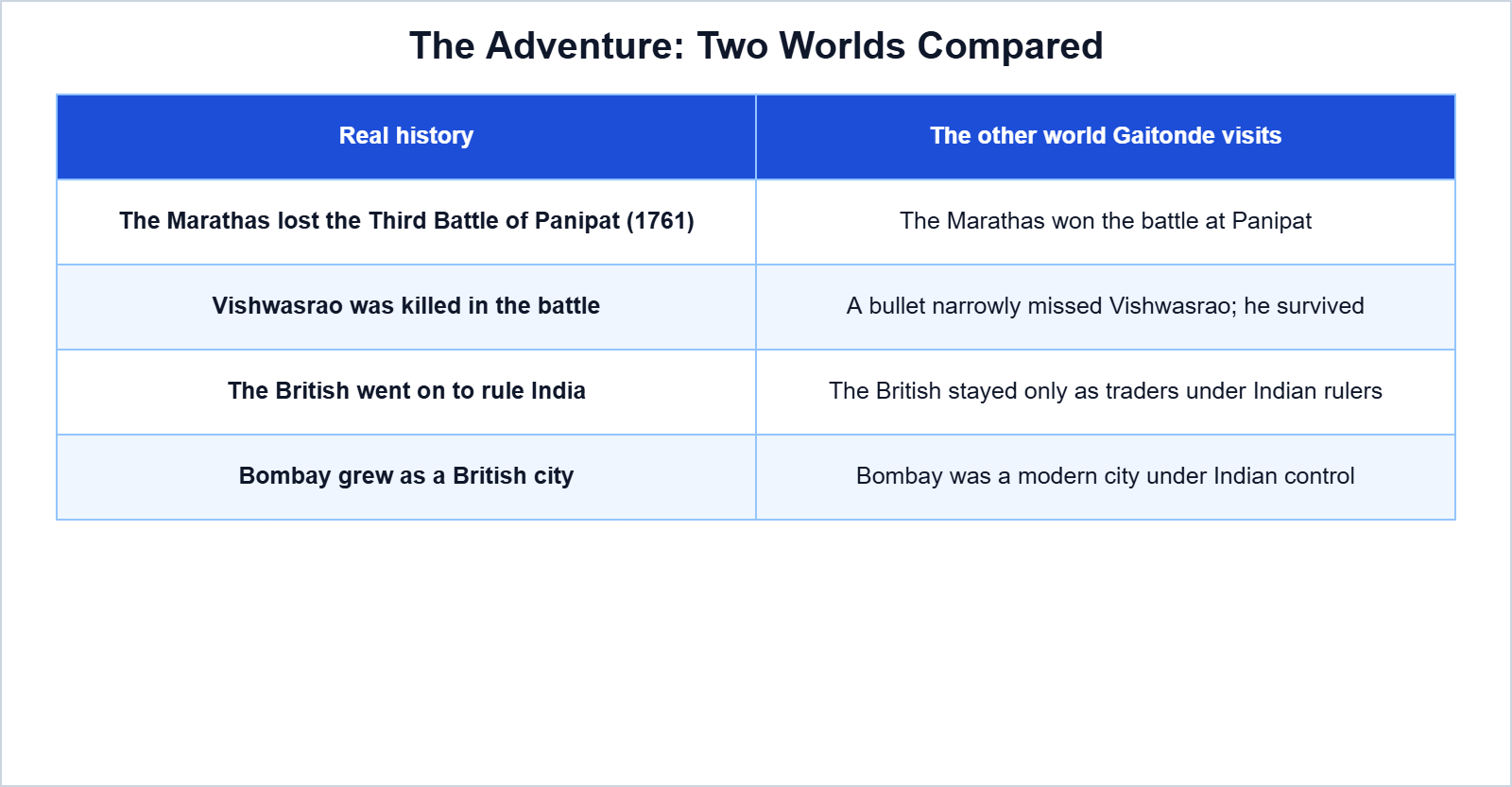
Exam point: The turning point in the other world is the battle of Panipat (1761). The Marathas won because Vishwasrao survived.
4. The Scientific Explanation
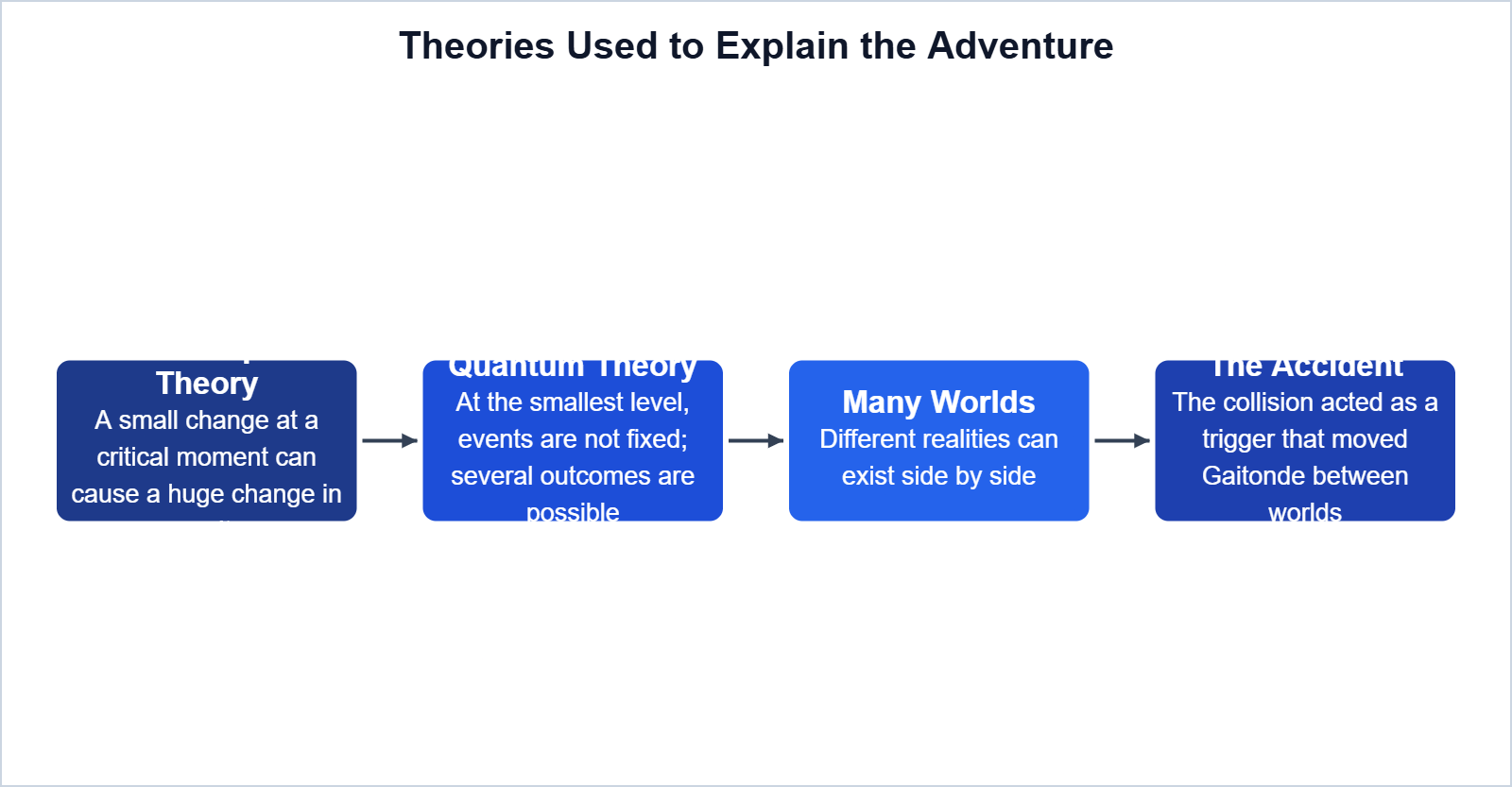
- Catastrophe theory: A system may change suddenly and greatly because of a small change at a critical point. The bullet missing Vishwasrao was such a small change that led to a completely different history.
- Quantum theory: At the level of tiny particles, nature does not follow a single fixed path; several outcomes are possible. Some scientists believe that different worlds, with different results, can exist together.
- The transition: According to Rajendra, Gaitonde’s mind, full of questions about Panipat, was the trigger. During the accident, he passed briefly from one reality to the other.
Remember: This is science fiction. The story uses real scientific ideas to make an imaginary adventure believable.
5. Theme and Message
- Turning points in history: A single event can change the whole course of history.
- Science and imagination: Science fiction uses scientific theories to explore “what if” questions.
- Many possibilities: Reality may have several possible paths, not just one.
6. Important Word Meanings
Word | Meaning |
|---|---|
Catastrophe | A sudden great change or disaster |
Transition | A change from one state to another |
Determinism | The idea that every event has a fixed cause and result |
Lull | A short period of calm |
Bewilderment | Confusion |
7. Short Answer Questions
Q1. What was the main difference between the two worlds Gaitonde saw?
Ans. In the real world the Marathas lost at Panipat and the British ruled India. In the other world the Marathas won, and the British remained only traders.
Q2. Why was Gaitonde thrown out of the meeting?
Ans. He sat on the empty president’s chair and started speaking without being invited. The audience was angry and drove him out.
Q3. What is catastrophe theory?
Ans. It is the theory that a small change at a critical point can produce a sudden and very large change in the final result.
Q4. How did Rajendra explain Gaitonde’s experience?
Ans. He said that at the time of his accident, Gaitonde’s mind was full of thoughts about Panipat. This made him pass briefly into another possible world where history had taken a different turn.
8. Long Answer Question
Q. How does the story combine history and science?
Ans. The story is based on a real event, the Third Battle of Panipat in 1761, and imagines what would have happened if the Marathas had won. Gaitonde, a historian, sees a world where India was never ruled by the British. Rajendra, a scientist, explains this through catastrophe theory, which shows how a small event can change everything, and quantum theory, which suggests that several realities can exist. In this way the story uses history for its setting and science for its explanation, making it an interesting work of science fiction.
Easy Memory Trick: “Bullet Missed, History Twisted”: Vishwasrao survived, so history changed.
Conclusion: The Adventure is an exciting science-fiction story. It shows how one small event can change history and how modern science opens the door to many possible realities.