The Portrait of a Lady – Class 11 English Notes
Hornbill | Chapter – 1
The Portrait of a Lady
(Khushwant Singh)
1. About the Author
Khushwant Singh (1915-2014) was a famous Indian journalist, historian and novelist. He is known for his honest writing, sharp humour and love of nature. His well-known works include Train to Pakistan and A History of the Sikhs.
The Portrait of a Lady is an autobiographical sketch. In it the author gives a loving word-picture of his grandmother and of his relationship with her from childhood to her death.
2. Introduction
The lesson is a pen portrait (a description in words) of the author’s grandmother. It shows how the bond between a grandmother and her grandson changes as he grows up, moves to the city and goes abroad, and how she meets her death with calm faith.
Remember: A portrait is usually a painting. Here the author “paints” his grandmother with words, so the title is very suitable.
3. Summary
- Her appearance: The grandmother was old, short, fat and slightly bent, with a face full of wrinkles. She was always dressed in spotless white and moved about the house with one hand on her waist and the other telling the beads of her rosary. The author felt she had always been old; he could not imagine that she was once young and pretty. To him she was like the winter landscape in the mountains: an expanse of pure white serenity.
- Life in the village: The author’s parents lived in the city, so he lived with his grandmother in the village. She woke him in the morning, bathed and dressed him, and gave him his wooden slate and breakfast. She walked with him to the school, which was attached to the temple. While the children learnt the alphabet and prayers, she read the holy books. On the way back they fed stale chapattis to the village dogs. They were good friends.
- The first turning point (city life): When his parents settled in the city, they called both of them there. The author joined an English school and went by motor bus. The grandmother could no longer go with him or help him with his lessons. She did not believe in the things taught there, such as science and English, and she was unhappy that there was no teaching about God and the scriptures. When she learnt that he was being taught music, she was upset, because she thought music was not meant for respectable people. After this she rarely talked to him.
- Growing apart: When the author went to university, he was given a room of his own. The common link of friendship was broken. The grandmother accepted her loneliness quietly. She spent her day at the spinning wheel and in prayer. In the afternoon she fed the sparrows, which gathered around her and even sat on her head and shoulders. This half hour was the happiest part of her day.
- Going abroad: When the author decided to go abroad for further studies for five years, she came to see him off at the railway station. She did not show any emotion. She kissed his forehead and kept praying. The author felt this might be their last meeting.
- The return: After five years she received him at the station. She did not look a day older. In the evening she showed great joy: she collected the women of the neighbourhood, took an old drum and sang songs about the home-coming of warriors for hours. For the first time she did not say her prayers.
- Her death: The next morning she fell ill with a fever. The doctor said it was mild, but she knew that her end had come. She refused to talk, lay in bed praying and telling her beads, until her lips stopped moving and the rosary fell from her lifeless fingers. In the evening, thousands of sparrows sat silently around her body. They did not chirp and did not touch the bread crumbs thrown to them by the author’s mother. When the body was carried away, they flew away quietly. The next morning the sweeper swept the crumbs into the dustbin.
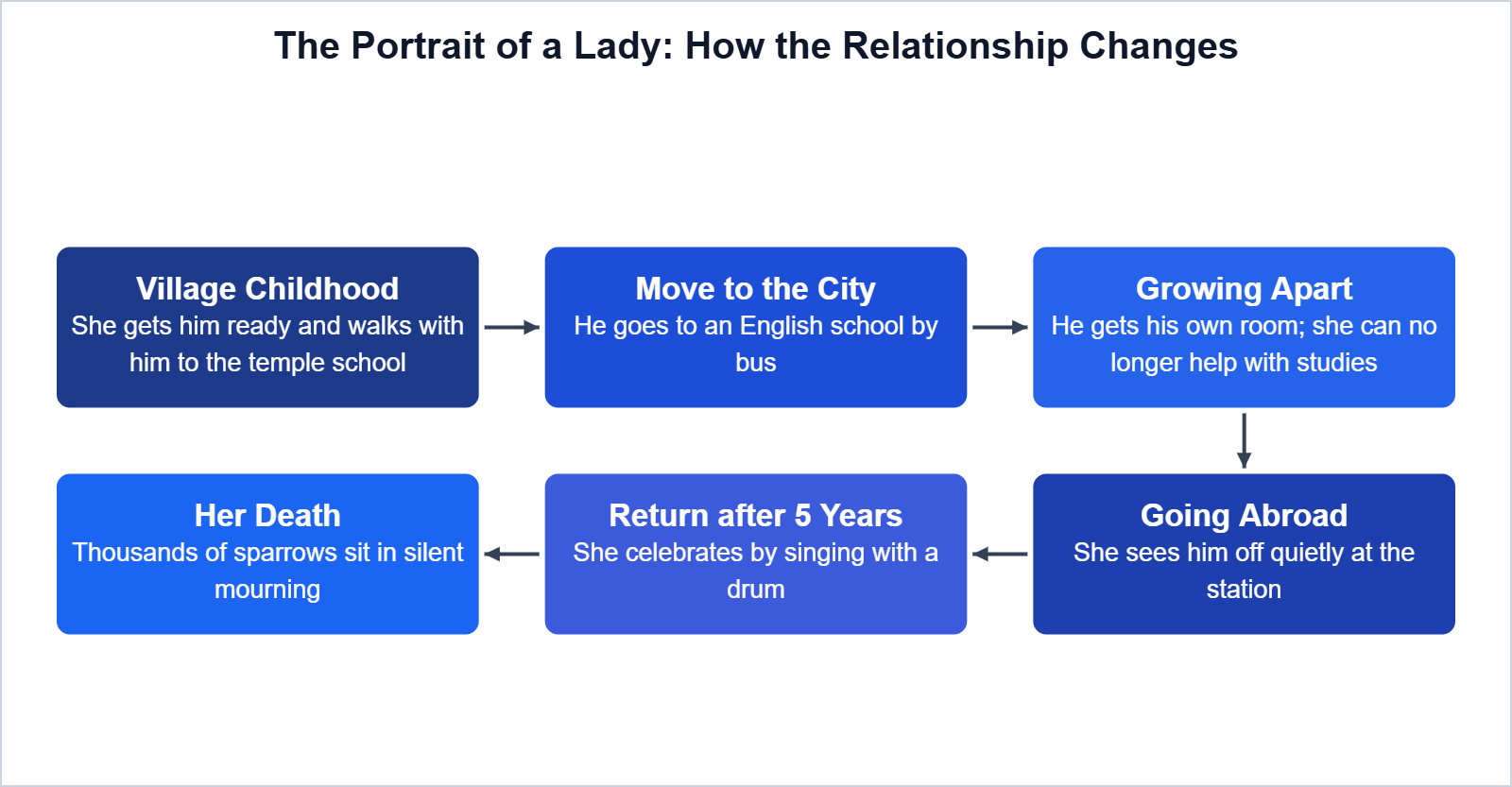
Exam point: The three stages of the relationship are: close friendship in the village, a slow drifting apart in the city, and a final separation when the author goes abroad and she dies.
4. Character Sketch of the Grandmother
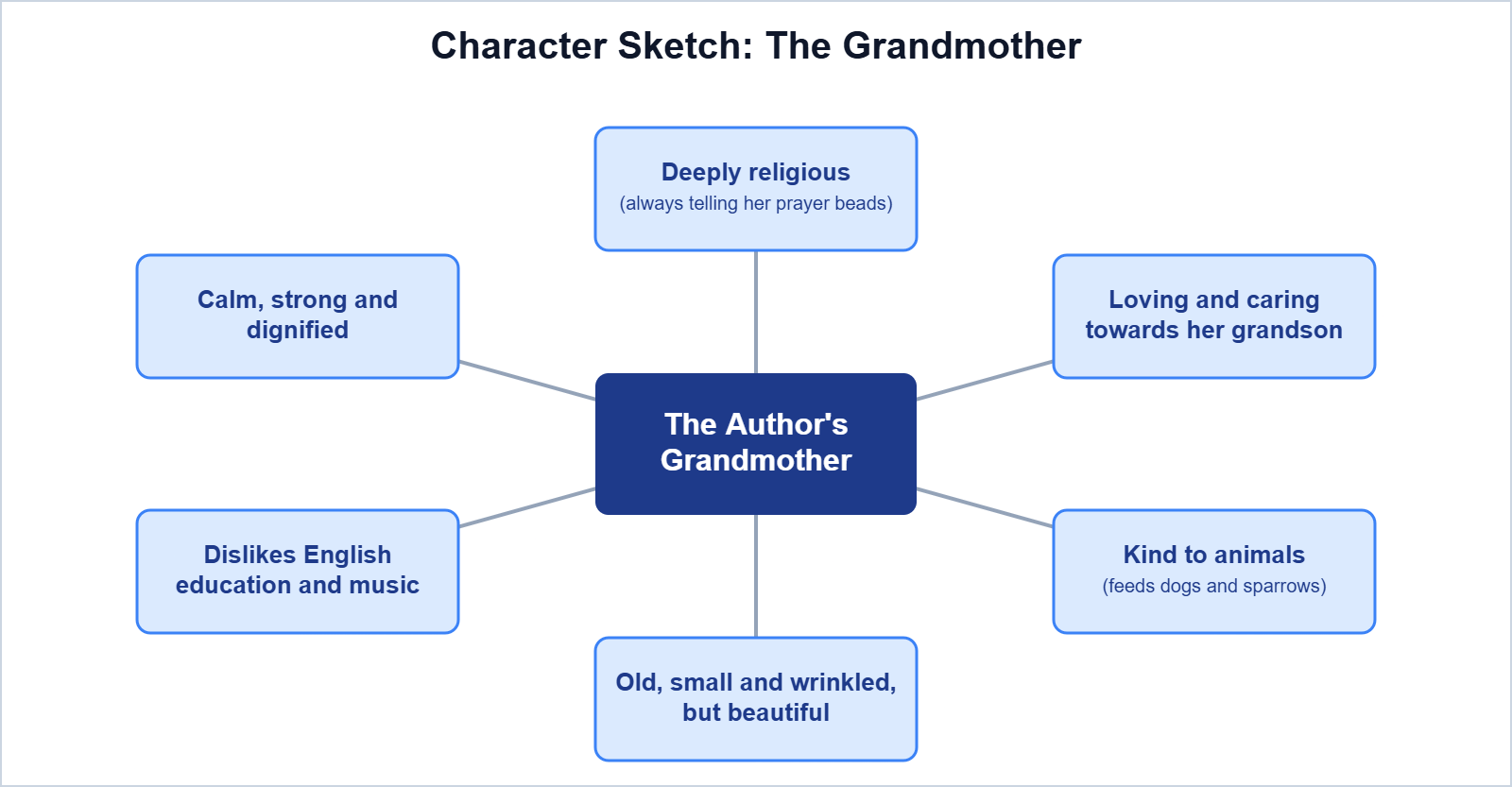
- Deeply religious: Her lips always moved in prayer and her fingers were always busy with her rosary. She prayed even at the moment of death.
- Loving and caring: In the village she looked after every need of her grandson. Even when he grew distant, she never complained.
- Kind to animals and birds: She fed the village dogs and, later, the sparrows of the city, who loved her in return.
- Traditional: She did not approve of English education, science and music, because they had no place for God and the holy books.
- Strong and dignified: She accepted loneliness without complaint and faced death calmly.
Easy Memory Trick: Remember her with the word “PRAY”: P = Pious, R = Rosary always in hand, A = Animal lover, Y = Yearning (loving) for her grandson.
5. Theme and Message
- Love between generations: The lesson shows the deep bond between a grandmother and grandson.
- Generation gap: Modern education and city life slowly separate the two.
- Faith and calmness: True faith gives a person the strength to face loneliness and death with peace.
- Love for all creatures: The mourning of the sparrows shows that love given to living beings is returned.
6. Important Word Meanings
Word | Meaning |
|---|---|
Portrait | A picture or description of a person |
Serenity | Calmness and peace |
Rosary | A string of beads used for counting prayers |
Scriptures | Holy books of a religion |
Turning point | A time when an important change happens |
Accepted her seclusion | Quietly accepted being alone |
Dilapidated | Old and in poor condition |
Shroud | A cloth used to cover a dead body |
Frivolous | Not serious |
7. Short Answer Questions
Q1. Why was it hard for the author to believe that his grandmother was once young and pretty?
Ans. He had known her only as old and wrinkled for the last twenty years. Hearing that she was once young and pretty seemed like a fairy tale to him.
Q2. What was the first turning point in their friendship?
Ans. The move to the city was the first turning point. The author went to an English school by bus, so she could no longer go with him or help him with his studies.
Q3. Why was the grandmother upset about the music lessons?
Ans. She believed that music was not suitable for respectable people. To her it was connected with beggars and people of low character, so she disapproved of it.
Q4. How did the grandmother spend her time after the author got a separate room?
Ans. She spent most of her time at her spinning wheel, reciting prayers. In the afternoon she fed the sparrows, which was the happiest half hour of her day.
Q5. How did the sparrows show their grief at her death?
Ans. Thousands of sparrows sat silently around her body. They did not chirp and ignored the bread crumbs. When her body was carried away, they flew off quietly.
8. Long Answer Questions
Q1. Describe the three phases of the author’s relationship with his grandmother.
Ans. In the first phase, in the village, they were close friends. She looked after him, took him to the temple school and fed the dogs with him. In the second phase, in the city, he went to an English school, learnt science and music, and she could not help him; they talked less. In the third phase, he got his own room at university and later went abroad for five years. She accepted her loneliness, found joy in feeding sparrows, and finally died peacefully after celebrating his return. The relationship moved from close friendship to distance, but her love never decreased.
Q2. Give a character sketch of the author’s grandmother.
Ans. The grandmother was an old, small, wrinkled woman, always dressed in white. She was deeply religious and always had a rosary in her hand. She was loving and caring towards her grandson, and kind to dogs and sparrows. She held traditional views and disliked English education and music. She was strong and dignified: she accepted loneliness without complaint and met death calmly while praying. Her serene personality made the author compare her to a peaceful winter landscape.
Conclusion: The Portrait of a Lady is a loving tribute to the author’s grandmother. It shows how time and modern life change relationships, but true love, faith and kindness remain until the end.