Creative Writing – Class 11 English Notes
Writing Skills | Chapter – 6
Creative Writing
1. What is Creative Writing?
Creative writing is writing that uses imagination to express ideas, feelings and experiences in an original way. It includes stories, descriptions, diary entries, speeches, poems and dialogues. The syllabus aims to help students use English creatively and imaginatively.
2. Forms of Creative Writing
Form | Key features |
|---|---|
Story writing | Characters, setting, plot, climax and ending |
Descriptive writing | Uses the five senses to describe a person, place or event |
Diary entry | Date, day, time; personal feelings; first person |
Speech | Greeting the audience, clear points, conclusion with thanks |
Dialogue writing | Conversation between characters, with names before each line |
3. Story Writing
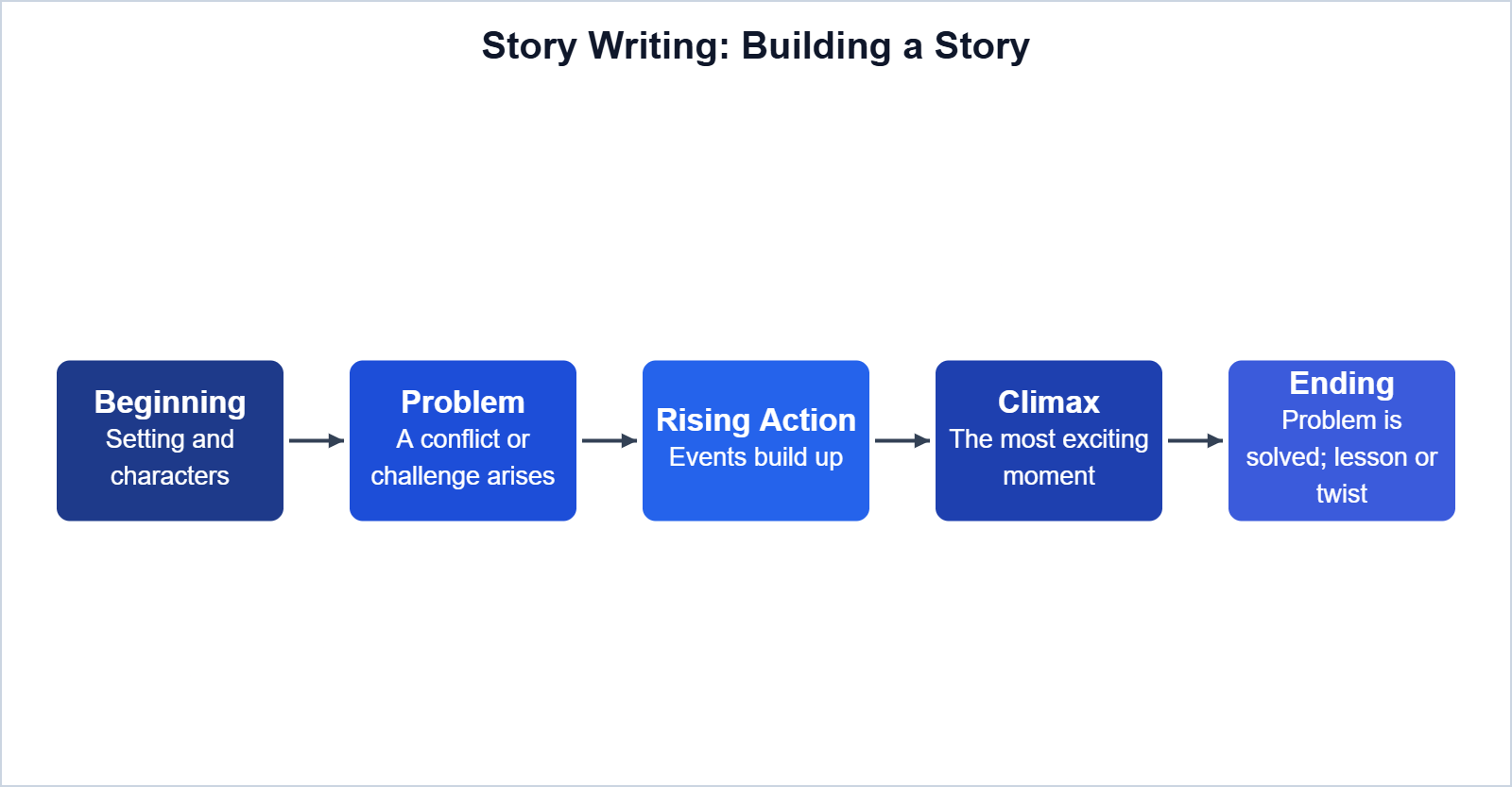
- Give a title that is short and interesting.
- Begin well: Introduce the place, time and main character.
- Develop the plot: Present a problem and build suspense.
- Use dialogue and description to make the story lively.
- End properly: Solve the problem, and if suitable, give a moral or a twist.
Remember: Write stories in the past tense and keep the events in a logical order.
4. Sample Story
The Lost Wallet
It was a cold December morning in Shimla. Ravi, a Class 11 student, was walking to school when he saw a brown wallet lying on the road. He picked it up and opened it. Inside were five thousand rupees, an identity card and a photograph of an old man with a little girl.
Ravi thought about the money. His family was poor, and he needed new books. But he remembered his mother’s words that what belongs to others is never ours. He decided to return it.
The address on the card was far away, but after school Ravi walked there. An old man opened the door. When Ravi held out the wallet, the man’s eyes filled with tears. “This money was for my granddaughter’s operation,” he said. “You have saved her.”
The next week, the old man came to Ravi’s school and told the principal the whole story. Ravi was honoured in the morning assembly. He felt prouder than he had ever felt before.
Moral: Honesty is the best policy.
5. Diary Entry Format
Date, day and time on the top (for example, 26 October 2026, Monday, 9:00 pm). Begin with “Dear Diary”. Write in the first person, in an informal and personal tone, expressing your feelings. Sign off with your name.
Sample:
26 October 2026, Monday, 9:00 pm
Dear Diary
Today was the most exciting day of the term. Our class went on a trip to the hills near our town. We walked through pine forests, watched the clouds float below us, and ate lunch beside a stream. I felt so free and happy. I wish every school day could be like this.
Meera
Exam point: Do not forget the date, day and time in a diary entry; marks are given for the format.
Easy Memory Trick: “Begin, Build, Burst, End”: beginning, build-up, climax and ending of a story.
Conclusion: Creative writing lets students express their imagination and feelings. With a clear structure, lively language and original ideas, any piece of writing can become interesting.