A Photograph – Class 11 English Notes
Hornbill | Poem – 1
A Photograph
(Shirley Toulson)
1. About the Poet
Shirley Toulson (1924-2018) was a British poet, writer and journalist. She wrote about family, memory, the countryside and old traditions. In A Photograph she remembers her mother through an old photograph.
2. Central Idea
The poem is about time, change and loss. An old photograph shows the poet’s mother as a young girl. Years later the mother laughs at the photo, remembering her childhood. Now the mother is dead, and the poet feels the pain of her loss. Human life keeps changing and ends, but nature (the sea) remains the same.
3. Stanza-wise Explanation
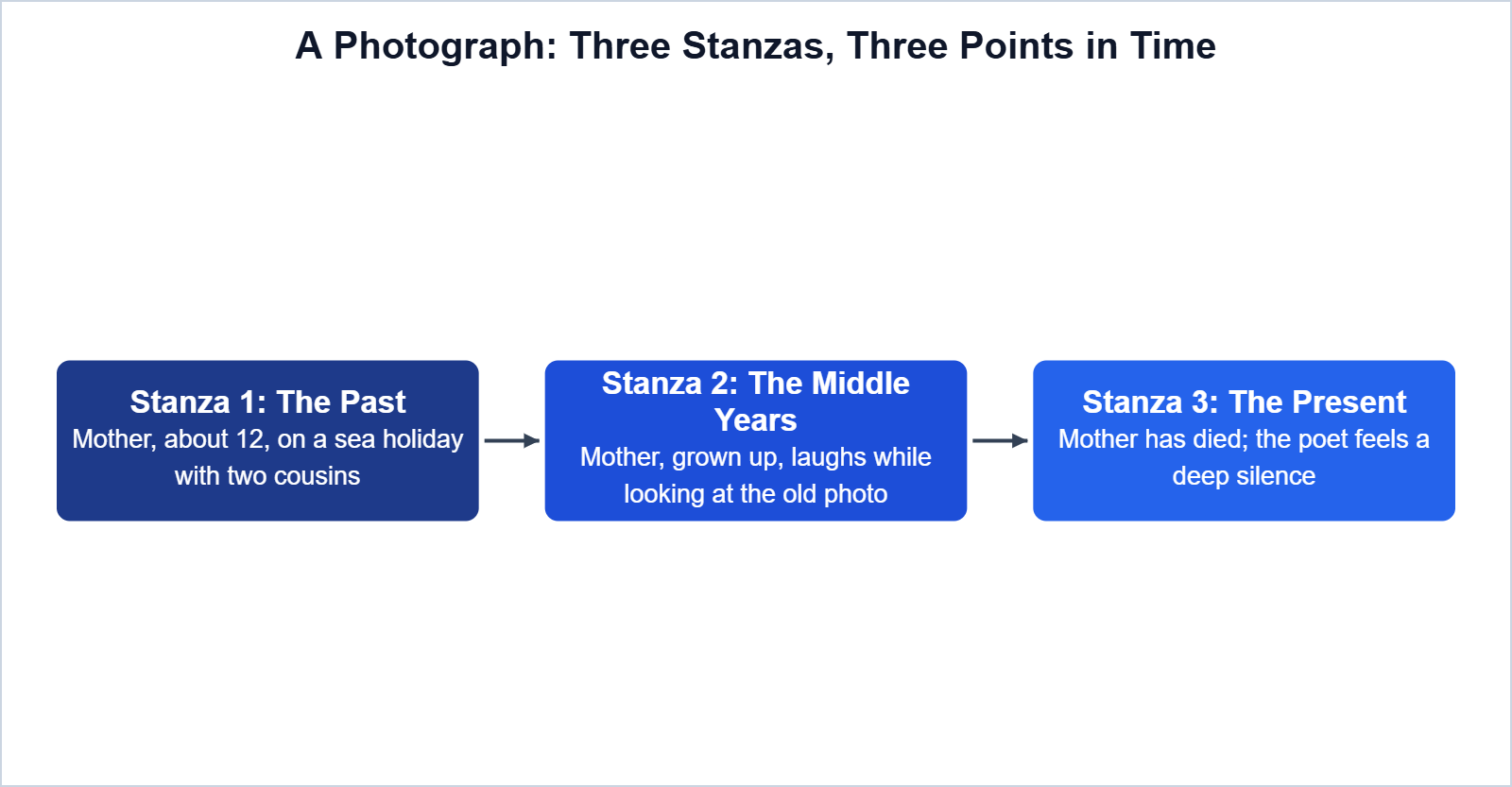
- Stanza 1 (the photograph): The photograph, mounted on cardboard, shows the poet’s mother at about twelve years of age. She is on a holiday at the seaside with her two girl cousins, who are younger than her. They are standing in the shallow water, holding hands and smiling, while their uncle takes the picture. The mother has a sweet face and her hair is blowing over it.
- Stanza 2 (the mother remembers): Twenty or thirty years later, the mother would laugh while looking at the snapshot. She would point at the old-fashioned clothes of her cousins and herself. For the mother, the sea holiday was her past; for the poet, the mother’s laughter is now the past. Both memories are sad because both are lost.
- Stanza 3 (the present): The mother has been dead for about as many years as the girl in the photo had lived (twelve). The poet says there is nothing to say about this situation. The silence of death leaves her without words.
Remember: The poem moves through three time periods: the mother’s childhood, the mother’s adult life, and the poet’s present after the mother’s death.
4. Theme and Message
- Change and permanence: The sea has not changed over the years, but the people in the photograph have grown old or passed away.
- Memory and loss: A photograph keeps a moment alive, but the people and the moment can never return.
- Love for the mother: The poet misses her mother’s laughter, which is now only a memory.
5. Poetic Devices
Device | Where and how |
|---|---|
Alliteration | “terribly transient” (repetition of the t sound) |
Contrast | The unchanging sea is contrasted with the “transient” (short-lived) human beings |
Oxymoron | “laboured ease”: two opposite ideas, effort and ease, put together |
Personification | Silence is shown as something that can make one silent |
Imagery | Picture of three girls paddling in the sea, holding hands |
Exam point: The rhyme scheme is irregular. The poem is written in free verse with three stanzas.
6. Important Word Meanings
Word | Meaning |
|---|---|
Paddle | To walk in shallow water |
Transient | Lasting for a short time |
Snapshot | A photograph taken quickly |
Wry | Showing both amusement and sadness |
Circumstance | Situation or condition |
7. Short Answer Questions
Q1. What does the word “cardboard” refer to in the poem?
Ans. It refers to the cardboard frame on which the old photograph is mounted. It also suggests that only a lifeless picture of the mother remains.
Q2. What has the camera captured?
Ans. It has captured a happy moment of the poet’s mother, about twelve years old, paddling in the sea with her two cousins and smiling for their uncle.
Q3. What has not changed over the years?
Ans. The sea has not changed. It is the same as it was, while the people in the photo have changed and grown old.
Q4. Why does the mother laugh at the photograph?
Ans. She laughs at the old-fashioned clothes and remembers her happy childhood with fond memories.
Q5. What is the meaning of “Its silence silences”?
Ans. The mother’s death has brought a silence that leaves the poet speechless. She has no words to express her grief.
8. Long Answer Question
Q. How does the poem show the contrast between the permanence of nature and the impermanence of human life?
Ans. The photograph shows three girls paddling in the sea. Years have passed, and the girls have grown up; the poet’s mother has even died. But the sea is the same as before. Its waves still wash the shore as they did then. The poet uses the word “transient” for the girls’ feet to show that human life is short and passing. The sea is a symbol of permanence, while humans change, age and die. This contrast makes the reader feel the sadness of time and loss.
Easy Memory Trick: “Sea Stays, People Pass”: the sea stays the same, people change and pass away.
Conclusion: A Photograph is a short, touching poem about a daughter’s loss. Through one old picture, it shows how time changes everything human, while memories and nature remain.