Discovering Tut: The Saga Continues – Class 11 English Notes
Hornbill | Chapter – 3
Discovering Tut: the Saga Continues
(A.R. Williams)
1. About the Lesson
This is a non-fiction (scientific and historical) article by A.R. Williams, written for National Geographic. It describes how modern technology (the CT scan) was used to study the mummy of the young Egyptian king Tutankhamun (King Tut) and to solve some of the mysteries about his life and death.
Remember: A saga is a long story full of events. The title means that the story of discovering Tut is still going on.
2. Who was Tutankhamun?
Tutankhamun was a pharaoh (king) of ancient Egypt who ruled more than 3,300 years ago. He became king as a boy and died at about 19 years of age. He was the last heir of a powerful family that had ruled Egypt for centuries. His sudden death has always been a mystery.
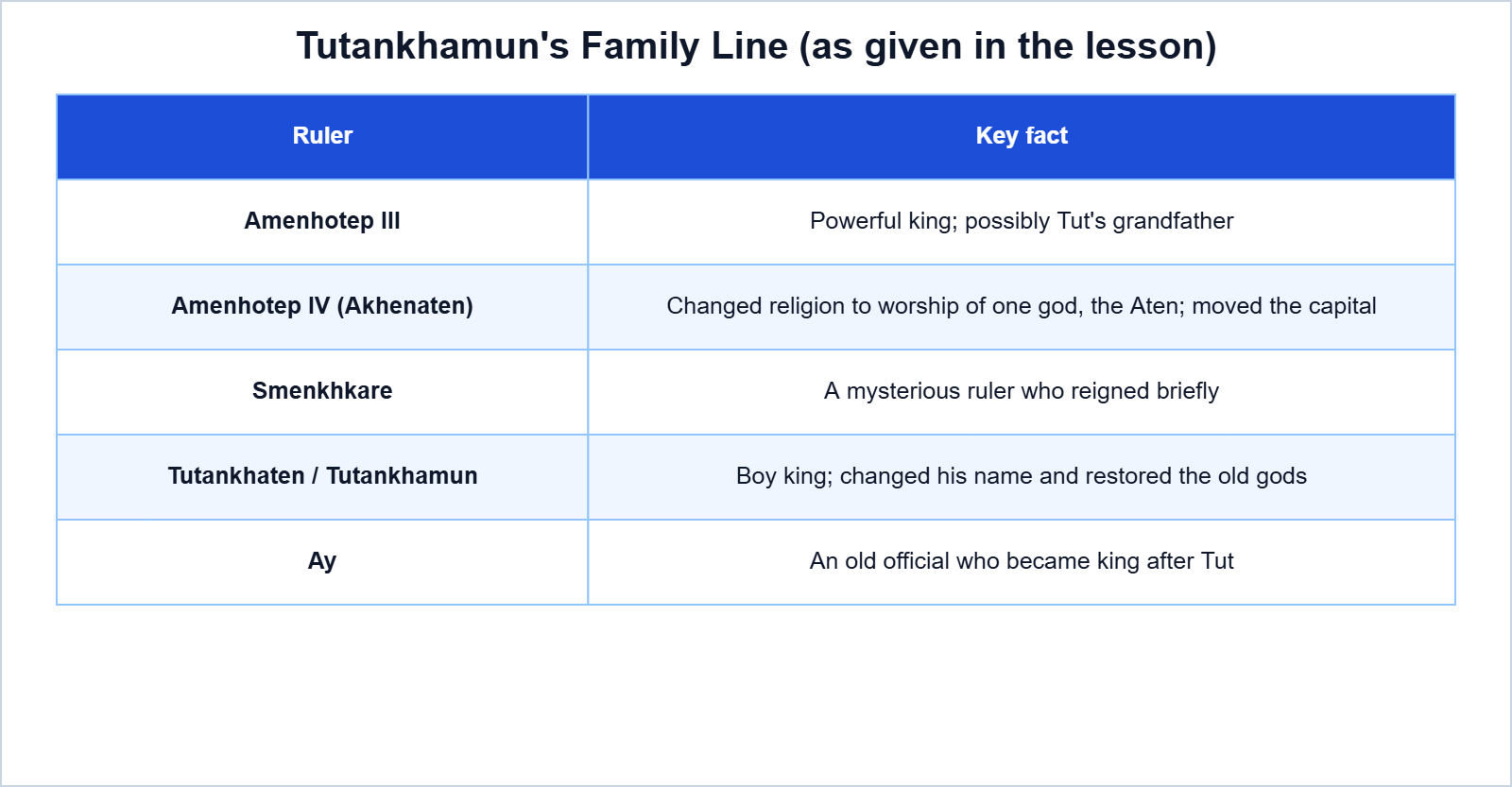
- Akhenaten (possibly his father) changed the religion of Egypt: he worshipped only one god, the Aten (the sun disc), and closed the temples of the other gods.
- Tutankhamun changed his name from Tutankhaten and brought back the worship of the old gods, including Amun.
3. Summary
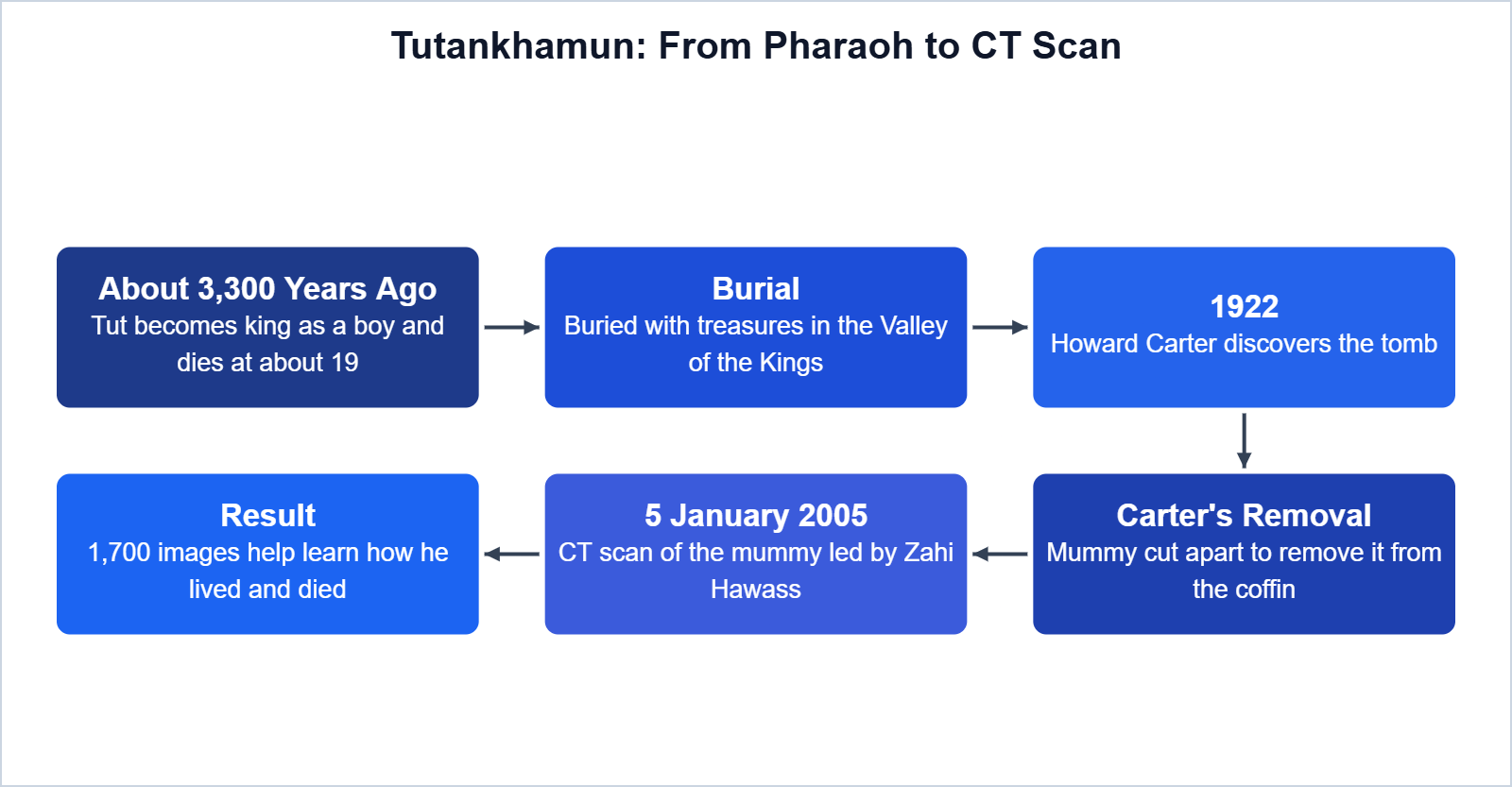
- The burial: Tut’s body was buried with great care in a tomb in the Valley of the Kings, along with gold, jewellery, furniture, chariots, weapons and other things he might need in the afterlife.
- Discovery by Howard Carter (1922): The British archaeologist Howard Carter found the tomb after a long search. He found the mummy inside three nested coffins, the innermost made of solid gold. Over time the resins used in burial had hardened and stuck the mummy to the coffin.
- Damage to the mummy: Carter tried to loosen the body by putting it in the sun, which did not work. His team then cut the mummy apart, removing the head and separating the joints, to take out the gold and jewellery. The body was later put back together and placed in a wooden box in the tomb.
- The CT scan (2005): On 5 January 2005, a team led by Zahi Hawass, head of Egypt’s Supreme Council of Antiquities, took the mummy out of its tomb and put it through a portable CT scanner kept in a trailer. The scanner took about 1,700 cross-section images. At first the scanner stopped working because of a technical fault, but it was fixed and the work was completed.
- Purpose of the scan: The scan would give a detailed 3-D picture of the body. It could tell how old Tut was when he died, how he lived, and whether he died of an illness, an injury or was murdered.
- After the scan: The mummy was returned to the tomb. Tut rests in the tomb, while the curious public, too, wants to know more about him.
Exam point: The CT scan was done in January 2005, under the guidance of Zahi Hawass. Howard Carter discovered the tomb in 1922.
4. Theme and Message
- Science helps history: Modern technology like CT scans, X-rays and DNA tests can solve ancient mysteries.
- Respect for the past: The careless handling of the mummy in Carter’s time shows how important it is to treat our heritage with care.
- Human curiosity: People’s interest in the past never ends; the story of Tut continues.
5. Important Word Meanings
Word | Meaning |
|---|---|
Pharaoh | The title of a king of ancient Egypt |
Mummy | A dead body preserved by special methods |
Archaeologist | A person who studies ancient remains |
Resin | A sticky substance from plants used in preserving mummies |
Forensic | Related to scientific methods used to find out facts about a death or crime |
Funerary | Related to burial |
Heir | A person who receives property or a title after someone’s death |
6. Short Answer Questions
Q1. Why was the mummy of Tut damaged by Carter’s team?
Ans. The hardened resins had glued the mummy to its coffin. To remove it and take out the gold and jewels, Carter’s team cut the body into pieces.
Q2. Why were things like gold, food and furniture buried with Tut?
Ans. The ancient Egyptians believed in life after death. They thought the king would need these things in the next world.
Q3. What is a CT scan?
Ans. A CT (computed tomography) scan takes hundreds of X-ray images in cross-section and joins them on a computer to produce a detailed 3-D image of the body.
Q4. Who was Akhenaten and what change did he make?
Ans. Akhenaten (Amenhotep IV) was probably Tut’s father. He gave up the old gods, worshipped only the Aten and moved the royal capital to a new city.
7. Long Answer Question
Q. How has modern technology helped to unravel the mystery of Tutankhamun?
Ans. For many years, people only guessed how Tut had died. X-rays in 1968 gave some clues, but in 2005 a CT scan gave a much clearer view. The portable scanner produced about 1,700 digital images, which formed a detailed 3-D picture of the mummy. Experts in radiology, forensics and anatomy studied these images to find his age, his health and the possible cause of his death. Thus science allowed archaeologists to study the mummy without causing further damage, and to learn more about the boy king than ever before.
Easy Memory Trick: “1922 Carter, 2005 Scanner”: the tomb was found in 1922, the scan was done in 2005.
Conclusion: Discovering Tut shows how the past and present meet. Ancient Egypt’s mysteries are being solved by modern science, and the story of the boy king continues to fascinate the world.