The Voice of the Rain – Class 11 English Notes
Hornbill | Poem – 3
The Voice of the Rain
(Walt Whitman)
1. About the Poet
Walt Whitman (1819-1892) was a great American poet, often called the father of free verse. His famous collection is Leaves of Grass. He loved nature, democracy and the common man.
2. Central Idea
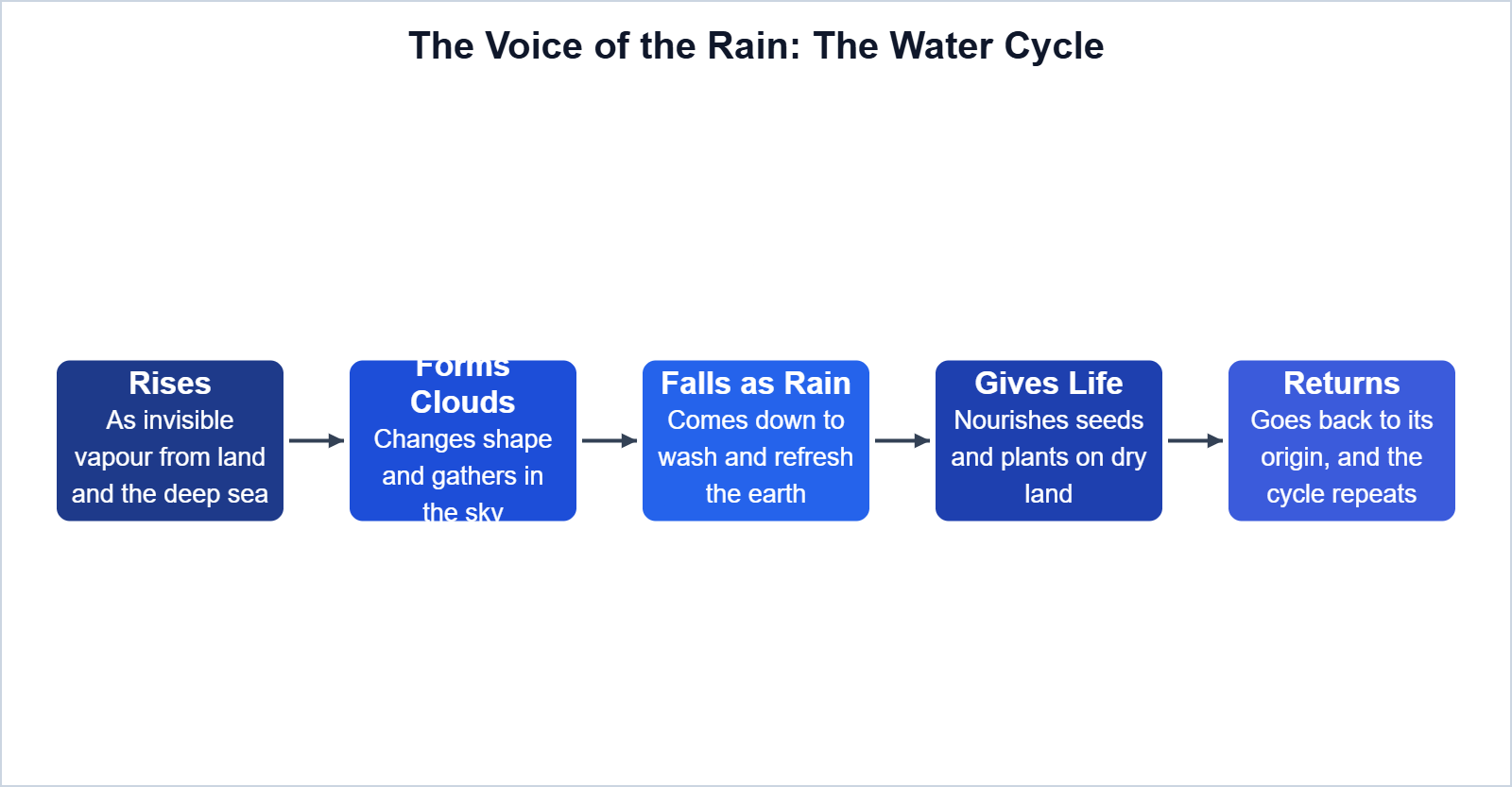
The poem is a conversation between the poet and the rain. The poet asks the rain who it is, and the rain replies that it is the “Poem of Earth”. It describes the water cycle: rising from the earth and sea, forming clouds, coming down as rain, giving life, and going back to its source. The poet compares this cycle to a song or a poem, which comes from the poet’s heart, travels to people and finally returns to the poet.
3. Explanation
- The question: The poet asks the gentle rain who it is. Surprisingly, the rain answers him.
- The rain’s reply: The rain says it rises unseen from the land and the deep sea, goes up to the sky, changes its form and comes down again.
- Its work: It washes away dust, cools the dry earth, and helps seeds that would otherwise stay dead and unborn to grow. It gives beauty and freshness to the earth.
- The return: Day and night it gives life back to its own origin, the earth, and makes it pure and beautiful.
- The comparison (in brackets): The poet adds that a song is like the rain. It rises from the poet’s heart, wanders around, is enjoyed by others, and finally comes back to the poet with love.
4. Poetic Devices
Device | Example |
|---|---|
Personification | The rain speaks and answers the poet like a person |
Metaphor | The rain calls itself the “Poem of Earth” |
Parenthesis | The last two lines are placed in brackets to compare a song with the rain |
Imagery | Pictures of vapour rising, clouds, rain falling on dry land |
Free verse | No fixed rhyme or metre |
5. Theme
- Cycle of nature: Rain moves in a never-ending cycle.
- Nature and art: Like rain, music and poetry come from a source, give joy to others and return to their creator.
Remember: Rain gives life without expecting anything in return. In the same way, a true poet shares his work selflessly.
6. Short Answer Questions
Q1. Who asks the question and who answers?
Ans. The poet asks the rain who it is, and the rain itself answers.
Q2. Why does the rain call itself the “Poem of Earth”?
Ans. Like a poem that comes from the poet and returns to him, the rain rises from the earth and returns to it, giving beauty and life along the way.
Q3. How is a song like the rain?
Ans. A song rises from the poet’s heart, travels to listeners, gives them joy, and returns to the poet with love, just as rain comes from the earth and returns to it.
Q4. Why are the last two lines in brackets?
Ans. They give the poet’s own comment, comparing the rain with a song. The brackets separate this thought from the rain’s words.
Easy Memory Trick: “Rise, Rain, Return”: the three steps of the rain’s journey.
Conclusion: The Voice of the Rain beautifully combines science (the water cycle) with art (the life of a song), showing that both give life and joy to the world.