Note Making – Class 11 English Notes
Writing Skills | Chapter – 1
Note Making
1. What is Note Making?
Note making is the skill of writing down the main ideas and important points of a passage, lecture or book in a short, organised form. Notes help us remember, revise and understand information quickly.
Remember: Notes are not full sentences. They are short phrases, arranged under headings and sub-headings.
2. Features of Good Notes
- Title: A suitable title that tells what the passage is about.
- Headings and sub-headings: The main ideas become headings; supporting ideas become sub-headings.
- Numbering: Use a clear numbering system (1, 1.1, 1.1.1 or 1, a, i).
- Abbreviations: Use short forms to save time and space, and give a key to explain them.
- Brevity: Only important points; no examples, repetitions or explanations.
3. Format of Notes
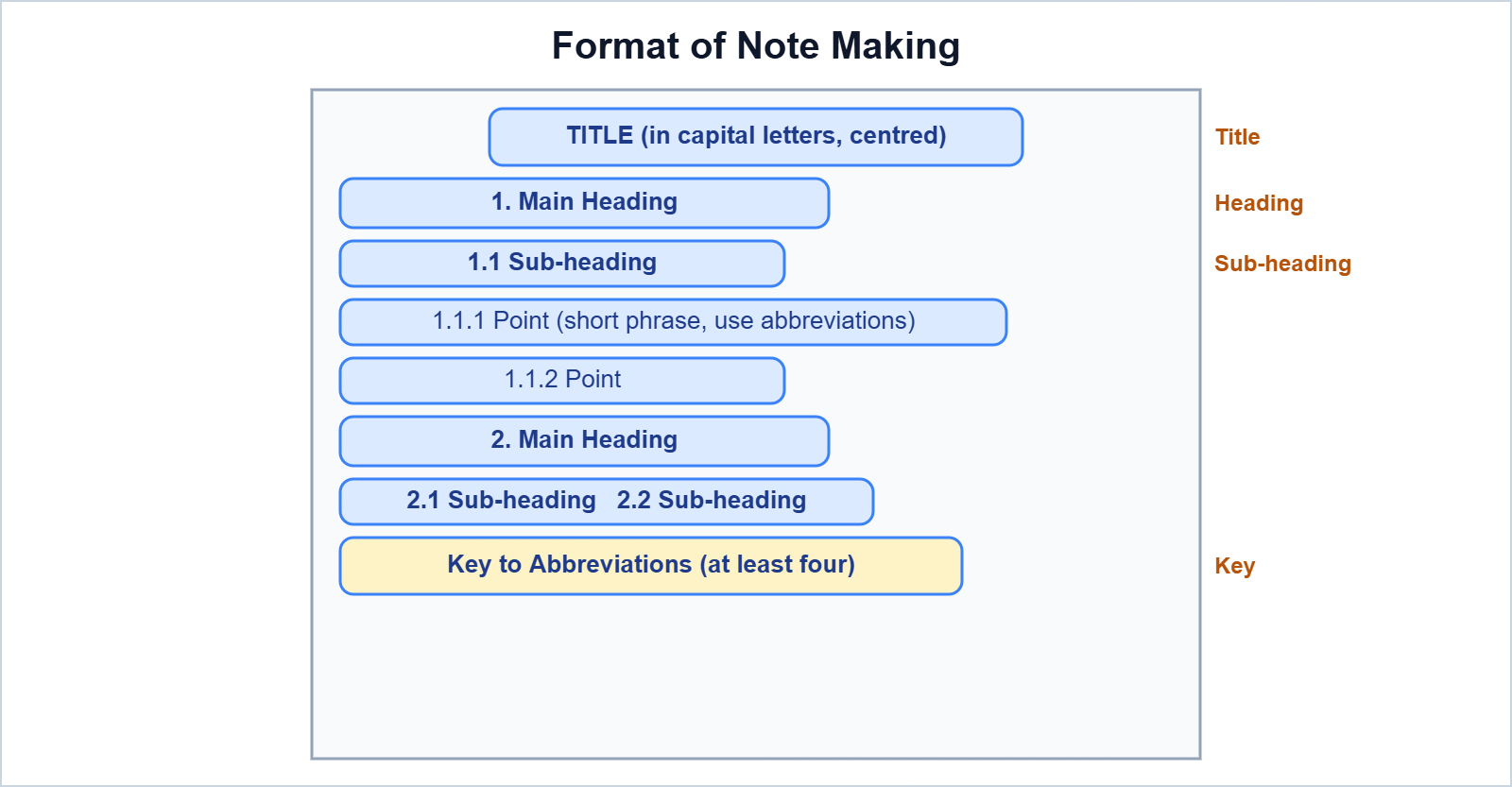
Exam point: In the exam, notes usually carry marks for the title, the format (headings and numbering), the content points and the key to abbreviations. Use at least four abbreviations.
4. Steps in Note Making
- Read the passage carefully two or three times.
- Find the main idea and give the notes a title.
- Divide the passage into main points (headings) and supporting points (sub-headings).
- Write the points as short phrases using abbreviations.
- Arrange them with numbering and indentation.
- Add a key to the abbreviations at the end.
5. Common Abbreviations
Abbreviation | Full form |
|---|---|
govt. | government |
imp. | important |
env. | environment |
edu. | education |
& | and |
e.g. | for example |
yrs. | years |
dev. | development |
6. Solved Example
Passage (original): Regular exercise is one of the best habits a person can develop. It keeps the heart healthy, improves blood circulation and helps control body weight. Exercise also has mental benefits. It reduces stress, improves mood and helps people sleep better. Students who exercise regularly often find it easier to concentrate on their studies. However, exercise should be done properly. Beginners should start slowly, warm up before exercising and drink enough water. It is also wise to choose an activity one enjoys, such as walking, cycling, swimming or playing a sport, so that the habit lasts.
Notes:
BENEFITS OF REGULAR EXERCISE
1. Physical benefits
1.1 keeps heart hlthy
1.2 improves blood circ.
1.3 controls body wt.
2. Mental benefits
2.1 reduces stress
2.2 improves mood
2.3 better sleep
2.4 better concentration in stds.
3. Right way to exercise
3.1 start slowly
3.2 warm up first
3.3 drink enough water
3.4 choose enjoyable activity, e.g. walking, cycling
Key: hlthy = healthy; circ. = circulation; wt. = weight; stds. = studies; e.g. = for example
Easy Memory Trick: “T-H-S-A-K”: Title, Headings, Sub-headings, Abbreviations, Key.
Conclusion: Note making helps us record information in a short and organised way. A good set of notes has a title, clear headings, numbered points, abbreviations and a key.