Practicals – Class 12 Biology Notes
Chapter – 14
Practicals
1. Practical Examination Pattern
The Biology practical examination carries 20 marks and lasts 3 hours. The syllabus lists the following components; follow the board’s marking scheme for the split of marks.
Item | Marks |
|---|---|
1. Two experiments | As per board scheme |
2. Slide preparation | As per board scheme |
3. Spotting | As per board scheme |
4. Investigatory project and viva based on the project | As per board scheme |
5. Record and viva based on the experiments | As per board scheme |
Total (time: 3 hours) | 20 |
Important: Keep your practical record complete, neat and signed. Write aim, materials, procedure, observation, result and precautions for every experiment.
2. List of Experiments
2.1. Pollen Germination on a Slide
Aim: To study pollen germination on a slide.
Materials: Fresh flowers (e.g., Catharanthus, Hibiscus, pea), sugar (sucrose), boric acid, distilled water, cavity slide, cover slip, microscope.
Procedure:
- Prepare a nutrient solution of about 10% sugar with a pinch of boric acid in distilled water.
- Put a drop of the solution on a cavity slide.
- Dust pollen grains from a mature anther onto the drop and cover with a cover slip.
- Keep the slide for 15-30 minutes and observe under the microscope at intervals.
Observation: Pollen tubes emerge from the germ pores of many pollen grains and grow longer with time.
Result: Pollen grains germinate in a suitable sugar solution, producing pollen tubes.
2.2. Soil Texture and Moisture Content
Aim: To collect soil from different sites and study their texture and moisture content.
Materials: Soil samples from a garden, roadside and field; balance; oven or sunlight; petri dishes; sieve.
Procedure:
- Collect soil from three sites in labelled bags.
- Rub a little moist soil between fingers to judge texture (gritty = sandy, smooth and silky = silty, sticky = clayey); sieve to separate particles.
- Weigh a fresh sample (W1), dry it completely and weigh again (W2).
- Moisture content (%) = (W1 – W2) / W1 x 100.
Observation: Garden soil is loamy with higher moisture; roadside soil is sandy with low moisture.
Result: Soils from different sites differ in texture and moisture content; loamy soil holds more moisture.
2.3. Soil pH and Water Holding Capacity
Aim: To study the pH and water holding capacity of soil and correlate them with the kinds of plants found.
Materials: Soil samples, distilled water, pH paper or universal indicator, funnel, filter paper, measuring cylinder, balance.
Procedure:
- pH: Mix soil with distilled water (1:2), let it settle, and test the clear liquid with pH paper; compare with the colour chart.
- Water holding capacity: Place a known weight of dry soil on filter paper in a funnel, pour a known volume of water, and collect the water that drains out.
- WHC (%) = (water added – water drained) / weight of soil x 100.
- Note the types of plants growing at each site.
Observation: Soils with more organic matter and clay hold more water; plants differ with pH (acidic soils support tea, alkaline soils support some grasses).
Result: Soil pH and water holding capacity vary with soil type and affect the kinds of plants growing there.
2.4. Water from Different Water Bodies
Aim: To study water samples for pH, clarity and presence of living organisms.
Materials: Water from a pond, river and tap; pH paper; clean glass bottles; slides; microscope.
Procedure:
- Collect water samples in clean labelled bottles.
- Test pH with pH paper.
- Judge clarity by looking through the sample against white paper (clear, slightly turbid, turbid).
- Observe a drop under the microscope for algae, protozoans and other organisms.
Observation: Pond water is usually more turbid and has many organisms (algae, Paramecium); tap water is clear with few organisms.
Result: Water bodies differ in pH, clarity and living organisms, indicating their quality.
2.5. Plant Population Density by Quadrat Method
Aim: To study plant population density by the quadrat method.
Materials: Quadrat frame (1 m x 1 m), string, pegs, notebook.
Procedure:
- Place quadrats at random in the study area (e.g., 10 quadrats).
- Count the individuals of the chosen species in each quadrat.
- Density = total number of individuals in all quadrats / total number of quadrats studied.
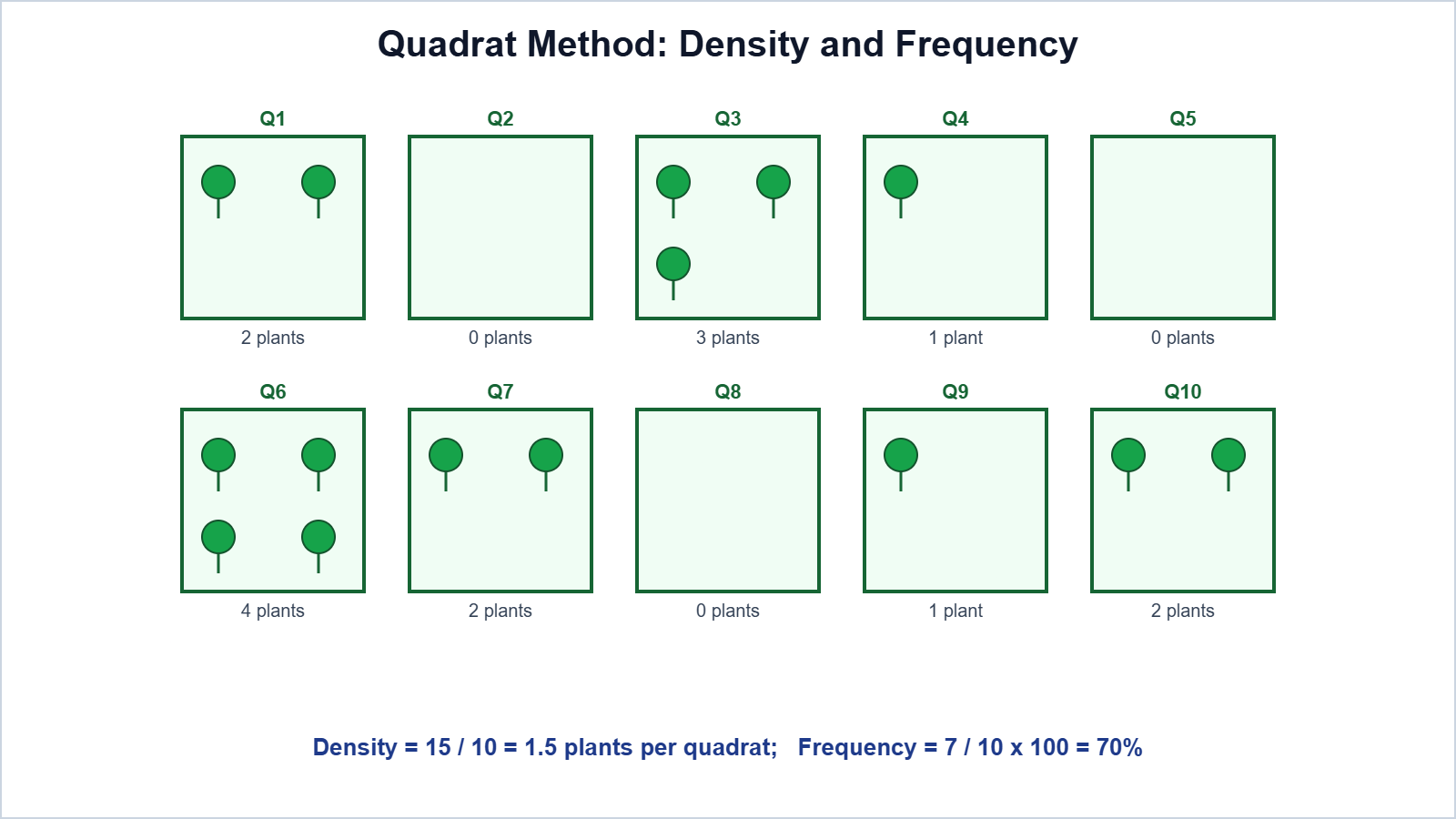
Observation: See the diagram below.
Result: Density of the species = 1.5 plants per quadrat.
2.6. Plant Population Frequency by Quadrat Method
Aim: To study plant population frequency by the quadrat method.
Materials: Same as above.
Procedure:
- Use the same quadrats.
- Note the number of quadrats in which the species is present.
- Frequency (%) = number of quadrats in which the species occurs / total number of quadrats x 100.
Observation: The species occurred in 7 of 10 quadrats.
Result: Frequency of the species = 70%.
3. Spotting (Study and Observation)
3.1 Flowers adapted to pollination by different agencies
- Wind-pollinated (e.g., grasses, maize): small, dull flowers; light, dry, non-sticky pollen; large feathery stigma; no nectar or scent.
- Insect-pollinated (e.g., Salvia, sunflower): large, colourful, scented flowers with nectar; sticky pollen; landing platforms.
3.2 Pollen germination on a slide
- Pollen tubes emerging from germ pores; tube nucleus near the growing tip.
3.3 T.S. of testis and T.S. of ovary (gamete development)
- Testis: seminiferous tubules with spermatogonia, spermatocytes, spermatids and sperms in the lumen; Sertoli cells; Leydig cells between tubules.
- Ovary: follicles at different stages (primary, secondary, tertiary, Graafian follicle with antrum); corpus luteum may be seen.
3.4 Meiosis in onion bud cells or grasshopper testis
- Identify stages such as prophase I (bivalents), metaphase I, anaphase I and telophase; reduction of chromosome number to half.
3.5 T.S. of blastula
- Hollow ball of cells (blastomeres) with a fluid-filled cavity called the blastocoel.
3.6 Mendelian inheritance using seeds
- Count seeds of different colours or shapes from a hybrid; a ratio close to 3:1 (monohybrid) or 9:3:3:1 (dihybrid) supports Mendel’s laws.
3.7 Pedigree charts of genetic traits
- Rolling of tongue and widow’s peak (autosomal dominant); colour blindness (X-linked recessive); blood groups (codominance and multiple alleles). Use standard symbols to trace inheritance.
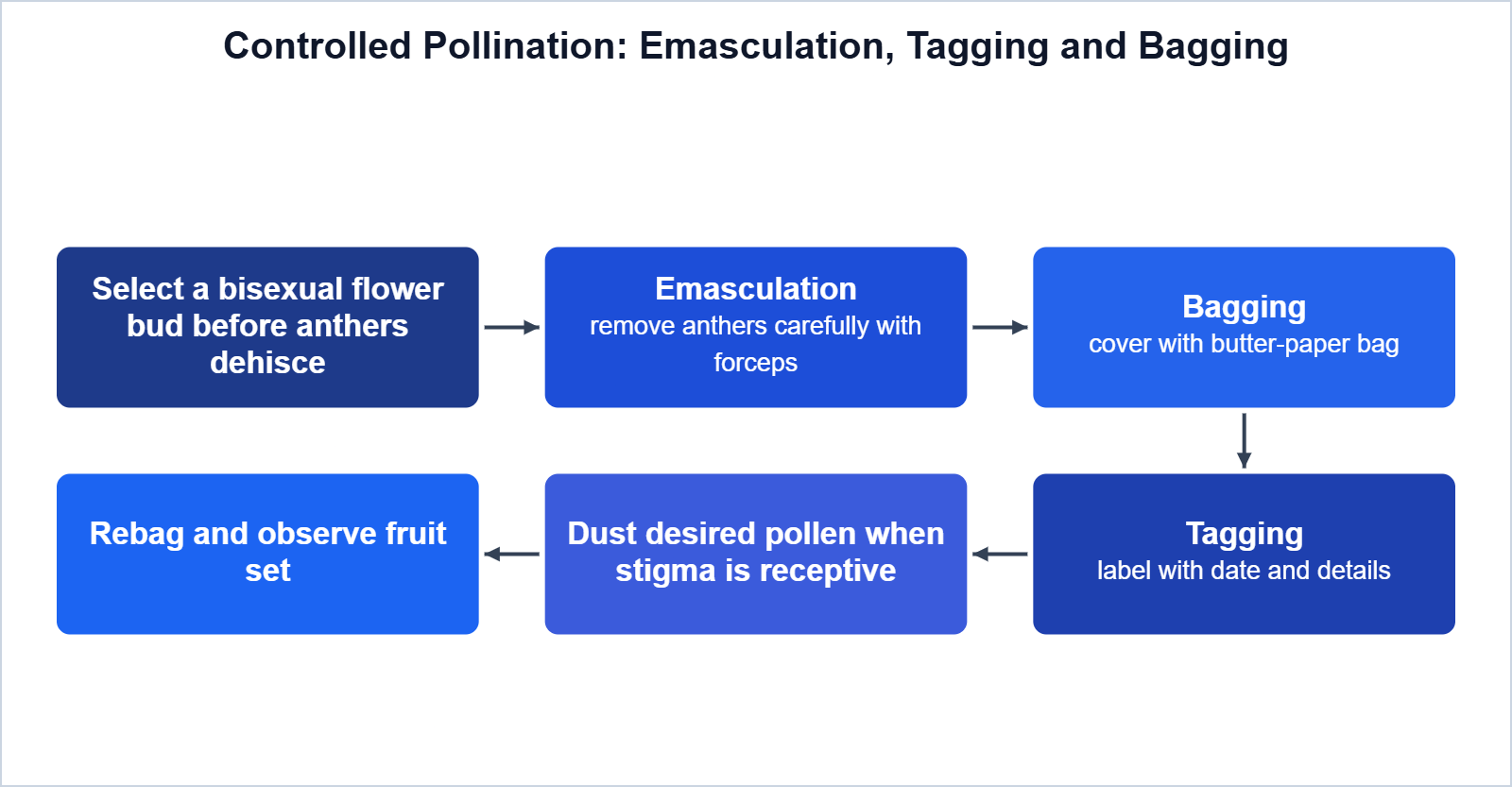
3.8 Controlled pollination: emasculation, tagging and bagging
- See the flow chart below; bags prevent contamination by unwanted pollen.
3.9 Disease-causing organisms (slides or specimens)
- Ascaris (roundworm): ascariasis; internal bleeding, muscular pain, fever, anaemia, blockage of intestine.
- Entamoeba histolytica: amoebiasis; constipation, abdominal pain, cramps, stools with mucus and blood.
- Plasmodium: malaria; chills and high fever recurring every 3-4 days.
- Ringworm fungi (Microsporum, Trichophyton, Epidermophyton): dry, scaly, itchy lesions on skin, nails and scalp.
3.10 Plants and animals of xerophytic conditions
- Plants (e.g., Opuntia): thick cuticle, sunken stomata, leaves reduced to spines, photosynthetic stem, CAM pathway.
- Animals (e.g., camel, kangaroo rat): conserve water, produce concentrated urine, can tolerate high temperature.
3.11 Plants and animals of aquatic conditions
- Plants (e.g., Hydrilla, water hyacinth): aerenchyma for buoyancy, reduced roots, thin or no cuticle.
- Animals (e.g., fish): streamlined body, fins, gills, swim bladder.
3.12 Homologous and analogous organs
- Homologous: forelimbs of human, whale and bat; thorn of Bougainvillea and tendril of Cucurbita (same origin, different function).
- Analogous: wings of bird and butterfly; sweet potato and potato (different origin, similar function).
4. Precautions (General)
- Use clean slides and cover slips; avoid air bubbles.
- Handle chemicals and the microscope carefully.
- Label all samples properly.
- Record observations honestly and draw neat, labelled diagrams.
Exam point: In spotting, write the identification first, then two or three distinctive features.
Easy Memory Trick: Quadrat formulas “Density = total count / quadrats; Frequency = quadrats with species / quadrats x 100”.
5. Important Viva Questions
Q1. Why is boric acid added to the sugar solution for pollen germination?
Ans. It helps pollen germination and pollen tube growth.
Q2. What is a quadrat?
Ans. A square frame of known area (e.g., 1 m x 1 m) used to sample vegetation.
Q3. Define frequency of a species.
Ans. The percentage of quadrats in which the species occurs.
Q4. Which soil has the highest water holding capacity?
Ans. Clayey soil (and soil rich in humus).
Q5. Why is emasculation done?
Ans. To prevent self-pollination in a bisexual flower.
Q6. Name the cavity seen in a blastula.
Ans. Blastocoel.
Q7. Give an example of an autosomal dominant trait shown in a pedigree practical.
Ans. Widow’s peak (or tongue rolling).
Q8. Name one adaptation of a xerophyte.
Ans. Sunken stomata (or leaves reduced to spines).
Conclusion: Practical work develops observation, measurement and recording skills. Careful procedure, accurate calculations and a complete record help in scoring full marks in the practical examination.