Molecular Basis of Inheritance – Class 12 Biology Notes
Chapter – 5
Molecular Basis of Inheritance
1. Structure of DNA
DNA is a long polymer of deoxyribonucleotides. Each nucleotide has a nitrogenous base, a pentose sugar (deoxyribose) and a phosphate group. Bases are purines (adenine, guanine) and pyrimidines (cytosine, thymine; uracil in RNA). Watson and Crick (1953) proposed the double helix model, based on X-ray diffraction data of Maurice Wilkins and Rosalind Franklin and on Chargaff’s rule (A = T and G = C).
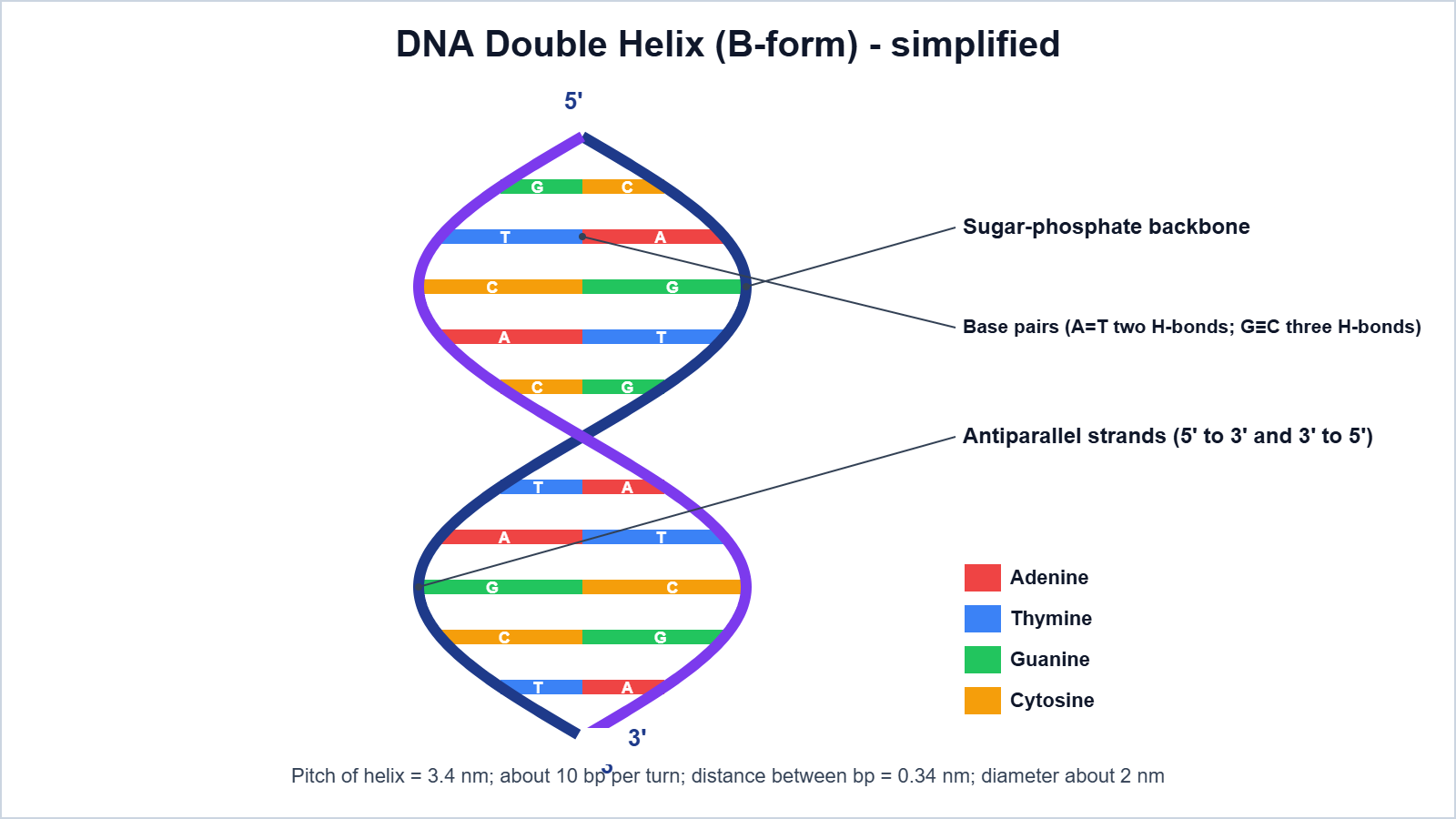
Packaging: In eukaryotes, DNA wraps around a core of eight histone molecules (histone octamer) to form a nucleosome (about 200 bp). Chromatin has loosely packed, active euchromatin and densely packed, inactive heterochromatin.
Worked Problem 1 (Chargaff’s rule): A DNA sample has 20% adenine. Find the percentages of the other bases.
Solution: A = T = 20%, so A + T = 40%. G + C = 60%, so G = C = 30%.
Worked Problem 2 (Complementary strand and hydrogen bonds): One strand of DNA is 5′-ATGCCGTA-3′. Write the complementary strand and find the number of hydrogen bonds.
Solution: Complementary strand = 3′-TACGGCAT-5′. There are 4 A-T pairs (2 H-bonds each = 8) and 4 G-C pairs (3 H-bonds each = 12). Total = 20 hydrogen bonds.
Worked Problem 3 (Length of DNA): Find the length of a DNA molecule with 5000 base pairs. Solution: 5000 x 0.34 nm = 1700 nm (1.7 micrometres).
2. The Search for the Genetic Material
Scientist(s) | Experiment | Conclusion |
|---|---|---|
Griffith (1928) | Streptococcus pneumoniae: heat-killed S strain + live R strain killed mice | A “transforming principle” changed R into S |
Avery, MacLeod, McCarty | Purified biochemicals; only DNase stopped transformation | DNA is the transforming principle |
Hershey and Chase (1952) | Bacteriophages labelled with 32P (DNA) and 35S (protein) | DNA is the genetic material |
Properties of genetic material: it should replicate, be chemically and structurally stable, allow slow changes (mutation) for evolution, and express itself as Mendelian characters. DNA is more stable than RNA; RNA is reactive and acts as a catalyst, and it was probably the first genetic material (RNA world).
3. DNA Replication
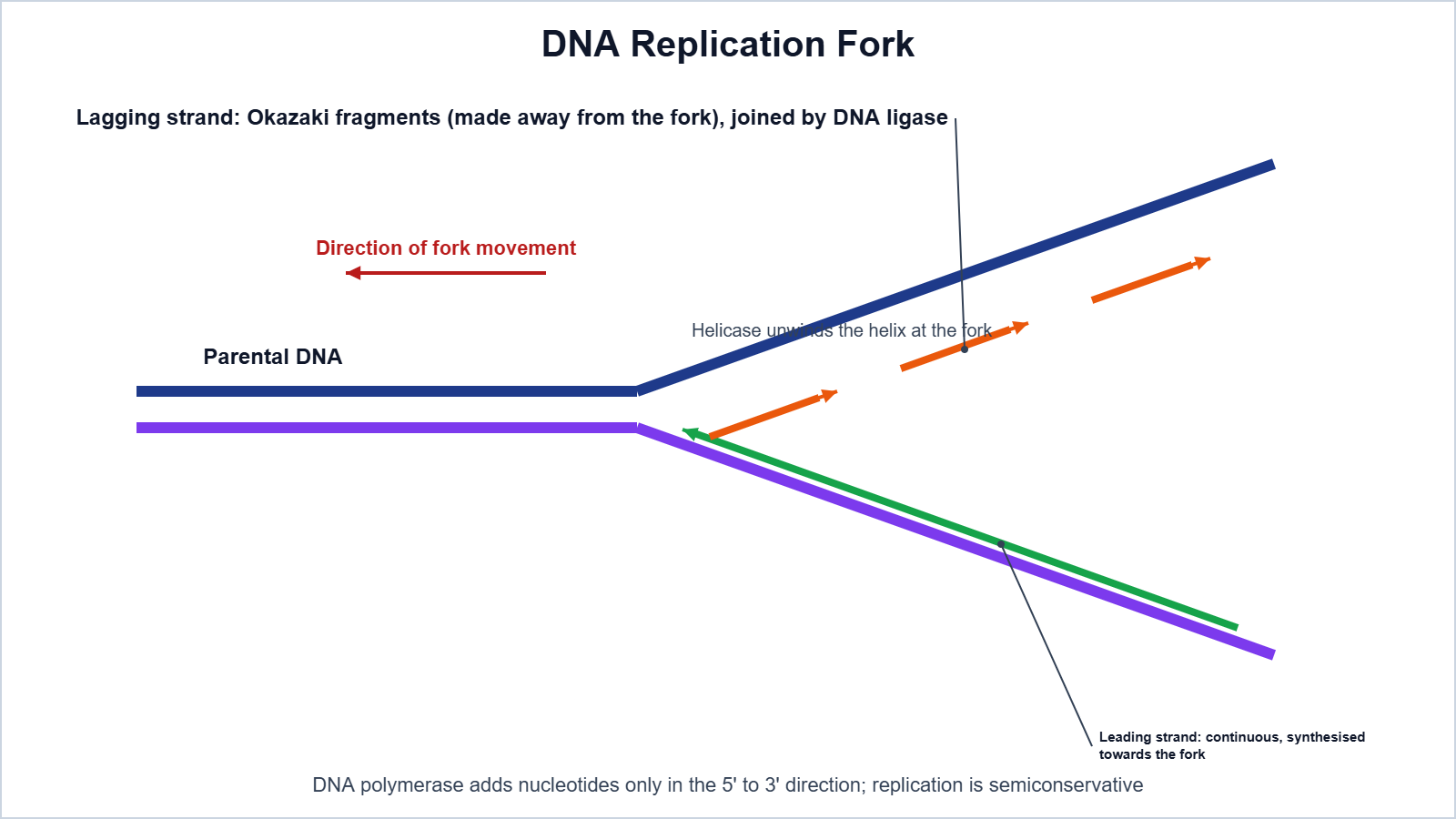
Replication is semiconservative, as shown by Meselson and Stahl (1958) using heavy nitrogen (15N) in E. coli. The main enzyme is DNA-dependent DNA polymerase. Replication starts at a definite point called the origin of replication. In eukaryotes it occurs in the S phase of the cell cycle.
4. Transcription
Transcription is the copying of genetic information from one strand of DNA into RNA. The strand with 3′ to 5′ polarity acts as the template strand; the other is the coding strand. A transcription unit has a promoter, the structural gene and a terminator. In bacteria, one RNA polymerase makes all types of RNA. In eukaryotes there are three: RNA polymerase I (rRNAs 28S, 18S, 5.8S), II (hnRNA, the precursor of mRNA) and III (tRNA, 5S rRNA, snRNAs).
Processing of hnRNA: splicing (introns removed, exons joined), capping (methyl guanosine triphosphate added at the 5′ end) and tailing (adenylate residues added at the 3′ end).
Worked Problem 4 (Transcription): The template strand is 3′-TACGGCAT-5′. Write the mRNA. Solution: 5′-AUGCCGUA-3′ (same as the coding strand with U in place of T).
5. Genetic Code
- The code is a triplet: 4 x 4 x 4 = 64 codons; 61 code for amino acids and 3 are stop codons (UAA, UAG, UGA).
- It is unambiguous and specific: one codon codes for only one amino acid.
- It is degenerate: some amino acids are coded by more than one codon.
- It is read in a contiguous fashion without punctuation.
- It is nearly universal.
- AUG codes for methionine and is also the initiator codon.
Worked Problem 5: An mRNA has 300 nucleotides in its coding region including the stop codon. How many amino acids will the polypeptide have? Solution: 300 / 3 = 100 codons; the stop codon codes for no amino acid, so 99 amino acids.
6. Translation
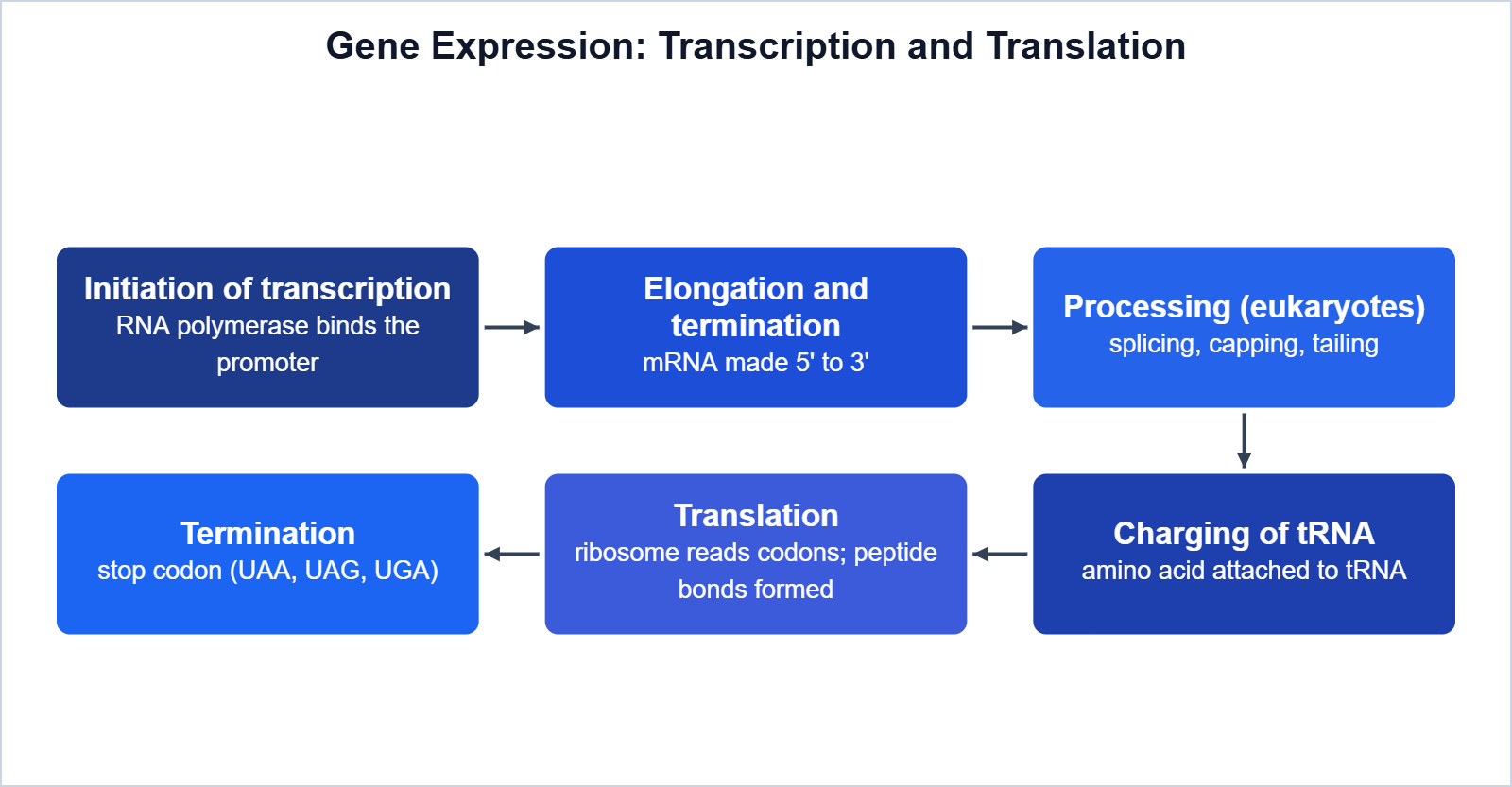
Translation occurs on ribosomes. Amino acids are activated and attached to their tRNA (charging). The small subunit binds mRNA, and the start codon AUG is recognised by the initiator tRNA. In bacteria, the 23S rRNA acts as a ribozyme (peptidyl transferase) that forms peptide bonds. Untranslated regions (UTRs) are present at both ends of mRNA.
7. Regulation of Gene Expression: The lac Operon
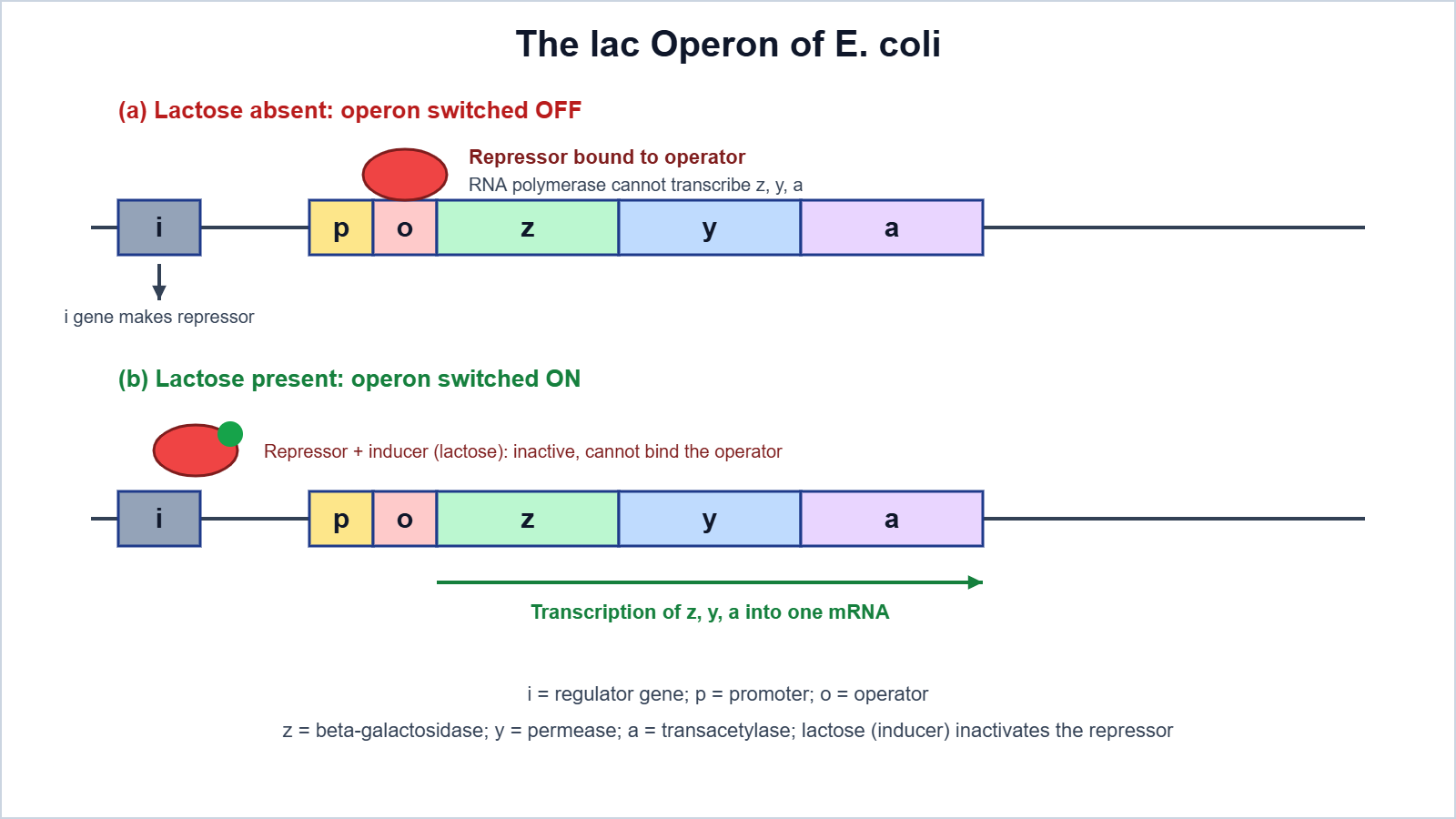
In prokaryotes, a group of genes with related functions is regulated together as an operon. The lac operon (Jacob and Monod) has a regulator gene (i), promoter, operator and three structural genes. It is an example of negative regulation by a repressor.
8. Human Genome Project and DNA Fingerprinting
The Human Genome Project (1990-2003) sequenced the human genome. Salient features: about 3164.7 million base pairs; the average gene has about 3000 bases (the largest, dystrophin, about 2.4 million bases); less than 2% of the genome codes for proteins; repeated sequences make up a large part; chromosome 1 has the most genes and Y the fewest; about 1.4 million single-base differences (SNPs) were identified.
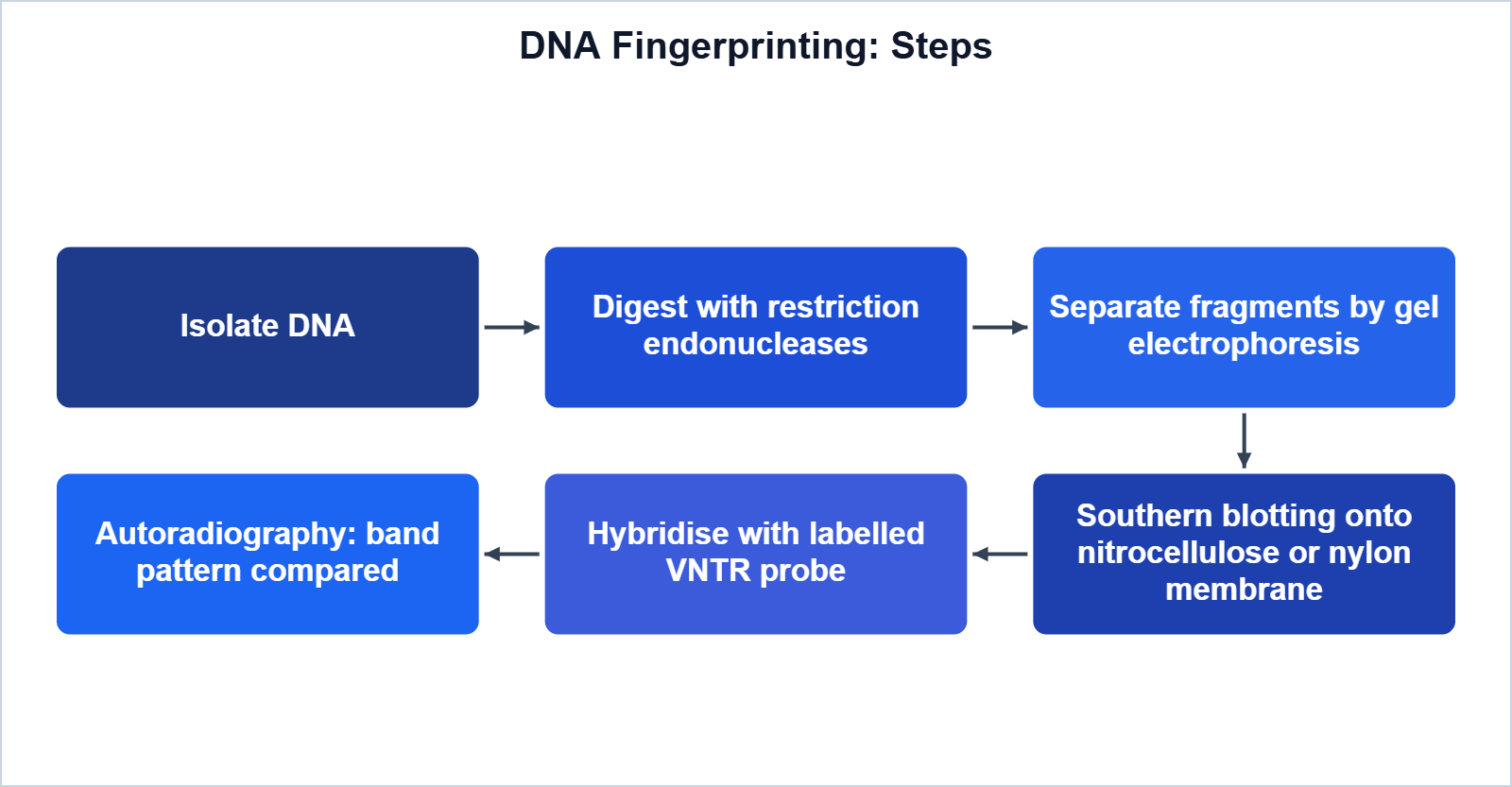
DNA fingerprinting, developed by Alec Jeffreys, uses VNTRs (variable number tandem repeats, a type of satellite DNA) as probes. It is used in forensic science, paternity disputes and studies of population diversity.
Easy Memory Trick: RNA polymerases “I – rRNA, II – mRNA (hnRNA), III – tRNA”.
9. Important Questions
Q1. What did the Hershey-Chase experiment prove?
Ans. That DNA, not protein, is the genetic material; radioactive phosphorus (DNA label) entered bacteria, while radioactive sulphur (protein label) did not.
Q2. What is semiconservative replication? Who proved it?
Ans. Each new DNA molecule has one old (parental) and one new strand; proved by Meselson and Stahl (1958) using 15N.
Q3. Why is replication discontinuous on one strand?
Ans. DNA polymerase works only in the 5′ to 3′ direction, so on the lagging strand DNA is made in short Okazaki fragments that are joined by DNA ligase.
Q4. What are the three types of RNA and their functions?
Ans. mRNA carries the code (template), tRNA brings amino acids and reads the code, rRNA is structural and catalytic in ribosomes.
Q5. What is splicing?
Ans. Removal of introns and joining of exons in hnRNA to form mature mRNA in eukaryotes.
Q6. State any three features of the genetic code.
Ans. It is triplet, degenerate (some amino acids have more than one codon) and nearly universal; AUG is the start codon.
Q7. Why is tRNA called an adapter molecule?
Ans. It has an anticodon that reads the mRNA codon and also carries the specific amino acid.
Q8. What is the role of lactose in the lac operon?
Ans. It (as allolactose) acts as an inducer that inactivates the repressor, allowing transcription of z, y and a genes.
Q9. When was the Human Genome Project completed and what did it find?
Ans. It was completed in 2003; the human genome has about 3164.7 million bp and less than 2% of it codes for proteins.
Q10. What is the basis of DNA fingerprinting?
Ans. Differences in repetitive DNA (VNTRs) between individuals, detected as different band patterns.
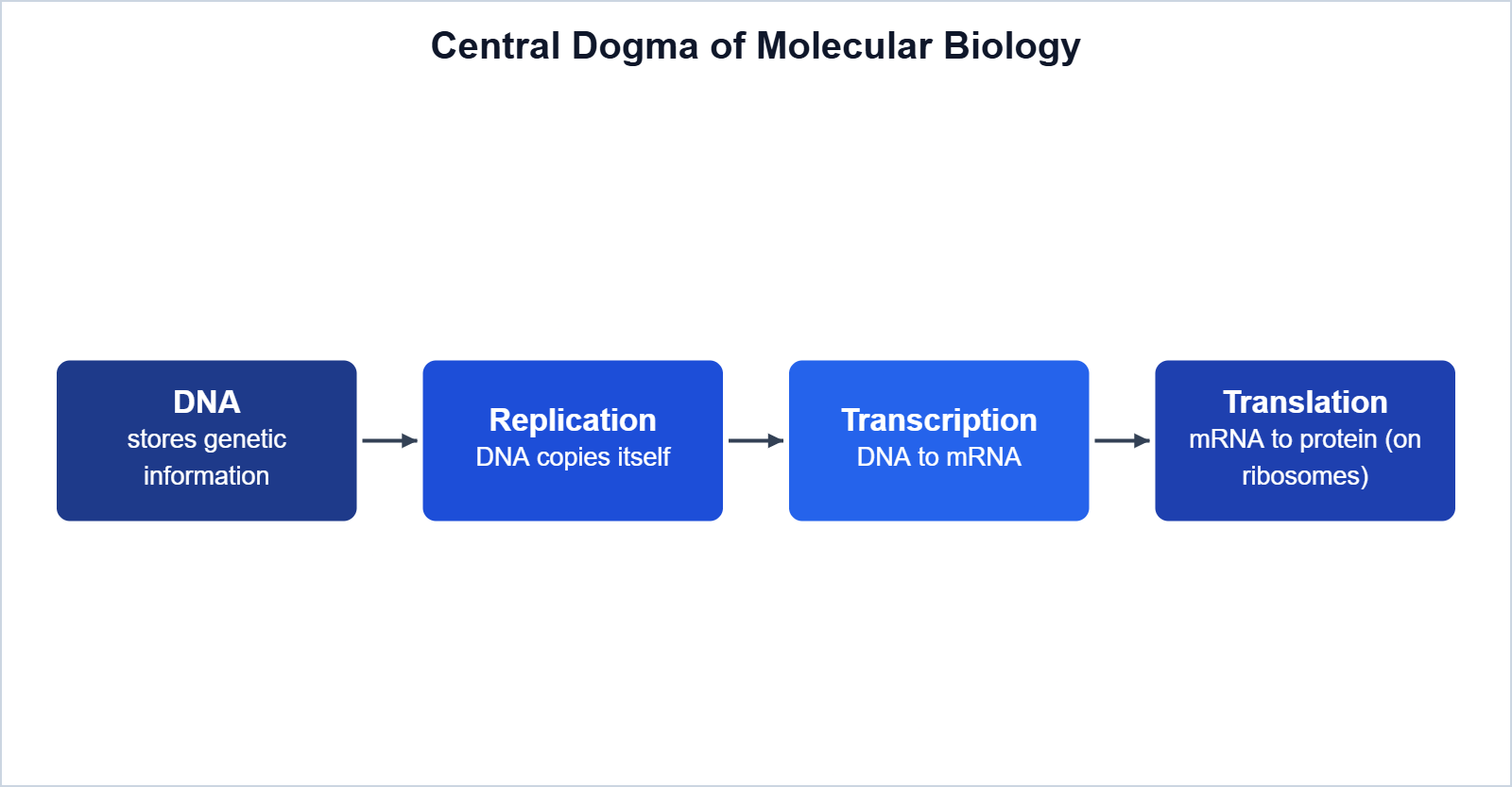
Conclusion: DNA stores, copies and expresses genetic information through replication, transcription and translation, and its regulation and analysis have led to powerful tools such as genome sequencing and DNA fingerprinting.