Ecosystem – Class 12 Biology Notes
Chapter – 12
Ecosystem
1. Ecosystem: Structure and Function
An ecosystem is a functional unit of nature where living organisms interact among themselves and with their physical environment. Ecosystems may be natural (forest, grassland, pond, ocean) or man-made (crop fields, aquarium).
Structure: biotic components (producers, consumers, decomposers) and abiotic components. Stratification is the vertical distribution of species at different levels (trees, shrubs, herbs, grasses). Functions: productivity, decomposition, energy flow and nutrient cycling.
Example: A pond is a simple, self-sustaining ecosystem with phytoplankton (producers), zooplankton and fish (consumers), and bacteria and fungi (decomposers) at the bottom.
2. Productivity
Primary production is the amount of biomass or organic matter produced per unit area over a time period by plants during photosynthesis (g m-2 yr-1 or kcal m-2 yr-1).
GPP (gross primary productivity) is the rate of production of organic matter during photosynthesis. NPP = GPP – R (respiration losses). Secondary productivity is the rate of formation of new organic matter by consumers.
Remember: The annual net primary productivity of the whole biosphere is about 170 billion tons (dry weight) of organic matter; oceans contribute only about 55 billion tons of it, despite covering about 70% of the surface.
3. Decomposition
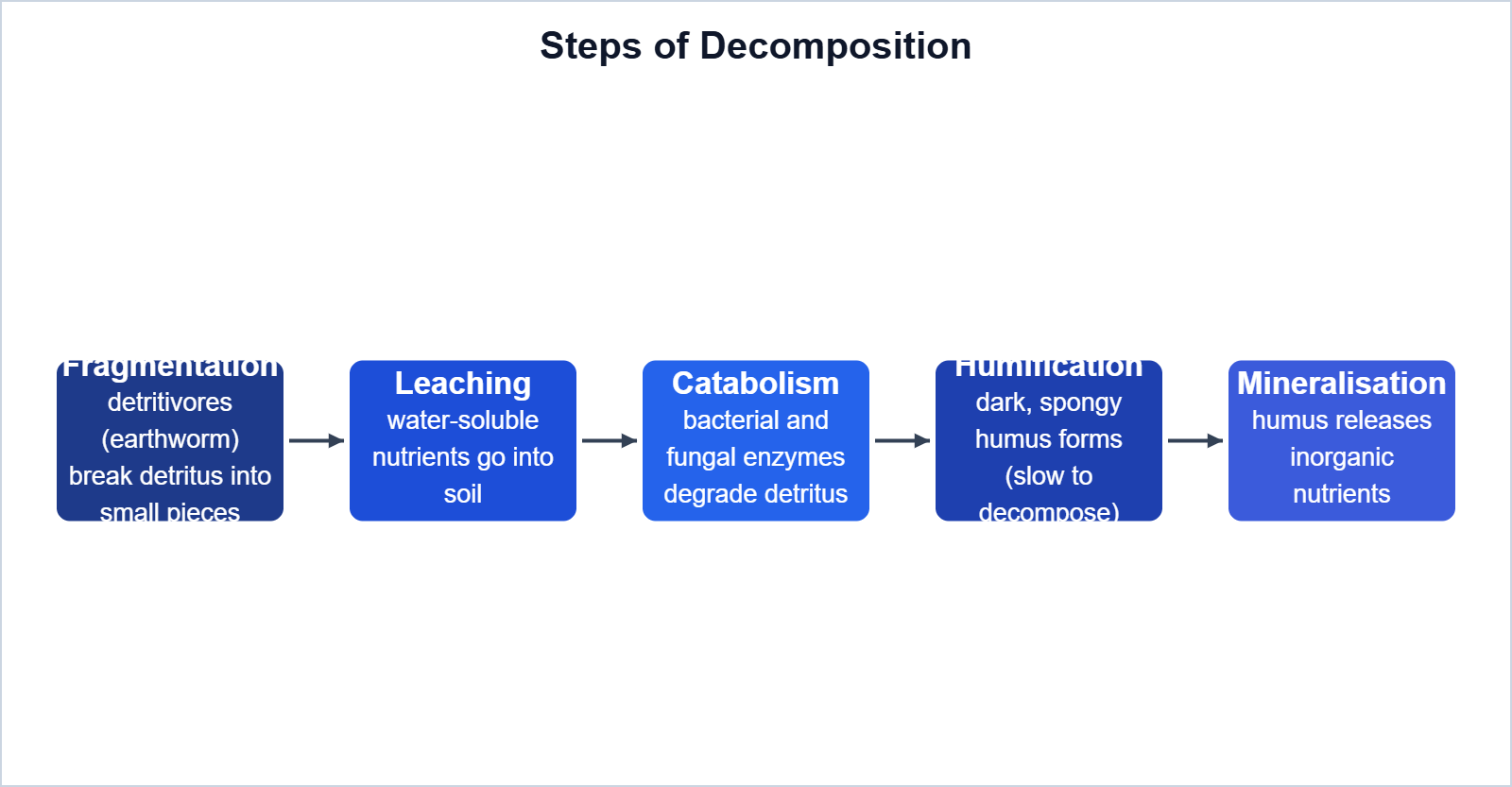
Decomposition is faster when detritus is rich in nitrogen and water-soluble substances like sugars, and slower when it is rich in lignin and chitin. Warm, moist conditions favour decomposition; low temperature and anaerobiosis slow it.
4. Energy Flow
The sun is the only source of energy for almost all ecosystems. Plants capture only 2-10% of photosynthetically active radiation (PAR), which is less than 50% of incident solar radiation. Energy flows in one direction: sun to producers to consumers (it is unidirectional).
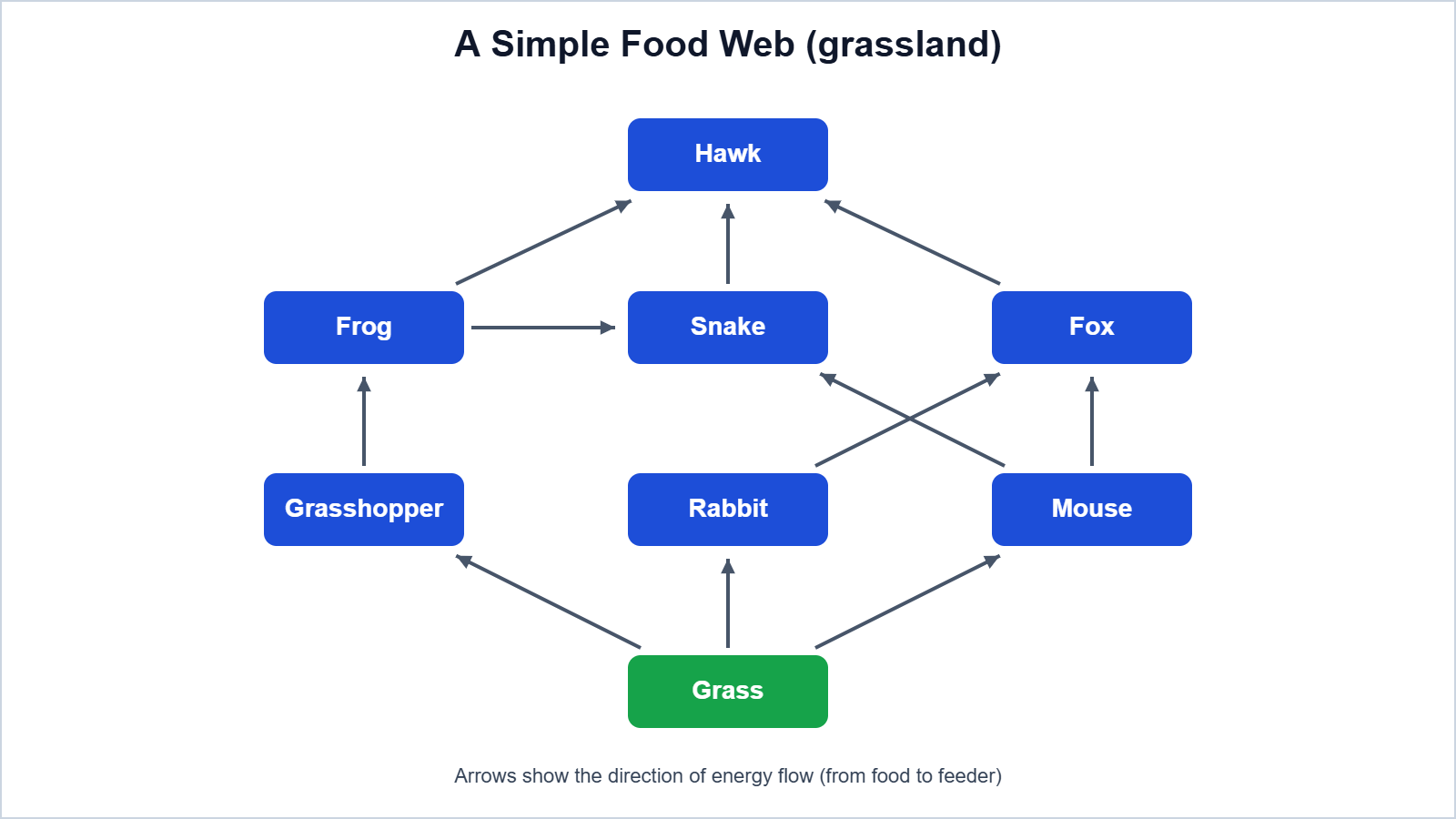
Food chains: the grazing food chain (GFC) starts from producers (grass, goat, man); the detritus food chain (DFC) starts from dead organic matter and decomposers. Interconnected food chains form a food web. Each step is a trophic level.
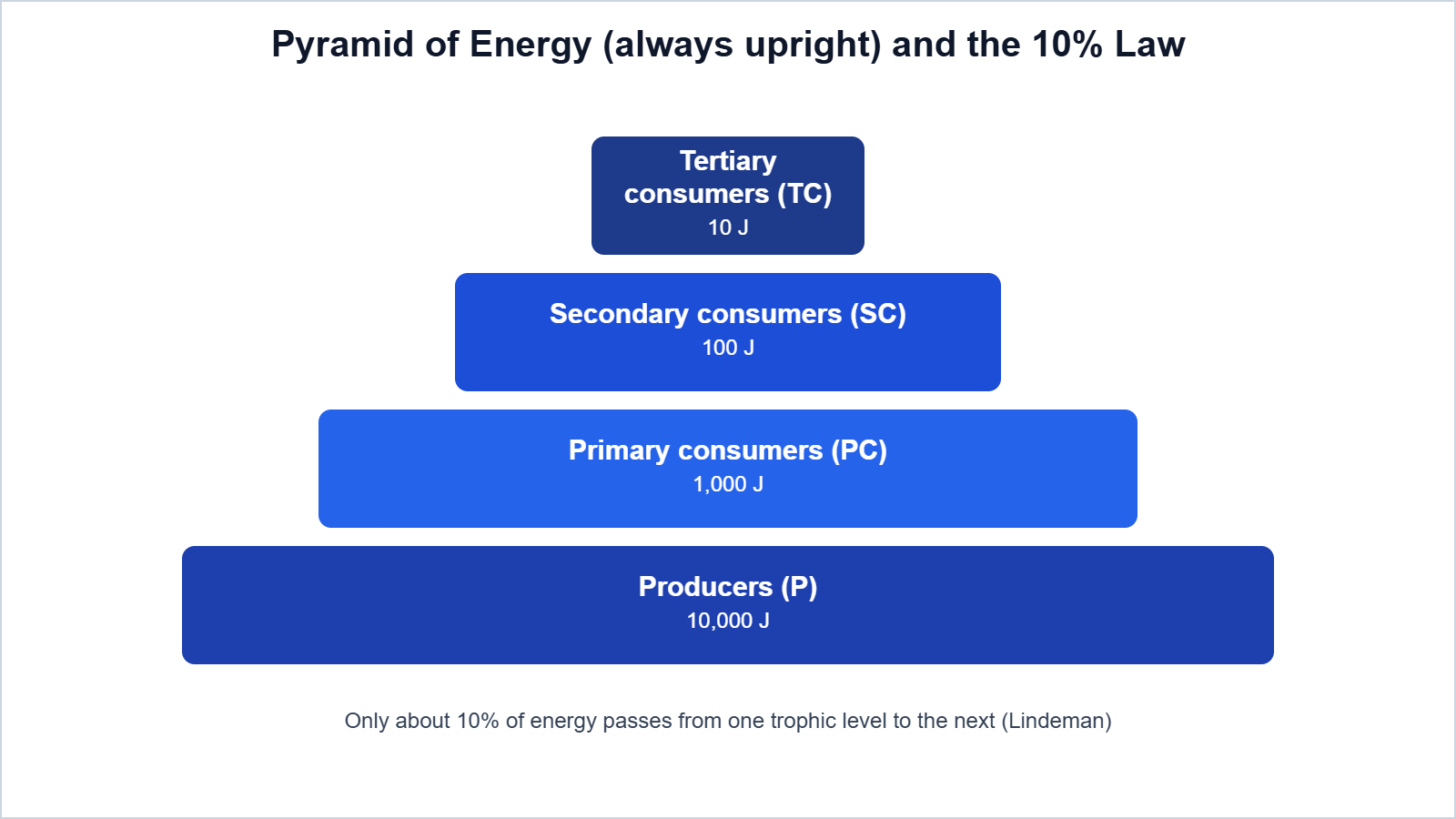
Worked Problem (10% law): If producers fix 20,000 J of energy, how much energy reaches the tertiary consumer? Solution: 20,000 to 2,000 (primary consumer) to 200 (secondary) to 20 J (tertiary).
5. Ecological Pyramids
Pyramid | Shape | Note |
|---|---|---|
Pyramid of number | Usually upright; inverted in a tree ecosystem (one tree, many insects) | Counts individuals at each level |
Pyramid of biomass | Usually upright; inverted in the sea (phytoplankton less than fish) | Dry weight at each level |
Pyramid of energy | Always upright | Energy decreases at each higher level |
Exam point: Ecological pyramids do not include saprophytes and assume simple food chains, which rarely exist in nature.
6. Ecological Succession
Ecological succession is the gradual and fairly predictable change in the species composition of an area. The sequence of communities is called a sere; each stage is a seral stage. The final stable community is the climax community.
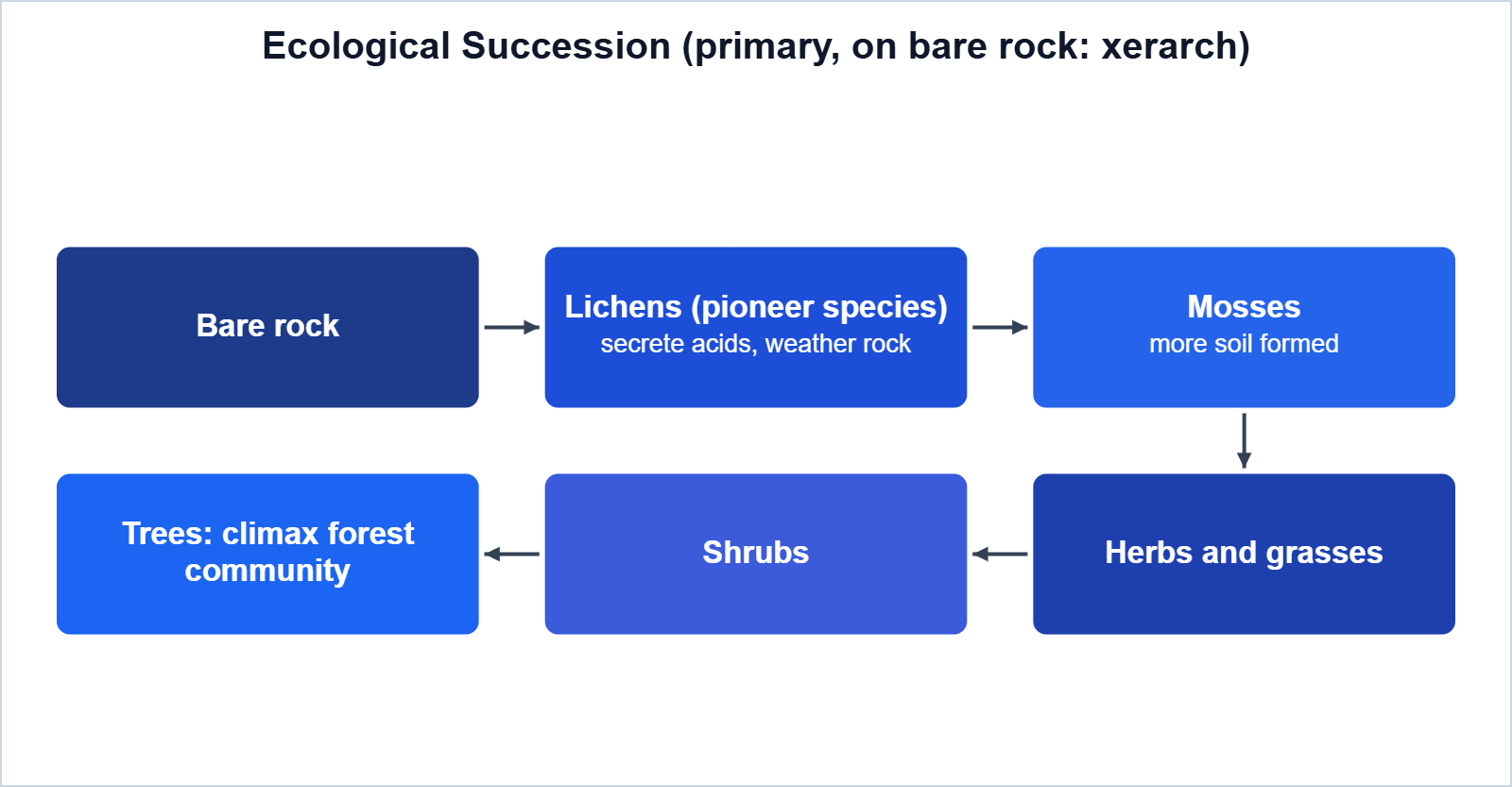
Hydrarch succession takes place in wet areas: phytoplankton, then submerged plants, floating plants, reed-swamp, sedge-meadow, woodland and forest. Xerarch succession takes place in dry areas. Both lead to mesic (medium water) conditions.
7. Nutrient Cycling
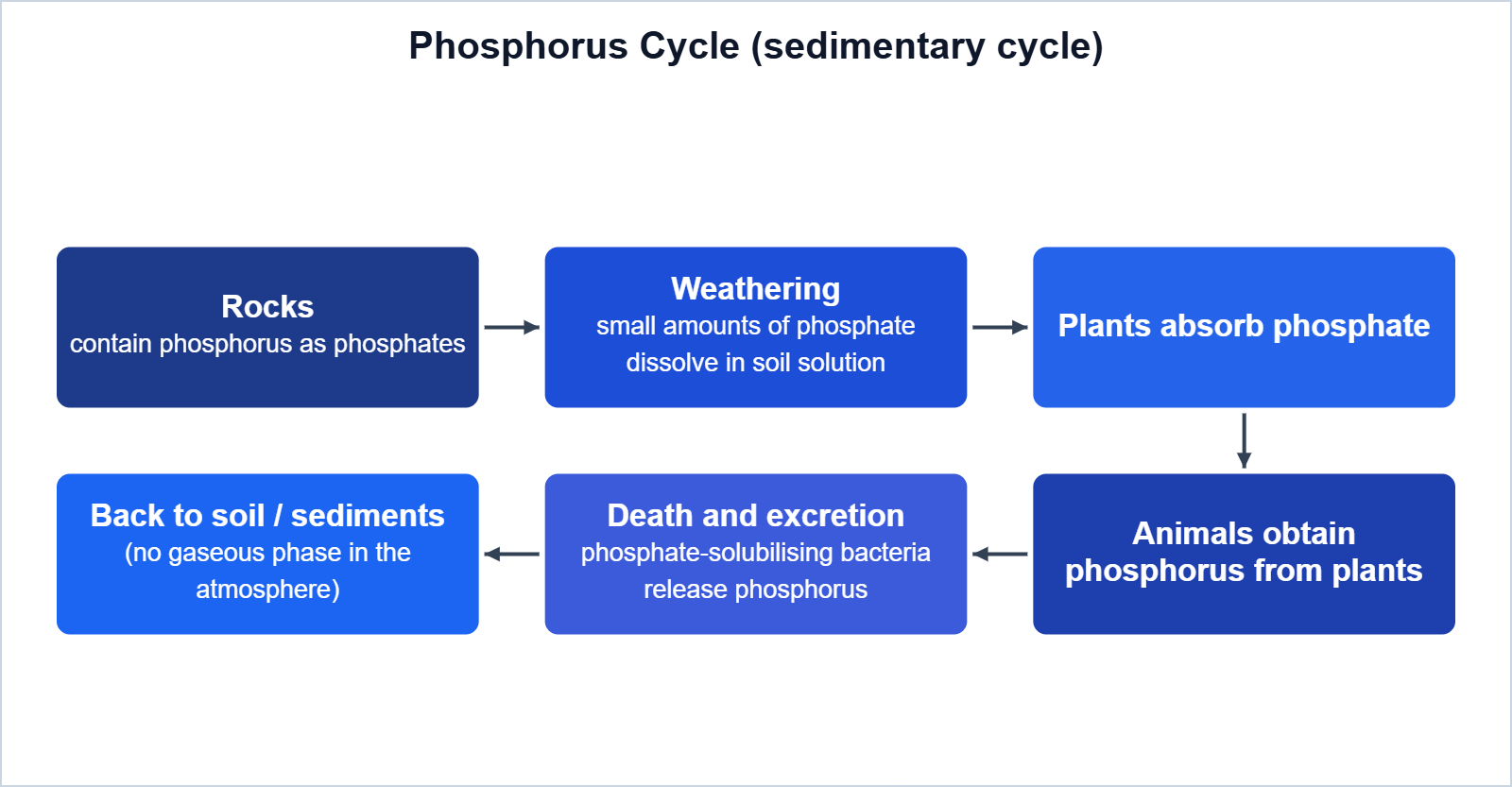
The movement of nutrient elements through the various components of an ecosystem is called nutrient cycling or biogeochemical cycles. They are gaseous (nitrogen, carbon; reservoir in atmosphere) or sedimentary (phosphorus, sulphur; reservoir in earth’s crust).
Carbon cycle: Carbon makes up about 49% of the dry weight of organisms. About 71% of global carbon is dissolved in oceans, which regulate atmospheric CO2. Burning of wood, forest fires, combustion of fossil fuels and respiration add CO2 to the atmosphere.
Easy Memory Trick: Decomposition steps “F-L-C-H-M”: Fragmentation, Leaching, Catabolism, Humification, Mineralisation.
8. Important Questions
Q1. Distinguish between GPP and NPP.
Ans. Gross primary productivity is the total rate of production of organic matter in photosynthesis; NPP = GPP – respiration losses (R), the biomass available to consumers.
Q2. What are the steps of decomposition?
Ans. Fragmentation, leaching, catabolism, humification and mineralisation.
Q3. Why is the pyramid of energy always upright?
Ans. Because energy is lost as heat at each trophic level, so less energy is available at each higher level.
Q4. Give an example of an inverted pyramid of biomass.
Ans. In the sea, the biomass of fishes (and zooplankton) can be more than the biomass of phytoplankton at a given time.
Q5. What is the 10% law? Who gave it?
Ans. Only about 10% of energy is transferred from one trophic level to the next; given by Lindeman.
Q6. Differentiate between grazing and detritus food chains.
Ans. A grazing food chain starts with producers (green plants); a detritus food chain starts with dead organic matter (detritus) and decomposers.
Q7. What are pioneer species? Name the pioneer species on bare rock and in water.
Ans. The first species to colonise a bare area; lichens on rock and phytoplankton in water.
Q8. Differentiate between primary and secondary succession.
Ans. Primary succession starts where no living organism existed (bare rock, new pond); secondary succession starts where natural vegetation was destroyed (abandoned farmland, burned forest) and is faster because soil is present.
Q9. Why is the phosphorus cycle called a sedimentary cycle?
Ans. Its main reservoir is the earth’s crust (rocks), and there is no respiratory release of phosphorus into the atmosphere.
Q10. Name two factors that influence the rate of decomposition.
Ans. Chemical composition of detritus (lignin and chitin slow it) and climatic factors (temperature and soil moisture).
Conclusion: An ecosystem functions through productivity, decomposition, one-way energy flow and cyclic movement of nutrients, and changes over time through succession towards a stable climax community.