Chapter – 13
Biodiversity and Conservation
1. Biodiversity
Biodiversity is the variety of life at all levels of biological organisation. The term was popularised by the sociobiologist Edward Wilson.
- Genetic diversity: variation within a species. Example: the medicinal plant Rauwolfia vomitoria shows variation in the potency of the chemical reserpine in different Himalayan ranges; India has more than 50,000 strains of rice and about 1,000 varieties of mango.
- Species diversity: variety of species in a region. Example: the Western Ghats have more amphibian species than the Eastern Ghats.
- Ecological diversity: variety of ecosystems. India, with deserts, rainforests, mangroves, coral reefs, wetlands, estuaries and alpine meadows, has greater ecosystem diversity than a Scandinavian country like Norway.
2. How Many Species Are There?
According to the IUCN (2004), more than 1.5 million species have been described. Robert May estimated the global species diversity at about 7 million. More than 70% of recorded species are animals, and among animals insects are the most species-rich group. India has about 45,000 recorded plant species and about twice as many animal species.
3. Patterns of Biodiversity
Latitudinal gradients: Species diversity decreases from the equator towards the poles. Example: Colombia near the equator has nearly 1,400 species of birds, India has more than 1,200, while Greenland has only 56. The tropical Amazon rainforest has the greatest biodiversity on earth.
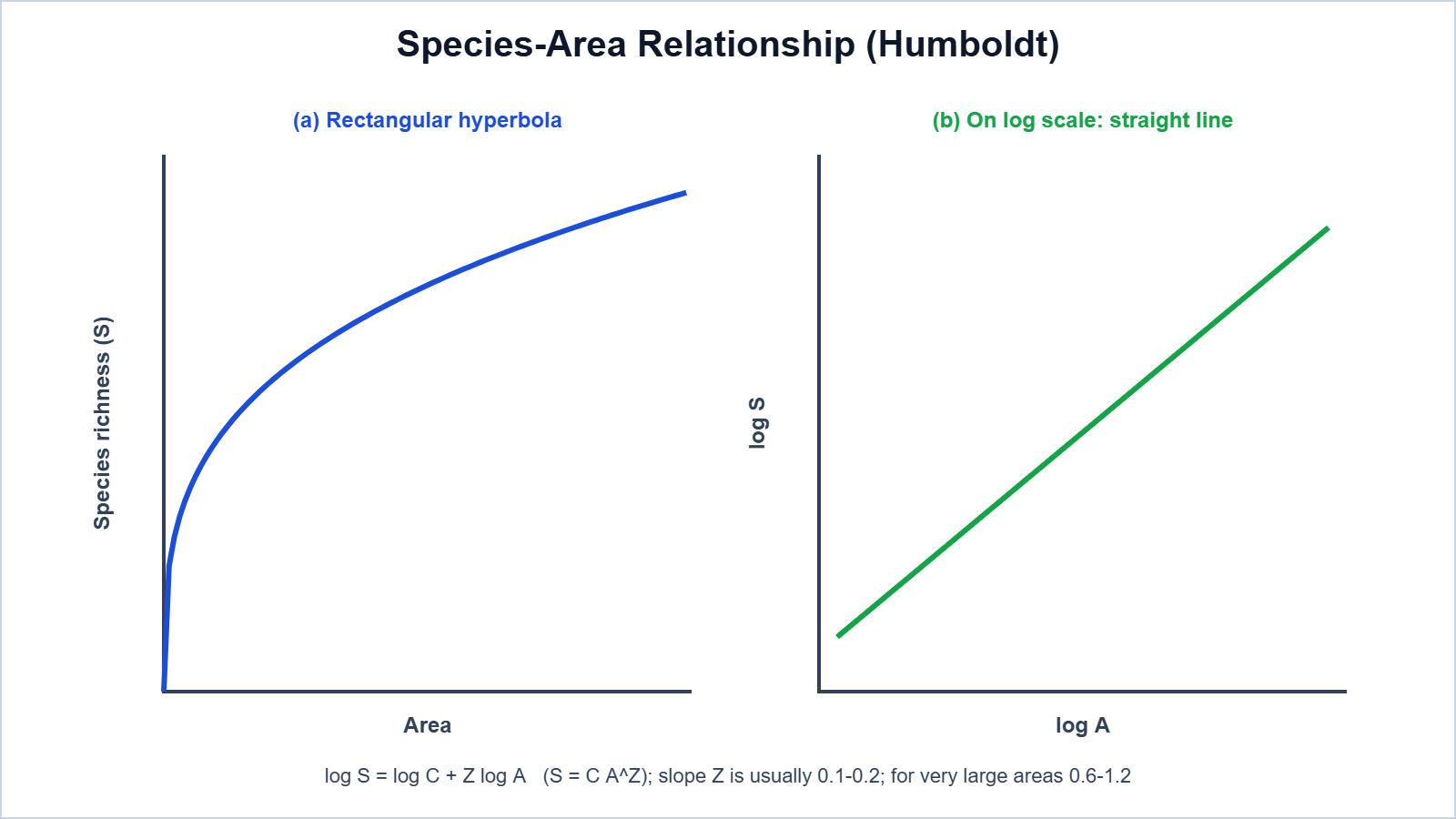
Worked Problem: If C = 10, Z = 0.2 and A = 1000 units, find species richness S. Solution: S = C AZ = 10 x 10000.2 = 10 x 3.98 = about 40 species.
Importance of species diversity: Communities with more species tend to be more stable and productive (David Tilman’s experiments). Paul Ehrlich’s rivet popper hypothesis compares species to rivets in an aeroplane.
4. Loss of Biodiversity
The IUCN Red List (2004) documents the extinction of 784 species in the last 500 years, including the dodo (Mauritius), quagga (Africa), thylacine (Australia), Steller’s sea cow (Russia) and three subspecies of tiger (Bali, Javan and Caspian).
Cause (“Evil Quartet”) | Example |
|---|---|
Habitat loss and fragmentation | Tropical rainforests once covered about 14% of the earth’s land surface and now cover no more than 6%; the Amazon rainforest is being cut for soybean and grazing |
Over-exploitation | Steller’s sea cow and passenger pigeon became extinct due to over-exploitation |
Alien species invasions | Nile perch in Lake Victoria; Parthenium, Lantana, water hyacinth; African catfish Clarias gariepinus in Indian rivers |
Co-extinctions | When a host fish becomes extinct, its unique parasites also become extinct |
5. Biodiversity Conservation
Why conserve? (1) Narrowly utilitarian: direct benefits like food, firewood, fibre, medicines (bioprospecting). (2) Broadly utilitarian: ecosystem services; e.g., the Amazon forest is estimated to produce about 20% of the total oxygen in the earth’s atmosphere through photosynthesis; pollination by bees and birds. (3) Ethical: every species has an intrinsic value and we have a moral duty to protect it.
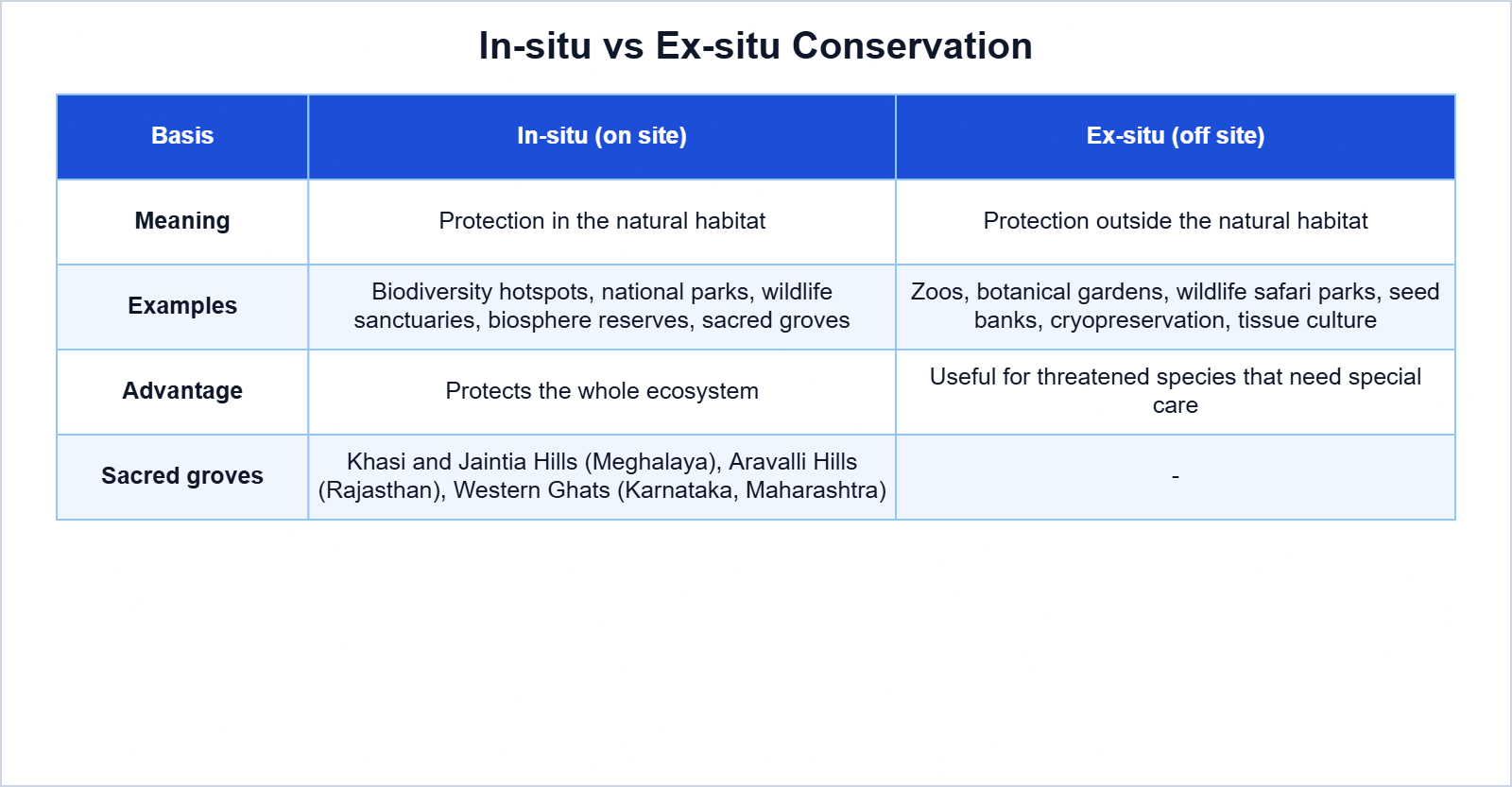
Remember: In-situ conservation protects the whole ecosystem; ex-situ conservation is used for threatened species, and gametes can be preserved for long periods by cryopreservation.
Exam point: India’s protected areas include biosphere reserves, national parks and wildlife sanctuaries; the country also has sacred groves protected by communities.
Easy Memory Trick: Evil Quartet “H-O-A-C”: Habitat loss, Over-exploitation, Alien species, Co-extinctions.
6. Important Questions
Q1. What are the three levels of biodiversity?
Ans. Genetic diversity, species diversity and ecological diversity.
Q2. What percentage of the world’s land area and species diversity does India have?
Ans. India has only 2.4% of the world’s land area but about 8.1% of global species diversity; it is one of the 12 mega-diversity countries.
Q3. Why are tropics richer in biodiversity?
Ans. Tropical areas remained relatively undisturbed for millions of years, are less seasonal and more constant, and receive more solar energy, leading to higher productivity.
Q4. State the species-area relationship.
Ans. Within a region, species richness increases with explored area but only up to a limit; log S = log C + Z log A.
Q5. Explain the rivet popper hypothesis.
Ans. Proposed by Paul Ehrlich: species are like rivets in an aeroplane; losing a few may not matter, but losing more (or key ones) can make the ecosystem collapse.
Q6. What is the “Evil Quartet”?
Ans. The four major causes of biodiversity loss: habitat loss and fragmentation, over-exploitation, alien species invasions and co-extinctions.
Q7. Give two examples of alien species that harmed native biodiversity.
Ans. Nile perch in Lake Victoria (caused extinction of many cichlid fish); Parthenium, Lantana and water hyacinth in India.
Q8. What are biodiversity hotspots?
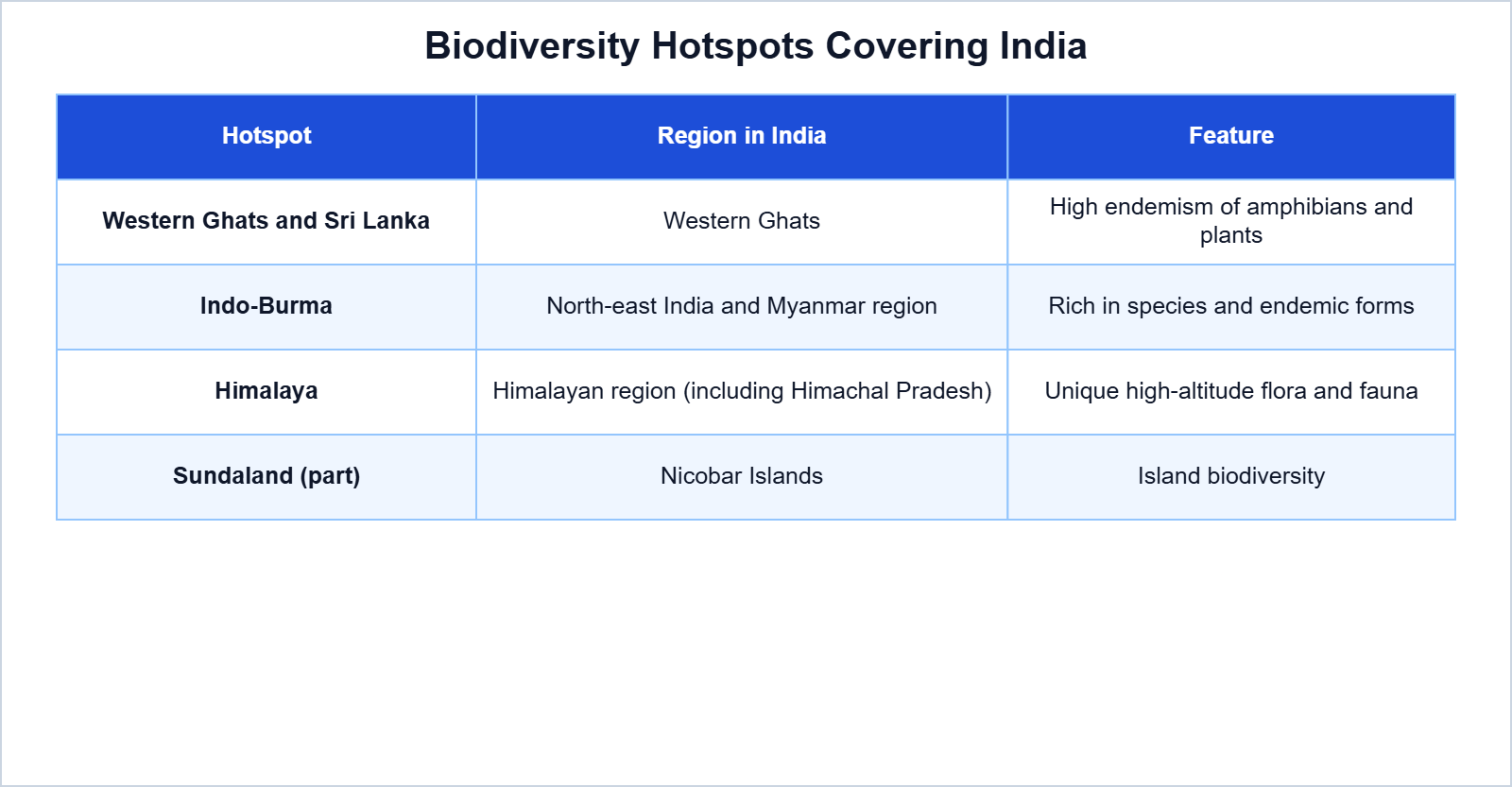
Ans. Regions with very high species richness and high endemism that are also under threat; they cover less than 2% of the earth’s land area.
Q9. What are sacred groves?
Ans. Forest patches protected by communities for religious reasons, such as those in the Khasi and Jaintia Hills of Meghalaya.
Q10. Name two international efforts to conserve biodiversity.
Ans. The Earth Summit at Rio de Janeiro (1992) and the World Summit on Sustainable Development at Johannesburg (2002).
Conclusion: Biodiversity is vital for ecosystem stability and human welfare. It is threatened mainly by human activities and must be conserved through in-situ and ex-situ methods and international cooperation.