Principles of Inheritance and Variation – Class 12 Biology Notes
Chapter – 4
Principles of Inheritance and Variation
1. Inheritance and Variation
Inheritance is the process by which characters are passed from parents to offspring; it is the basis of heredity. Variation is the degree to which offspring differ from their parents. Genetics is the branch of biology that studies inheritance and variation.
2. Mendel’s Laws of Inheritance
Gregor Mendel conducted hybridisation experiments on garden pea (Pisum sativum) for seven years (1856-1863). He chose seven pairs of contrasting traits and used true-breeding lines. Garden pea was suitable because it is self-pollinating, has many contrasting traits, a short life cycle and is easy to cross.
Term | Meaning |
|---|---|
Allele | Alternative forms of a gene (e.g., T and t) |
Homozygous | Both alleles identical (TT or tt) |
Heterozygous | Two different alleles (Tt) |
Genotype | Genetic constitution (TT, Tt, tt) |
Phenotype | Observable character (tall, dwarf) |
3. Inheritance of One Gene (Monohybrid Cross)
Worked Problem 1: A true-breeding tall pea plant (TT) is crossed with a true-breeding dwarf plant (tt). Find the F1 and F2 results.
Solution: P: TT x tt; gametes T and t; F1 = Tt (all tall). F1 is selfed (Tt x Tt):
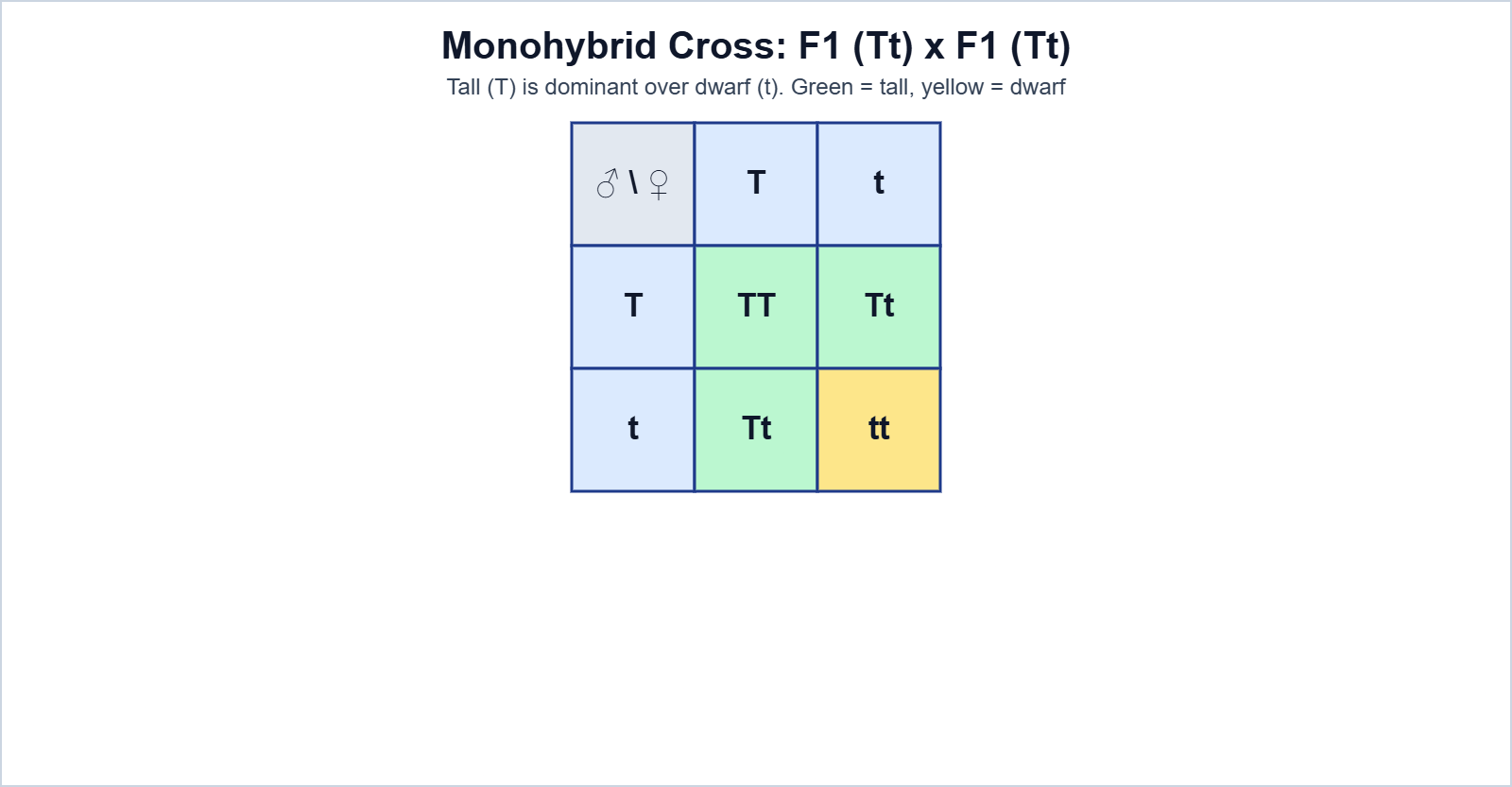
F2 genotypic ratio = 1 TT : 2 Tt : 1 tt; phenotypic ratio = 3 tall : 1 dwarf.
Law of Dominance: Characters are controlled by discrete units called factors that occur in pairs; in a dissimilar pair, one (dominant) expresses itself over the other (recessive).
Law of Segregation: The two alleles of a pair separate during gamete formation and a gamete receives only one of them.
4. Test Cross
Worked Problem 2: A tall pea plant of unknown genotype is crossed with a dwarf plant (tt). (a) All offspring are tall. (b) Half are tall and half dwarf. Find the genotype of the tall parent.
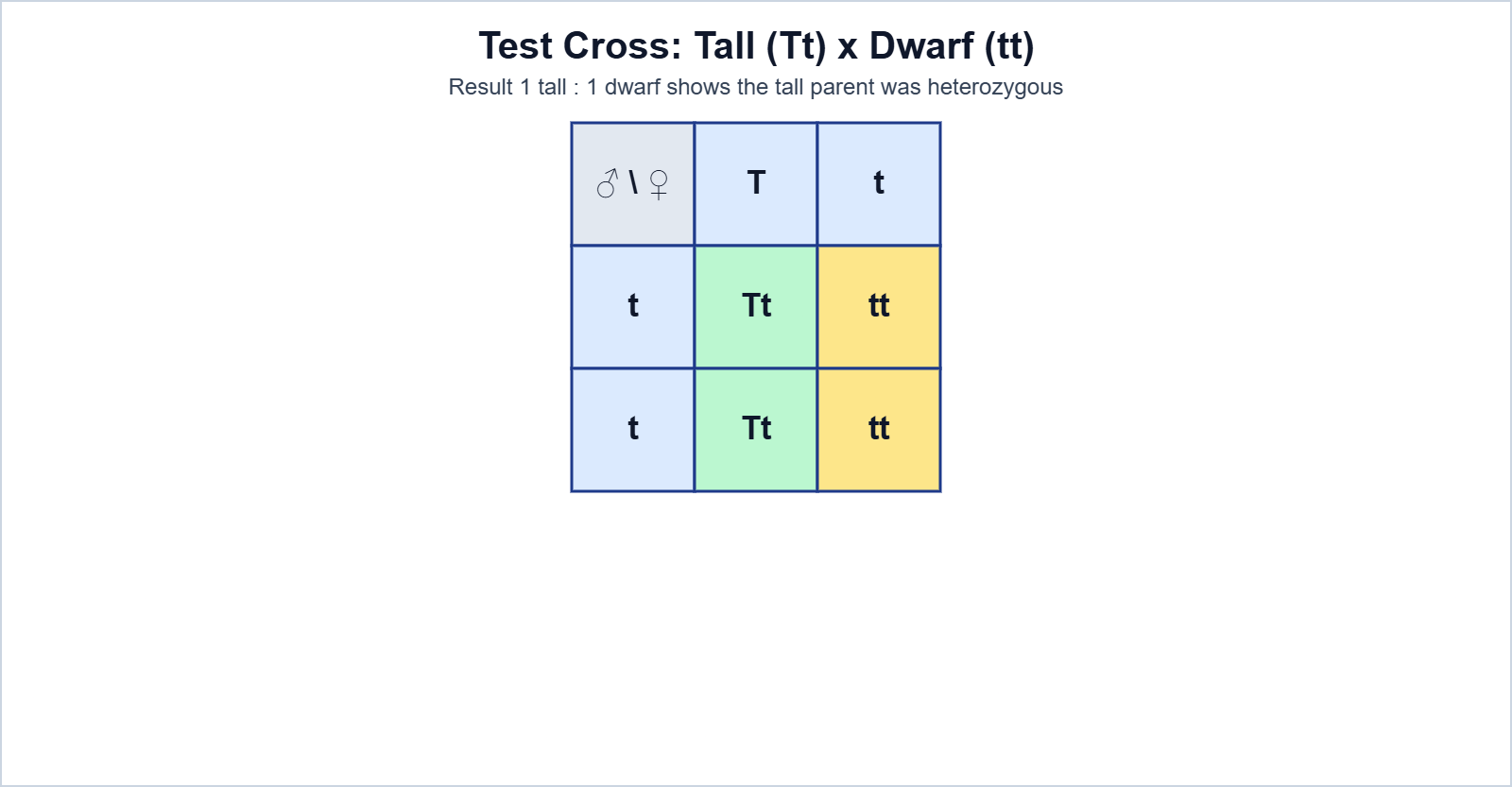
Solution: (a) If all offspring are tall, the tall parent is TT. (b) A ratio of 1 tall : 1 dwarf shows the tall parent is Tt.
5. Deviations from Mendelian Inheritance
Incomplete dominance: The heterozygote shows an intermediate phenotype. Example: flower colour in snapdragon (Antirrhinum).
Worked Problem 3: Red (RR) snapdragon is crossed with white (rr). F1 is pink (Rr). Find the F2 ratio.
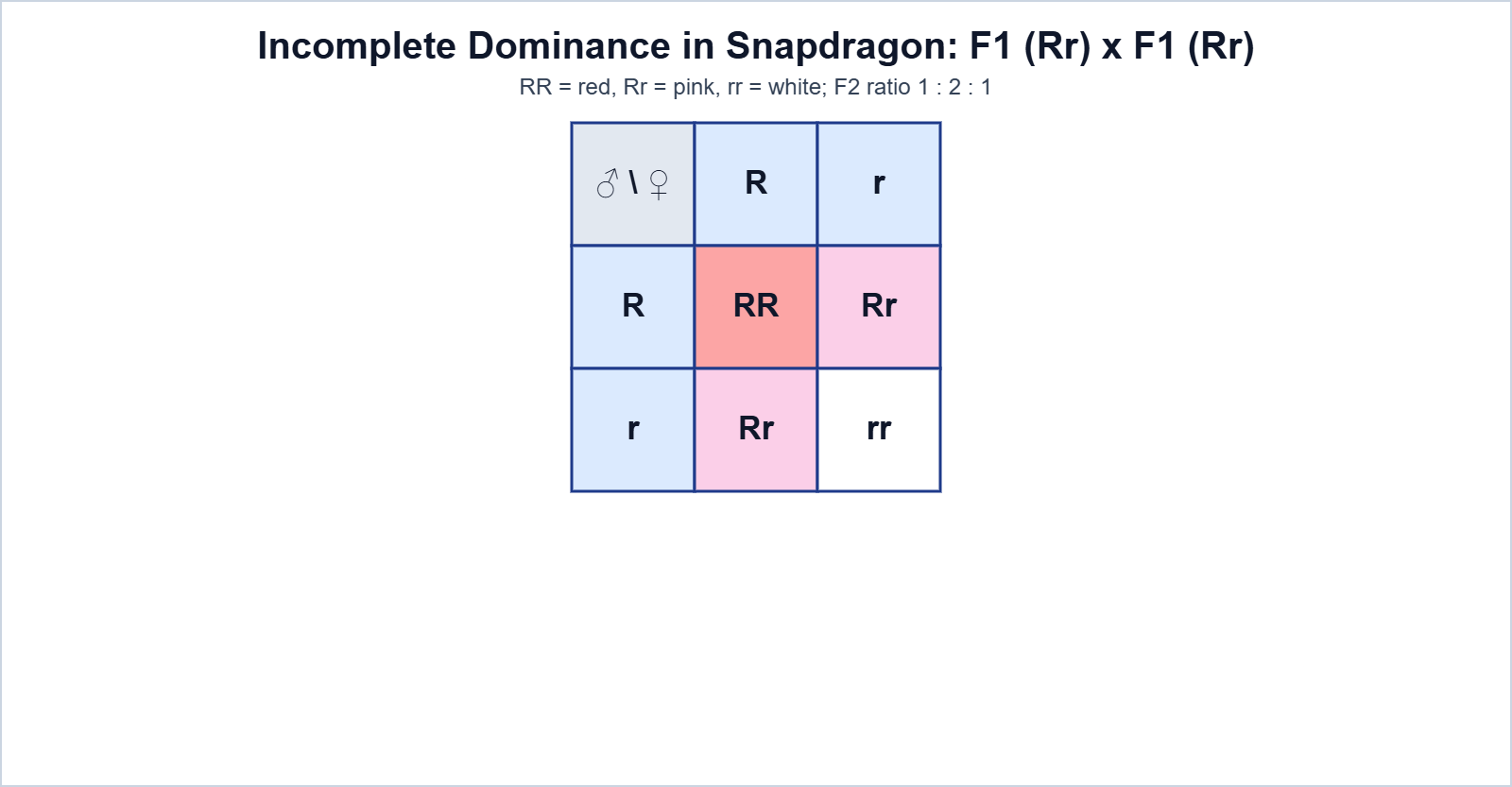
Solution: F2 = 1 red (RR) : 2 pink (Rr) : 1 white (rr); genotypic and phenotypic ratios are the same.
Codominance and multiple alleles: The ABO blood group gene (I) has three alleles: IA, IB and i. IA and IB are codominant; both are dominant over i. Since there are three alleles, there are six genotypes and four blood groups.
Genotype | Blood group |
|---|---|
IAIA, IAi | A |
IBIB, IBi | B |
IAIB | AB |
ii | O |
Worked Problem 4: A father with blood group A (heterozygous) and a mother with blood group B (heterozygous) have children. Find the possible blood groups.
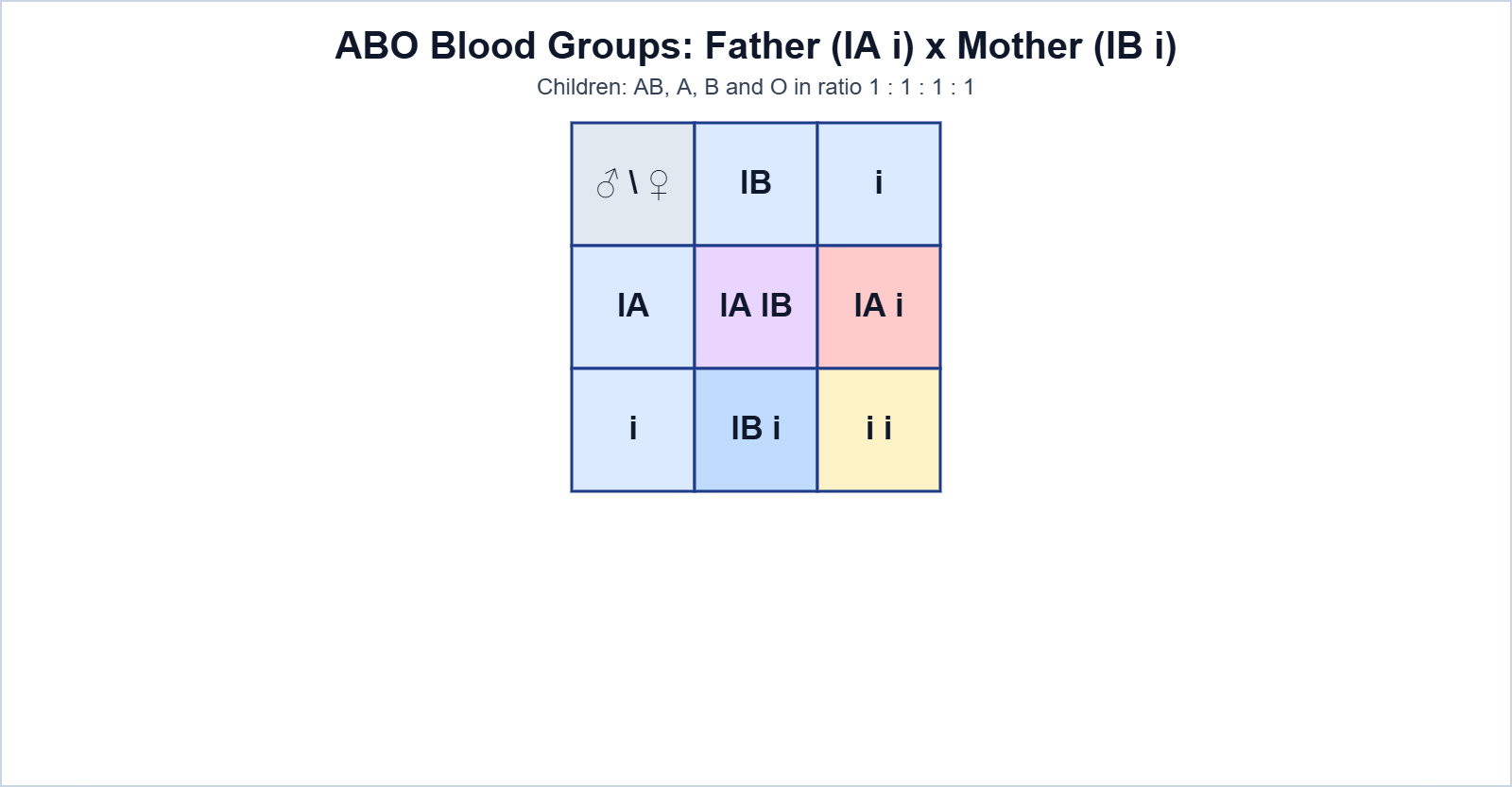
Solution: Children can be AB, A, B or O, each with a probability of 1/4.
Pleiotropy: one gene affecting many traits (e.g., phenylketonuria). Polygenic inheritance: a trait controlled by several genes, each adding a small effect (e.g., human skin colour).
6. Inheritance of Two Genes (Dihybrid Cross)
Worked Problem 5: A pea plant with round, yellow seeds (RRYY) is crossed with one having wrinkled, green seeds (rryy). Find the F2 ratio.
Solution: F1 = RrYy (round, yellow). F1 forms four types of gametes: RY, Ry, rY, ry.
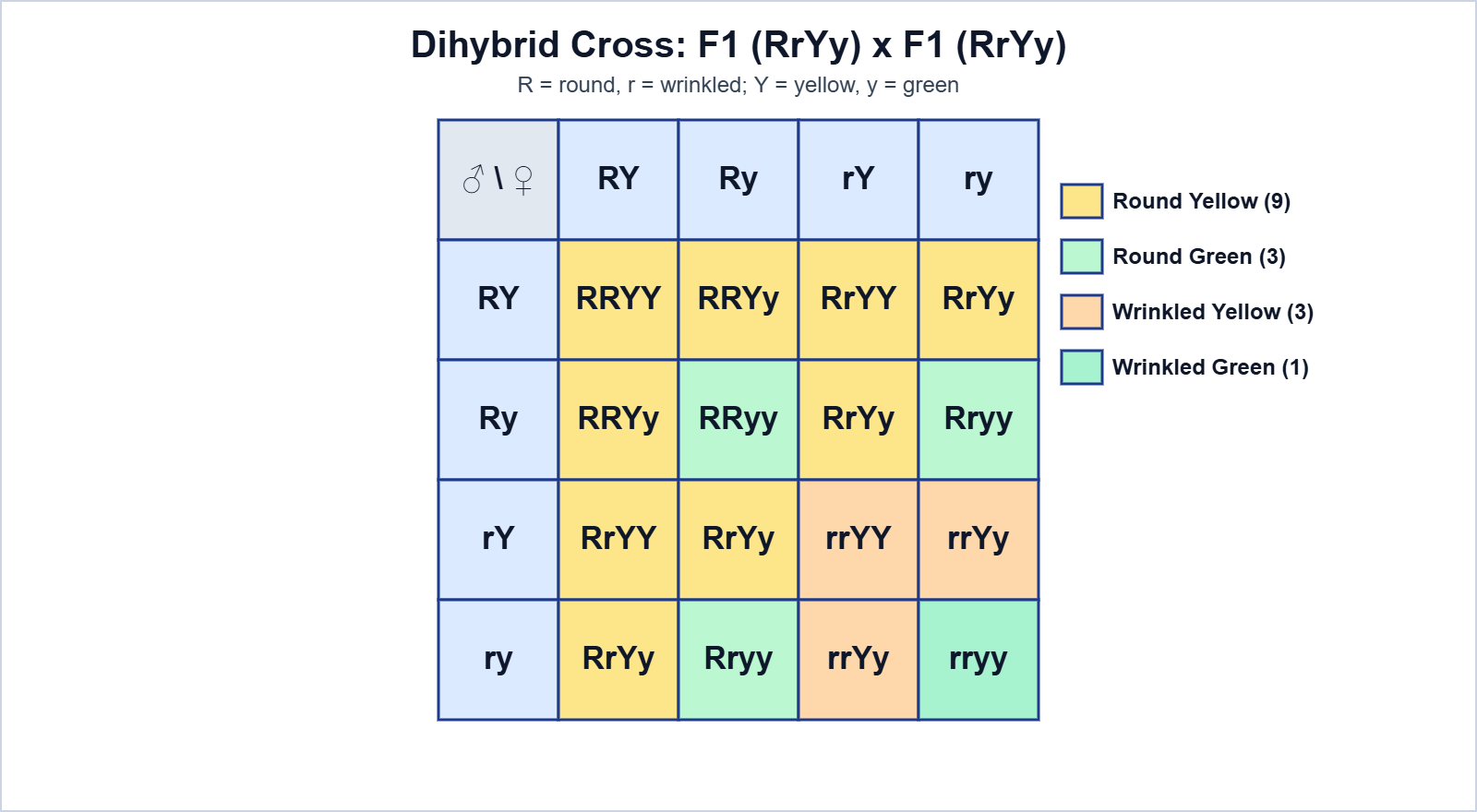
F2 phenotypic ratio = 9 round yellow : 3 round green : 3 wrinkled yellow : 1 wrinkled green.
Law of Independent Assortment: When two pairs of traits are combined in a hybrid, the segregation of one pair is independent of the other pair.
Worked Problem 6 (Dihybrid test cross): RrYy x rryy. Gametes of RrYy: RY, Ry, rY, ry; of rryy: ry. Offspring: RrYy, Rryy, rrYy, rryy = 1 : 1 : 1 : 1.
7. Chromosomal Theory of Inheritance, Linkage and Recombination
Sutton and Boveri proposed that chromosomes carry genes and that the behaviour of chromosomes during meiosis explains Mendel’s laws. T.H. Morgan, working with the fruit fly Drosophila melanogaster, provided experimental proof and found that some genes on the same chromosome are inherited together (linkage), while crossing over produces new combinations (recombination). Tightly linked genes show very low recombination. Sturtevant used recombination frequencies to map genes on chromosomes.
Remember: Drosophila is useful because it can be grown on simple synthetic medium, completes its life cycle in about two weeks, gives many progeny, and males and females are easily distinguished.
8. Sex Determination
Henking (1891) observed a nuclear structure in some insects which he called the X body; it was later named the X chromosome.
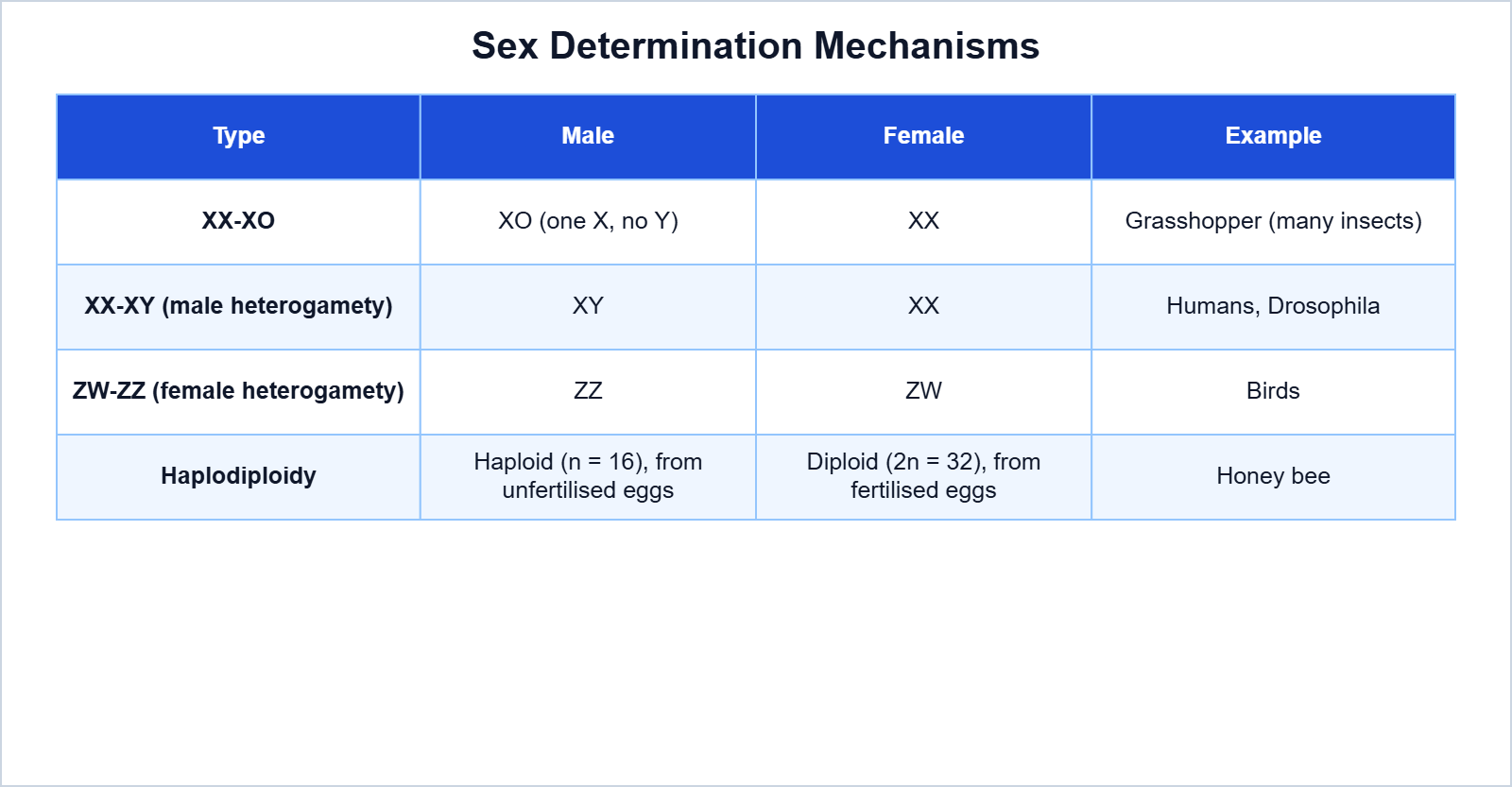
In humans, the female (XX) produces only X-bearing eggs, while the male (XY) produces X- and Y-bearing sperms in equal proportion. So the sex of the child is determined by the father, and there is a 50% chance of a son or a daughter in each pregnancy.
9. Mutation and Pedigree Analysis
Mutation is a sudden heritable change in DNA. Point mutation changes a single base pair (as in sickle-cell anaemia); frameshift mutations involve insertion or deletion of bases. Pedigree analysis is the study of a trait over several generations of a family using standard symbols.
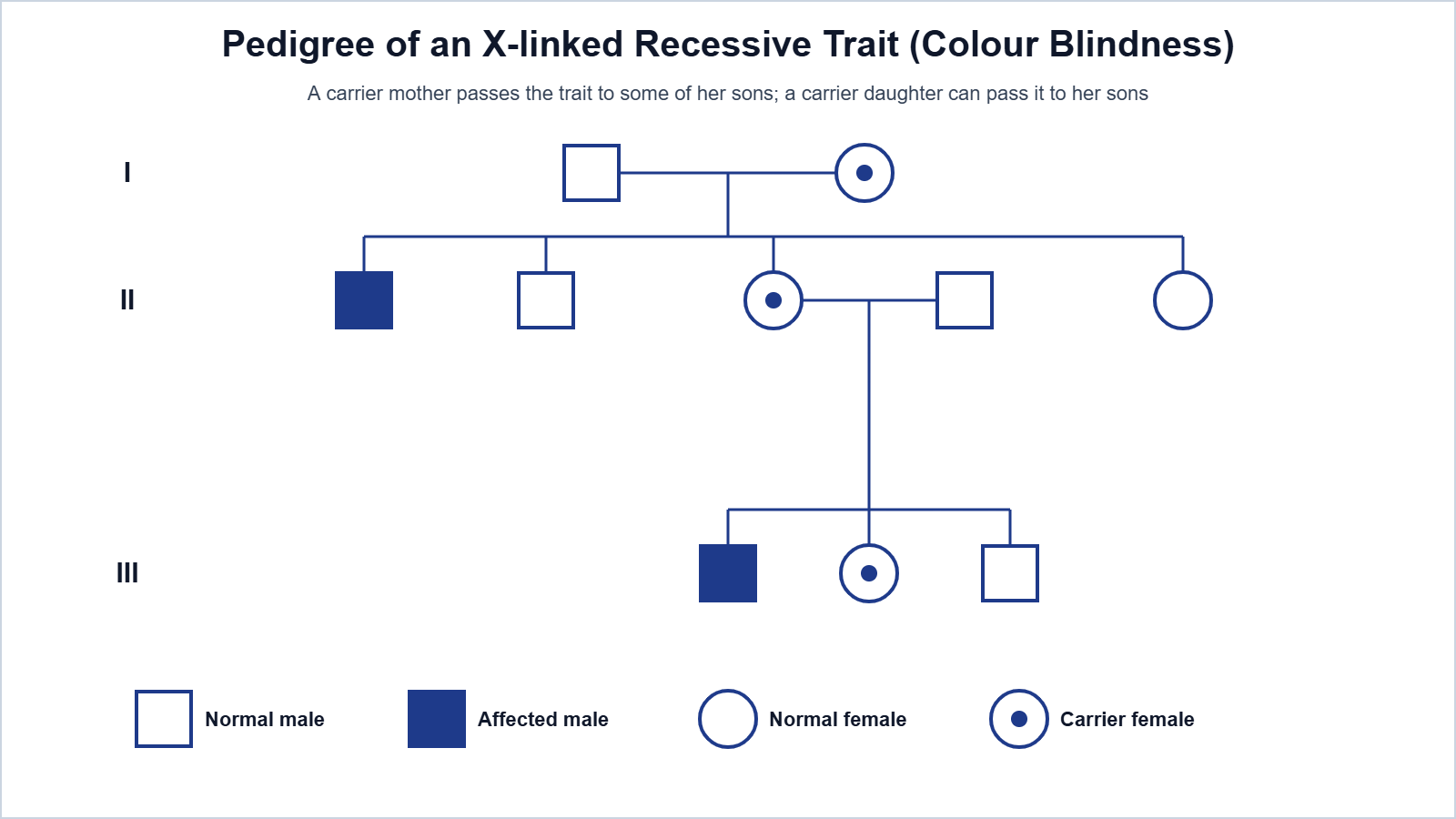
Worked Problem 7 (Sex-linked inheritance): A normal man marries a woman who is a carrier for colour blindness. What proportion of their children will be colour blind?
Parents | Gametes | Children |
|---|---|---|
Normal man (XY) x Carrier woman (XXc) | Man: X, Y; Woman: X, Xc | Daughters: XX (normal), XXc (carrier); Sons: XY (normal), XcY (colour blind) |
Result |
| 50% of sons colour blind; 50% of daughters carriers; no daughter affected |
10. Genetic Disorders
Disorder | Type | Key point |
|---|---|---|
Haemophilia | X-linked recessive | Blood does not clot properly; mostly in males |
Colour blindness | X-linked recessive | Defect in red or green cone cells |
Sickle-cell anaemia | Autosomal recessive | Glu replaced by Val at the 6th position of beta-globin; sickle-shaped RBCs |
Phenylketonuria | Autosomal recessive | Lack of enzyme that converts phenylalanine to tyrosine |
Thalassaemia | Autosomal recessive | Reduced synthesis of globin chains |
Down syndrome | Trisomy of chromosome 21 | Short stature, mental retardation, furrowed tongue |
Klinefelter syndrome | 47, XXY | Male with sterility and some female features |
Turner syndrome | 45, XO | Female with sterile ovaries and rudimentary secondary sexual characters |
Exam point: Haemophilia and colour blindness are X-linked recessive; sickle-cell anaemia, phenylketonuria and thalassaemia are autosomal recessive.
Easy Memory Trick: Mendel’s ratios “3:1 (mono), 9:3:3:1 (di), 1:1 (test), 1:2:1 (incomplete)”.
11. Important Questions
Q1. State the law of segregation.
Ans. Alleles of a gene separate during gamete formation, so each gamete receives only one allele of each pair.
Q2. What is a test cross? Why is it done?
Ans. A cross between an organism with a dominant phenotype and a homozygous recessive; it reveals whether the dominant organism is homozygous or heterozygous.
Q3. Why is the F2 ratio of incomplete dominance 1:2:1 for both phenotype and genotype?
Ans. Because the heterozygote (Rr) has an intermediate phenotype (pink), different from both homozygotes, so each genotype has its own phenotype.
Q4. Explain codominance with an example.
Ans. Both alleles express themselves fully in the heterozygote; e.g., in blood group AB, both IA and IB produce their antigens.
Q5. How many genotypes are possible for human ABO blood groups?
Ans. Six: IAIA, IAi, IBIB, IBi, IAIB and ii.
Q6. What is pleiotropy? Give an example.
Ans. A single gene affecting several phenotypic traits; e.g., phenylketonuria.
Q7. What did T.H. Morgan show using Drosophila?
Ans. He experimentally verified the chromosomal theory of inheritance and discovered linkage and recombination of genes on the X chromosome.
Q8. Why is haemophilia more common in males?
Ans. It is X-linked recessive; males have only one X, so a single recessive allele causes the disease, while females need two.
Q9. What is the cause of sickle-cell anaemia?
Ans. An autosomal recessive mutation that substitutes valine for glutamic acid at the sixth position of the beta-globin chain of haemoglobin (HbS).
Q10. Give the karyotypes of Down, Klinefelter and Turner syndromes.
Ans. Down: trisomy 21 (47); Klinefelter: 47, XXY; Turner: 45, XO.
Conclusion: Mendel’s laws, their deviations, the chromosomal theory, sex determination and genetic disorders together explain how traits are inherited and why offspring vary.