Biotechnology: Principles and Processes – Class 12 Biology Notes
Chapter – 9
Biotechnology: Principles and Processes
1. Biotechnology
Biotechnology deals with techniques of using live organisms or enzymes from organisms to produce products and processes useful to humans. The European Federation of Biotechnology (EFB) defines it as the integration of natural science and organisms, cells, parts thereof and molecular analogues for products and services.
2. Principles of Biotechnology
Modern biotechnology is based on two core techniques: genetic engineering (altering the chemistry of genetic material and introducing it into host organisms) and bioprocess engineering (maintaining a sterile, contamination-free environment to grow only the desired microbes or cells in large quantities).
The first recombinant DNA was made by Stanley Cohen and Herbert Boyer in 1972. They isolated an antibiotic resistance gene by cutting a piece of DNA from a plasmid and linked it to a plasmid of Salmonella typhimurium.
Remember: Three basic steps in genetically modifying an organism: (i) identification of DNA with desirable genes; (ii) introduction of the identified DNA into the host; (iii) maintenance of the introduced DNA in the host and transfer to its progeny.
3. Tools of Recombinant DNA Technology
(a) Restriction enzymes (molecular scissors): The first restriction endonuclease studied was Hind II. Each enzyme recognises a specific palindromic sequence. Naming of EcoRI: E = Escherichia, co = coli, R = strain RY13, I = first enzyme isolated from this strain. EcoRI cuts between G and A in 5′-GAATTC-3′, producing sticky ends. Exonucleases remove nucleotides from the ends; endonucleases cut within the DNA.
Separation of fragments:

(b) Cloning vectors:

- Origin of replication (ori): where replication starts; it controls the copy number.
- Selectable marker: helps identify transformants, e.g., genes for resistance to ampicillin or tetracycline.
- Cloning sites: unique recognition sites for restriction enzymes. Inserting DNA into the tetR site (e.g., at BamHI) makes the recombinant lose tetracycline resistance (insertional inactivation).
- Vectors for plants and animals: the Ti plasmid of Agrobacterium tumefaciens is used as a vector for plants after being disarmed; retroviruses are disarmed for animal cells.
Blue-white selection: Insertion into the gene coding for beta-galactosidase inactivates it. On a chromogenic substrate, colonies without insert become blue, while recombinant colonies stay white.
(c) Competent host: DNA is hydrophilic and cannot pass through membranes easily. Methods: treatment with calcium ions plus heat shock (bacteria), microinjection into the nucleus (animal cells), biolistics (gene gun) with gold or tungsten particles coated with DNA (plant cells), and disarmed pathogen vectors.
4. Processes of Recombinant DNA Technology
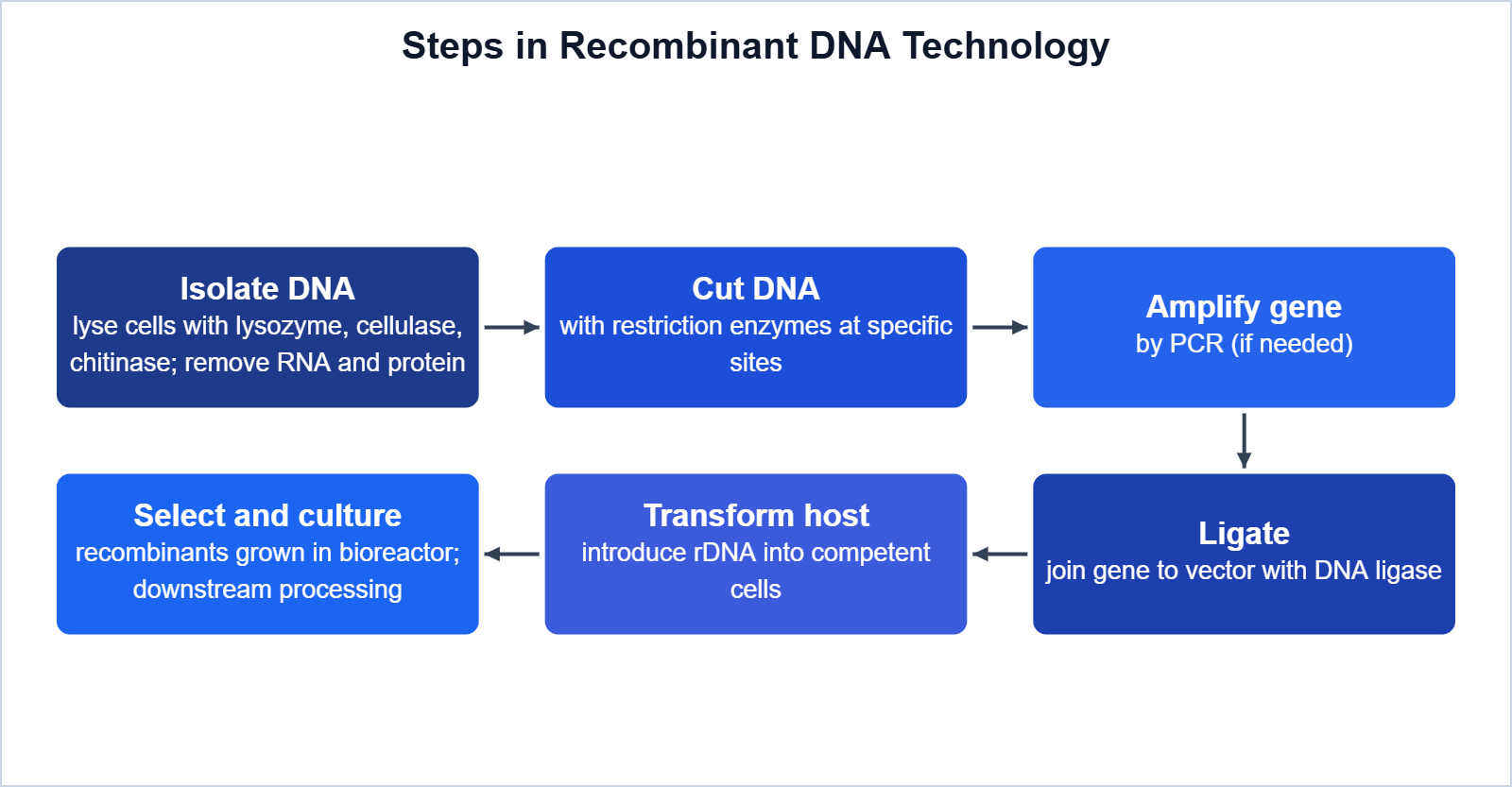
PCR (Polymerase Chain Reaction) makes many copies of a gene in vitro.

Exam point: After n cycles, one DNA molecule gives 2n copies; after 30 cycles, about 1 billion (230 = 1,07,37,41,824) copies.
5. Bioreactors and Downstream Processing
Bioreactors are large vessels (100 to 1000 litres) in which raw materials are biologically converted into specific products using microbial, plant, animal or human cells. The most common is the stirred-tank bioreactor.

Downstream processing includes separation and purification of the product, its formulation with preservatives, and strict quality control testing, including clinical trials for drugs.
Easy Memory Trick: PCR steps “D-A-E”: Denature, Anneal, Extend.
6. Important Questions
Q1. Define biotechnology according to EFB.
Ans. The integration of natural science and organisms, cells, parts thereof and molecular analogues for products and services.
Q2. Who made the first recombinant DNA?
Ans. Stanley Cohen and Herbert Boyer (1972), by linking an antibiotic resistance gene with a native plasmid of Salmonella typhimurium.
Q3. What is a palindromic sequence? Give the EcoRI site.
Ans. A DNA sequence that reads the same on both strands in the same direction (5′ to 3′); EcoRI recognises 5′-GAATTC-3′.
Q4. What are sticky ends?
Ans. Single-stranded overhanging ends produced when a restriction enzyme cuts a little away from the centre of the palindrome; they help join DNA fragments.
Q5. Why is DNA separated towards the anode in electrophoresis?
Ans. Because DNA is negatively charged.
Q6. List three features of a cloning vector.
Ans. Origin of replication (ori), a selectable marker, and unique cloning (recognition) sites.
Q7. What is insertional inactivation?
Ans. Insertion of foreign DNA into a gene (e.g., for beta-galactosidase) inactivates it; recombinant colonies appear white and non-recombinants blue on a chromogenic substrate.
Q8. How is a bacterial cell made competent?
Ans. By treating it with a divalent cation such as calcium, followed by heat shock (42°C) and placing on ice.
Q9. Name the three steps of PCR and the enzyme used.
Ans. Denaturation, annealing and extension; Taq polymerase from Thermus aquaticus, which is heat-stable.
Q10. What is downstream processing?
Ans. Separation and purification of the product after biosynthesis, followed by formulation with preservatives and quality testing.
Conclusion: Restriction enzymes, vectors, competent hosts, PCR and bioreactors together allow scientists to cut, join, copy and express genes, forming the foundation of modern biotechnology.