Chapter – 3
Reproductive Health
1. Reproductive Health: Problems and Strategies
According to the WHO, reproductive health means total well-being in all aspects of reproduction: physical, emotional, behavioural and social. India started the family planning programme in 1951. These programmes are now called Reproductive and Child Health Care (RCH) programmes.
- Creating awareness about reproduction-related aspects through audio-visual and print media.
- Introducing sex education in schools to give correct information and remove myths.
- Educating people about birth control, care of pregnant mothers, post-natal care, breastfeeding and equal opportunities for male and female children.
- Providing medical facilities for problems like STIs, infertility, abortions and menstrual problems.
- Statutory ban on amniocentesis for sex determination, to prevent female foeticide.
2. Population Stabilisation and Birth Control
Better health facilities reduced the death rate (especially maternal and infant mortality rates), which led to a rapid rise in population. The population at independence was about 350 million and crossed 1.2 billion (1200 million) by the 2011 census. To control growth, the legal marriageable age is 18 years for females and 21 years for males, and small families are encouraged.
An ideal contraceptive should be user-friendly, easily available, effective and reversible, with no or least side effects, and should not interfere with sexual drive or the sexual act.
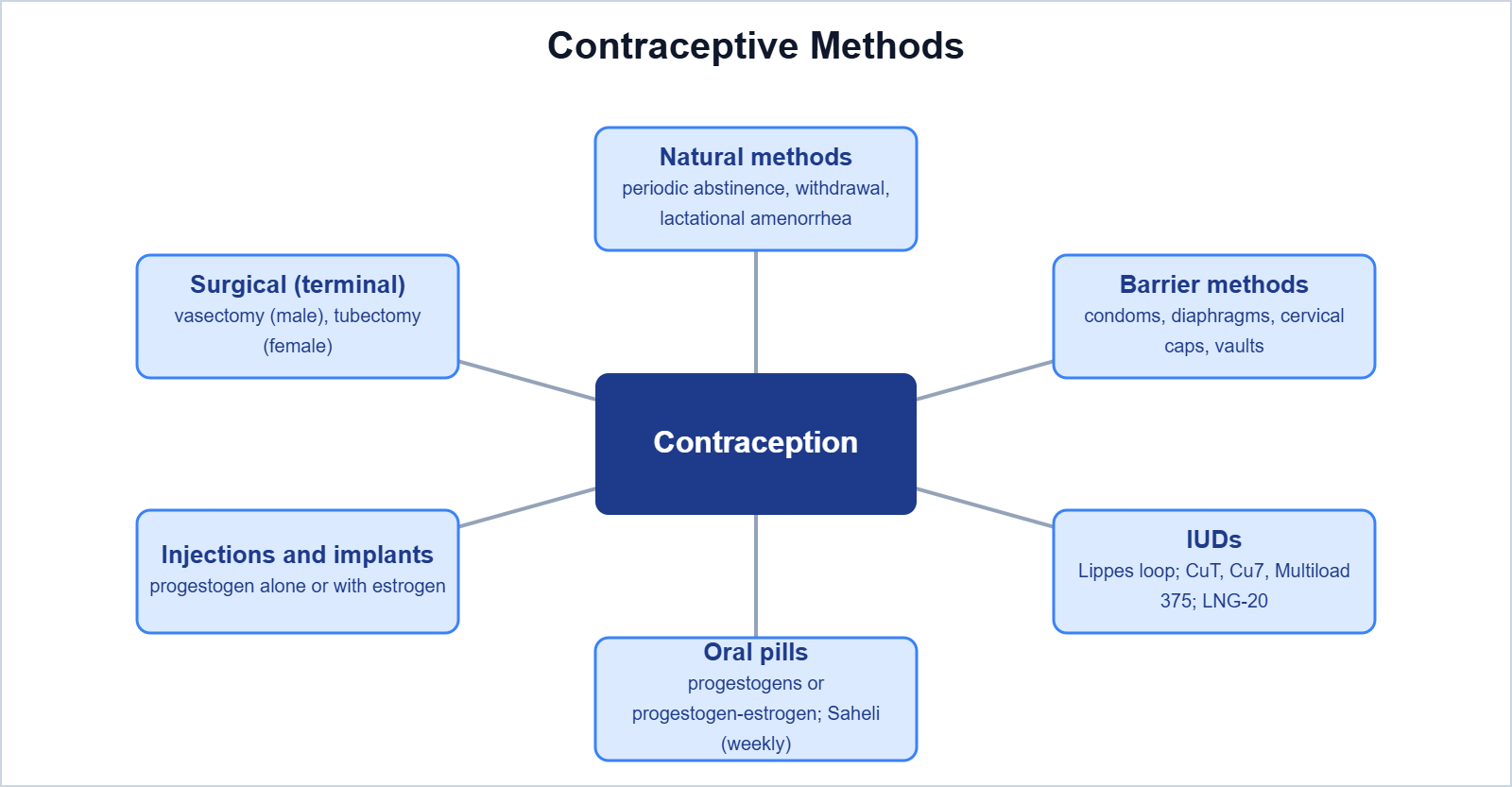
Method | How it works |
|---|---|
Periodic abstinence | Avoiding coitus from about day 10 to 17 of the cycle (fertile period) |
Barrier methods | Prevent ovum and sperms from meeting |
IUDs | Increase phagocytosis of sperms; copper ions reduce sperm motility; hormone-releasing IUDs make the uterus unsuitable for implantation and the cervix hostile to sperms |
Oral pills | Inhibit ovulation and implantation, and alter cervical mucus to block sperms |
Emergency contraception | Pills or IUDs used within 72 hours of unprotected coitus |
Surgical methods | Block gamete transport: part of the vas deferens (vasectomy) or fallopian tube (tubectomy) is removed or tied |
Remember: Surgical methods are highly effective, but their reversibility is very poor.
3. Medical Termination of Pregnancy (MTP)
MTP is the intentional termination of pregnancy before full term. It was legalised in India in 1971 with conditions to prevent misuse. MTPs are considered relatively safe during the first trimester (up to 12 weeks). The law has since been amended to allow termination at later stages only in specified situations, on the opinion of registered medical practitioners. Illegal MTP by unqualified people is dangerous and can be fatal.
Important: MTP should not be used for sex-selective abortion; female foeticide is illegal.
4. Sexually Transmitted Infections (STIs)
STI | Note |
|---|---|
Gonorrhoea, syphilis, chlamydiasis | Bacterial; curable if detected early |
Genital herpes | Viral; not completely curable |
Genital warts, trichomoniasis | Treatable |
Hepatitis-B | Viral; not completely curable; also spread through blood |
HIV leading to AIDS | Viral; not completely curable |
Complications of untreated STIs include pelvic inflammatory diseases, abortions, still births, ectopic pregnancies, infertility and even cancer of the reproductive tract.
Prevention: avoid sex with unknown or multiple partners, always use condoms, and seek early medical help if in doubt.
5. Infertility and Assisted Reproductive Technologies
Infertility is the inability to produce children in spite of unprotected sexual co-habitation. Specialised health care units can diagnose and correct some disorders, and couples can be helped by ART.
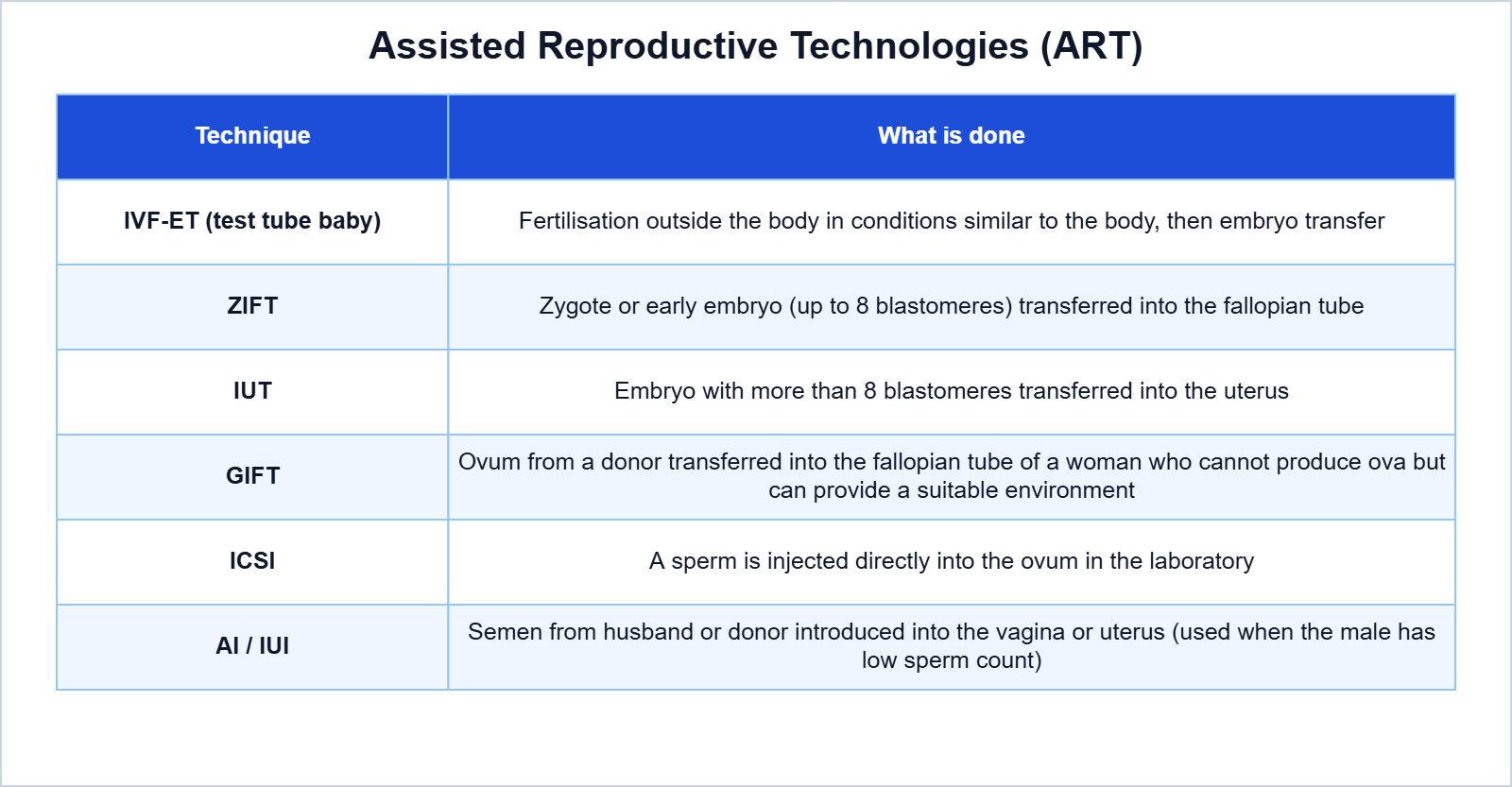
Exam point: In IVF, the embryos are formed in the laboratory; the technique that transfers early embryos up to the 8-celled stage into the fallopian tube is ZIFT.
Easy Memory Trick: “Z for Zygote to tube, U for Uterus with more cells” (ZIFT vs IUT).
6. Important Questions
Q1. What is reproductive health?
Ans. A total well-being in all aspects of reproduction: physical, emotional, behavioural and social.
Q2. When did India start its national family planning programme?
Ans. In 1951; India was among the first countries in the world to do so.
Q3. How do copper-releasing IUDs work?
Ans. The copper ions released suppress sperm motility and the fertilising capacity of sperms.
Q4. What is Saheli?
Ans. A once-a-week oral contraceptive pill developed by CDRI, Lucknow; it is non-steroidal.
Q5. What is lactational amenorrhea?
Ans. Absence of menstruation during intense breastfeeding after delivery; it can work as a natural contraceptive for up to about six months.
Q6. Name two terminal methods of contraception.
Ans. Vasectomy in males and tubectomy in females.
Q7. When was MTP legalised in India?
Ans. In 1971 (Medical Termination of Pregnancy Act); it was later amended.
Q8. Name four STIs. Which of them are not completely curable?
Ans. Gonorrhoea, syphilis, genital herpes and hepatitis-B; genital herpes, hepatitis-B and HIV infections are not completely curable.
Q9. Differentiate between ZIFT and IUT.
Ans. In ZIFT the zygote or early embryo (up to 8 blastomeres) is transferred into the fallopian tube; in IUT an embryo with more than 8 blastomeres is transferred into the uterus.
Q10. Why is there a statutory ban on amniocentesis for sex determination?
Ans. To prevent female foeticide; amniocentesis is meant to detect genetic disorders in the foetus.
Conclusion: Reproductive health requires awareness, safe contraception, prevention of STIs, legal and safe MTP, and modern techniques to help infertile couples, all of which contribute to a healthy society.